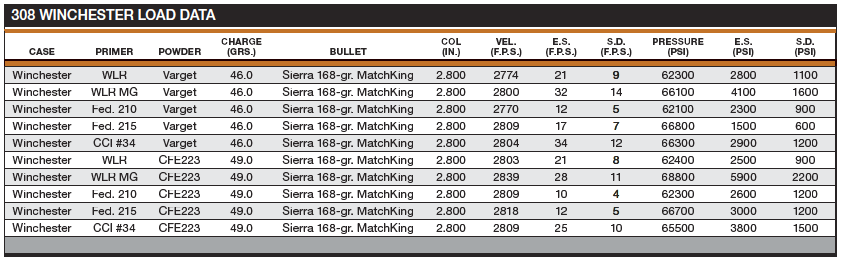



At the time of this writing, primers for both metallic and shotshell reloading remain in extremely high demand. While there are some signs of life in the primer supply chain, more often than not, the primers that are available are not the primers listed in this manual or online at the Hodgdon Reloading Data Center. On a regular basis we are asked, “What happens if I substitute Primer A for Primer B?” And the ever popular, “Can I use a magnum primer instead?” To help understand what happens when a primer is substituted, we will share the results of our tests, determining what effect the primer has on velocity, pressure, standard deviation, and extreme spread. Our test included Winchester Large Rifle primers as the control, Winchester Large Rifle Magnum primers, Federal Large Rifle primers(210), Federal Large Rifle Magnum primers(215), and CCI #34 primers.
The Takeaways
Let’s discuss some takeaways after reviewing the data in the accompanying chart.
Pressure is the unseen variable that goes hand in hand with velocity. Generally speaking, you can expect a 1,000 psi increase for every 11 fps in velocity, so we strongly urge you to chronograph your velocity and watch for pressure signs and follow this rule to ensure that you do not exceed maximum S.A.A.M.I. pressure. For 308 Win. ammunition, it is 62,000 psi. Our control lot was intentionally set at max pressure so we could see what happens when we change out the primer in this scenario.
Looking at the data, we can see that changing the primer can change the pressure (up or down). Some of the magnum-type primers yielded pressure increases of 6,000+ psi. This is important to remember if you intend to substitute a magnum-type primer in a load that doesn’t call for it. It also is important to remember that when working up a load, always begin with the starting load, advance in small increments, watch for pressure signs, and begin again if changing components, especially primers. Do not exceed the maximum charge weights listed in our data. Some high-pressure signs to look for include bolt handles that stick or are difficult to cycle and flattened primer faces.
Velocity has a direct relationship with pressure. Caldwell, Magneto-Speed, and LabRadar all make accurate and affordable chronographs that are available to shooters. Buy one and check your loads!
As you can see, changing the primer can change velocity a lot—39 fps in one load. If you are working up a load and notice a drastic change in the velocity, the pressure has changed as well. Proceed with caution if you notice a sharp increase in velocity. Don’t wait until the bolt is stuck or your primer faces are flat.
Extreme spreads and standard deviations are where reloading your own ammo can really pay off. Change out a component. Adjust the COL. Experiment with the powder charge weight within the Min and Max range. By changing components, you can tailor your load to your specific firearm. Different firearms can have different barrel lengths, twist rates, throat dimensions, and overall barrel harmonics. Changing your powder charge weight by a tenth of a grain or adjusting your cartridge COL can be the difference between a sub-MOA load or a 2-MOA load in your specific firearm.
When you change the primer, you change the ignition flame volume, temperature, and consistency. All of these can affect the extreme spreads and standard deviations of a given load. Depending upon the powder grain size and composition, primers can crack or fracture the grains, changing how they will ignite and burn. Just because Primer A works well doesn’t mean that Primer B will.
Other variables are worth considering. For our test we didn’t change the brass manufacturer, bullet type, or COL. All can be changed and adjusted to tune the load for your specific firearm. Cartridge cases from different manufacturers will vary in thickness and capacity. Bullets can vary in internal construction, jacket hardness, and design.
Barrel wear is another variable. If you have a barrel with a lot of rounds on it, you may experience lower velocities and pressures than with a new barrel. Also, the temperature that the ammunition is stored and fired in will change the performance of both the primer and powder, so be careful if you set up your loads for maximum performance on a cold day and then fire them when it is hot.
Remember that when you change one of these variables you should always go back to the starting load, advance in small increments, and watch for pressure signs. Your firearm is a complex system, and no one component can guarantee accuracy. The downside is that just one component can degrade accuracy tremendously.
The data in the accompanying chart is for informational purposes—it is not an endorsement to deviate from the loads listed in this manual or online at www.hodgdonreloading.com/reloadingdata-center. All testing was done under controlled conditions at Hodgdon Powder Company’s Ballistic Laboratory, using S.A.A.M.I.-spec test barrels and equipment.
In conclusion, there can be up to a 5 percent variation in performance when using primers supplied from Remington, Federal, CCI, and Winchester. For other primers that are not listed in our catalog, (Ginex, Wolf, etc.), there could be variation greater than this. Please be safe and keep all safety precautions in mind.
Happy shooting.