



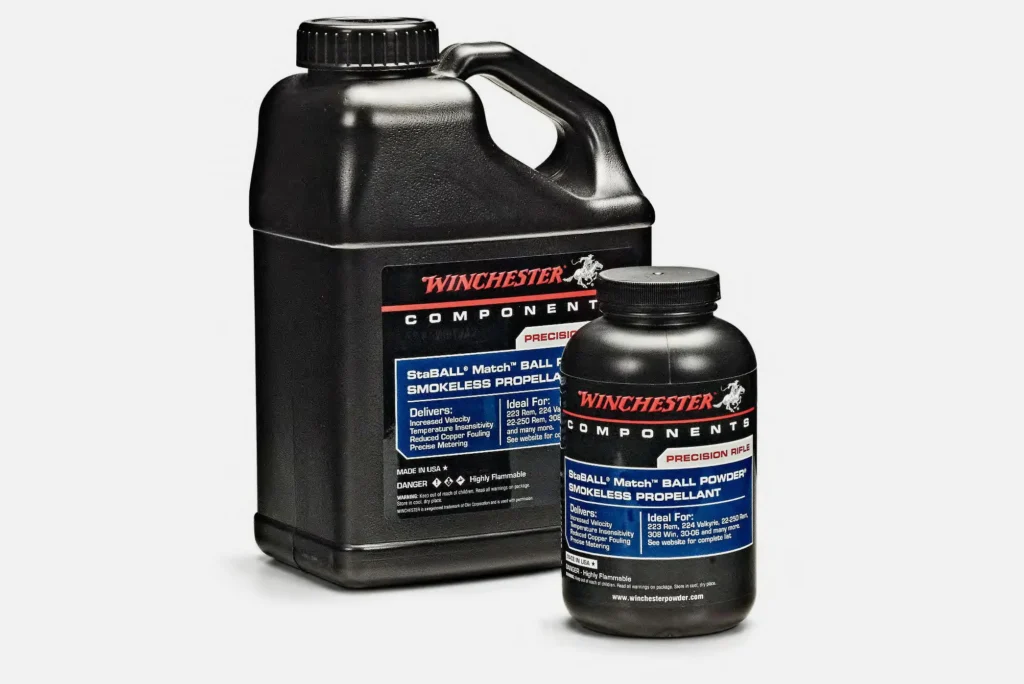
Winchester’s new staball match has a burn rate that’s just slightly slower than Varget. It’s a Ball powder, as the name suggests, so it meters very precisely through volumetric chargers. It’s temp-stable, meaning it will provide consistent velocity performance across a broad spectrum of temperatures. Plus, it has a copper fouling reducer agent, so rifle bores stay accurate longer and are easier to clean. And not least, StaBALL Match provides top velocities in certain cartridges.
You might wonder why (when gunpowder has been so hard to find lately) a company would introduce a new propellant. Why not just focus on producing the powders everyone is clamoring for?
Here’s the answer. Most of those gunpowder staples are made overseas—or at least out of the country. For example, Hodgdon’s excellent, temp-stable Extreme line—which includes the über-popular H4350, H4831, H1000, and Varget—is manufactured in Australia.
Winchester’s StaBALL Match is made right here in the USA. Being domestically produced, it won’t face the same supply chain and import complications. In short, it should be much more regularly available than, for example, Varget.
Varget is debatably the most popular propellant for the efficient 6mm match cartridges, such as 6BR, 6 Dasher, 6mm GT, and so forth, that currently dominate the PRC competitive scene. StaBALL Match is a logical substitute—and one that very possibly will gain preferred status in short order.
Cartridges for StaBALL
Match With a medium-fast burn rate, StaBALL Match provides excellent performance in a spectrum of popular cartridges. It’s good with medium-heavy bullets in the 223 Remington. It should prove to be excellent with light-for-caliber projectiles in the 6mm Creedmoor (achieving nearly 4,000 fps with 55-grain varmint bullets!), 243 Winchester, and 6.5 Creedmoor.
In the hunting-cartridge realm, StaBALL Match provides useful heavy-bullet velocities with the 7mm-08 Remington, high velocity in the 308 Winchester, and good performance with light bullets in the 30-06 Springfield.
And don’t think it’s suitable only for medium-size modern zingers. It’s excellent in the classic 45-70 Government—something I find particularly attractive. Even at mild pressures that are safe in vintage rifles, such as the Trapdoor Springfield, it’ll drive 405-grain bullets at 1,770 fps. In strong, modern lever-action rifles with long barrels, it’ll push 350-grain bullets at more than 2,000 fps.
On the lever-gun note, StaBALL Match is also outstanding in the grand old 30-30 Winchester, pushing 150- and 170-grain bullets a bit faster than most propellants.
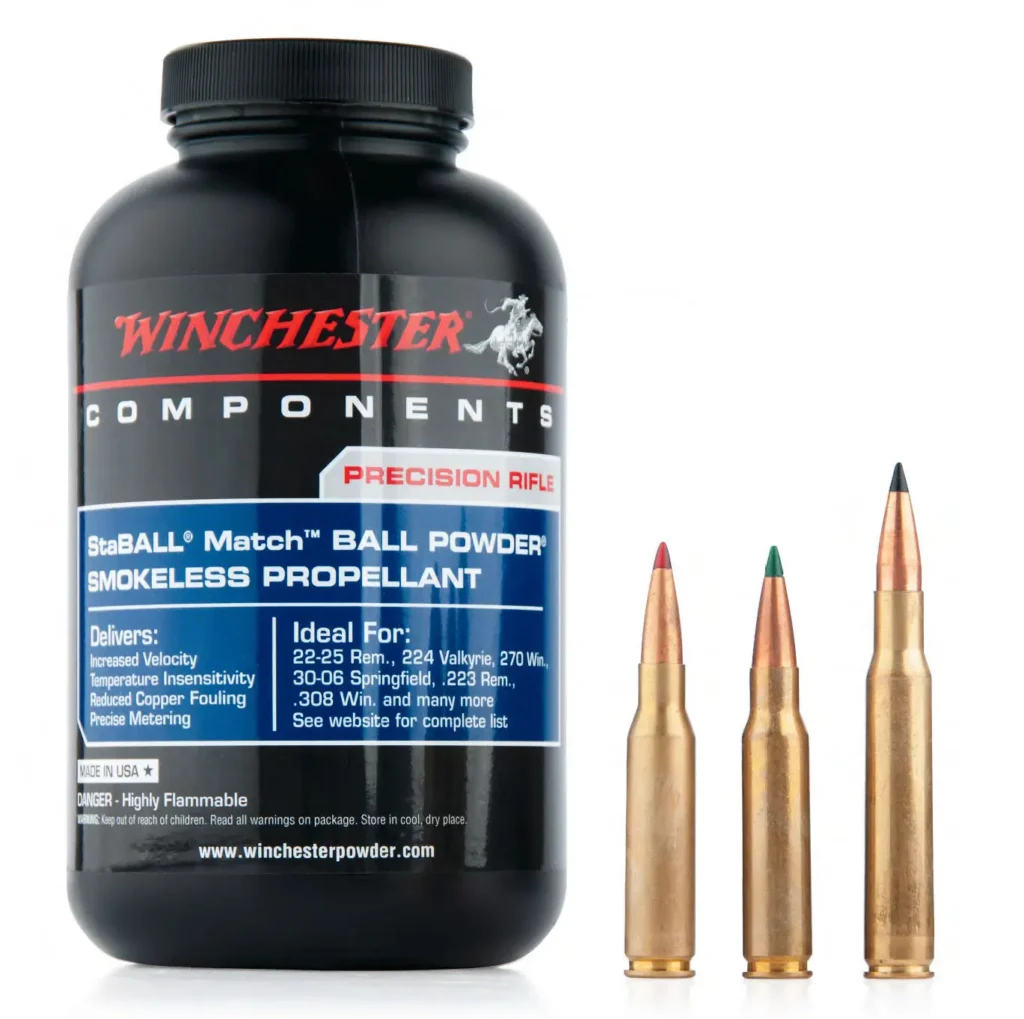
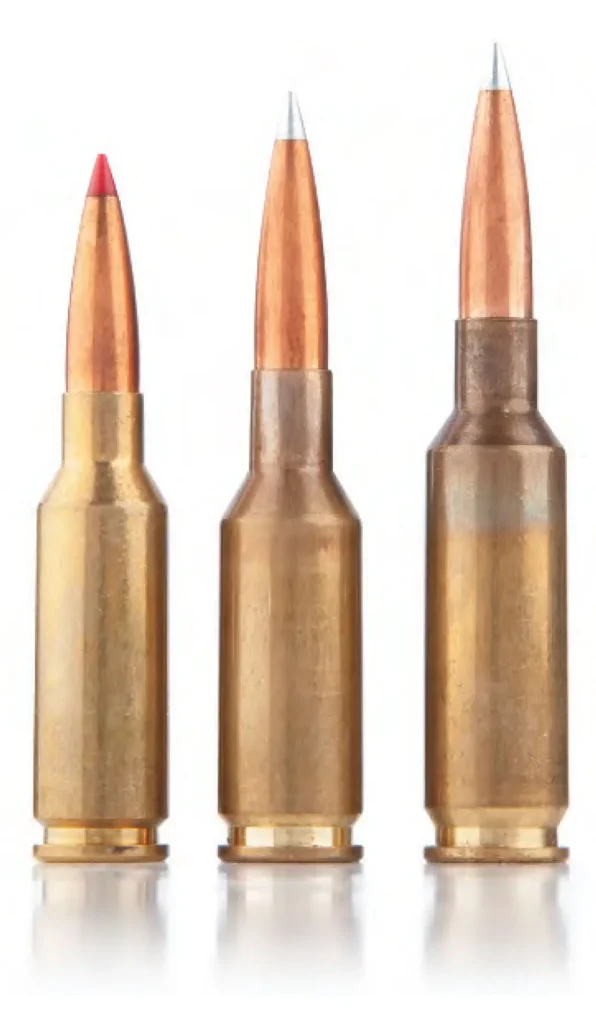
StaBALL Match Handloads
To gain practical experience with Winchester StaBALL Match gunpowder, I assembled test batches of handloads in 223 Remington, 7mm-08 Remington, and 45-70 Government. By the time you read this, data will be available on the data centers of Hodgdon and Winchester Powder, but when starting, I relied on initial lab data provided by Hodgdon Ballistician Justin Schrader.
For the 223 Rem., I charged Hornady cases with 26.0 grains of StaBALL Match under 60-grain Hornady V-Max bullets and seated to 2.270 inches cartridge overall length (COL) to test in my son’s CZ 527 bolt-action rifle.
For the 7mm-08, I charged Federal cases with 41.0 grains of StaBALL Match and topped them with 162-grain Hornady ELD-X bullets, seated to 2.885 inches COL, for a sleek Ruger Hawkeye rifle.
And just because I couldn’t resist, I charged a batch of Hornady 45-70 cases with 65.0 grains of StaBALL Match and assembled some oh-so-sexy loads topped with 350-grain Swift A-Frame bullets. These were destined for a Marlin 1895 Custom Shop rifle with an 18-inch barrel.
At the range, I double-sandbagged the little 223 rifle and fired three consecutive three-shot groups for average. Velocity was decent out of the 22-inch barrel, averaging 3,001 fps, with an extreme spread of 55 and a standard deviation of 17. Accuracy was decent; the rifle averaged 1.23 inches with StaBALL Match. I don’t doubt that a bit of load tuning would produce sub-MOA averages.
Next, I tested the 7mm-08. The accuracy average with the StaBALL Match powder was 1.79 inches. Velocity from the 22-inch barrel was 2,583 fps. Extreme spread spanned 34; standard deviation was 11. It’s worth noting this was not a compressed load (the others tested were), and the primers showed no sign of high pressure at all. Likely, a couple more grains would bump velocity up to more impressive numbers and could tighten groups. However, the 41.0 grains I used was listed as maximum in the initial data I received.
Then I queued up the 45-70 Marlin carbine. It has a Leupold VX-R 1-6X scope mounted on it, and it has a crisp but heavy trigger pull. Hornady’s 325-grain LEVERevolution FTX and Barnes’s 300-grain VOR-TX Triple-Shock factory ammunition shoot beautifully in it, averaging less than 1.5-inch groups, which is darned good for a lever-action carbine.
My StaBALL Match loads topped with Swift 350-grain A-Frame bullets were compressed, too. That 65.0-grain load comes within 1/8 inch of the case mouth. I like compressed-powder loads in lever-action cartridges because the compressed powder column supports the base of the bullet and helps keep bullets from sliding back into the case if the crimp gives way. Tubular magazines have a way of pushing bullets back into the case—and Murphy’s Law dictates that it always happens at the worst time and jams up your rifle.
However, I was beginning to question as to whether the compressed charges could be degrading accuracy.
I fired a group. Two shots were almost touching, 1.5 inches high on the 100-yard target. The third was a couple of inches higher. Suspecting I’d made a poor shot, I fired a fourth shot and landed it right next to the pair. Cheerfully throwing out the flyer as a shooter-induced error, I claimed the mulligan and the 1.17-inch group.
What happened next blew my socks off! My second three-shot group—no mulligans—measured 0.74 inch. And the third—again, no mulligans—an itty-bitty 0.45 inch.
The average was 0.78 inch.
That sort of accuracy just doesn’t occur with lever-action big bores. I was jubilant. Clearly, when the right charge is put into a cartridge that likes StaBALL Match, wonderful things happen.
Velocity was great, too, from the 18-inch barrel, elocity w averaging 1,846 fps. That’s as fast as most propellants will push a 350-grain bullet from a 22-inch 45-70 barrel, at strong lever-gun pressure levels. Consistency, too, was outstanding. The load posted an extreme spread of 28 and a standard deviation of just 10—excellent for a lever-action big bore.
I wish I’d had rifles in 6mm ARC, 6BR, and 6mm GT to try StaBALL Match in because I expect it is excellent in them.
StaBALL Match powder meters beautifully. And it’s easy to load in cases, making the process of handloading with it rather likable.
Like all propellants, it has unique characteristics, and my gut feeling is that it’s like a beautiful but temperamental woman—full of promise but you must treat her right. I suspect that StaBALL Match may be somewhat sensitive to charge weight. But that’s okay—it just means that when you get it right, dramatically good results occur.
StaBALL Match will fill gaps when other propellants are unavailable, and I believe it has its own set of virtues that will endear it to certain handloaders. It’s certainly my new go-to powder for accurate, fast 45-70 loads.
When you see StaBALL Match show up on your dealer’s shelves, give it a try. It may surprise you by doing something extraordinary.