



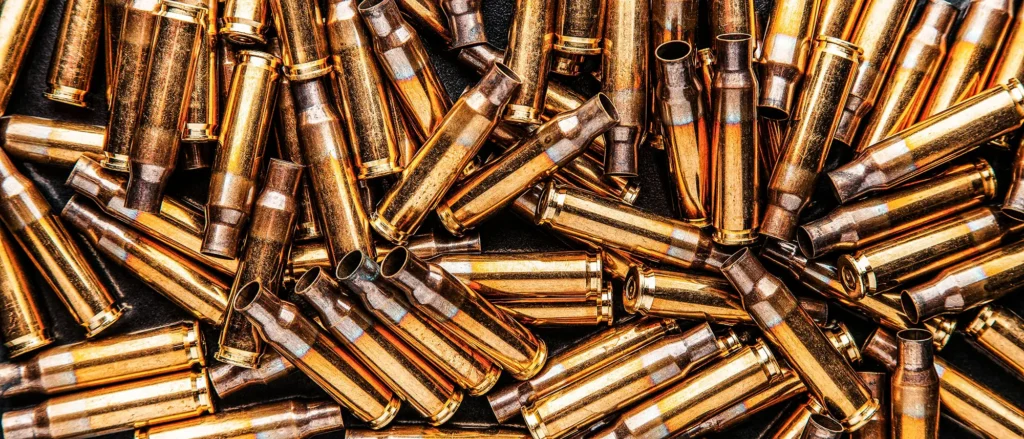
One of the best ways to lower the cost per round is to load with once-fired military brass. It is readily available in bulk amounts, can be found at great prices, and is comparable in quality to that of commercial brass. A co-worker and I went in on several thousand pieces of unprocessed military 223 Rem./5.56 NATO brass. It was dirty and had mixed manufacturers, but it also had such great potential.
I am going to describe my steps in the process of taking once-fired military brass and transforming it into quality, sub-MOA ammunition that is perfect for plinking and competitive use. As with many other things in my life, this process isn’t perfect, but it works for me to create quality loads.
My first step is to sort the brass into one of three categories: 5.56mm, 223 Rem., or Berdan-primed. The Berdan-primed brass is not reloadable without special equipment and is generally discarded by reloaders. Both 5.56mm and 223 Rem. brass are reloadable. However, generally, the 5.56mm brass has a different interior volume, resulting in ballistic results that are slightly different than 223 Rem. brass. Keeping these two separated in your batch of reloads is a step to improve uniformity. This guideline applies to all military/commercial brass reloading, including 7.62 NATO/308 Win.
Next, remove the spent primers with a universal deprimer. This can be more difficult than depriming commercial loads due to their crimped primers. Once deprimed, the cases are ready to be cleaned. For several years I ran a vibratory tumbler with corncob media. I now use a rotary tumbler with water and stainless-steel pins. Both tumbler options have worked well. The water/pins method seems to make for shinier brass, but it has an added step for drying. Make sure to check cases for cracks along the neck or signs of case-head separation.
After the initial cleaning, the cases are ready to be resized. I use a full-length die on a single-stage press. Don’t forget to lubricate! Stuck cases are an annoyance that can easily be avoided with proper case lube. Find one that works for you and follow the manufacturer’s directions for use. Not too much, not too little.
After sizing, the cases will need to be trimmed to length. For 223 Rem., I aim for 1.750 inches. After trimming, the case can be chamfered and deburred. This is a great time to address the crimped primer pocket.
Military rounds have primers that are crimped into place, designed to endure the rigorous conditions that brave military men and women are subjected to. This crimp will cause issues when trying to re-prime the cartridge and must be removed in some way (often called swaging). There are companies that build dedicated swagers for single-stage use or on a progressive press. I have used these with great success. The crimp is “pushed” out of the way, rounding the pocket corners.
For small runs on a single stage, I have also used a pocket reamer that is mounted to my case-prep station. Companies make specific reamers for this, but I also have used the chamfer/deburring tool to bevel out the inside primer crimp. Just enough brass needs to be removed to seat the next primer smoothly. Some trial and error will help you determine how far to swage/ream out that crimp.
At this point, the brass is ready to load. Prime the cases, then grab your favorite bullets and your preferred Hodgdon family powder. We show only Winchester cases in our 223 Rem. reloading data, so the load workup must be approached with caution. The case capacity and brass thickness may be different with military brass.
I have come to rely on Hodgdon’s Benchmark powder for most of my 223 Rem. needs. It is a small, extruded grain that meters wonderfully; has an adequate case fill; and is in the Extreme line of powders that are temperature stable.
Begin at the start loads and work up. I work up in 0.3-grain increments, looking for primer pressure signs. Using a 69-grain HPBT bullet and Benchmark, my workup landed me at 23.2 grains. There were no pressure signs, and 23.2 grains was the most accurate at 100 yards. A three-shot test with a grouping of 0.7 inch at 100 yards is more than accurate enough for my needs!
I have used this process with a variety of bullets and powders. StaBALL 6.5 makes a great long-range 77-grain bullet load, and for easy plinking with a 55-grain bullet, IMR 4198 uses a lower charge weight—all inside of cost-efficient military brass.