



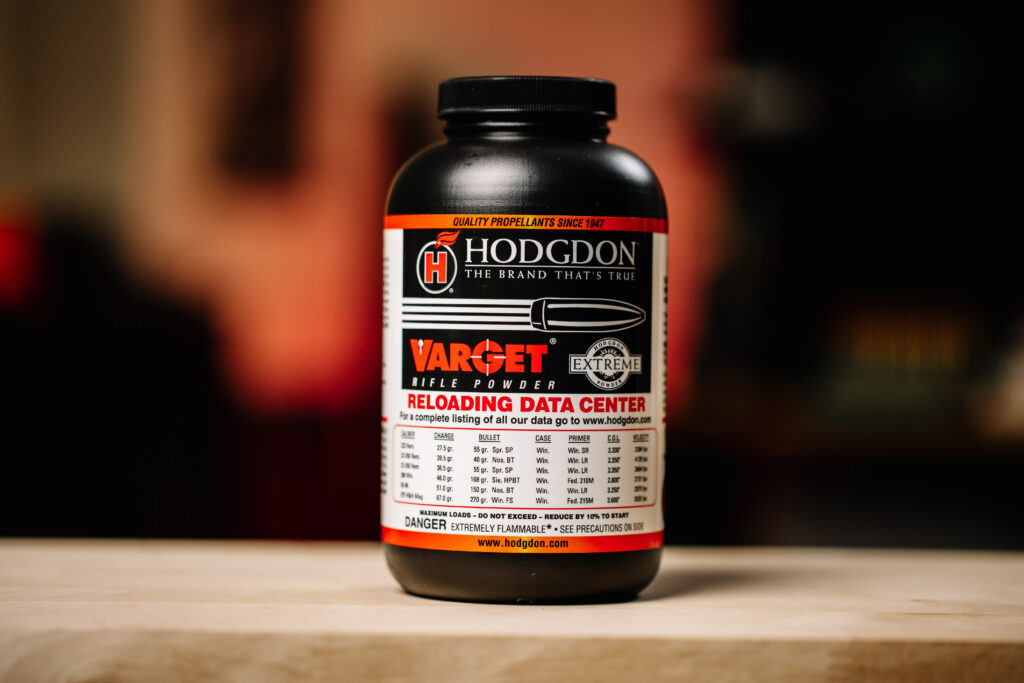
The 308 Winchester has been the de facto standard accuracy cartridge for legions of shooters for many years, and it still holds sway, in spite of several new 6.5mm and other "accuracy" cartridges. The 308's gilt-edged accuracy, ballistic efficiency, and the huge selection of components all contribute to the round's popularity. Top-notch handloads can be carefully tailored for specific needs, such as F-Class, 1,000-Yard Benchrest, NRA courses, etc. You name it, and there's a component set out there just waiting to be discovered by the enterprising handloader. The vast selection of premium bullets and an almost unlimited selection of specialized propellants make the process fun and rewarding, but it can also be complex and a bit overwhelming.
The rifles used in the various shooting disciplines are of two forms: bolt action and AR, which we, in the age of political correctness, euphemistically call "modern sporting rifles." So I thought a relatively scientific comparison would be in order—with a twist. All hardcore handloaders, myself included, love trying every combination of bullet and powder imaginable in our favorite shootin' irons, but such an approach quickly becomes unwieldy, unmanageable, and generally unproductive.
I took a different approach here. The idea was to make the loads as similar as possible and to compare their accuracy in two gilt-edged rifles, a bolt action and an AR. To that end, the selection and assembly of components, scopes, and the actual test shooting techniques were all geared for uniformity.
The Powders
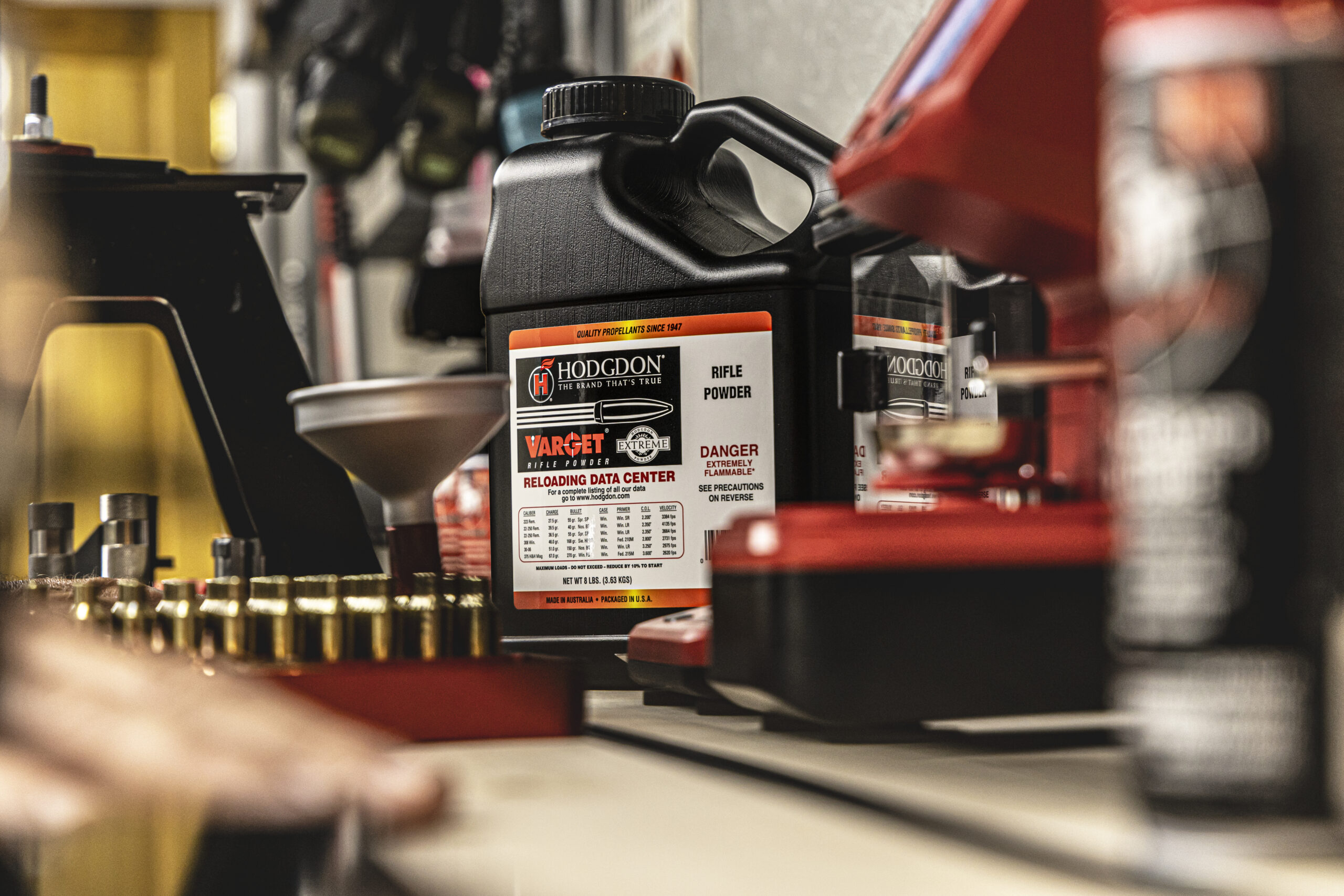
There are at least 150 powders available, so I had to choose carefully for this project. In the end, I relied on five from Hodgdon/IMR that work well in many cartridges, especially in the 308. As you might expect, these powders fall in the middle of the burning-rate spectrum and are just about optimal for the case capacity and expansion ratio of the well-balanced and efficient 308 case.
In order of approximate burning rate (from slowest to fastest), the powders used are CFE 223, Varget, IMR 4064, IMR 4166, and IMR 8208 XBR, and except for the spherical CFE 223, each is an extruded powder. Two powders are especially noteworthy because they have Hodgdon/IMR's revolutionary new copper-reducing chemistry. IMR 4166 uses what Hodgdon calls "Enduron Technology," while CFE 223 relies on a "Copper Fouling Eraser" additive. Both retard the buildup of jacket fouling, and their continued use actually helps reduce existing fouling as you shoot, so both are eminently suited for shooting programs that result in high-round counts. Varget and IMR 4064 are versatile stalwarts that support a host of cartridges. The relatively new IMR 8208 XBR is actually a little fast burning for the 308, but it turned in excellent accuracy.
Another important aspect of these powders is their bulk density. All fill the case pretty much to the base of the neck, and this helps promote ballistic uniformity. However, charges with IMR 4064 had to be compressed considerably to get the bullets to the desired overall cartridge length (COL).
The Rifles
Two premium rifles were selected for the tests. The bolt action was a new Savage Model 12 Low Profile Varminter. Its 26-inch, stainless-steel, fluted barrel is free-floated and has a 1:10-inch twist. The rifle also has Savage's AccuTrigger. The laminated wood stock has a flat fore-end that sits well in a benchrest. I mounted a new Burris Veracity 4-20X 50mm scope in Burris 30mm XTR Signature rings to the Weaver-type bases that came on the rifle. So equipped, the rig weighed in at 12 pounds, 8 ounces.
The AR is the LAR-8 Varminter from Rock River Arms (RRA). It also has a 26-inch, stainless-steel barrel with a 1:10-inch twist. The barrel is not fluted, but it is free-floated within the handguard. RRA calls the trigger "two stage," but I can attest that it's as light and crisp as many bolt guns. The scope is a Burris XTR II 5-25X 50mm with an illuminated front focal plane reticle. I used the Burris P.E.P.R. 34mm mount to install the scope. The AR weighed a hefty 14 pounds, 11 ounces with scope and empty magazine.
The fit and finish of the two test rifles were absolutely superb. The trigger pulls were outstanding, and the barrels were so slick that there was little, if any, jacket fouling after a 15-round session. I can recommend both.
The Cases, Primers, and Bullets
I was fortunate to have a large supply of new Federal 308 cases, factory primed with the Federal 210 primer. All test loads were in these new cases; no once-fired cases were used.
All powder charges were weighed on an RCBS M-1500 electronic scale, and Hornady dies in a Redding T-7 Turret press were used to assemble the test ammo.
Rather than use dozens of bullets and powders, I reviewed the bullets often used by match shooters for the 308 Win. and selected three for this test. Match bullets in .30 caliber come in a wide variety of weights, ranging from 135 to 220 grains. Probably the most popular overall are the 165-, 168-, and 175-grain hollowpoint boattails. (Yes, I know 155-grain bullets are used in many matches, but I had to draw the line somewhere.) I concentrated on three popular match-grade bullets: Sierra's 168- and 175-grain MatchKings and Hornady's 178-grain A-Max. The COL for all handloads was 2.800 inches.
The Test Protocol
I've heard many people whine that breaking in the barrel of a new rifle doesn't do any good, but I've never heard anybody say it hurts anything, so I generally do some break-in shooting before I start testing. Before shooting for the record, I performed my simple break-in procedure on both new rifles. I loaded some mild loads and miscellaneous factory ammo and shot 20 rounds in each rifle. I cleaned after each shot. Then I shot four, three-shot groups, cleaning after each group. After that, I thoroughly cleaned and inspected the bore with a Hawkeye borescope. If there was so much as a hint of copper wash, it was back to the patches and solvents. For the record, I used Butch's Bore Shine to remove primer and powder fouling and Otis 012-Cu Copper Remover for jacket fouling.
Here's the test protocol. Three, five-shot groups were fired with each handload and each factory load in each rifle at 100 yards. I cleaned after every 15 shots and fired one fouling shot after each cleaning before shooting the next load series.
I did only minimal load work-up for this project. Instead I relied on the extensive and excellent pressure-tested data in Hodgdon's Annual Manual. I fired a few starting loads with each powder to get a feel for the rifle (those loads are not included in the load tables) and then went right to the test loads. The test loads I settled on were just a hair under the maximums listed in this manual.
I shot the Savage Model 12 off of a Caldwell Lead Sled DFT and the LAR-8 from a more traditional benchrest so I could use the 20-round magazine that came with the rifle. I loaded the Model 12 single-shot style, but all rounds for the LAR-8 were fed from the AR's magazine.
The Results
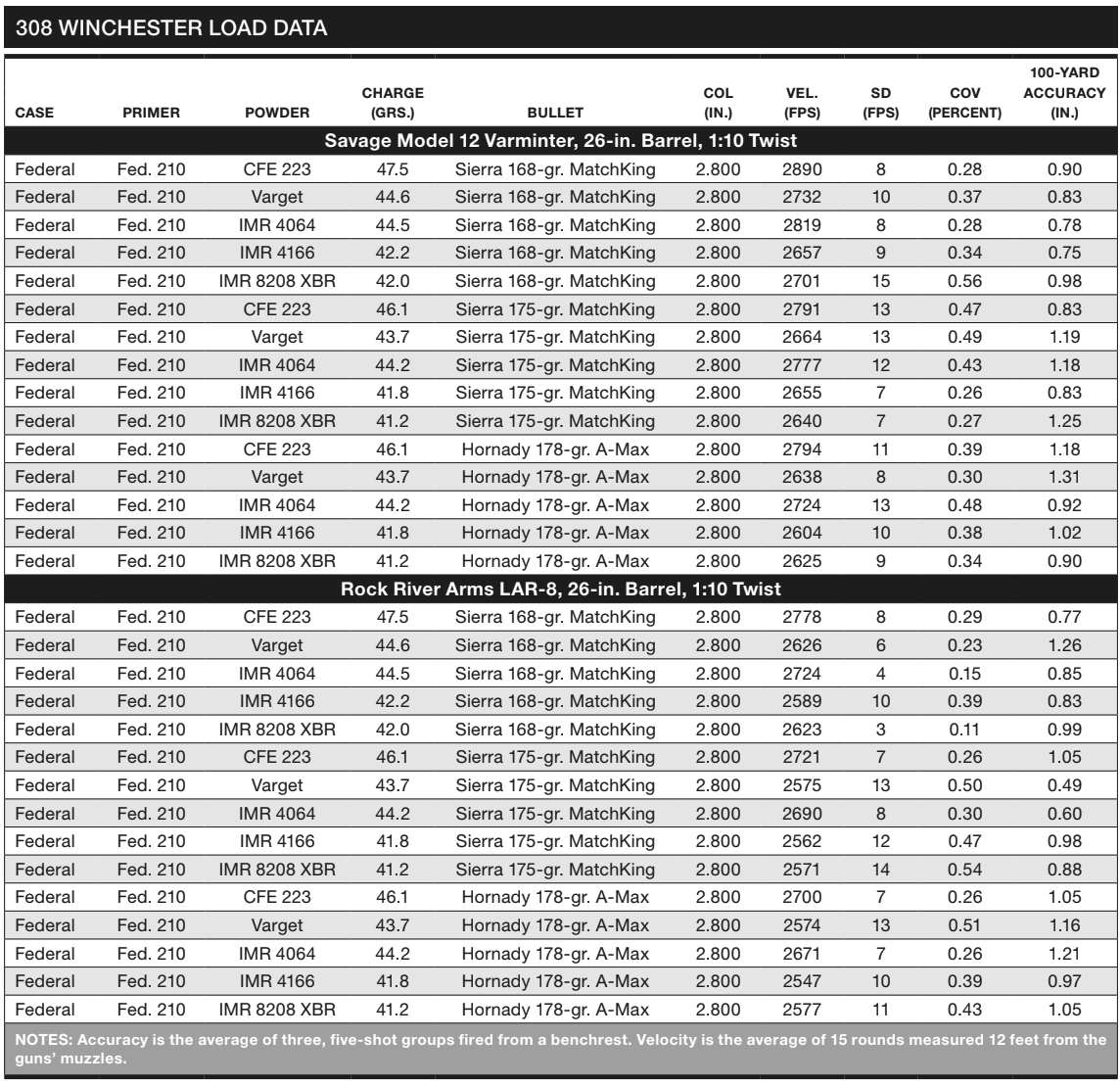
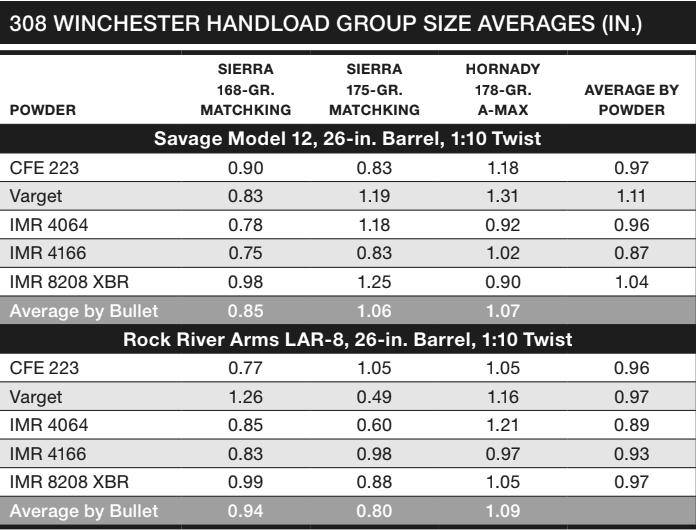
Okay, to heck with the methods. How did these loads shoot? In a word, great. All of the individual loads and their groups are shown in the accompanying charts, as are some short and sweet summary boxes that point out the differences in results between rifles, bullets, and powders.
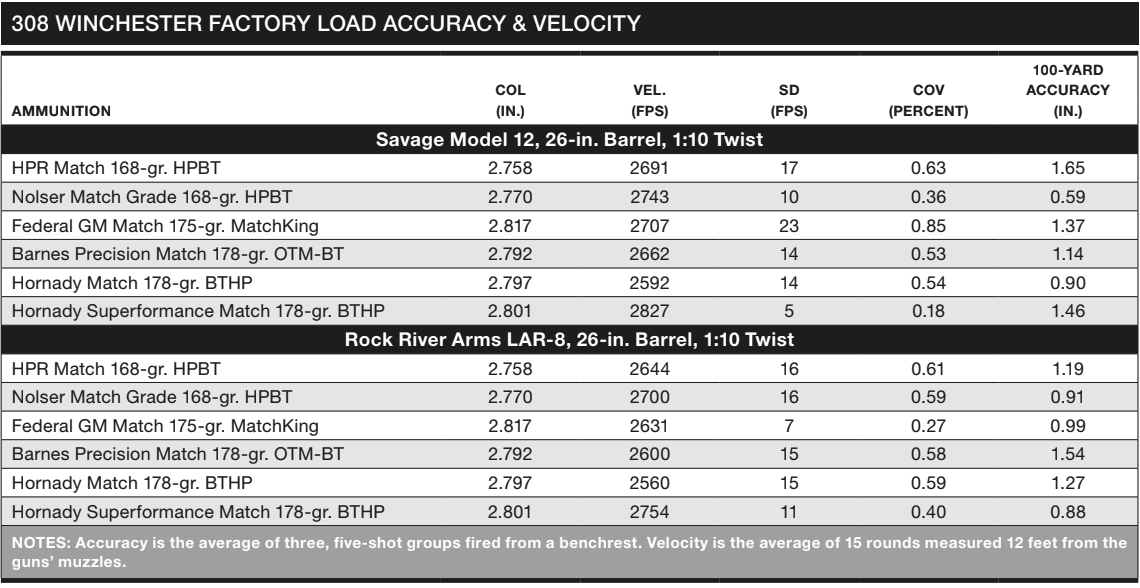
Every experiment needs a "control," so I selected six factory loads for comparison and fired each in the two rifles with the same three, five-shot group protocol as with my handloads. The average accuracy of the six factory loads was almost identical in the two rifles, averaging 1.19 inches for the Model 12 and 1.13 inches for the LAR-8. The best load in the bolt gun was the Nosler Match Grade with the 168-grain HPBT, averaging a tiny 0.59 inch. Tops in the AR was Hornady's Superformance Match load with the 178-grain A-Max bullet, which averaged a delightful 0.88 inch. Interestingly, the average velocity of all factory loads was 56 fps (about 2 percent) faster in the bolt action than in the semiauto.
Now for the handloads. Let's start at the top and work our way down. Again, the average accuracy of all handloads was almost identical in both rifles. For the Model 12, it was 0.99 inch; for the LAR-8, it was 0.94 inch. The powder that turned in the smallest aggregate accuracy was IMR 4166, with a 0.90-inch average, and it was followed closely by IMR 4064 at 0.92 inch.
CFE 223 turned in the highest velocities with all bullets in both rifles, and IMR 4064 was second with all three bullets in both rifles. The lowest velocities in all cases were with IMR 4166, except for the Sierra 175-grain MatchKing in the Model 12 bolt gun, where IMR 8208 XBR was somewhat slower.
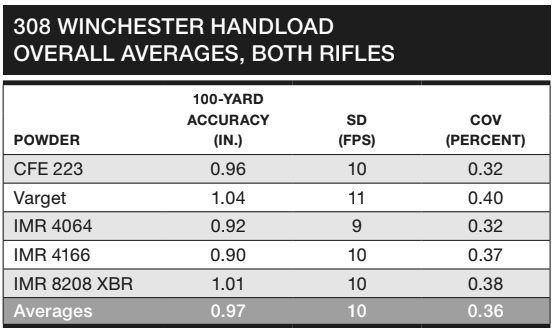
An important indicator of load uniformity is standard deviation (SD). Statisticians out there: Get those fingers off the email "send" key! I am well aware of the lack of "statistical significance" between the test results. The differences between the group sizes produced by these gilt-edged rifles is so small that it would take dozens, if not hundreds, of groups to detect a "statistically significant" difference (95 percent, 90 percent, etc.) between them.
For our purposes, SD is just a convenient indicator of the uniformity of a given load. Another comparative measure is the coefficient of variation (COV), which is the SD expressed as a percentage of the mean. I've listed both values in the chart. This statistic is handy because it allows a direct apples-to-apples comparison of loads. A COV of 2 percent is considered good, and less than 1 percent is very good. The overall average COVs for the test loads was an outstanding 0.36 percent.
The powder that had the lowest SD (9 fps) was IMR 4064, while the powder with the highest SD was Varget (11 fps). Both of these figures are only a hair off of the overall average of 10 fps. In other words, with today's modern powders, uniform cases, and consistent primers, variations in SDs are essentially non-factors.
Aggregate bullet accuracy for both rifles was in this order: Sierra 168-grain MatchKing (0.89 inch), Sierra 175-grain MatchKing (0.93 inch), and Hornady 178-grain A-Max (1.08 inches). The Savage Model 12 liked the Sierra 168-grain MatchKing best (0.85 inch) and the other two bullets tied (1.06 inches). In the RRA LAR-8, the Sierra 175-grain MatchKing came in with a beautiful 0.80-inch average, followed by the Sierra 168-grain MatchKing (0.94 inch) and Hornady 178-grain A-Max (1.09 inches).
Overall, I was extremely impressed with the performance of each of these powders, bullets, and rifles. CFE 223, IMR 4166, IMR 4064, IMR 8208 XBR, and Varget are top choices to try for match loads in the 308 Win. All have an excellent probability for quick success.
Based on my results, I can say that within the huge selection of Hodgdon and IMR powders available, there is bound to be one (or more) that's "perfect." It's a relatively simple matter for the shooter to select a handload that delivers top-notch accuracy for the cartridge at hand with a minimum of fuss and muss. The bottom line is that the handloader can spend less time experimenting with powders, bullets, and primers and more time shooting. The only downside I see is that it eliminates the pleasurable task of handloading endless combinations of components for testing!