


Originally designed to function in AR-type rifles, the 24 Nosler is one heck of a hunting round in other types of guns, including the Nosler Custom Handgun.
Nosler has long been known for making superior bullets. Heck, the Partition is legendary, and the new AccuBond Long Range bullets are carving out their niche, too. In 2006 the company introduced a new line of bolt-action rifles called the Model 48, and shortly thereafter, Nosler launched a line of bolt-action handguns based on the Model 48 action called the Nosler Custom Handgun (NCH). The pistol can be ordered in many calibers, including the new 24 Nosler. I used one for this report, and I’ll get to the details of the pistol in a bit, but first let’s take a good look at the cartridge.
Nosler’s Senior Manager of Research and Development Mike Lake designed all the new Nosler cartridges, and in size they run the gamut from prairie dogs to pachyderms. Mike is a serious and knowledgeable gun guy and worked very hard to make sure his creations are ballistically sound and, more importantly, safe.
The three smallest of the new Nosler cartridges are of the most interest to those who hunt varmints and big game with a handgun. They are the 20 Nosler, 22 Nosler, and 24 Nosler. Each is based on the 6.8 Remington SPC case, but they have subtle changes in case dimensions so that other cartridges can’t be used in firearms so chambered. The three Nosler cartridges have rebated rims that are the same diameter as the rim of the 223 Remington.
It is said that there is nothing new under the sun, so it is interesting to note the ballistic lineage of the 24 Nosler. It is similar to the 6x47 (the benchrest darling of the 1960s), which is the 222 Remington Magnum necked up to 6mm. Fast-forwarding to the present, we find that the ultra-popular 204 Ruger is also based on the 222 Remington Magnum. A favorite cartridge of an inveterate rock chuck hunter of my acquaintance (Hodgdon’s own Ron Reiber) dotes on the 6mm-204 wildcat, in a custom bolt-action pistol no less. This wildcat cartridge is made by necking up the 204 Ruger. I’m sure you see a pattern here.
Nonetheless, the 24 Nosler is, in my opinion, the cream of the crop of the smaller-cased Nosler rounds. It shoots lightweight varmint bullets at maximum warp, but also handles sleek, high-tech bullets for deer- and antelope-sized game. The case, chamber, and throat of the 24 Nosler are designed for maximum efficiency and accuracy. The round gets the most out of every grain of propellant, and it’s so accurate that it’s downright scary.
The shoulder of the 24 Nosler is pushed back from the 22 Nosler to provide a 0.297-inch neck (1.22 calibers) for good bullet orientation in the case, and the case itself is only 1.600 inches (0.160 inch shorter than the 22 Nosler).
The 24 Nosler has not been officially “introduced,” but it has created enough buzz that I wouldn’t exactly faint if it was introduced in the near future. It’s that good.
The Nosler Custom Handgun
The NCH is a futuristic custom pistol that is built to order, and it can be had with all sorts of delightful options to suit the customer. The NCH’s Model 48 action is converted to single shot, so perhaps the term “handrifle” might be more appropriate. It reminds me of the classic Remington XP-100 bolt-action pistol of years ago. The NCH’s barrel length is 16.1 inches.
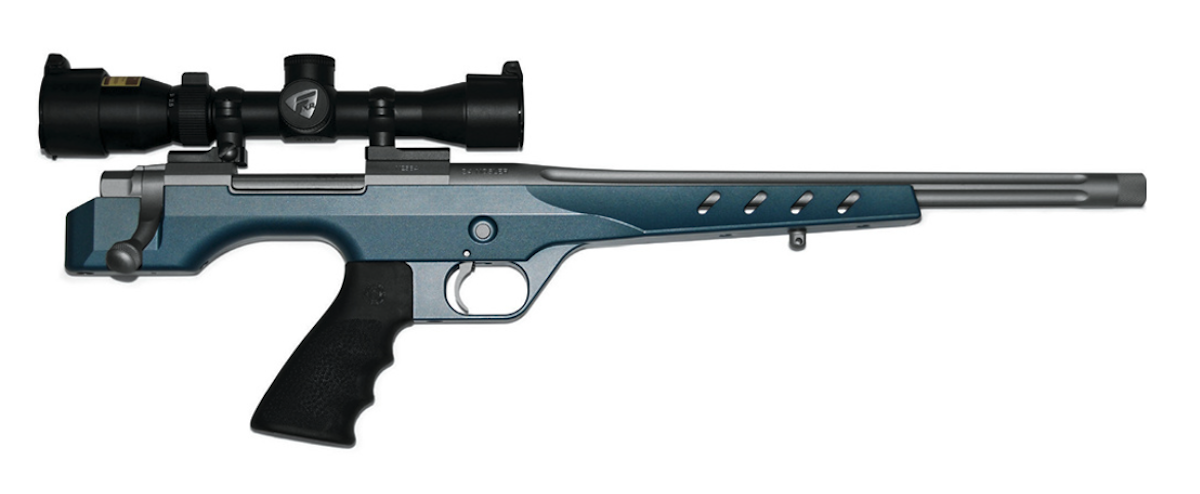
As you can see, the NCH is a striking gun in the extreme. You either love its looks or hate its looks. But the shooting, ah, just wait until you shoot one! For this report, I installed a brand-new Nikon Force XR 2.5-8X 28mm handgun scope in Leupold mounts. This fine scope has crystal-clear optics, extended eye relief, and a Ballistic Drop compensating reticle. It was a perfect fit for use on the NCH.
Loads for the 24 Nosler
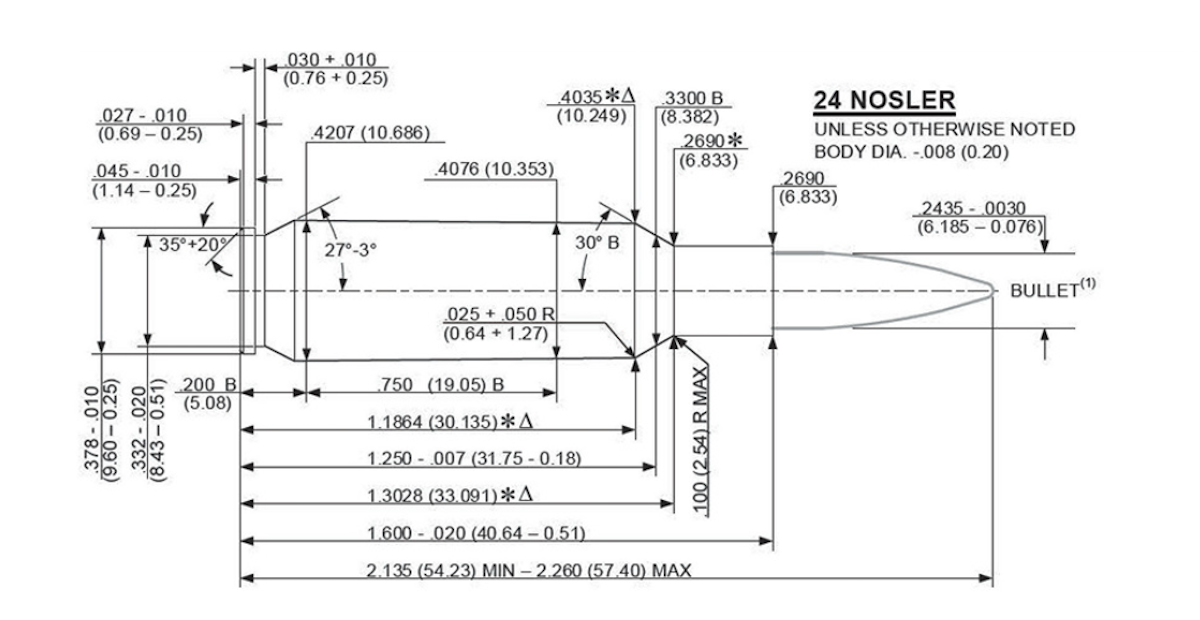
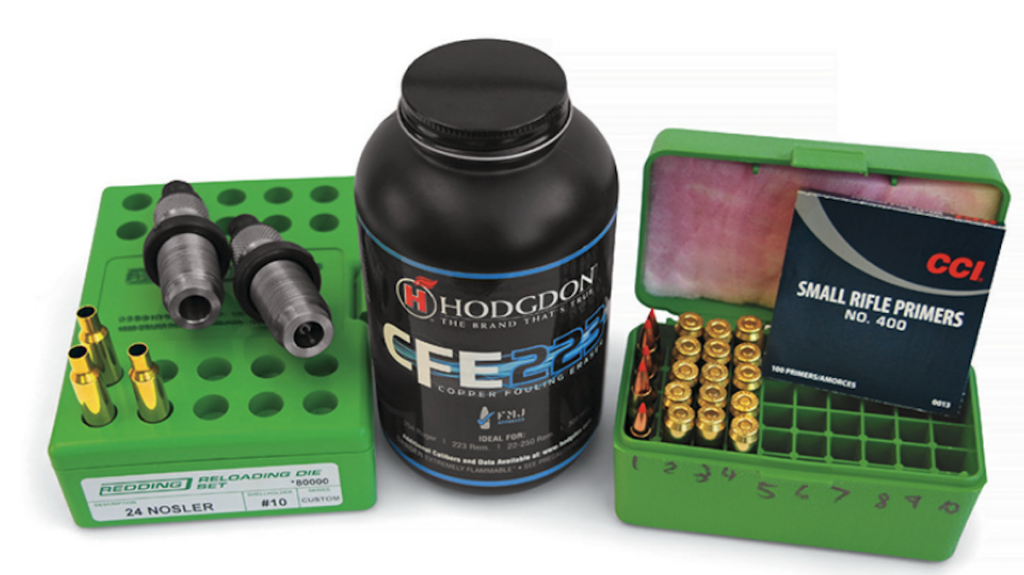
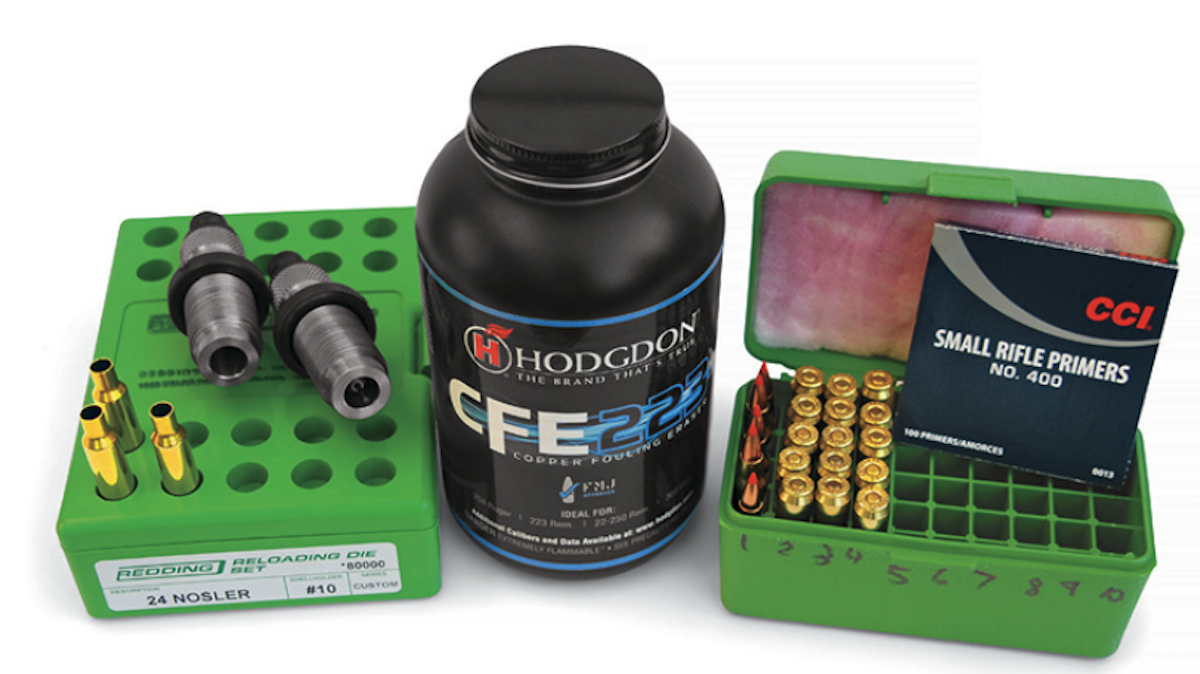
Along with my sample NCH, Nosler also sent a set of Redding reloading dies, which I used in my Redding T-7 Turret press for all load preparation. The 24 Nosler case has the same rim diameter as the 223 Remington rim diameter, so the Redding #10 shellholder works just fine. The round uses Small Rifle Magnum primers. All were seated with a Hornady Handheld Priming Tool. You can’t conveniently make 24 Nosler cases out of any other brass, but Nosler makes top-notch cases that last for many, many reloads, and they’re readily available.
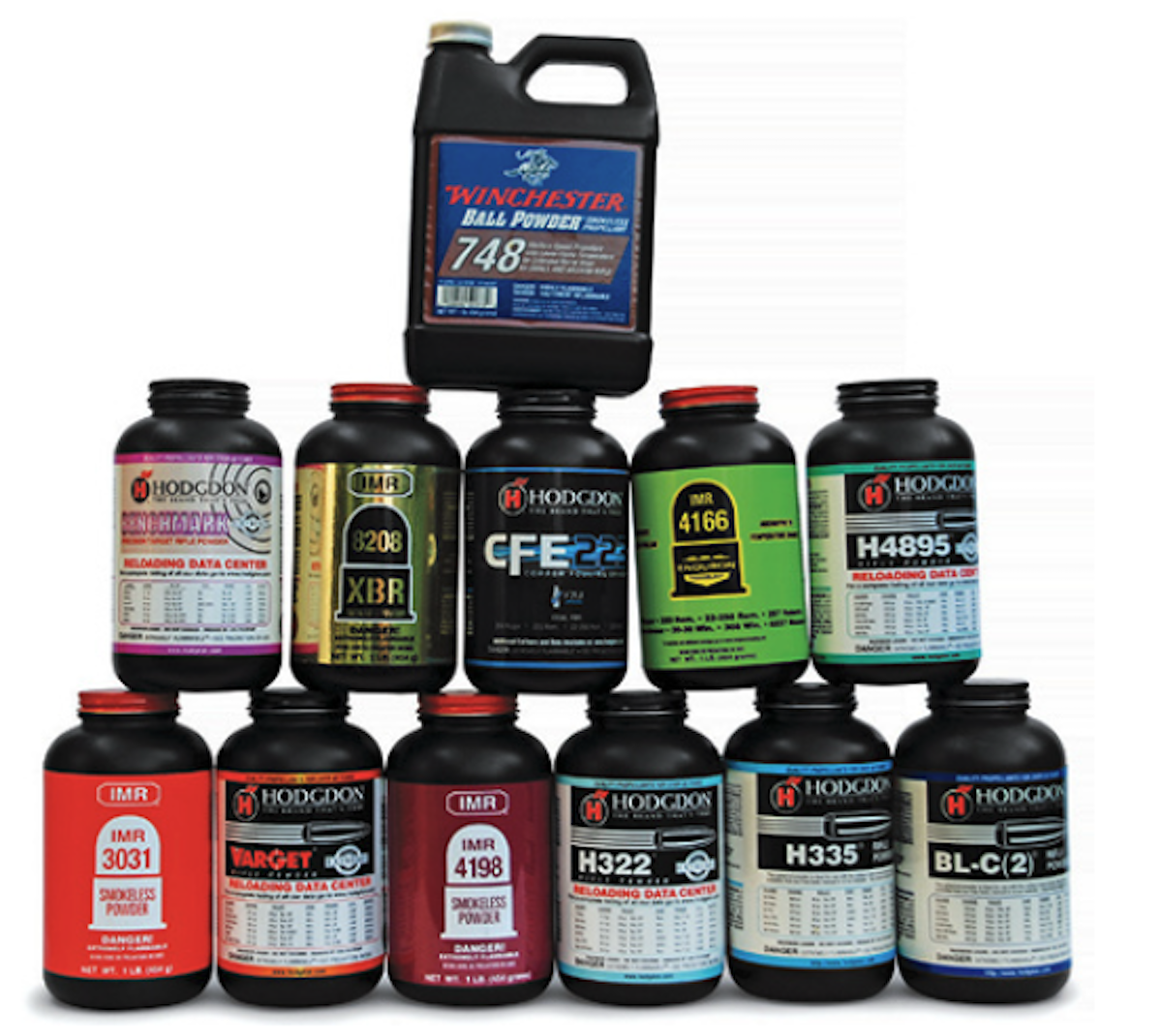
Never a laggard, the powder wizards at Hodgdon jumped right in and developed a slew of pressure-tested loads for the 24 Nosler—172 loads to be precise. All of those loads are available on the firm’s Reloading Data Center website, which is updated regularly, and all that data is free.
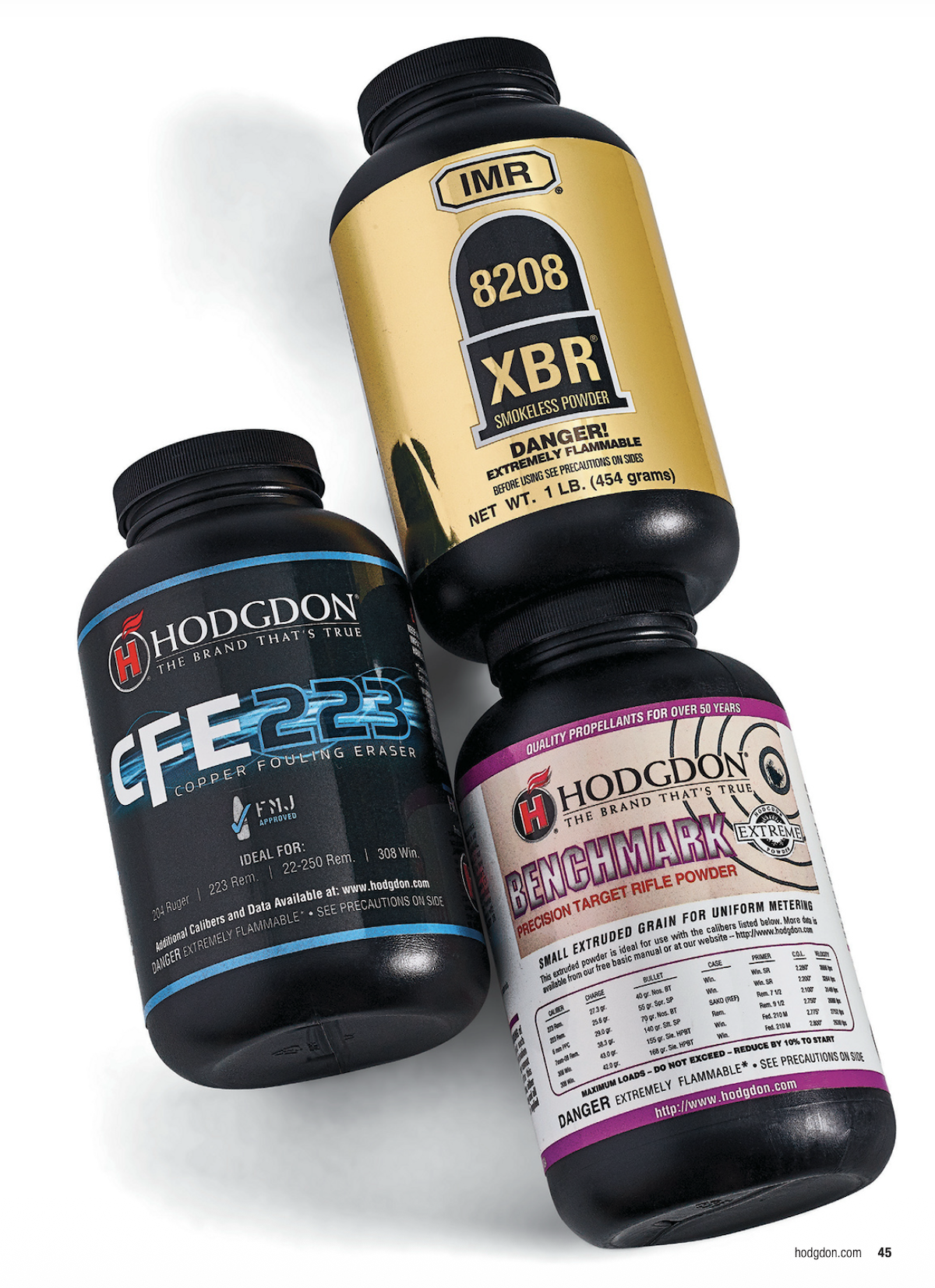
Hodgdon shows data for 13 different powders, from IMR 4198 on the fast side (rated at No. 75 on their powder list) to CFE 223 (rated at No. 111) on the slow end. I tried some loads with each of these powders, and while all shot well, my pick of the litter for handloading the 24 Nosler is CFE 223. Velocities were high, groups were small, and this powder metered very uniformly. It ignited easily with Winchester Small Rifle (WSR), CCI 400, and Federal 205 primers, and the copper eraser “pixie dust” they put in CFE 223 reduces jacket fouling substantially.
Just because Hodgdon listed “only” 13 powders in their data doesn’t mean that others weren’t tried. I have visited the Hodgdon test lab and packaging facility and have been impressed by the mass of very expensive scientific instrumentation. The lab techs there are serious as a heart attack about reloading and ballistics. They check and double-check everything, and I am confident they listed only the “best” powders for this cartridge. They even weigh every can of powder before it leaves the plant. I asked the plant manager what the tolerance range was for the can; I expected to hear something like “plus or minus 1 to 2 percent.” Not a chance. It is minus 0 percent to plus 1.5 percent. “We don’t want to accidentally cheat a guy out of a couple of ounces of powder,” he said.
The crop of 6mm bullets is so overwhelming that there is no way one could test them all. Hodgdon shows load data for eight representative 6mm bullets weighing from 55 to 108 grains that the enterprising reloader can use to develop handloads for just about any shooting purpose. To handle the heaviest 6mm bullets available, the standard twist rate for the 24 Nosler is one turn in eight inches.
The 24 Nosler is one of the most rewarding cartridges to reload I’ve ever worked with. Many Hodgdon powders work well in it, and the resulting rounds offer exceptional ballistic uniformity and accuracy. It just seems to shoot well with about any combination of components you can put together. You can’t say that about many cartridges.
The 24 Nosler is approved by S.A.A.M.I., which officially makes it a “factory” cartridge, so any company can make guns and/or factory loads for it as long as they conform to S.A.A.M.I. specs. The MAP (maximum average pressure) for the 24 Nosler is 55,000 psi, just like the 223 Remington. All of Hodgdon’s data are within that MAP limit, and a bolt-action gun like the NCH will easily handle them.
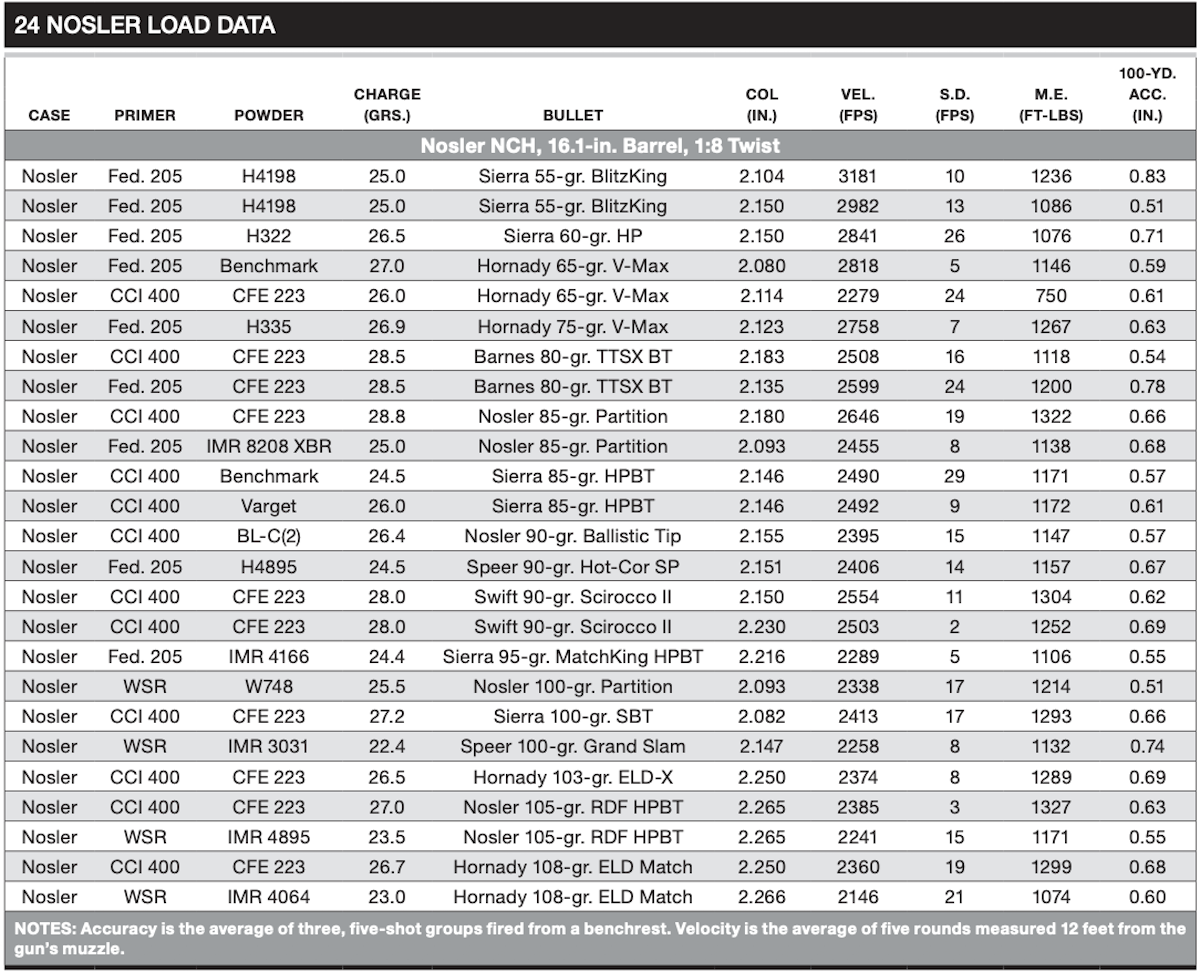
For all testing, I fired three, five-shot groups at 100 yards from my indoor benchrest, and the accuracy listed in the load data chart is the average of those groups. Velocity is for five rounds measured with an Oehler Model 35P chronograph with the start screen 10 feet from the gun’s muzzle, and the stop screen at 14 feet.
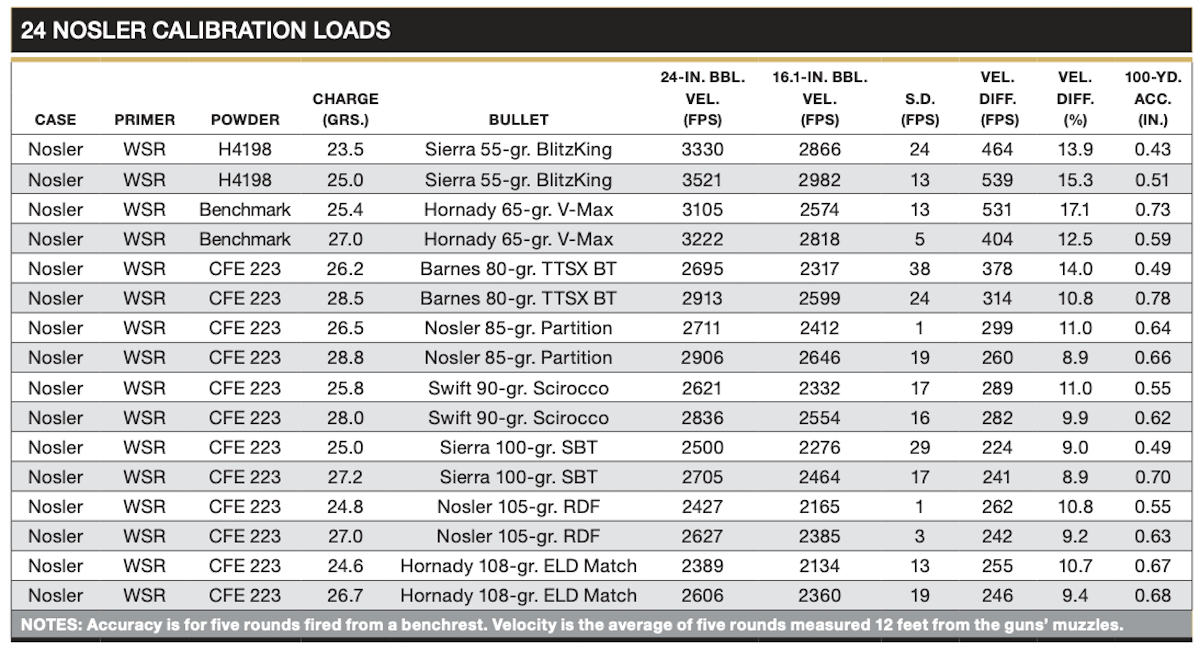
Let’s look at some load particulars. Since there is no factory ammo for the 24 Nosler at present, I skipped ahead to the second step in my typical testing protocol, what I call my “calibration loads.” These are made from Hodgdon’s load data, which were developed in a 24-inch pressure barrel. For the powder that gives the highest velocity with each bullet Hodgdon tested, I loaded five rounds each of the starting and the maximum loads with each bullet. For the Sierra 55-grain BlitzKing, that powder was IMR 4198, which edged out Benchmark by a hair. Benchmark was the highest with the Hornady 65-grain V-Max. For 80- to 108-grain bullets, Hodgdon CFE 223 delivered the highest velocities.
In the calibration loads, I duplicated all of Hodgdon’s components and cartridge overall lengths (COL) for the starting and maximum loads with selected powders with each bullet, and the results were compared with Hodgdon’s results. This created a good frame of reference and was especially interesting with the NCH, considering its 16.1-inch barrel. The results are shown in the accompanying calibration loads chart. The Nosler pistol handled all loads with aplomb and illustrated two interesting points.
First, both the starting and maximum loads were superbly accurate. (I was to learn later that this wasn’t a fluke, but the norm.) The average group size of all eight starting loads was a miserly 0.57 inch, and for the maximum loads, it was 0.65 inch. Remember, these loads were not “worked up,” just plucked off the Hodgdon website.
The second point of interest was the velocity loss for the eight loads fired in the NCH’s 16.1-inch barrel versus Hodgdon’s 24-inch pressure barrel. The average velocity loss for the starting loads averaged 338 fps in the shorter barrel. That’s 42.2 fps slower per inch. For the maximum loads, it was 316 fps slower, or 39.5 fps per inch. The correlation coefficient for the starting loads was -.8; it was -.9 for the maximum loads. This shows a strong negative correlation in both sets of data, as the velocity loss became somewhat greater as bullet weight increased. The correlation coefficient merely shows the strength of the relationship and implies no cause and effect whatsoever of the two normally distributed variables.
Armed with the calibration data, I made up a broad selection of handloads. I used COLs that placed the bullet ogives 0.010 inch off the lands, as determined by the Hornady Lock-N-Load A.O.L. Gauge, except for the shorter bullets, which I seated to the base of the case neck to provide good neck tension.
Rather than try to test every powder-bullet combination, I randomly chose one or two loads with each powder listed in Hodgdon’s data and used slower-burning powders as bullet weights increased. Actually, that worked out pretty well, although I darn near ran out of case volume as I approached the heavier bullets. Then I narrowed the powder list down to the “best” ones, and it soon became apparent that CFE 223 was the red-hot setup for the 24 Nosler.
I also tried a couple loads at different lengths to test the effect of COL on velocity and accuracy. I loaded the Sierra 55-grain BlitzKing over 25.0 grains of IMR 4198 at COLs of 2.104 inches and 2.150 inches. The velocity of the longer load was 199 fps slower than the short load, but groups averaged 0.51 inch, as opposed to 0.83 inch from the shorter COL. However, with the Swift 90-grain Scirocco II and 28.0 grains of CFE 223, the longer load was 51 fps slower, and groups were virtually identical at 0.62 inch (shorter COL) and 0.69 inch (longer COL).
In a nutshell, all of the powders tested did quite well, including standards like IMR 3031, BL-C(2), H322, and Varget.
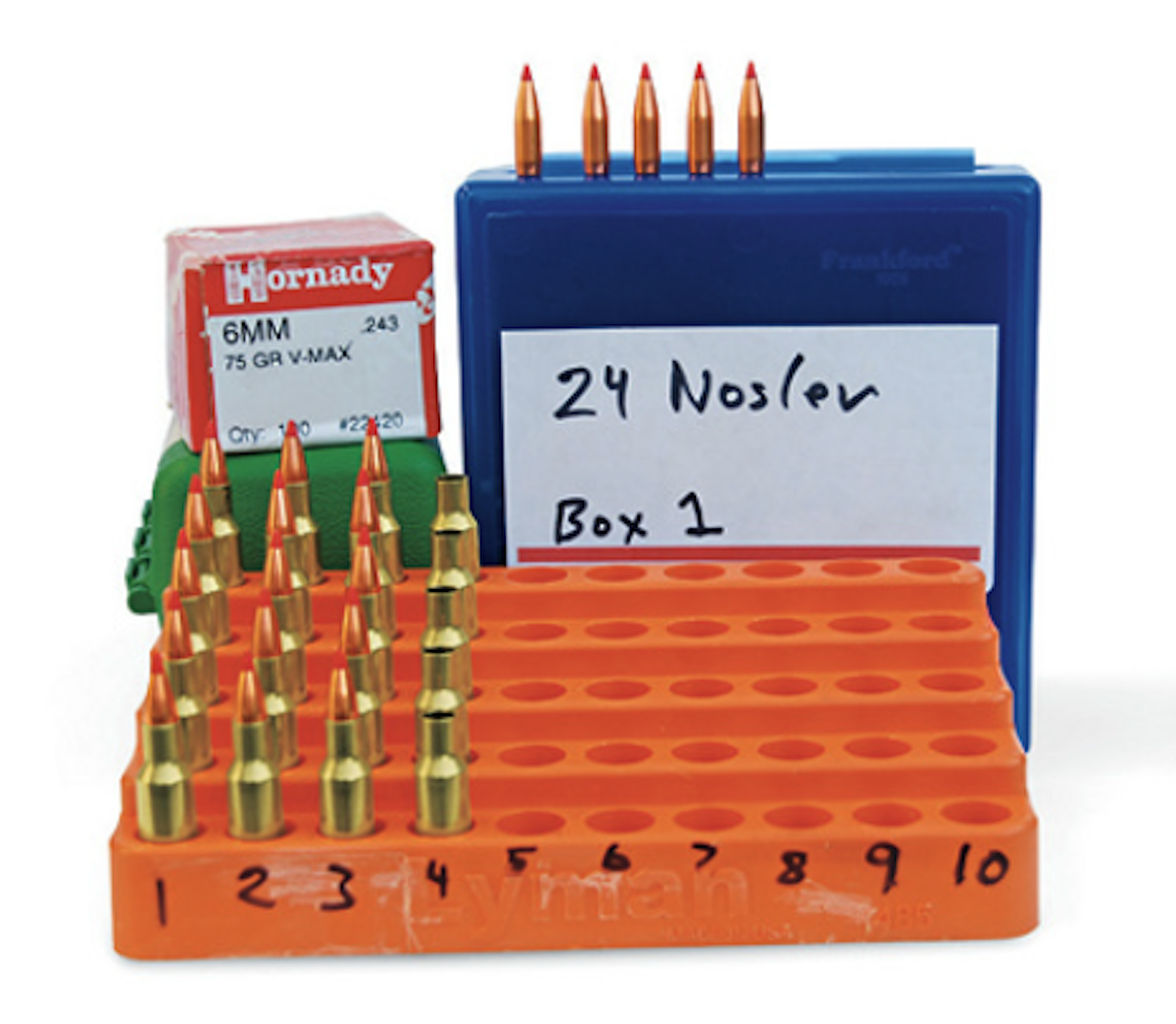
For pure paper punching, it’s hard to beat two relatively new powders that have become stalwarts: IMR 8208 XBR and Benchmark. Both powders have itty-bitty granules that meter very uniformly, provide good load density, and produce great accuracy. With the Hornady 65-grain V-Max, a charge of 27.0 grains of Benchmark gave a velocity of 2,818 fps, and groups averaged 0.59 inch. My favorite load with Benchmark was with the Sierra 85-grain HPBT (always an accurate bullet in my 243 Winchester). A charge of 24.5 grains of this powder put the bullets into an average of 0.57 inch at an average velocity of 2,490 fps. Another great varmint bullet is the Sierra 60-grain HP. It shot into 0.71 inch over 26.5 grains of H322, which has been a great benchrest powder for decades. Another winner was the Hornady 75-grain V-Max with 26.9 grains of H335, which shot into 0.63 inch at 2,758 fps.
But the 24 Nosler isn’t just for varmints or targets. It is lethal on larger game, too, and has taken several deer and antelope. In my handloads, a charge of 25.0 grains of IMR 8208 XBR under the Nosler 85-grain Partition produced a velocity of 2,455 fps, and groups averaged 0.68 inch. This should be potent whitetail deer medicine.
The Speer 90-grain Hot-Cor SP is one of my favorite 6mm game bullets, so I just had to try it in the 24 Nosler. With 24.5 grains of H4895, velocity was 2,406 fps, and accuracy was 0.67 inch. I have taken deer with this bullet (in a 243 Winchester rifle), and performance was all that could be desired.
I tried only a few match bullets because I see the 24 Nosler, at least in NCH, as more of a hunting cartridge than a target tool, but the Hornady 108-grain ELD Match registered group averages of 0.60 inch and 0.68 inch with IMR 4064 and CFE 223. The Nosler 105-grain RDF HPBT was also excellent, at 0.55 inch with IMR 4895 and 0.63 inch with CFE 223. The Sierra 95-grain MatchKing HPBT averaged 0.55 inch with 24.4 grains of IMR 4166, one of the Enduron powders, but velocity was a rather modest 2,289 fps.
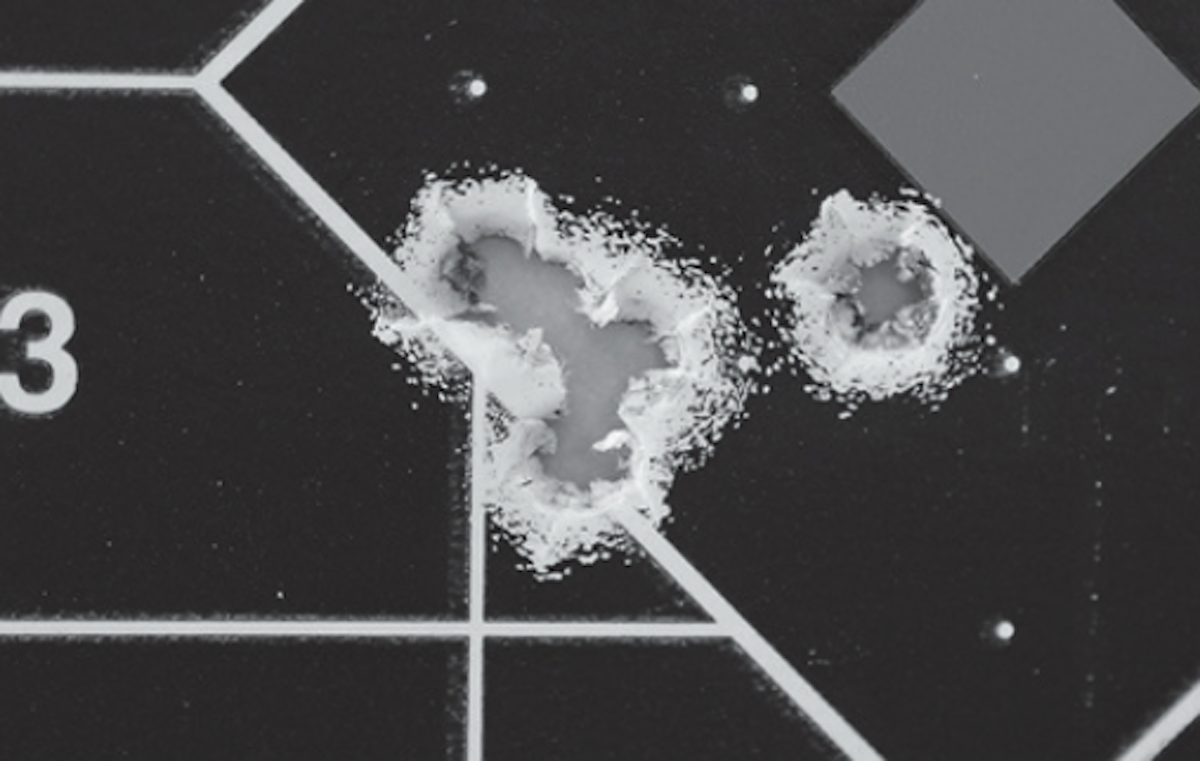
At the end of all the shooting, I tallied up the results of the 25 handloads fired. The average was a remarkable 0.64 inch; the range was from 0.51 inch (with the Nosler 100-grain Partition, 25.5 grains of W748 powder, and a WSR primer) to 0.78 inch (with the Barnes 80-grain TTSX BT, 28.5 grains of CFE 223 powder, and a Federal 205 primer). The standard deviation of the groups was 0.081 inch, so, statistically, it is reasonable to expect 95 percent of all groups (in my gun) to average between 0.48 inch and 0.80 inch.
After all the dust settled, I had a new appreciation of the Nosler Custom Handgun. Candidly, the pistol was hard to hold steady from the benchrest. I made do with my Caldwell DFT Lead Sled that supported the fore-end and the back of the stock. I got along pretty well, but it was a struggle. But you can’t argue with the excellent results. For those brave souls who hunt varmints and big game with a handgun of this type, it will deliver the goods. And I confess that I really am impressed with the 24 Nosler cartridge. In fact, I’m having a rifle with a 24-inch barrel chambered for it as I write these lines. Loads stoked with any of the Hodgdon, IMR, or Winchester powders listed in this report will spell jeopardy for all game, large and small, during upcoming hunting seasons.
The 24 Nosler is one of the most rewarding cartridges to reload I’ve ever worked with. Many Hodgdon powders work well in it, and the resulting rounds offer exceptional ballistic uniformity and accuracy.
Load Data Charts