



The new 350 Legend straight-wall hunting cartridge can be a challenge to handload, but these tips will help you build accurate, consistent, and effective ammo.
It’s like Bobby said so long ago, “The times they are a-changin’.” For generations many Midwestern states have dictated shotguns-only for deer hunting. Recently, and fairly rapidly, many of those states are moving to allowing straight-wall rifle cartridges. The first new cartridge introduction that has resulted from those changes is the 350 Legend from Winchester. The round’s recoil is very mild, and it’s a great cartridge for youth and recoil-sensitive hunters.
The new 350 Legend is, more or less, the 223 Remington case straightened and trimmed to 1.710 inches, so it’s a good fit with many existing rifles, including the AR-15 platform. There are some subtle differences between 223 Remington and 350 Legend cases, but the differences are small. They both use a 0.378-inch rim diameter, but the 350 Legend uses a slightly larger case diameter, measuring 0.390 inch at the base. This results in a rebated rim. The two are not interchangeable, and you cannot make 350 Legend brass from 223 Remington cases. Also, magazines designed for the 223 Remington/5.56 NATO will not work, so the 350 Legend requires a dedicated magazine.
In the world of straight-wall rifle cartridges, the 350 Legend is on the smaller end. The three most popular straight-wall rifle cartridges are the 450 Bushmaster, 444 Marlin, and 45-70 Government. The 350 Legend case is substantially smaller than any of them. If you subscribe to the theory of 1,000 foot-pounds (ft-lbs) of bullet energy on impact as a minimum for deer-size game—and I do—the 350 Legend is a 100-yard cartridge. It’s capable of hitting things much farther, of course, and I have shot targets out to 300 yards. It is easy enough to hit a large steel target, but the energy level is down to the 500 ft-lbs range, and the velocity at that distance is approaching the minimum needed to ensure expansion. Bottom line: To be sure of a clean kill, the 350 Legend is a 150-yard deer cartridge.
As I write this in late summer 2019, the 350 Legend is the hottest cartridge in the shooting industry. Just about every gun and ammo company is racing to introduce it into their product lines in time for the fall hunting season. However, it has not been without controversy. Much of that revolves around bullet diameter and has kept the technical gun nerds busy on the internet. (For the record, I self-identify as a technical gun nerd.)
Winchester’s engineers cribbed many of the existing numbers from the 357 Magnum and 357 Maximum cartridge drawings and used them for the 350 Legend. As with those cartridges, the bore diameter is listed at 0.346 inch and the groove diameter at 0.355 inch. Just like those cartridges, the bullet diameter specification is listed at 0.357 inch – 0.003 inch.
But make no mistake: The working bullet diameter for the 350 Legend is 0.355 inch. If that seems a bit odd to you, I agree. It limits the cartridge to existing bullets designed to be used in the 9mm Luger or 357 Sig pistol cartridges or bullets specifically designed for the cartridge currently available only from Winchester and Hornady. (There may be more before this publication goes to press as I hear rumors of at least two other companies working on bullets specific to the cartridge.) Of course, the 9mm Luger and 357 Sig bullets are designed for a much lower impact velocity.
One reason for the 350 Legend’s odd diameter, I suspect, is that 0.355-inch bullets ensure any feeding issues in AR-15 rifles with other bullets can be brushed off by saying, “Well, that bullet was not designed for the 350 Legend.”
No handloader would ever be compelled to follow those rules, and I tried a wide range of bullets for my handloads. The two bolt-action rifles I used had some minor feeding issues with some bullets, but in the end, they both fed and shot all the ammo I tested. Just a few loads were not very smooth when feeding, particularly some of the pistol bullets.
You can expect the AR-15 design might be a little more finicky about which bullets feed well. The Ruger AR-556 I have would not feed the pistol bullets reliably, but it’s hard to say what to expect from any other AR-15.
So why not just list the bullet diameter at 0.355 inch with S.A.A.M.I. and be done with it? My guess is because some important hunting states list a 0.357-inch minimum diameter for any straight-wall cartridge to be legal for deer hunting. By listing the bullet at 0.357 inch – 0.003 inch on the S.A.A.M.I. specifications, Winchester has been able to skirt the technicalities of the law. It’s foolish to quibble over two-thousandths of an inch in hunting regulations, but quibbling is what many government officials, and some engineers, do best.
Hodgdon has load data for two 0.355-inch bullets designed for handgun cartridges: the Hornady 147-grain XTP and the Barnes 125-grain TAC-XP. Both handgun bullets shot pretty well in my tests, and the velocities were impressive. However, I can’t comment on how well the bullets work in terms of terminal ballistics. They are designed for much lower impact velocity, so the results on game might be “interesting” to say the least. I would urge caution in using these bullets on big game until more testing is completed, although I would love to stick one in a coyote’s ribs and see what happens.
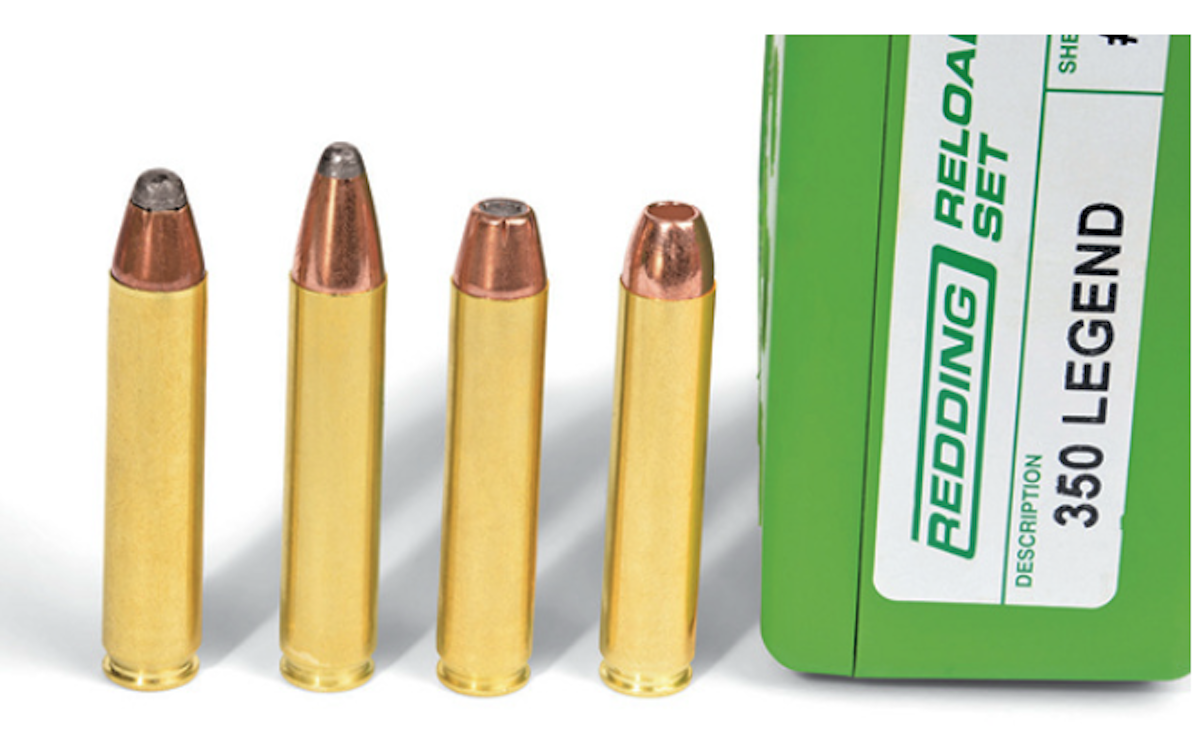
The other two bullets that Hodgdon tested are designed specifically for the 350 Legend. They are the Winchester 180-grain Power-Point and the new Hornady 170-grain InterLock. Also, both are offered in 350 Legend factory ammo. They are probably a better choice for hunting big game than the pistol bullets.
There are reports of cartridges loaded with larger-diameter bullets failing to chamber. One note that may be relevant if you are planning to load 0.357-inch bullets is that at this writing, brass was available from Winchester, Hornady, and Starline, and the Winchester case walls measured 0.001 inch thicker than the Starline and Hornady brass. That will add 0.002 inch to the cartridge diameter, which might become an issue with a tight chamber.
To see for myself, I made up dummy cartridges using 0.357-inch and 0.358-inch bullets. I used the thicker Winchester brass and loaded ammo with Speer’s 0.358-inch 180-grain bullet that’s designed for the 35 Remington and with Hornady’s 0.357-inch 180-grain XTP. The cartridges with the Speer bullet chambered in both bolt actions. The Hornady bullet also chambered fine, but its short ogive caused a tight enough fit in the chamber throat that I had trouble getting the cartridges out of my Ruger bolt action. That’s a bullet profile issue rather than bullet diameter. Neither of these loads would chamber in the Ruger AR-556 carbine.
So I guess this will vary from gun to gun depending on the tolerances when the chamber was cut. If 0.357-inch bullets chamber okay, they should be fine to use, as the S.A.A.M.I. specifications allow that diameter, assuming you have laboratory-tested load data with that bullet. Also, it would seem that the bolt-action rifles are going to be a lot more forgiving of bullet variation than the AR-15-style rifles.
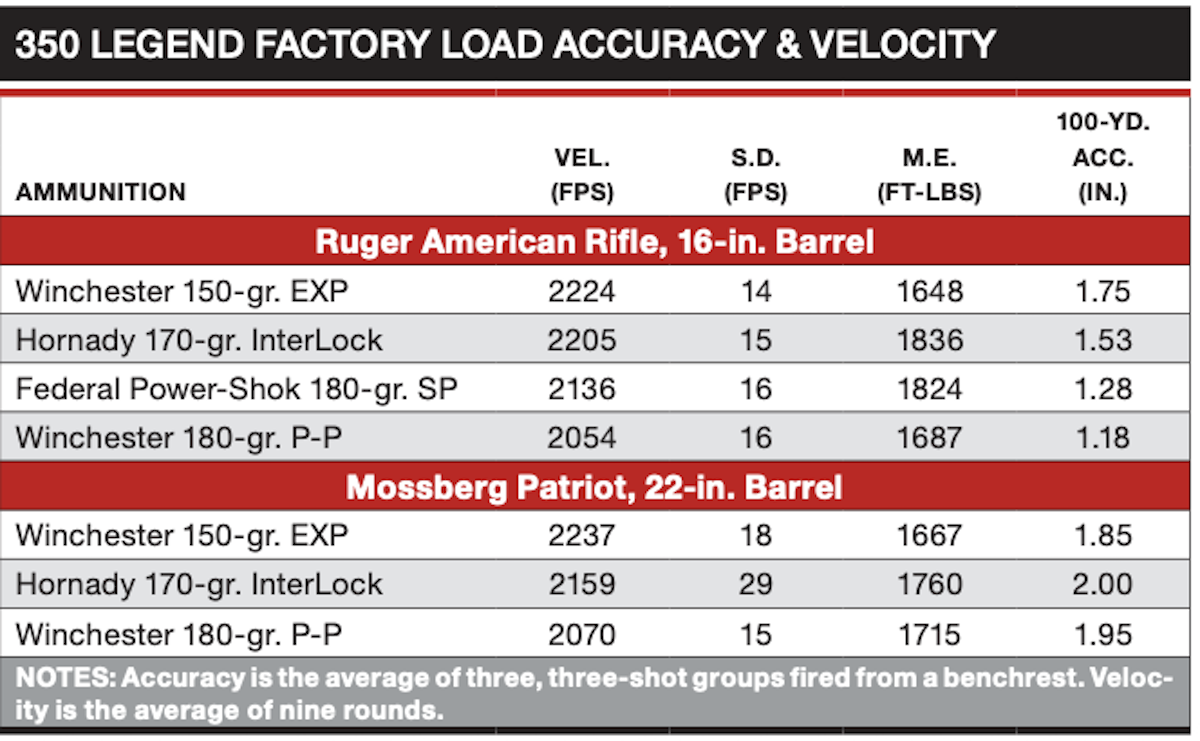
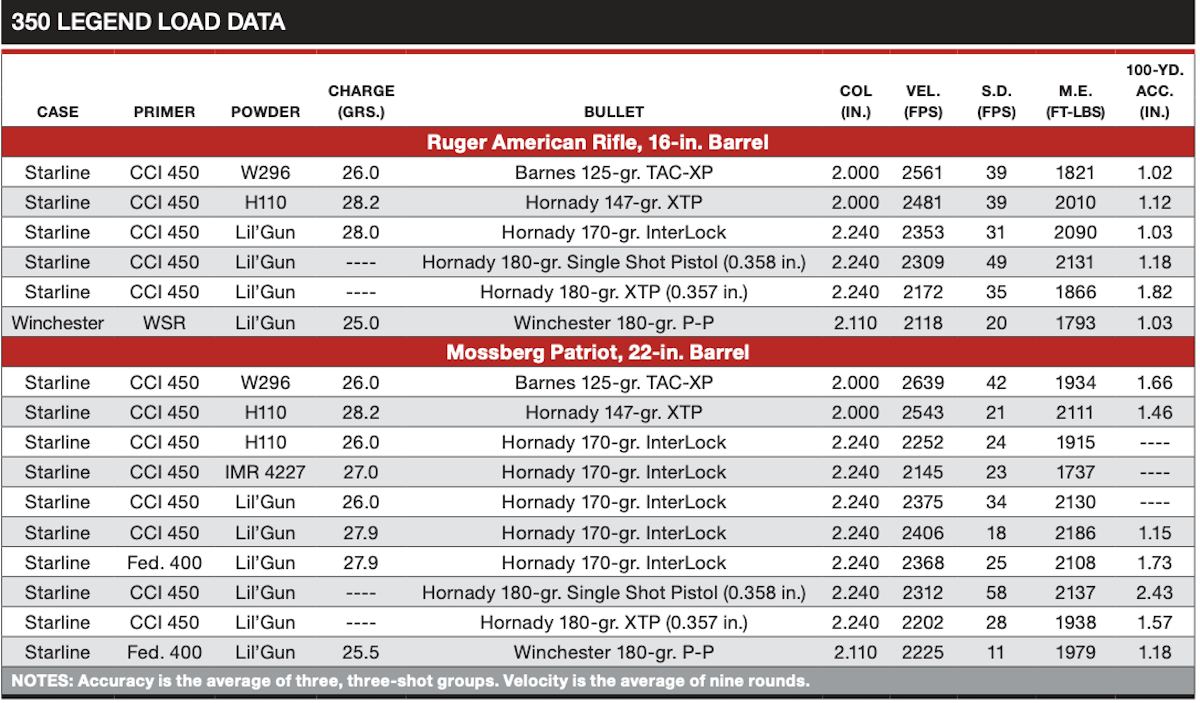
Based on that, I loaded some of the Hornady 180-grain XTP (0.357 inch) and Single Shot Pistol 180-grain Pointed (0.358 inch) bullets with Hodgdon Lil’Gun powder (I won’t give you the charge weight here as it has not been tested with Hodgdon) just to see if the larger bullets would shoot well. They were accurate enough for hunting deer. The results are listed in the chart.
Results
The 350 Legend is a fussy cartridge to handload. I experienced high to very high standard deviations (S.D.) when chronographing many handloads and even some factory loads. (I did not list every load I tested in the accompanying chart, as some were poor performers.) I weighed every single powder charge. I tried switching primers, including Magnum primers. I tried all the suitable propellants. I used larger-diameter bullets, and I added a taper crimp to the case. I was able to get the S.D.s down, but never to a great level. No load tested made it to single digits with the S.D. That probably contributes to the occasional flyer that opens the group average.
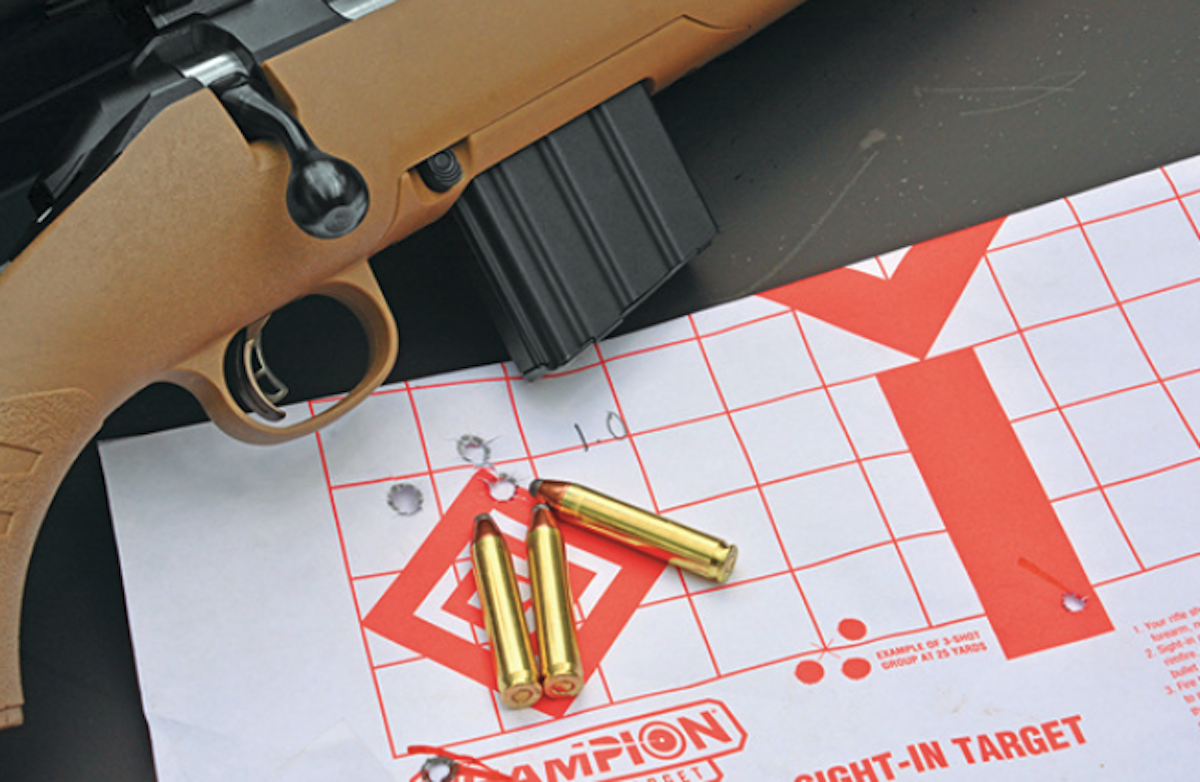
Accuracy was also often erratic. The rifles I tested are both capable of MOA accuracy and achieved several groups that size. The issue was inconsistency. Often, I would have two very good groups with the third opening up to twice the size and skewing the results. That goes hand in hand with the high S.D.s.
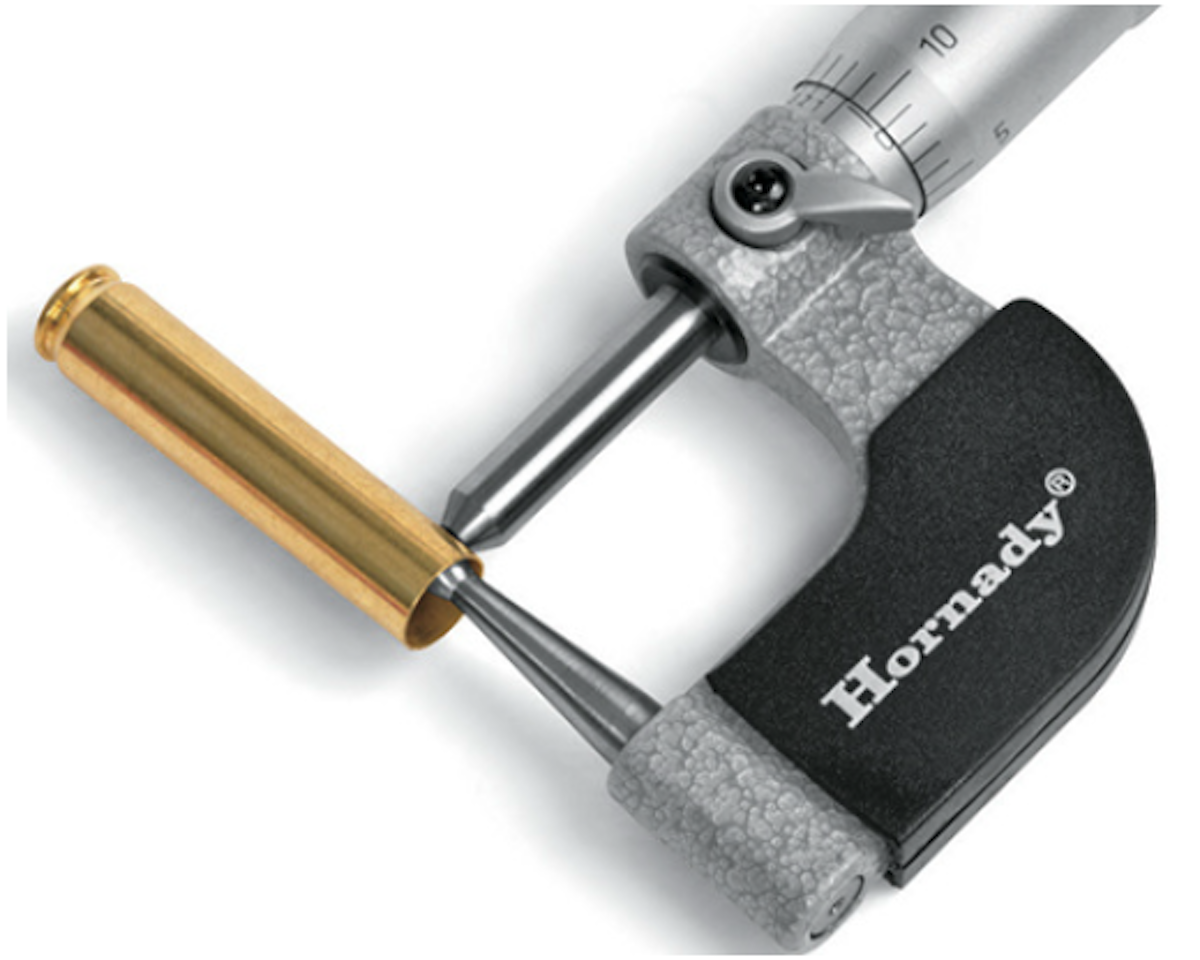
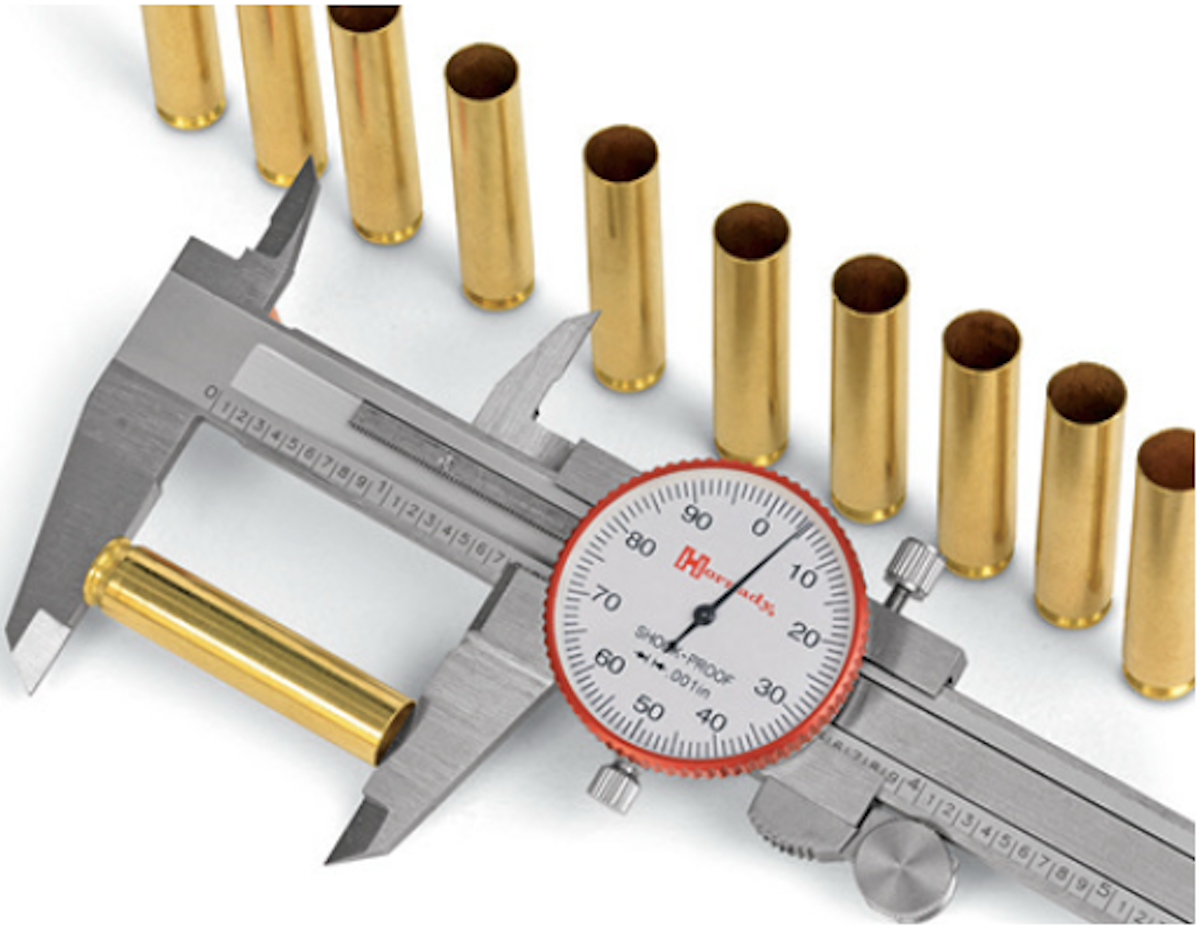
One thing I found is that case lengths vary a lot. I checked a bag of new Winchester brass, and cases varied from 1.701 to 1.708 inches. The early-production Starline brass I used was all over the place, with a lot of it under the minimum spec. However, I just checked a new batch of Starline brass, and it’s consistent to 0.002 inch and right in the middle of the tolerance at 1.705 inches on average.
Case length is important because the cartridge headspaces off the case mouth. This variation in case length is probably a big part of the reason for the high S.D.s and erratic accuracy. The S.A.A.M.I. case length spec is 1.710 inches - 0.010 inch. The chamber length spec for headspacing is 1.710 inches minimum and 1.720 inches maximum. So if you have a maximum chamber and a minimum cartridge case, there is a 0.020-inch gap between the case mouth and the support of the chamber. Any wonder why S.D.s run high and accuracy is erratic?
I measured 100 new Winchester cases and picked out 60 that measured within one-half thousandth of 1.703 inches—still a bit short, but at least they were consistent. I primed them with Winchester Small Rifle primers and loaded them with 25 grains of Lil’Gun. To be certain, I weighed every charge on two scales. I seated Winchester 180-grain bullets to the Hodgdon recommended cartridge overall length (COL) of 2.110 inches.
I modified a Redding micrometer taper crimp die for 9mm and 38 Super by chucking the reversible insert in my lathe and cutting it off to allow the 350 Legend cartridge to enter far enough to be supported by the die. I put a very heavy taper crimp on every case. The result was my best-performing handload. The S.D. was an acceptable 20, and the average of three, three-shot groups with the Ruger American bolt action was 1.033 inches. More importantly, the accuracy was consistent: 1.0, 1.0, and 1.1 inches.
For best results with this cartridge, sort or trim all cases so they are exactly the same length. Ideally, I would try for the 1.707 to 1.709 inches range and every one trimmed to the same length. Then add a strong taper crimp. Or use a Lee collet crimp die. The crimp adds case tension to the bullet and helps keep ignition consistent.
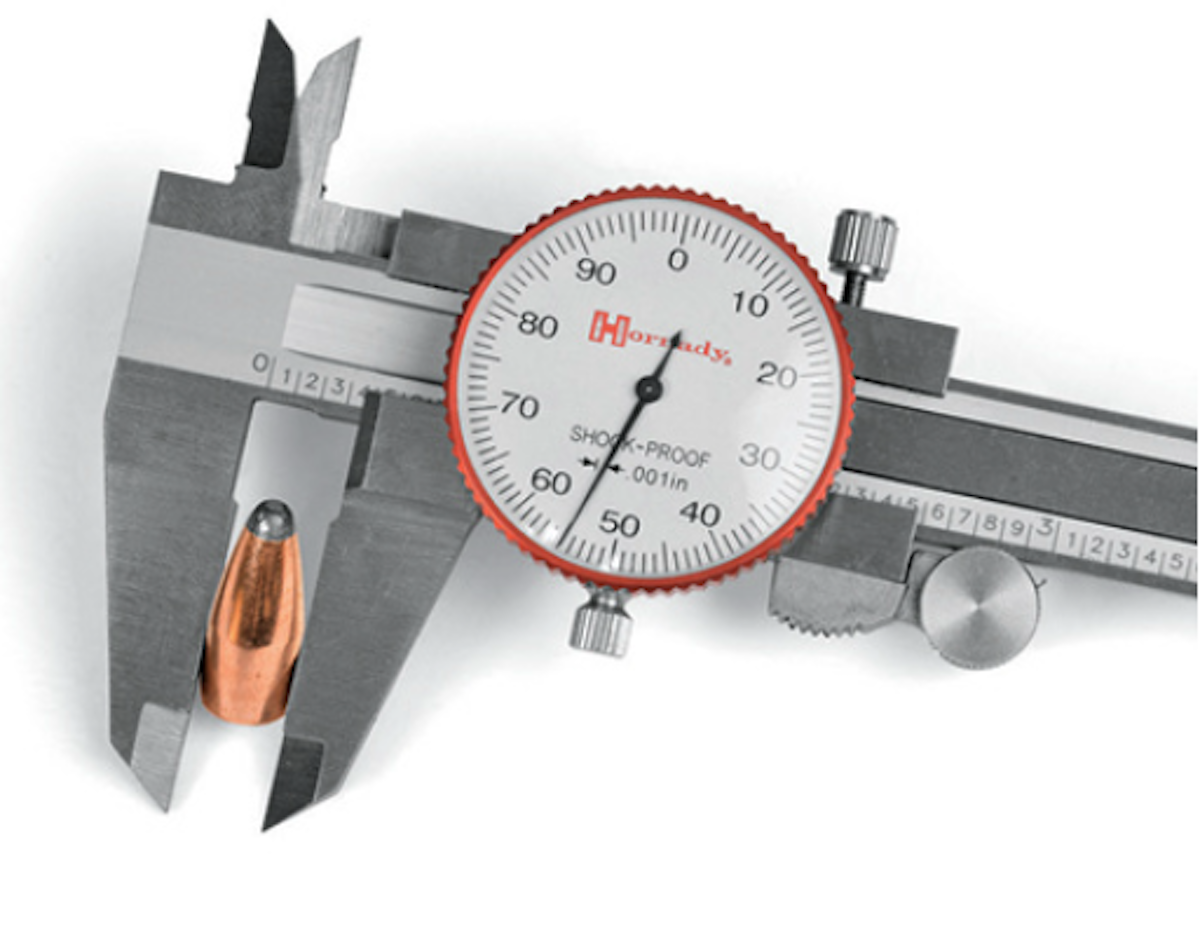
I modified a case to work with the Hornady Lock-N-Load O.A.L. Gauge, and I was surprised to find that the bullet jump to the rifling was pretty substantial. With a Winchester 180-grain bullet in the Ruger American rifle, the bullet jump was 0.344 inch. The Hornady 170-grain bullet jumped 0.320 inch. That’s using the Hodgdon recommended COL. If I use the S.A.A.M.I. COL maximum, the Hornady bullet jumped 0.331 inch.
These bullets are lightweight for the caliber, so they are short. It’s not possible to seat close to the lands as that leaves almost no bullet inside the case. This long freebore was probably designed to help achieve higher velocity, but it’s likely also a factor in the erratic accuracy that I and a lot of other shooters have experienced with this cartridge.
Tips
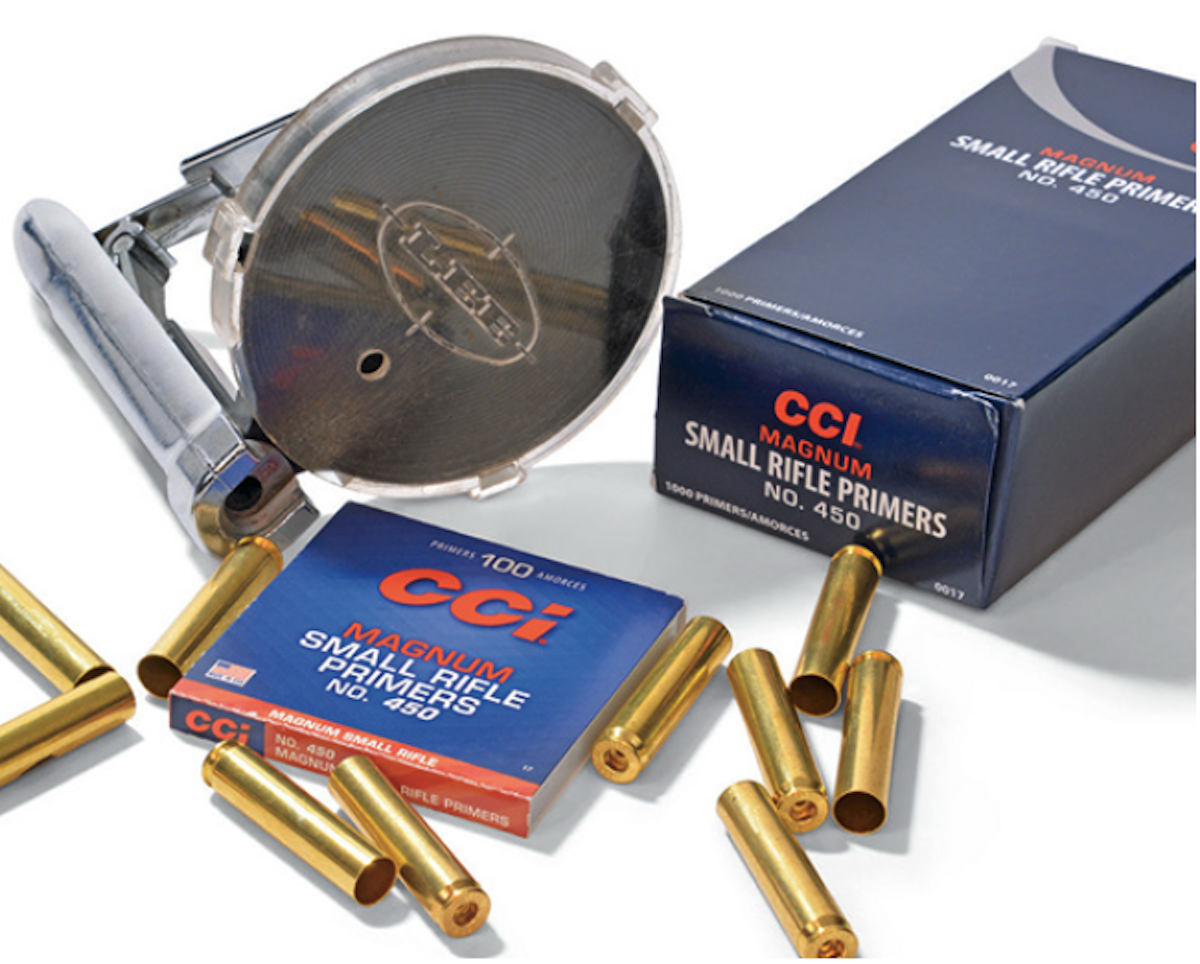
Hodgdon has tested five suitable propellants: W296, IMR 4227, H110, CFE BLK, and Lil’Gun. Never monogamous, cartridges are often in love with multiple propellants, but married to one. It’s clear when looking at the data that Lil’Gun is the standout powder in terms of producing the highest velocity. In the Hodgdon test data, it produced the fastest velocity with three out of the four bullets tested. Even the lone standout, the Hornady 147-grain XTP, was only off the leader by 40 fps, which is pretty much nothing, statistically speaking.
Lil’Gun is a great place to start, but as any handloader knows, each gun is an individual. It’s possible that you will get better accuracy and overall performance with one of the other powders. That’s why they test multiple powders and list the data. It is also notable that the Hodgdon data was shot with a 24-inch test barrel. Many of the rifles on the market are using barrels that are much shorter, often 16 inches. The powder that performs the best with a 24-inch barrel may not be the best performer with a short barrel. The only way to know for sure which powder your rifle likes is to load and shoot some ammo. After all, isn’t that what we handloaders live to do?
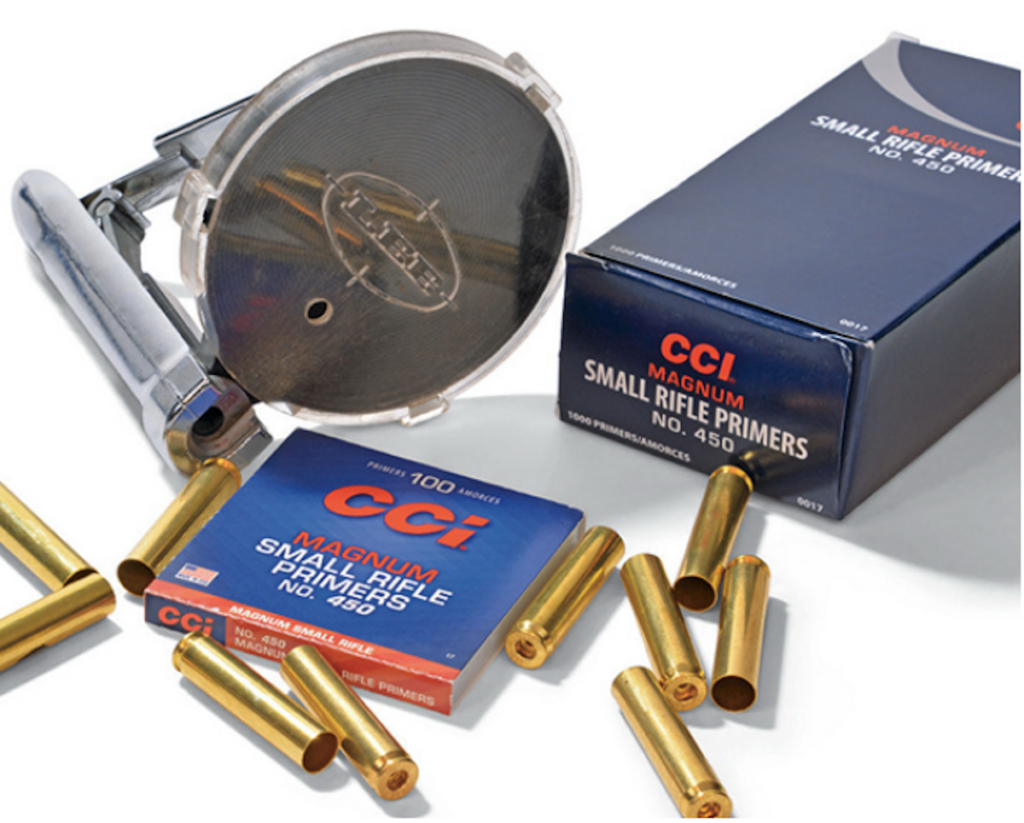
This cartridge should be loaded with Magnum primers. The Hodgdon data lists Winchester Small Rifle primers. I was out of them when I started this project, so I used Federal standard and CCI Magnum primers. Later, I loaded some ammo with Winchester primers. If there is a major difference due to the primers, I could not detect it. That said, it’s always best to stick to the recipe and use what Hodgdon recommends.
The first batch of Winchester once-fired brass that I used had a crimp on the primer pocket which I had to remove. The Winchester unprimed cases that I procured later did not have the crimp. I am not sure if that was just something from the early ammo, but you might encounter crimped primer pockets. If so, remove the crimp before attempting to seat a new primer.
Aligning the case with the resizing die in the press can be a little tricky. With so little case taper, the case must enter a hole in the die that’s not much larger than the case mouth. If you try to go fast, you will all but be guaranteed crushed cases. Work slowly and watch your fingers. I got blood on more than one case from a pinched finger.
I also found that the rebated rim and shallow extractor groove did not play well with the universal shellholder in my RCBS priming tool. I ended up using a Lee hand primer with a dedicated shellholder.
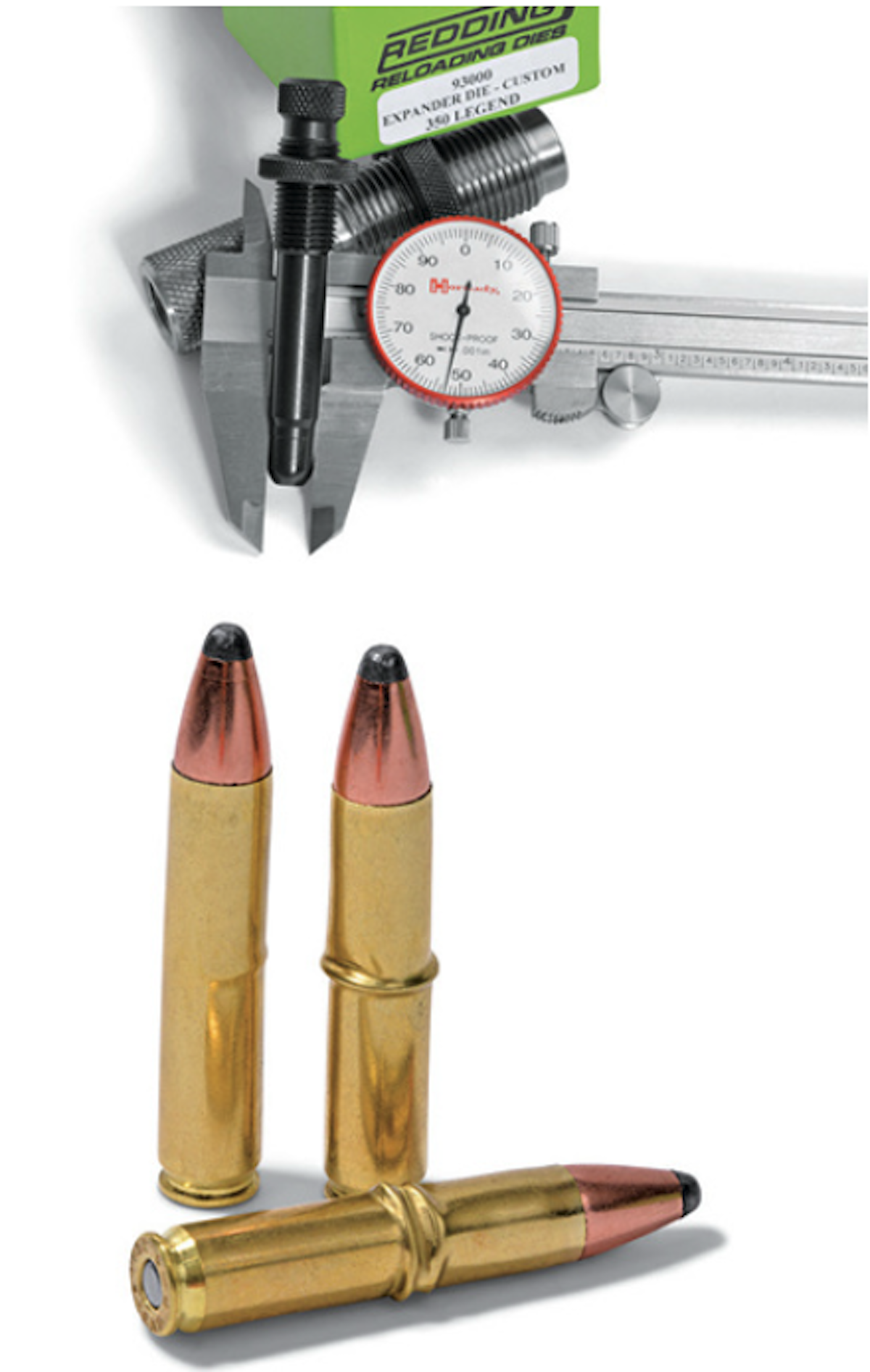
Also, when applying a taper crimp, make sure the case is supported and be cautious as it’s easy to collapse the case. I tried using a 9mm taper crimp die and ended up destroying a lot of cases.
Like all straight-wall cartridges, the 350 Legend requires three dies: a sizing die, an inside expander die, and a bulletseating die. I used Redding dies. The sizing die puts a small bottleneck on the case that the expander die removes as it expands the inside of the case to the correct diameter. I had my best results using a case neck expander plug that measured 0.353 inch. This helped make sure there was enough case tension on the bullet to keep ignition consistent. This aids in reducing the inconsistent performance leading to high S.D.s and erratic accuracy. The die should also have a case mouth belling function to aid in starting the bullets into the case.
The 350 Legend will no doubt find a home in areas requiring straight-wall cartridges for deer hunting, and it will also likely see a lot of use on hogs. With the 170-grain to 180-grain bullet weights, it should perform well on this size of big game. It might be a bit challenging to handload, but if you pay attention to the details, the cartridge can perform well.
It might be a bit challenging to handload, but if you pay attention to the details, the cartridge can perform well.
Load Data Charts