
The 6mm ARC may be hot off the press, but Hodgdon has already developed handload data for it.
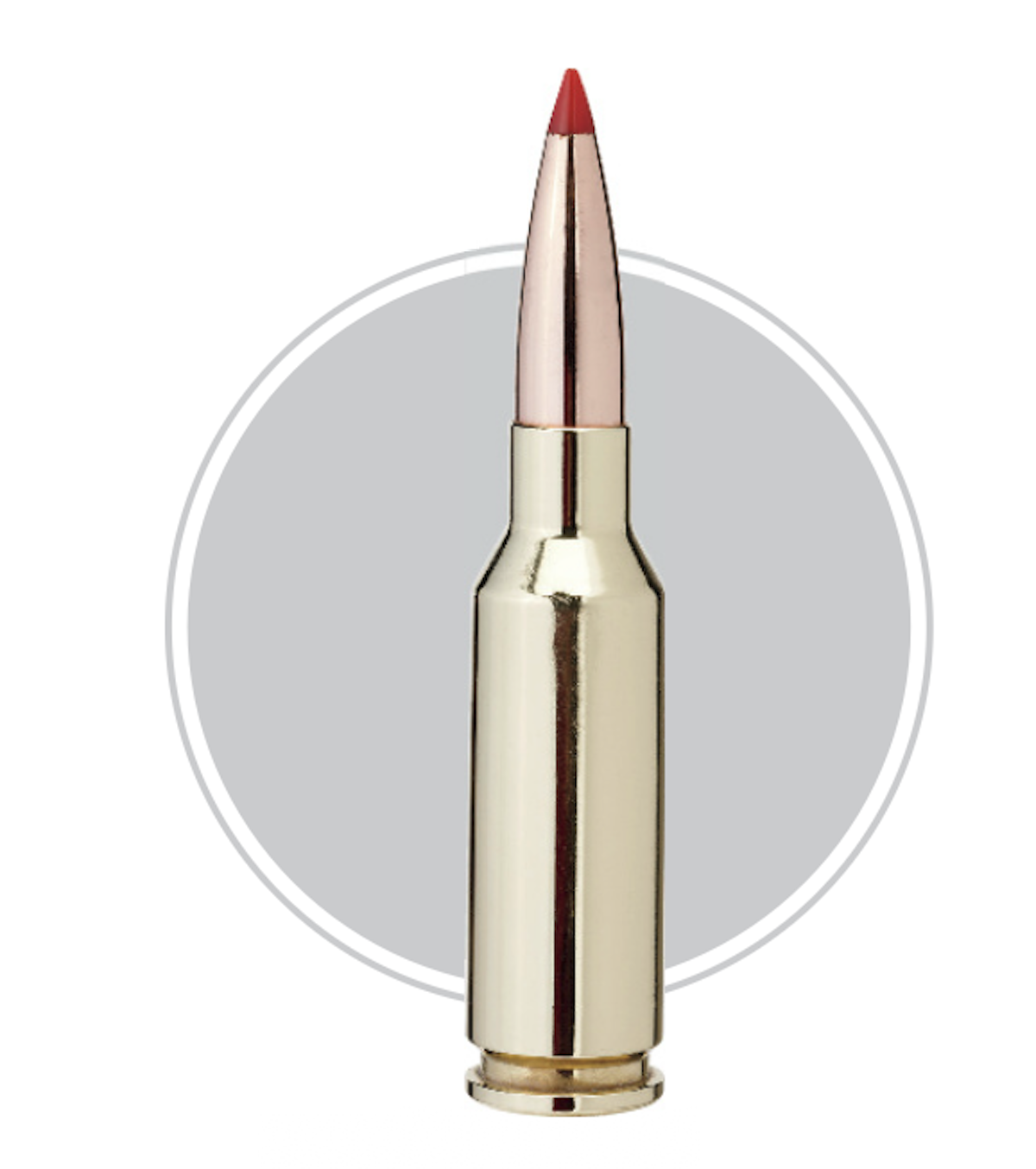
As I reviewed the development of the new 6mm ARC (Advanced Rifle Cartridge), I recalled a simple yet profound part of The Origin of Species by Charles Darwin. In Chapter IV, Darwin laid out the evidence for his theory that only the “fittest” organisms survive. I was thinking about how that that concept is applicable to cartridges. Many are conceived, some flourish, and others wither away. New cartridges and the powders that fuel them also seem to evolve new forms that include members with similar characteristics. The new 6mm ARC offers an example.
The Driving Force
In 1999 military writer Stanley C. Crist, writing in Infantry magazine, published by the U.S. Army in Fort Benning, Georgia, called for the development of a cartridge named the “6mm Optimum.” Crist wanted the Army to replace both the 5.56mm and the 7.62x51 with this hypothetical .24-caliber cartridge.
His rationale was sound. Ammunition for such a round would be about the same weight and have about the same recoil as the 5.56 but produce terminal performance nearer the 7.62x51. Thus, the cartridge could serve multiple purposes in individual infantry carbines and in general-purpose machine guns and sniper rifles as well.
The ballistics for Crist’s proposed 6mm Optimum were impressive. It would launch a 100-grain bullet at a muzzle velocity of 2,900 fps, with a muzzle energy of 1,868 ft-lbs, and it would have a wind deflection of around “150 inches at 1,200 meters in a 10 mph crosswind.” The new 6mm ARC comes pretty close to Crist’s criteria. It is touted as a round for a plethora of shooting chores, from military use through long-range target shooting to hunting varmints and big game, with the proper bullets.
The 6mm ARC’s case is based on a firm foundation. The 7.62x39 Russian was the basis for the 220 Russian (a.k.a. 5.6x39 Vostok), which in 1972 was formed into the highly accurate and immensely popular 22 PPC. The case was then necked up to form the match-winning 6 PPC. This in turn was reformed slightly into the 6.5 Grendel. Finally, the Grendel was necked down to 6mm and slightly modified to become the 6mm ARC. In a nutshell, the 6mm ARC evolved from the 7.62x39 to the 5.6x39 to the 22 PPC to the 6 PPC to the 6.5 Grendel to the 6mm ARC.
Cartridge Enhancements
The 6mm ARC case and chamber were designed by Hornady with the same criteria for case and chamber design used for the 6.5 Creedmoor and 6mm Creedmoor cartridges. This is of some moment, as both have a well-documented record of uniform ballistics and outstanding accuracy.
The 6mm ARC case head measures 0.440 inch, or only 0.005 inch smaller than the 7.62x39, and the rim is non-rebated that feeds well in box magazines. The ARC’s overall length is set at a maximum of 2.26 inches, making it compatible with AR-15 magazines created for the 6.5 Grendel. The ARC case retains the proven 30-degree shoulder angle, which promotes feeding in AR platforms and is also thought to contribute to a more efficient powder burn. All that is required to convert a 5.56mm AR-15 to the 6mm ARC is a barrel, a bolt, and a magazine. I can imagine the demonstrated superior performance of the 6.5 Grendel and its rabid following will logically carry over to the 6mm ARC.
The 6mm ARC has better long-range performance, with less wind drift in most situations, than the 7.62x51. Although the ARC has less muzzle energy, it catches up downrange. The case volume is about 34 grains of water, similar to the 6 PPC (32 grains of water) and the 6mm BR Remington (38.5 grains of water). Those two rounds have proven their accuracy potential.
The standard twist adopted for the 6mm ARC is a steep 1 turn in 7.5 inches, and that makes the round suitable for today’s long-for-caliber bullets with sky-high ballistic coefficients. Data from Hornady notes that a 108-grain ELD Match bullet has a G1 ballistic coefficient of .536, and at 2,700 fps it stays supersonic up to 1,150 yards at sea level. The muzzle energy of such a projectile would be 1,749 ft-lbs—only slightly lower than what Crist recommended over 20 years ago. Significantly, the recoil of this load is approximately 30 to 35 percent less than the 7.62x51. My test loads averaged from 3.7 to 5.4 ft-lbs of recoil. Plus, a soldier could carry about as many of these more powerful rounds as with the 5.56mm, which has a muzzle energy of about 1,030 ft-lbs with a 55-grain bullet.
A careful comparison of the specifics of the 6mm ARC reveals that it excels in every category examined. It is “advanced” for the AR platform. It’s versatile and suitable in mini-bolt and chassis guns for hunting and target shooting. It uses propellants efficiently, and its performance is effective with a variety of bullets.
Building Handloads
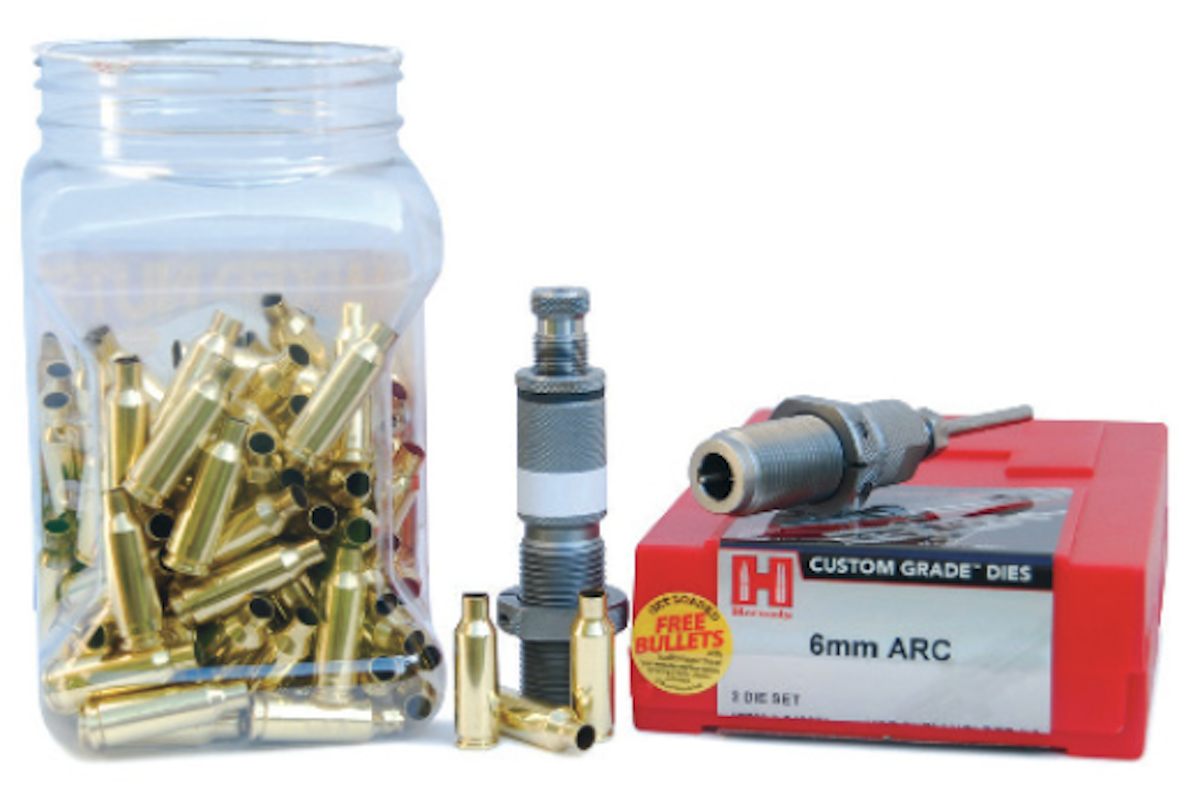
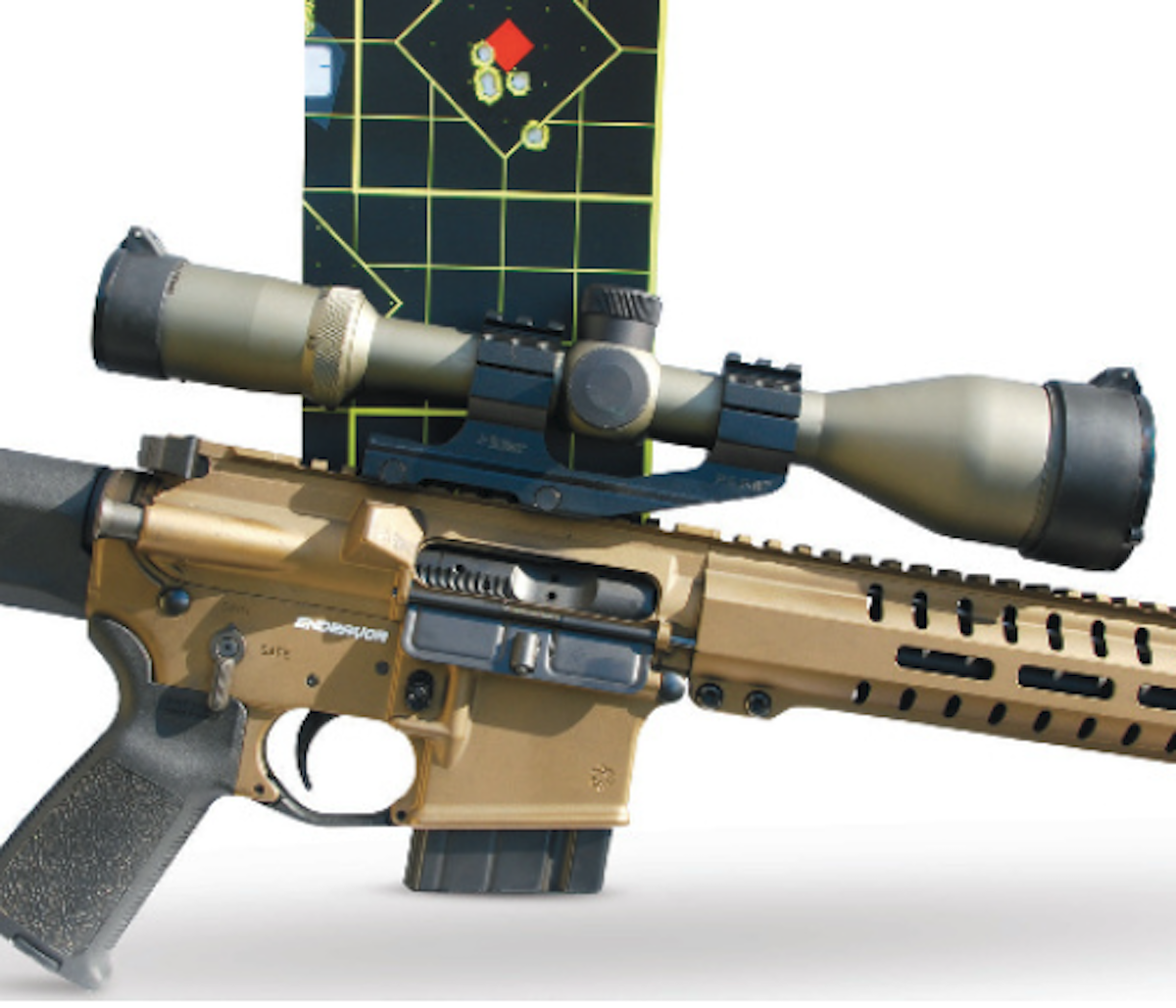
With all the hoopla surrounding the new 6mm ARC, I couldn’t wait to get my hands on a rifle and assess the round with factory-loaded ammo and an assortment of handloads. Fortunately, Hodgdon has a wide selection of suitable powders. My interest was furthered by the fact that the 6.5 Grendel is my overall favorite AR cartridge, and as we’ve seen, the 6mm ARC is a direct descendant, deeply steeped in Grendel DNA.
I used a CMMG Mk4 Endeavor AR-15 outfitted with a Burris Fullfield II Tactical 4.5-14X 44mm scope for this exercise. This AR has an 18-inch barrel with a 1:7.5-inch twist. I also obtained two Hornady factory loads. The Match loading has a 108-grain ELD Match bullet at a rated velocity of 2,750 fps. The Black loading shoots a 105-grain BTHP at 2,750 fps. Eventually, a third factory load will be available, and it will be in the Precision Hunter line. It features a 103-grain ELD-X bullet at a listed velocity of 2,800 fps. Each of these bullets will eventually be available as handloading components, and their ballistic coefficients are eye-opening. In the same order, they are .512, .536, and .530.
In addition to ammo and bullets, Hornady, as the “parent” of the ARC, offers a full complement of reloading equipment and components to us eager votaries. I received reloading dies, cartridge cases, and new bullets specifically designed for the ARC. In addition, I had many other suitable 6mm bullets on hand.
To capitalize on the round’s virtues, this new critter needs food, and that’s where Hodgdon comes in. Hodgdon has always been on the cusp of developments in cartridge propellants, so the company hopped right on the ARC bandwagon and quickly produced and tested an impressive set of loading data for its powders in the new cartridge.
The S.A.A.M.I. MAP (maximum average pressure) for the 6mm ARC is 52,000 psi, making it “AR-15 compatible.” Hodgdon’s loads are within that pressure limit and are applicable for just about any shooting chore.
The powders suitable for the 6mm ARC are the usual suspects for a case of this size. Hodgdon’s initial load data was for 100- to 110-grain bullets and utilized Winchester 748 and 760; Hodgdon Varget, LEVERevolution (LVR), CFE 223, and BL-C(2); and Winchester StaBALL 6.5. I had all of these powders in my cache, so I wasted no time whipping up a bunch of different loads.
I studied Hodgdon’s data carefully, and after a while, I was sure I had it all figured out. While this initial set of hand-load data listed seven powders, it looked like LVR and CFE 223 would be the “best” powders, no problem.
As I approached handloading, I was a bit concerned that there would not be enough room in the ARC’s small case to hold the selected powder charges. However, I had no problems with case volume with any of these powders in my handloads, and neither will you.
All cases were full-length sized, and the sizer was set with the Hornady Lock-N-Load Headspace Comparator gauge to set the shoulder back only 0.002 inch. The overall cartridge lengths (COL) used were set at 2.260 inches or less to feed through the AR’s magazine. However, the Nosler 95- and 100-grain Partitions and the Speer 90-grain Hot-Cor SP bullets had to be seated much shorter due to their relatively blunt ogives. Also, the shorter, lightweight varmint bullets were seated so that the base of the bullet was positioned at least to the start of the case neck.
Of course, all cases were from Hornady. Winchester Small Rifle primers were used for the majority of my hand-loads, but I also tested two loads with Federal 205M and CCI No. 41 primers just for comparison. All delivered excellent performance.
All of the powders used flowed through a powder measure with great uniformity, but for small batches of test loads, I weighed each charge. I gathered and recorded the results for five-shot groups at 100 yards, firing from a Caldwell Lead Sled DFT from my shooting building. It was pretty hot on most shooting days, so I let the barrel cool down a little between shots and really cooled it by placing it in front of my air conditioner between groups. The bore was cleaned with Butch’s Bore Shine every 30 rounds, but I must report that the thirtieth groups were every bit as good as the first ones, so my cleaning ritual may have been superfluous.
Range Results
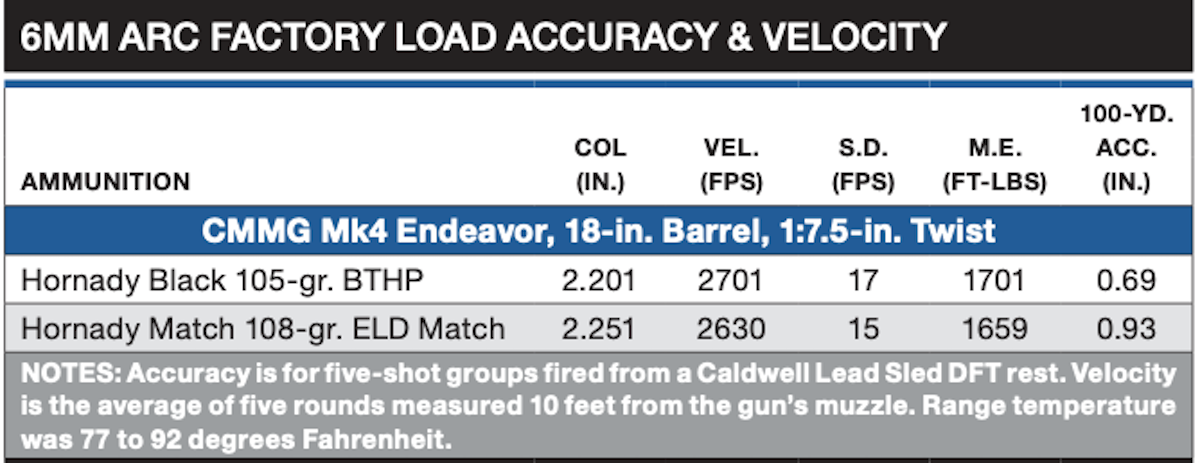
I first fired two of Hornady’s factory loads for a baseline: the Black ammo with its 105-grain HPBT bullet and the Match load with the 108-grain Match bullet. I fired three, five-shot groups with each load. As the chart found on a previous page shows, the Black ammo averaged 2,701 fps and 0.69 inch. The velocity of the Match load was 2,630 fps, and its accuracy averaged 0.93 inch.
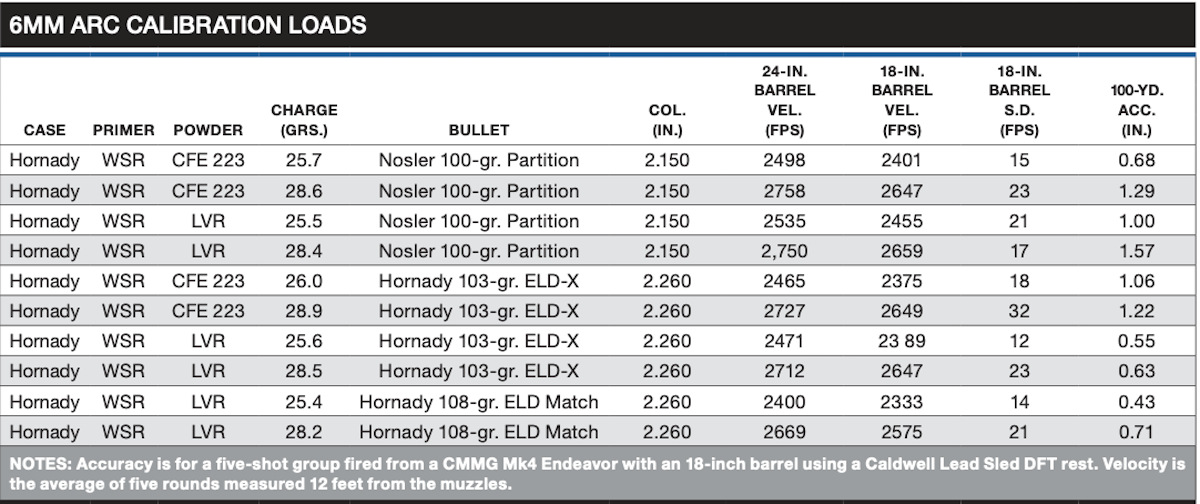
Whenever I work with a new cartridge, I prepare and shoot what I call “calibration loads” to see how Hodgdon’s minimum and maximum loads from the test gun compare with the same loads in Hodgdon’s 24-inch minimum-spec pressure barrel. So I shot 10 different loads using CFE 223 and LVR powders with the bullet weights and types as close as I could get to those used by Hodgdon. Overall, the velocity loss from Hodgdon’s 24-inch pressure barrel to the CMMG’s 18-inch barrel averaged 86 fps, or a tiny 3.3 percent. While the velocities of my test loads ranged from 65 to 111 fps slower than Hodgdon’s, most were in the 75- to 90-fps range. The results are listed in an accompanying chart.
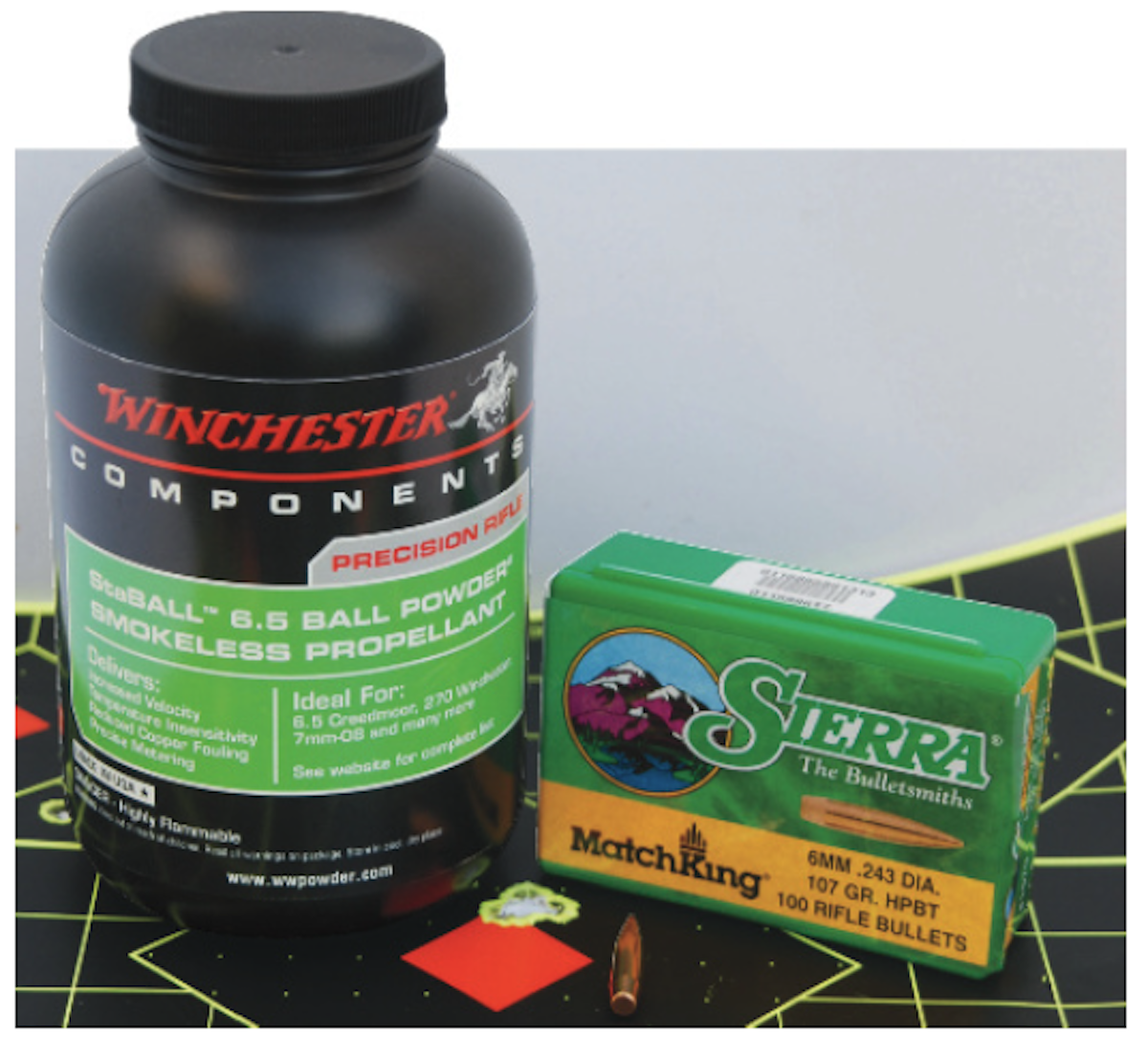
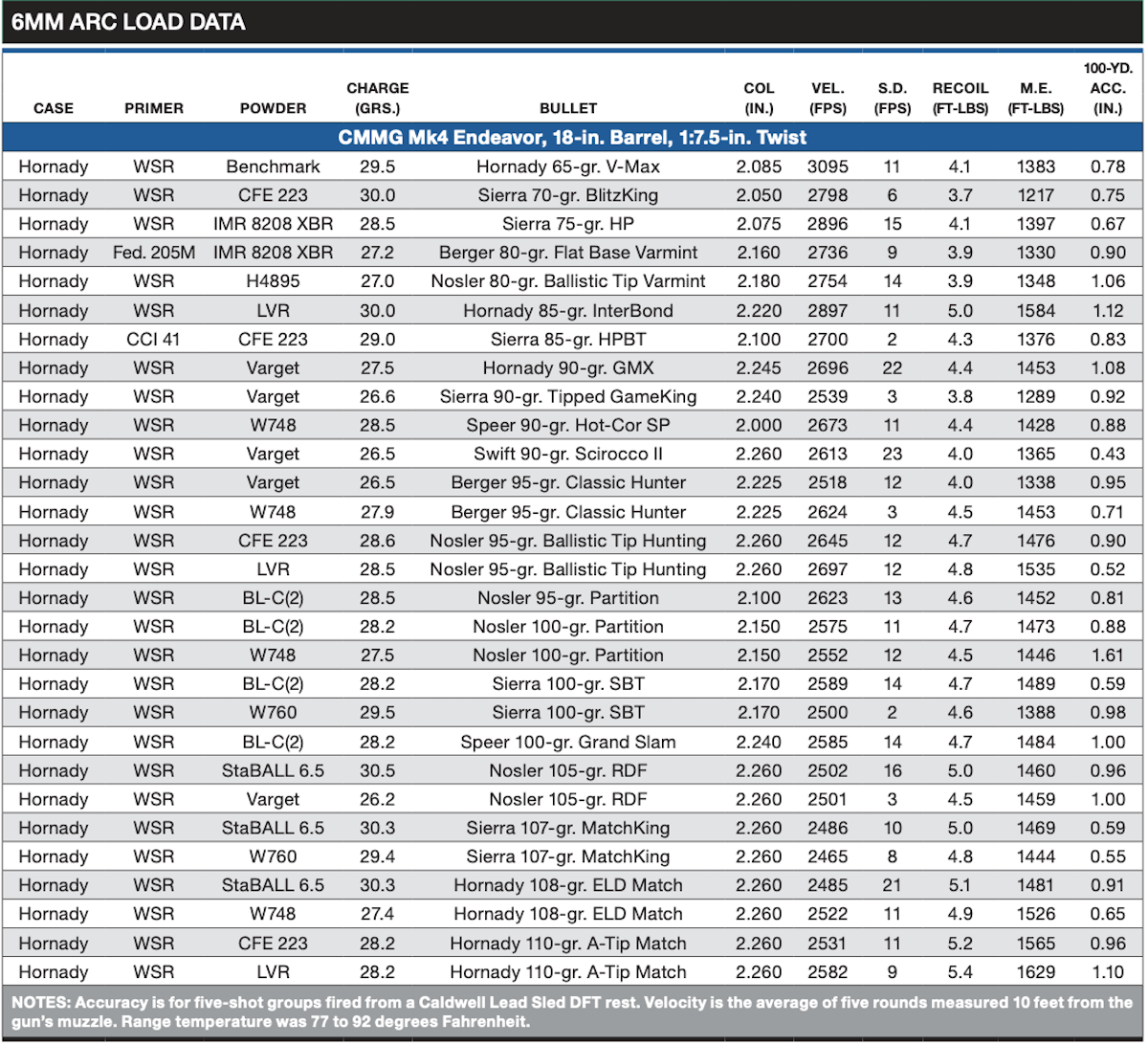
Exclusive of the calibration loads, I tested 29 additional loads with 10 Hodgdon and Winchester powders and 21 different bullets. These results are listed in the chart on the following page. Due to the emphasis these days on “long-range” shooting, I first concentrated on loads for the 6mm ARC that represented a good cross-section of the new, long, skinny 6mm bullets, including several heavyweights over 100 grains, with charges of LVR and CFE 223 powders. Each of my loads shot well. Accuracy was quite acceptable; velocities were slightly lower than Hodgdon’s.
Trying not to play favorites, I fired at least one load with each of the other nine powders. I was delighted to learn that virtually all of the powders shot great, in a variety of loads, and only a few recipes averaged over an inch for accuracy. Here are some examples.
As expected, LVR and CFE 223 turned in stellar performances, with group averages of 0.94 inch and 1.01 inches respectively. They were not the only stars. I was sure that W748 would be “too fast” for the ARC, but it delivered excellent accuracy (1.08 inches), and velocities crowded the speeds of LVR and CFE 223. Uniformity was great, with low standard deviations. W760 is only a bit faster burning than H4350, so I figured it would be too slow; however, the Sierra 107-grain MatchKing over a charge of 29.4 grains of W760 clocked 2,465 fps. Its accuracy averaged 0.55 inch.
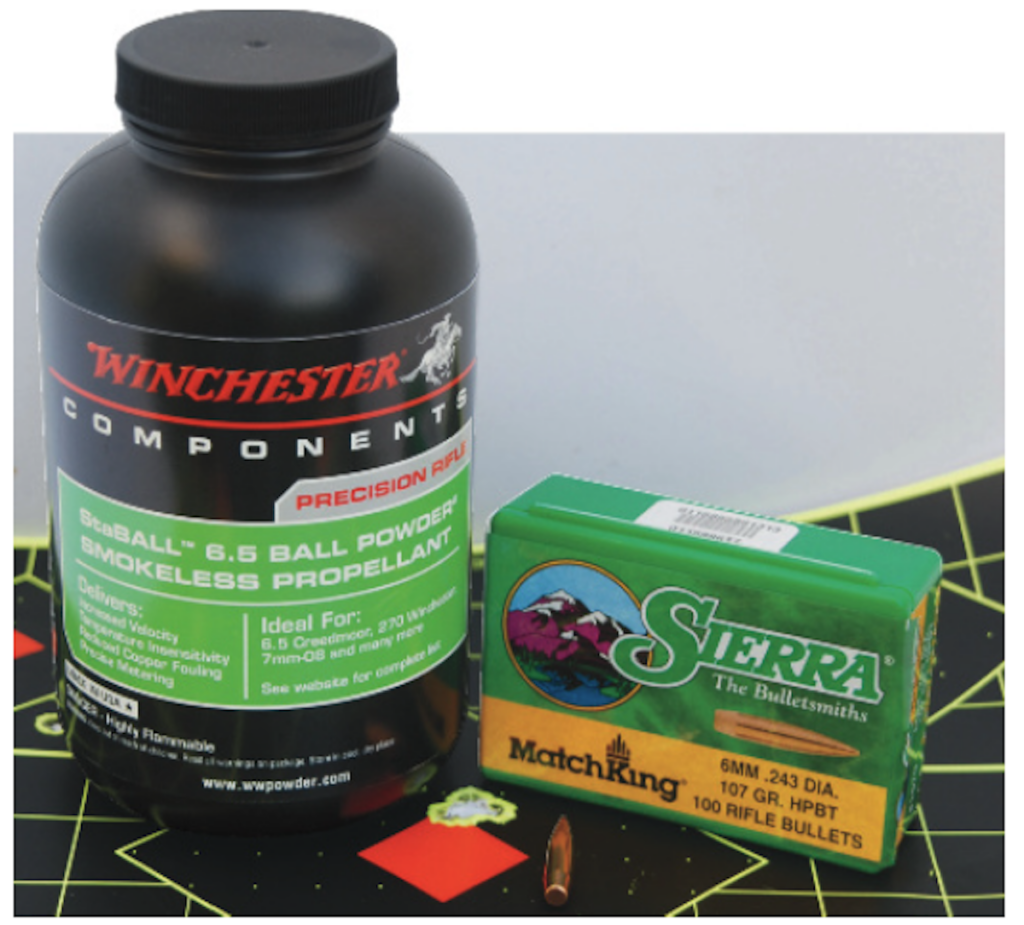
A real surprise was StaBALL 6.5. This powder was introduced in last year’s Annual Manual, and it has the delightful combination of uniform metering, chemical ingredients that retard copper fouling, and temperature insensitivity. It is the first Ball powder to include all of these most desirable qualities. As a bonus, this powder usually delivers slightly higher velocities and lower standard deviations in suitable cartridges than most of the powders in its burning rate. While the velocities produced by StaBALL were not the fastest of the bunch, all were quite sufficient, and accuracy was nothing to sneeze at, either. It averaged 0.82 inch.
One of my favorite powders is the versatile Varget because it is simply great in a multitude of cartridges. In the 6mm ARC, its groups averaged 0.88 inch, and a charge of 26.5 grains propelled the Swift 90-grain Scirocco II bullet at 2,613 fps, with a delightful group size of 0.43 inch.
The fastest velocity recorded was with the Hornady 65-grain V-Max over 29.5 grains of Benchmark; the average velocity was 3,095 fps. In a virtual tie for the second-highest velocity was the Sierra 75-grain HP and 28.5 grains of IMR 8208 XBR (2,896 fps) and the Hornady 85-grain InterBond with 30.0 grains of LVR (2,897 fps).
The heavyweight bullets did well, too. While it seems strange to be shooting 103-grain to 115-grain bullets out of this small 6mm case, the times they are a changin’. Here, LVR and CFE 223 came to the fore and turned in impressive ballistics that should make long-range target shooters very happy and coyotes and rock chucks very sad. These bullets start out a little slower than the lighter-weight ones, but they really “catch up” downrange.
Some of the eye-catching loads include the Nosler 105-grain RDF (Reduced Drag Factor) with 30.5 grains of StaBALL 6.5 or 26.2 grains of Varget. They achieved 2,500 fps. The Hornady 108-grain ELD Match favored a charge of 28.2 grains of LVR (a calibration load) and produced a velocity of 2,575 fps. The same charge of 28.2 grains of LVR launched the Hornady 110-grain A-Tip at 2,582 fps. And the new Nosler 115-grain RDF took to 26.6 grains of W748 at 2,614 fps.
Bottom Line
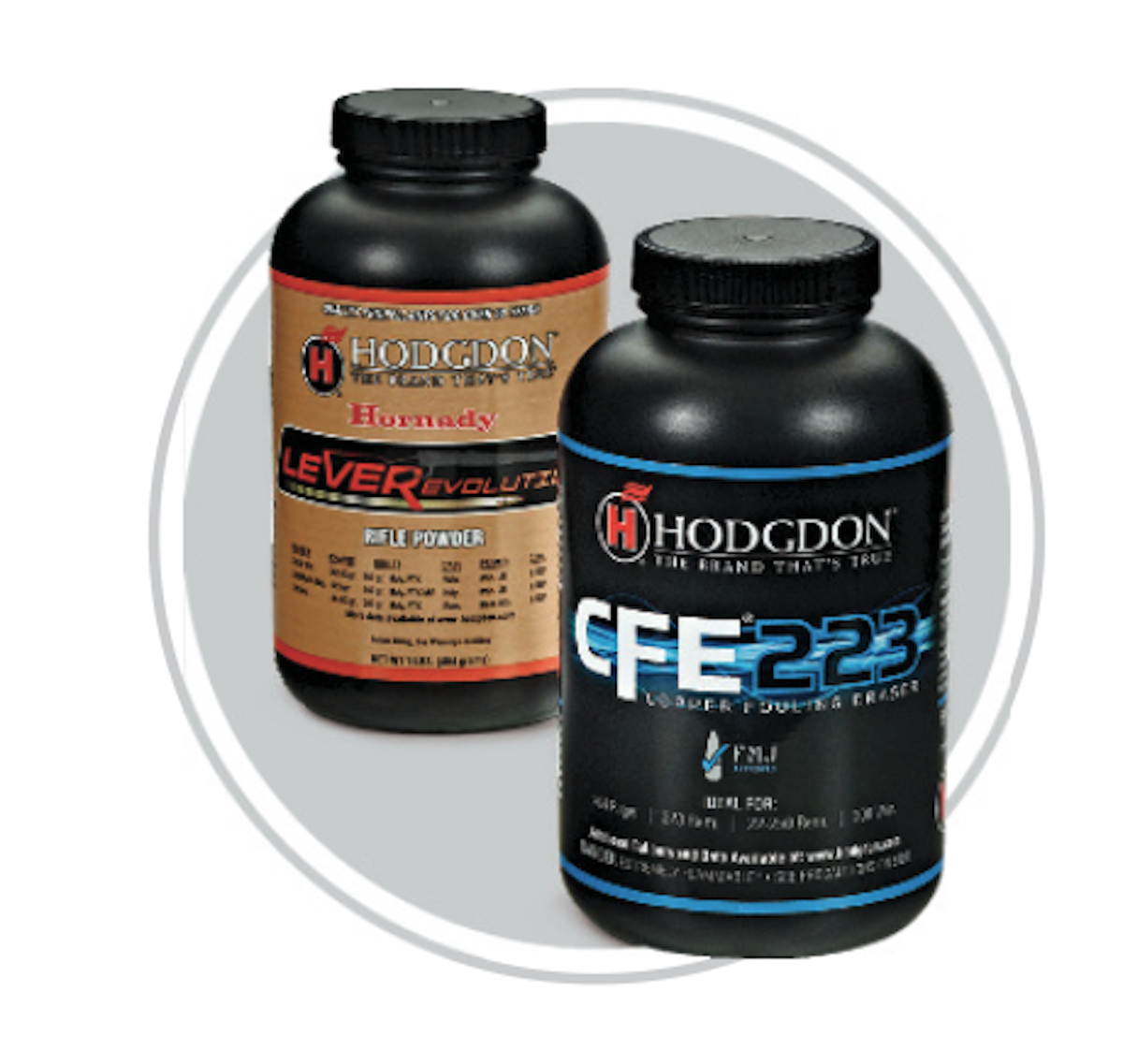
When the overall results are examined, we see that there’s a Hodgdon, IMR, or Winchester powder suitable for just about any bullet weight or shooting purpose: hunting varmints and medium-size big game, long-range target shooting, and defending oneself against a horde of vicious tin cans. With the cartridge’s stellar heritage and the superb results observed with tailored handloads, the 6mm ARC round is quite predictable. Best powders? That’s easy. Any of the ones listed here work well, with CFE 223 and LVR the top performers.
It looks like natural selection does apply to cartridges after all, and my results show the 6mm ARC will likely be one of the “fittest.” I predict it will not merely survive, but it will prosper, especially with a steady diet of Hodgdon powders.
The 6mm ARC may be hot off the press, but Hodgdon has already developed handload data for it.
Load Data Charts