These three cartridges can turn your AR-15 into the right gun for hunting deer, black bears, hogs, and even elk and moose.
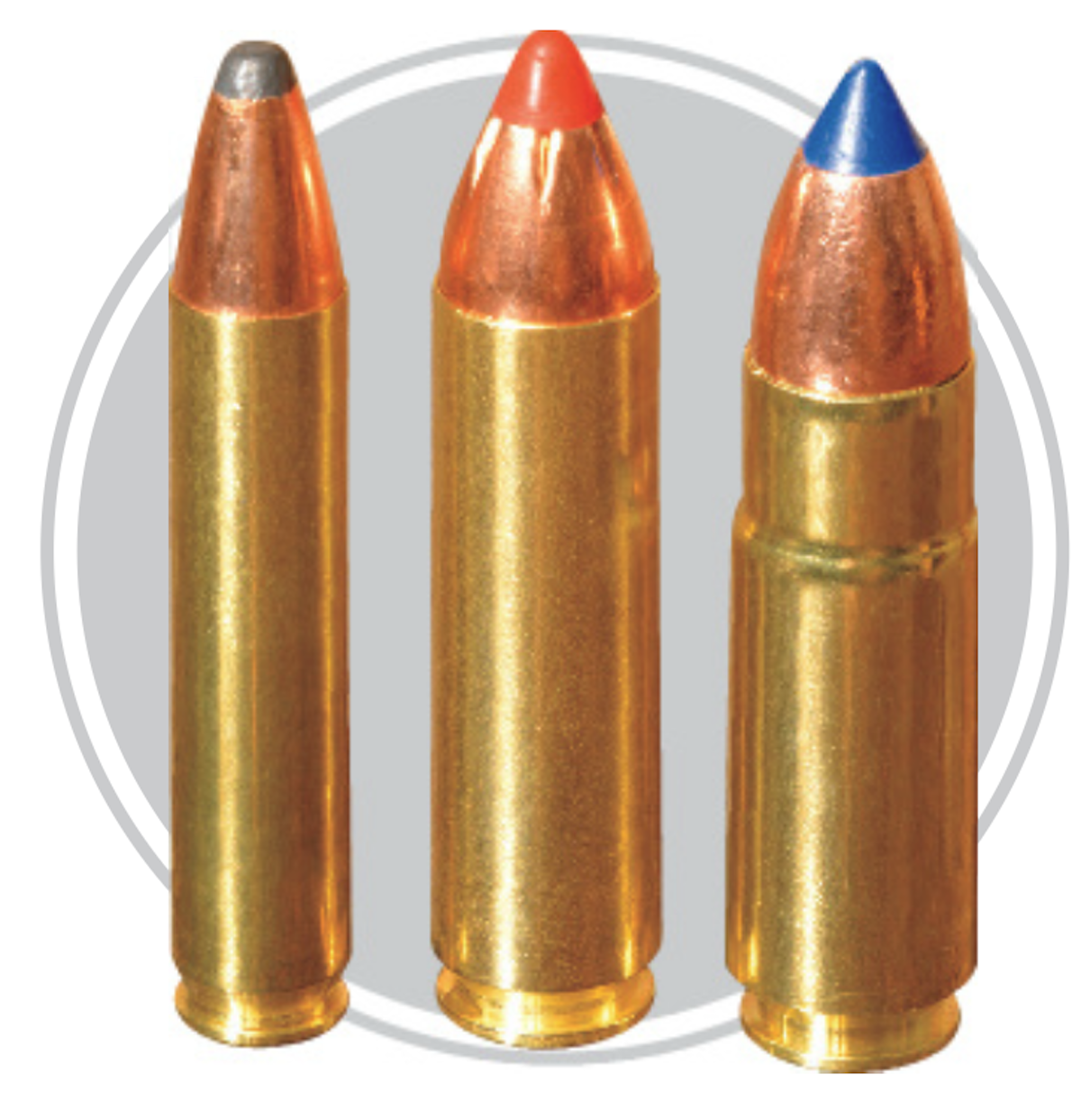
Believe it or not, the modern AR-15 has a lot in common with the black powder cartridge rifles from the 1800s. As a propellant, black powder had velocity limitations, so if they couldn’t make a bullet go faster to increase power, they made them bigger. That’s why so many black powder cartridges use large-diameter bullets.
The AR-15 is limited in the length of the cartridges it can use. The cartridges can’t be longer, so to increase power, they made them bigger with larger-diameter cases and bullets.
Three of the most popular these days are the 350 Legend, 450 Bushmaster, and 458 SOCOM. The first two are straight-wall cartridges, which means they can be used in many states for deer hunting. The 458 SOCOM is a bottlenecked cartridge with its roots in the tactical community, but it is also one heck of a hunting cartridge.
350 Legend
I covered this cartridge pretty extensively in last year’s Annual Manual, but it’s worth revisiting.
The 350 Legend was the first new cartridge created to address the emerging regulations regarding straight-wall-cartridge deer-hunting. It is sort of the 223 Remington case straightened out and expanded to create a rebated rim. The differences are enough to prevent making cases from 223 Rem., and you must use properly headstamped cases.
It is by far the smallest of the three and the lowest in power. Handloading it can be a challenge, but if you pay careful attention to the details, it can be an accurate cartridge capable of taking deer-size game.
In a nutshell, the key to handloading accurate 350 Legend ammo is attention to case length, bullet diameter and construction, and proper crimping.
Because the cartridge headspaces off the case mouth, it’s essential for good accuracy that all the cases are within the case-length specifications and that they are all the same length. Use plenty of neck tension on the bullet, and if you crimp, only use a taper crimp, never a roll crimp.
The working bullet diameter for the 350 Legend is 0.355 inch. Larger-diameter 0.357 to 0.358 bullets will work, but they can have feeding issues. Most were also developed for higher impact velocity, so expansion on game may not be acceptable. Many 0.355-inch bullets are developed for handguns and for a far lower impact velocity than expected from the 350 Legend, so they may not penetrate well on big game.
For the best results in hunting loads, and to ensure feeding in an AR-15, it’s always best to use one of the bullets developed specifically for the 350 Legend. The dedicated bullets in the 170-grain to 180-grain weight range from Hornady, Winchester, and perhaps a few others are the best option for deer or hogs. They perform well with the rather small powder capacity of this case and are also engineered for good terminal ballistics at 350 Legend impact velocities. Finally, they are designed to feed well in an AR-15.
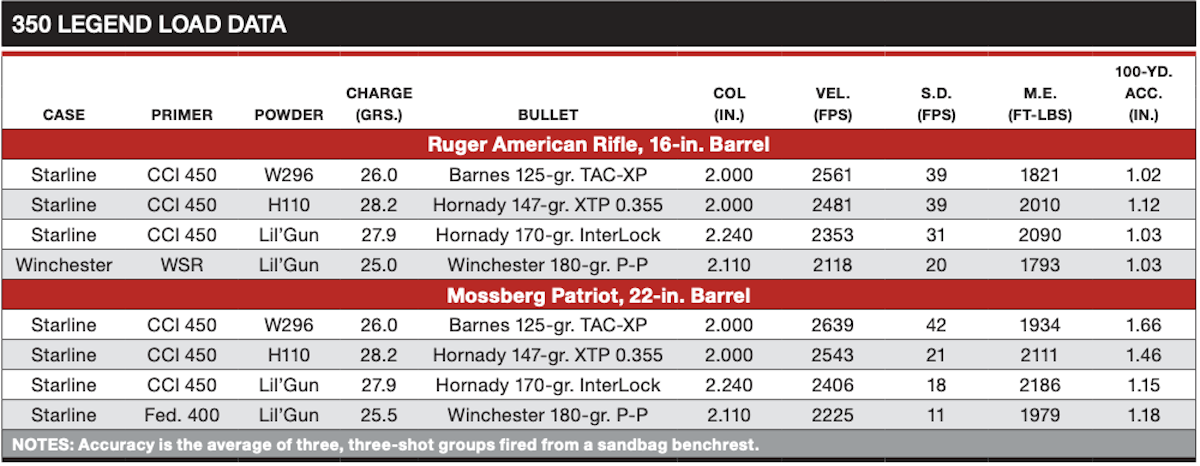
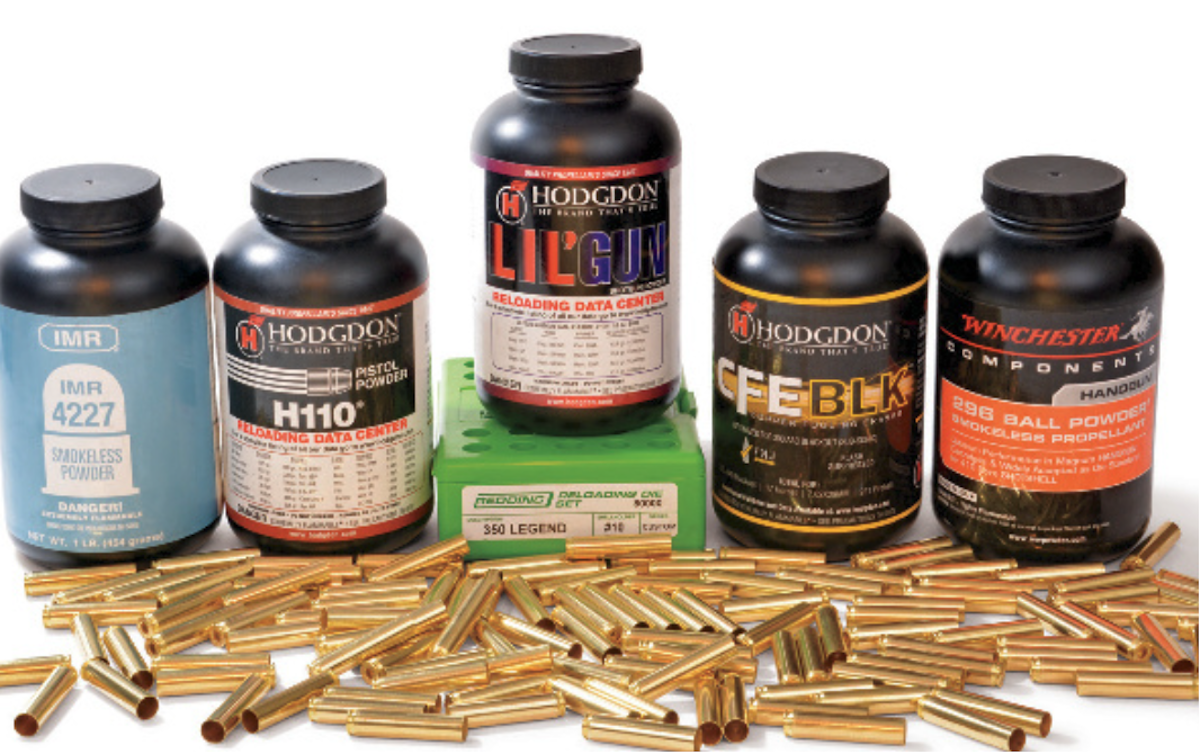
I have worked with this cartridge in multiple rifles, including AR-15s and bolt actions. With the 170-grain to 180-grain bullets that I think are best for hunting big game, Lil’Gun is the powder that consistently gave me the best results, both in accuracy and velocity. There are a lot of propellants to choose from, but if you start with Lil’Gun, I don’t think you can go wrong.
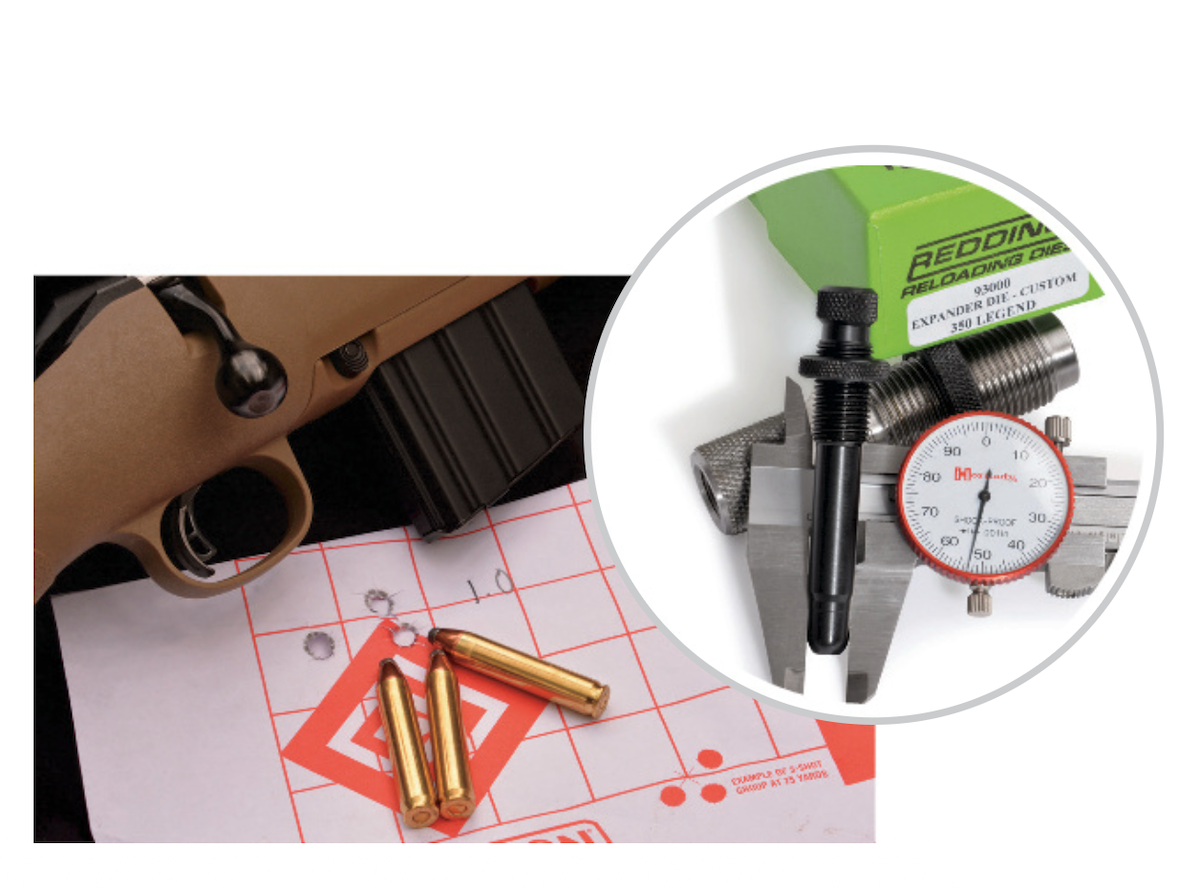
Like all straight-wall cartridges, the 350 Legend requires three dies: a sizing die, an inside expander die, and a bulletseating die. I used Redding dies where the sizing die puts a small bottleneck on the case that the expander die removes as it expands the inside of the case to the correct diameter. This ensures the correct inside case diameter. I had my best results using a case neck expander plug that measures 0.353 inch. I apply a strong taper crimp after the bullet is seated. This helps make sure there is enough case tension on the bullet to help keep ignition consistent.
The 350 Legend is a mild, low-recoil cartridge that should appeal to recoil-shy hunters. It’s fine for whitetails and hogs with careful shot placement at moderate ranges.
450 Bushmaster
The 450 Bushmaster is the end result of Jeff Cooper’s “Thumper” concept of a semiautomatic rifle with a cartridge larger than .44 caliber, capable of taking big game out to 250 yards. It was designed for the AR-15 platform and brings a good level of terminal performance for hunting big game to that rifle. I have personally used my AR-15 carbine in 450 Bushmaster to hunt hogs, whitetails, black bears, and even a water buffalo. My bullet of choice for hogs and the buffalo was the Barnes 275-grain TSX. I have also used the Hornady 250-grain Flex Tip bullet on deer with good results. Hornady introduced the cartridge around this bullet, and it sets the standard for performance.
I was lucky enough to spend a week in late 2019 hunting deer with Matt and Meribeth Sironen and their extended family on their Ohio property. They filled the freezer with several deer while I was there, mostly shooting Ruger bolt-action rifles in 450 Bushmaster. Matt’s handloads use the Hornady 250-grain Flex Tip bullet. I helped with the skinning and was very impressed with the terminal performance of the cartridge. Matt echoed that and said he is very happy with the bullet and cartridge on big Ohio whitetails.
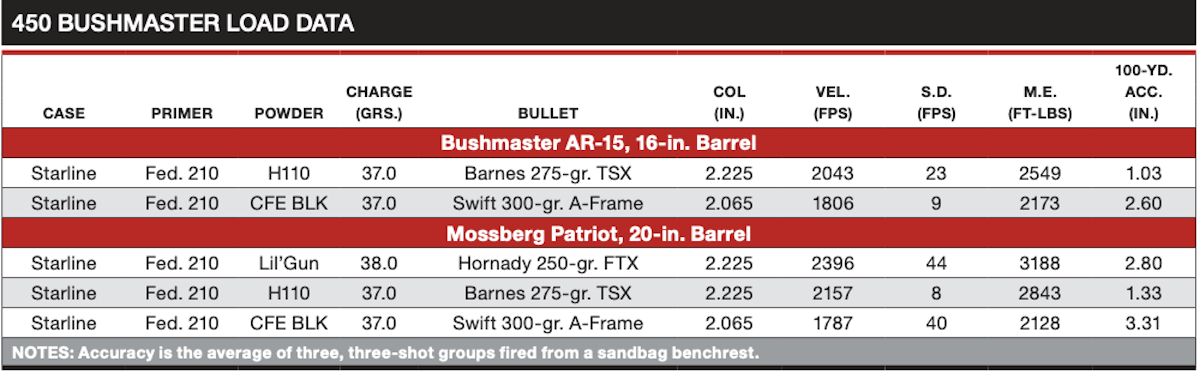
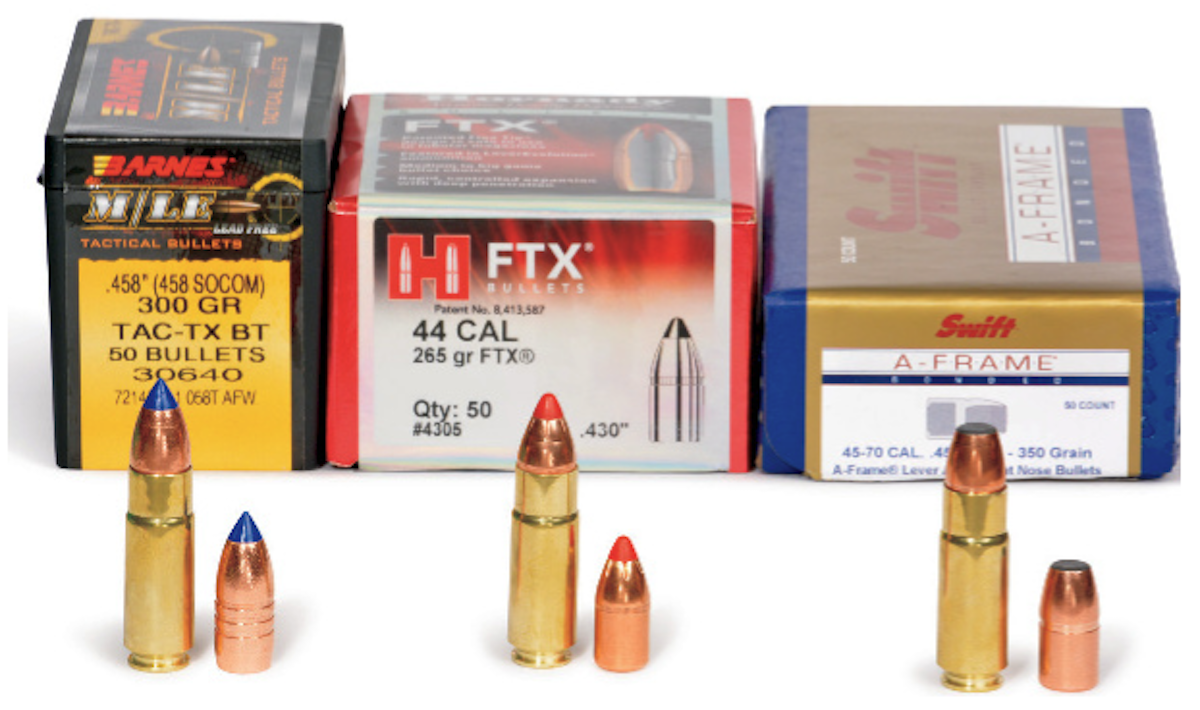
I have not yet tried Swift’s 300-grain A-Frame bullet on game, but based on years of experience with A-Frame bullets on everything from pronghorn to Cape buffalo, I expect it will be a good choice for hunting anything appropriate to this cartridge. The bullet does not feed reliably in my AR-15, but it feeds fine in the Mossberg bolt action I have used. Accuracy was not stellar in either of my rifles, which is unusual for a Swift bullet, and that leads me to think the bullet is perhaps a bit heavy for the twist rate. Of course, your rifle may love them.
The 450 Bushmaster has a rebated rim that was developed using a modified 284 Winchester case, and it uses a 0.452-inch-diameter bullet. It has a maximum overall cartridge length of 2.260 inches, which means it fits well in the AR-15 platform. Like the 350 Legend, this case also headspaces on the case mouth, so it’s important to trim all the cases to a common length. Do not use a roll crimp.
I have not experienced the accuracy issues with the 450 Bushmaster that I encountered with the 350 Legend. Perhaps that is due to the larger diameter—I honestly don’t know—but the 450 Bushmaster is a lot less fussy about what it is fed than the 350 Legend.
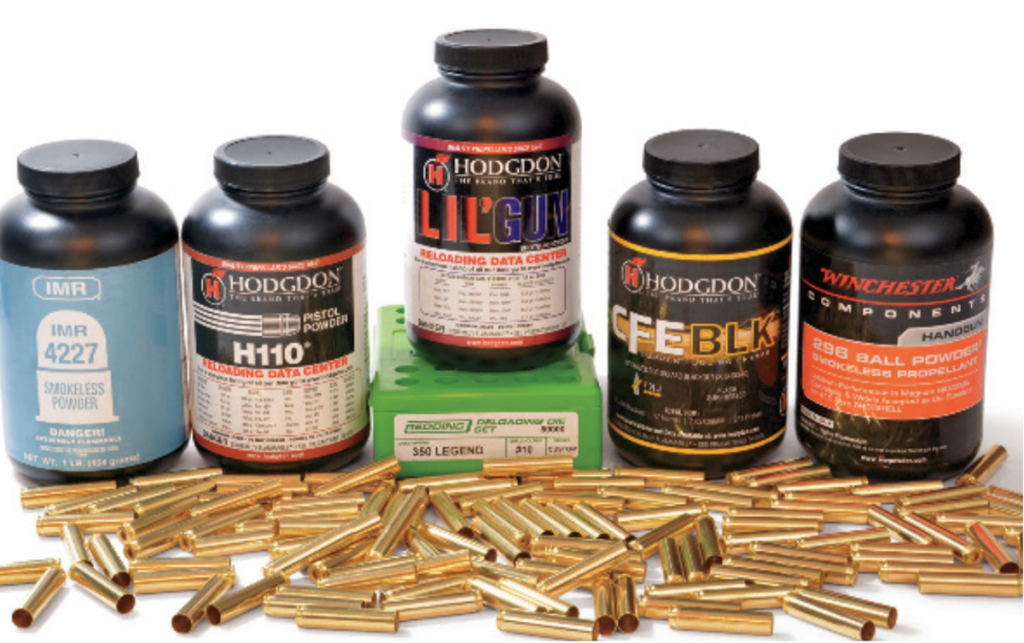
There are long lists of powders that work with this cartridge. When you are working up new loads, I suggest starting with Lil’Gun for the lighter bullets (225 grains to 250 grains). For heavier bullets, I would start with CFE BLK. That powder often produces the highest velocity in my rifles and is usually very accurate. But don’t neglect the old standbys like H110, H4198, and IMR 4227. In fact, H110 works great with the Barnes 275-grain bullet.
The 450 Bushmaster, being a straight-wall case, uses a three die set. Hornady introduced this case, so I use Hornady dies—it just makes sense.
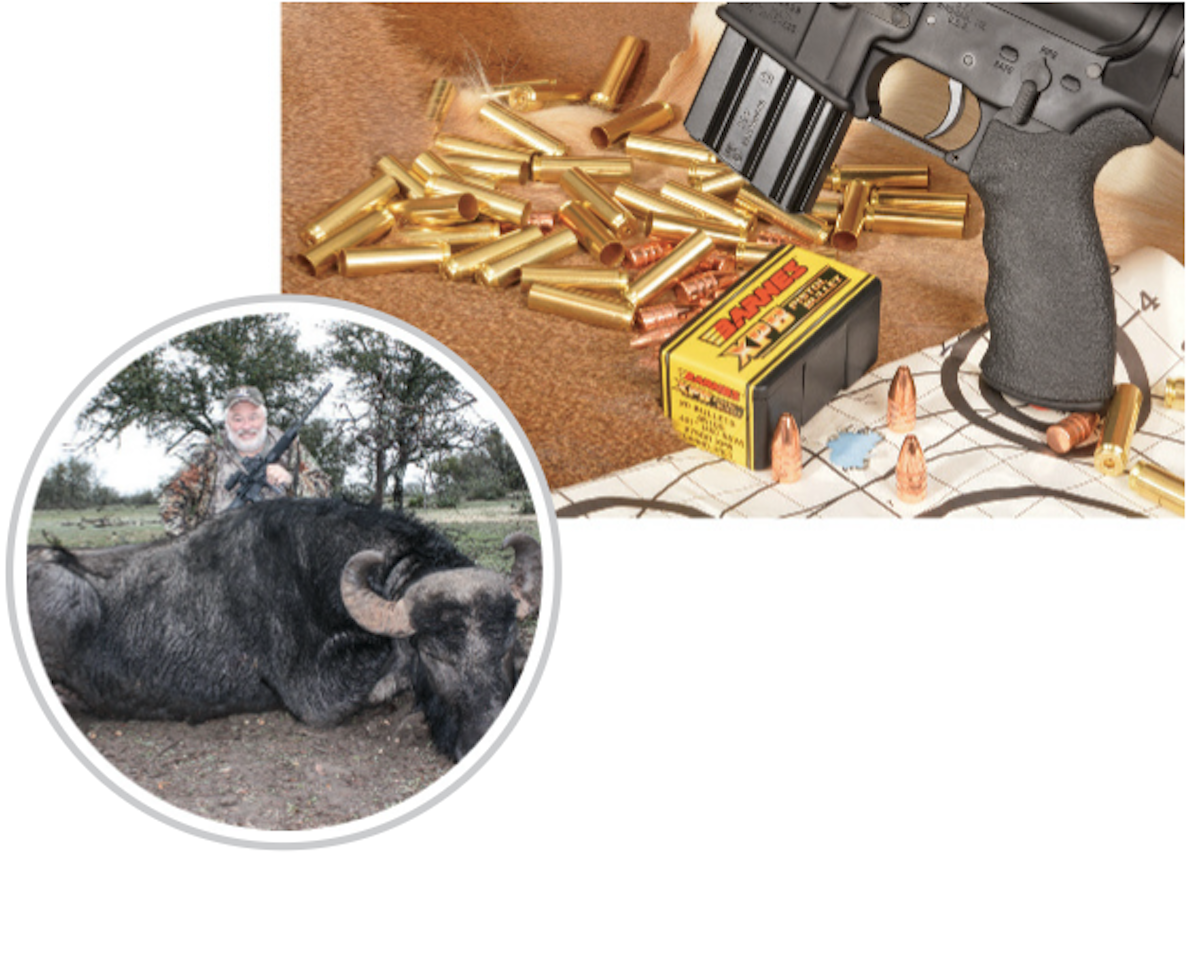
I will admit that the 450 Bushmaster is pretty light for water buffalo. The Murrah water buffalo like the one I shot average about 1,200 pounds. However, it was the gun I had in my hand when the opportunity presented itself, and I filled the freezer with some wonderful meat.
For the record, the Barnes 275-grain bullet performed well but did not exit the big critter. I have shot a bunch of hogs with the same Barnes bullet and never recovered a bullet.
The 450 Bushmaster is well suited for deer, black bears, hogs, and perhaps even elk if you match the bullet to the game.
458 SOCOM
The 458 SOCOM was developed for military applications after the fighting in Mogadishu in 1993. That battle left a lot of participants on the U.S. side disappointed in the performance of the 5.56 NATO cartridge, and they wanted some serious 45-70-class thumping power from their M16/M4 rifles.
The 458 SOCOM came out in 2002, and while it didn’t gain widespread acceptance as a military round, it has proven to be a great hunting cartridge. Bill Wilson and his grandson both shot Cape buffalo with the 458 SOCOM, proving in the hands of an experienced hunter there is likely nothing on earth it can’t handle. The cartridge nearly matches the modern factory load performance of the 45-70, a cartridge that was introduced in 1873 with a well-established reputation for successfully bringing down big game.
The 458 SOCOM uses a lengthened 50 Action Express case with a rebated rim that is necked down for a 0.458-inch bullet. Unlike the straight-wall cartridges that must headspace off the case mouth, the 458 SOCOM has a shoulder to control headspace. This allows the bullets to be roll crimped in place if they have a cannelure.
Caution: The 458 SOCOM is not yet a S.A.A.M.I.-accepted cartridge, and it’s important to stick to the pressure-tested data from Hodgdon. Be very afraid of random data on the Internet. Like any developing cartridge, the specifications have been changed and tweaked over the years. It’s best to know who made your rifle, when it was made, and to what specifications. There can be some compatibility issues with ammo, depending on which generation chamber specifications are used. So, to avoid problems, always full-length size cases—even new, unfired cases. This is to ensure they will fit in the chamber of any rifle. My dies are Redding, and they’re working fine with my Wilson Combat rifle that has the newest design chamber. Always trim to a uniform length for a consistent crimp. Starline is the sole supplier of cases at this writing, and their quality is outstanding.
The twist rate standard seems to be settled at 1:14, which handles most of the available bullets acceptably well. Wilson Combat says it has achieved better accuracy with the lighter hunting bullets up to 350 grains with a 1:22 twist, and the company uses that twist rate on its hunting specific models. The Wilson Combat Recon Tactical rifle I used for my testing has a 1:14 twist. Model name aside, I plan to use it hunting this fall. In fact, the short, compact design will be a blessing inside a pop-up blind where I seem to spend a lot of time hunting deer and bears.
One big advantage of this cartridge over the 450 Bushmaster is the 0.458-inch bullet diameter. There is a wide selection of appropriate bullets on the market that weigh from 250 grains to 400 grains. Bullets are even available up to 600 grains for those who want to go subsonic. With the 45-70, that uses the same bullets, having been around even longer than Joe Biden, there are a lot of good bullets on the market.
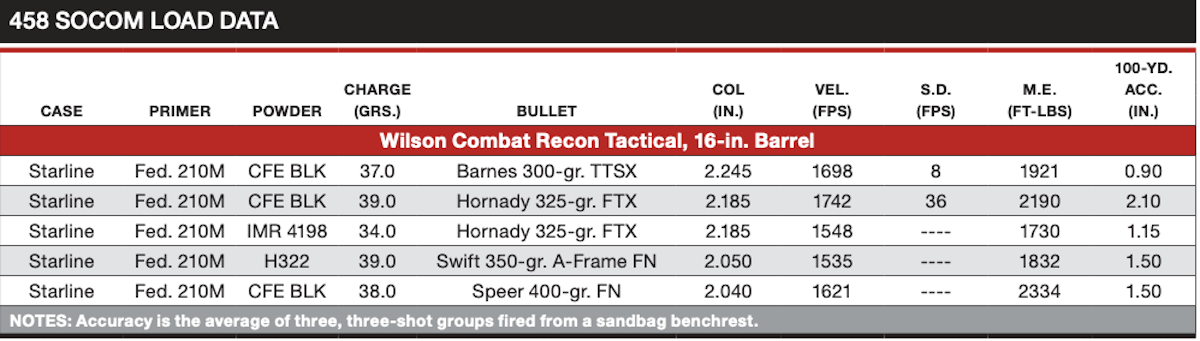
The cartridge was designed around the Barnes 300-grain TSX, and Barnes later developed a 300-grain Tipped TSX (TTSX) bullet specifically for the 458 SOCOM. It remains one of the most popular choices for any big-game hunting, and it’s the bullet the Wilsons used on their Cape buffaloes. It also proved to be the most accurate bullet I tested, with an average group size under MOA.
The Hornady 325-grain Flex Tip bullet has a pointed profile that provides a bump in the ballistic coefficient and is an excellent bullet for deer and hogs. Swift’s 350-grain A-Frame that was designed specifically for the 45-70 should be a great all-around hunting bullet for the 458 SOCOM, although the big, blunt lead nose that is so critical to a tube-fed lever-action rifle caused some feeding issues in my AR-15. In a bolt action or single shot, feeding would not be a problem.
The Speer 400-grain bullet has been around a long time. I have used it in 45-70 rifles for a bunch of game, including a big New Brunswick black bear. Speer was sold out when I requested some new bullets, but I found a partial box on a shelf. The first thing I discovered was the large, exposed lead nose will need a different seating stem than that used for most of the newer bullet designs. The stem with my Redding seating die distorts the lead. I fixed the problem by ordering a different seating stem from Redding. This bullet, though, would not feed reliably in the semiauto. AR-15 rifles are just not designed for flat-nose, lead-tip bullets. I fed this bullet and the Swift bullet in single-shot mode, and the ballistics and accuracy were good. It would be an excellent choice for a bolt-action or single-shot rifle.
I had good luck in velocity and accuracy with CFE BLK, and it would be my starting powder for developing loads for a new rifle. There are a lot of powders that work well with this cartridge, ranging from IMR 4227 through H322, which is a wide range on the burn rate chart, and those I tried worked great. Other than the bullet profile, I found very little drama with this cartridge when handloading. The Wilson Combat AR-15 was acceptably accurate with any load I tried and outstandingly accurate with the best of the bunch.
The 458 SOCOM is a hard-hitting cartridge out of the AR-15, and those combatants who were unhappy with the 5.56 NATO’s performance on sickly, underfed insurgents are probably amazed at what their solution cartridge will do on deer, hogs, bears, elk, and moose.
These three cartridges can turn your AR-15 into the right gun for hunting deer, black bears, hogs, and even elk and moose.
Load Data Charts