




To say the least, loading bismuth shot in the 16 gauge is a challenge. But the efforts can result in top-notch handloads.
So. You want to load bismuth shot in 16-gauge shotshells. You probably have a nice old 16-gauge double gun or pump shotgun, and you want to hunt upland birds in the public preserves that are increasingly demanding nontoxic shot. Well, understand that this undertaking is not easy, and it’s not cheap. You need patience and determination to see it through to the end. However, it can be a challenging but fun exercise for an experienced handloader.
Bismuth shot has certain intrinsic qualities that seriously affect how it must be loaded for optimal results, while the 16 gauge presents challenges all its own due to limited selection of hulls, wads, and other bits and pieces. Based on my experience—and please just take my word for it because space limitations prevent me giving you chapter and verse to back it up—here is what you need to do to get started.
First, buy a copy of The Bismuth Manual and The 16-Gauge Manual in their latest editions from Ballistic Products and read them thoroughly. The next step is to get yourself a 16-gauge MEC (or other single-stage) press. It doesn’t have to be the most expensive. In fact, since our project is what might be called “boutique” loading, with each single round requiring close attention and hand labor, a progressive press just complicates things and gets in the way.
Given the price of bismuth shot—five to seven times that of lead—you are not going to be mass-producing ammunition to demolish clays by the hundreds. Most likely, you have a trip in the offing and need two or three boxes of shotshells to see you through. With a little practice, that’s two to three hours’ work.
The next step, and this will provoke some argument, is that you should forget everything you think you know about loading shotshells and start learning again from the beginning. This is because many of the usual techniques don’t work with bismuth. For example, measuring shot. A charge bar that throws an ounce of No. 8 lead is not going to throw an ounce of bismuth of any size.
The answer, along with your new press, is Ballistic Products’s adjustable charge bar. It’s another C-note on top of the price of the press, but it’s well worth it. Attempting to substitute fixed-amount charge bars to match your requirements will be expensive and frustrating. You also need a scale, which most handloaders already have.
Bismuth Properties
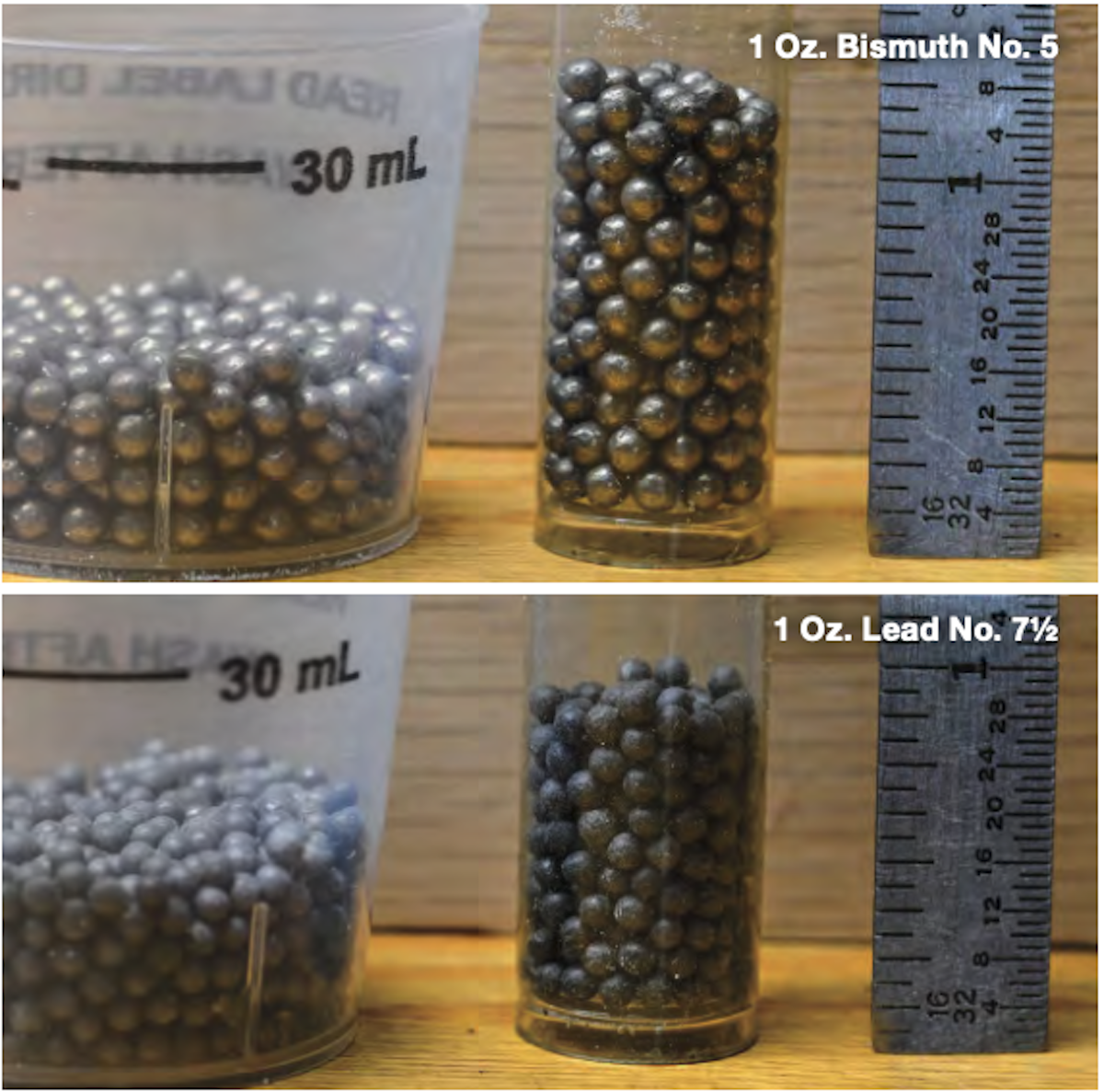
To understand what you’re up against, you have to understand the nature of the physical element, bismuth. It’s a nontoxic lead substitute that can be formed into pellets that can then be fired from a shotgun. Pure bismuth is brittle—the pellets will crumble under pressure—so it’s alloyed with tin to make it more cohesive and malleable. Being about 15 percent lighter than lead, pellet for pellet, an ounce of bismuth takes up more space. This not only affects charge measurement, but it also dictates which wads can and cannot be used.
Not only that, bismuth does not have the natural lubricity of lead—the ability of pellets to happily rub and roll around together and sort themselves out. To overcome this, manufacturers have produced tin-plated bismuth, which is about half-again more expensive ($17/pound versus $12/pound). Standard bismuth requires a buffer to cushion the shot and keep the pellets separate. Since bismuth tends to crush, even in alloyed form, it’s essential to cushion the pellets on firing to prevent this. Otherwise, you end up with deformed pellets and erratic patterns—obviously not desirable in a premium-quality hunting load.
While I’m on the subject, this lack of lubricity also causes pellets to clog in the loading machine. A few pellets drop, you raise the bar, the jiggling jars the rest loose, and they’re scattered all over. (Ask me how I know this.) The brittleness also causes enough crushed and deformed pellets to magnify the problem. And the larger the pellets, the worse it gets. To match the weight and get the penetration of a No. 7½ lead pellet, you need a No. 5 bismuth, which is that much more likely to clog.
It’s good practice, after dropping the shot but before raising the handle, to rap the charging tube several times to loosen any jams. And you need to do this for every single round. Forget to do it once, and you’re on your hands and knees picking up pellets. The good news is that because they don’t have lead’s free-spirited bounce and roll, they don’t travel as far under the bench. It proved to be enough of a headache that, henceforth, I’ll pay more and get the tin-plated shot for its greater lubricity.
Ballistic Products goes to great lengths in its bismuth manual to caution against any—that’s any—substitution of components: hulls, primers, wads (shot cup, cushion, or over-shot), or powders. So critical is this that some of the load formulae in the manual even stipulate what size shot they’re for: No. 5, No. 6, and so on. They don’t say you can’t use No. 6 shot in a No. 5 recipe, but the implication is there.
16-Gauge Considerations
Now to the challenges that afflict all loaders of the 16 gauge and have for a century. Most can be blamed on the gauge’s exclusion when Skeet took off in the 1920s. Skeet loads in 12, 20, and 28 gauge resulted in top-quality hulls in great profusion along with a suitable plethora of wads. Target hulls like Winchester AA and Remington STS are made to be easily reloaded. Such cases don’t exist in American 16 gauge, most of which are old-fashioned hunting loads using equally old-fashioned hulls.
Fortunately, Europeans look at the 16 gauge differently, and you can buy new Cheddite and Fiocchi hulls, primed or unprimed, 2¾ and 2½ inch, and it makes sense to simply buy several hundred of these and go from there. Most of Ballistic Products’s data calls for Cheddite or Fiocchi hulls anyway, with matching Cheddite and Fiocchi primers.
Out of 32 loads for 2¾-inch shells in the Ballistic Products manual, exactly one (1) used Federal hulls; all the others were Cheddite or Fiocchi. On the Hodgdon website, there is data for Federal, Remington, and Winchester hulls, as well as Fiocchi.
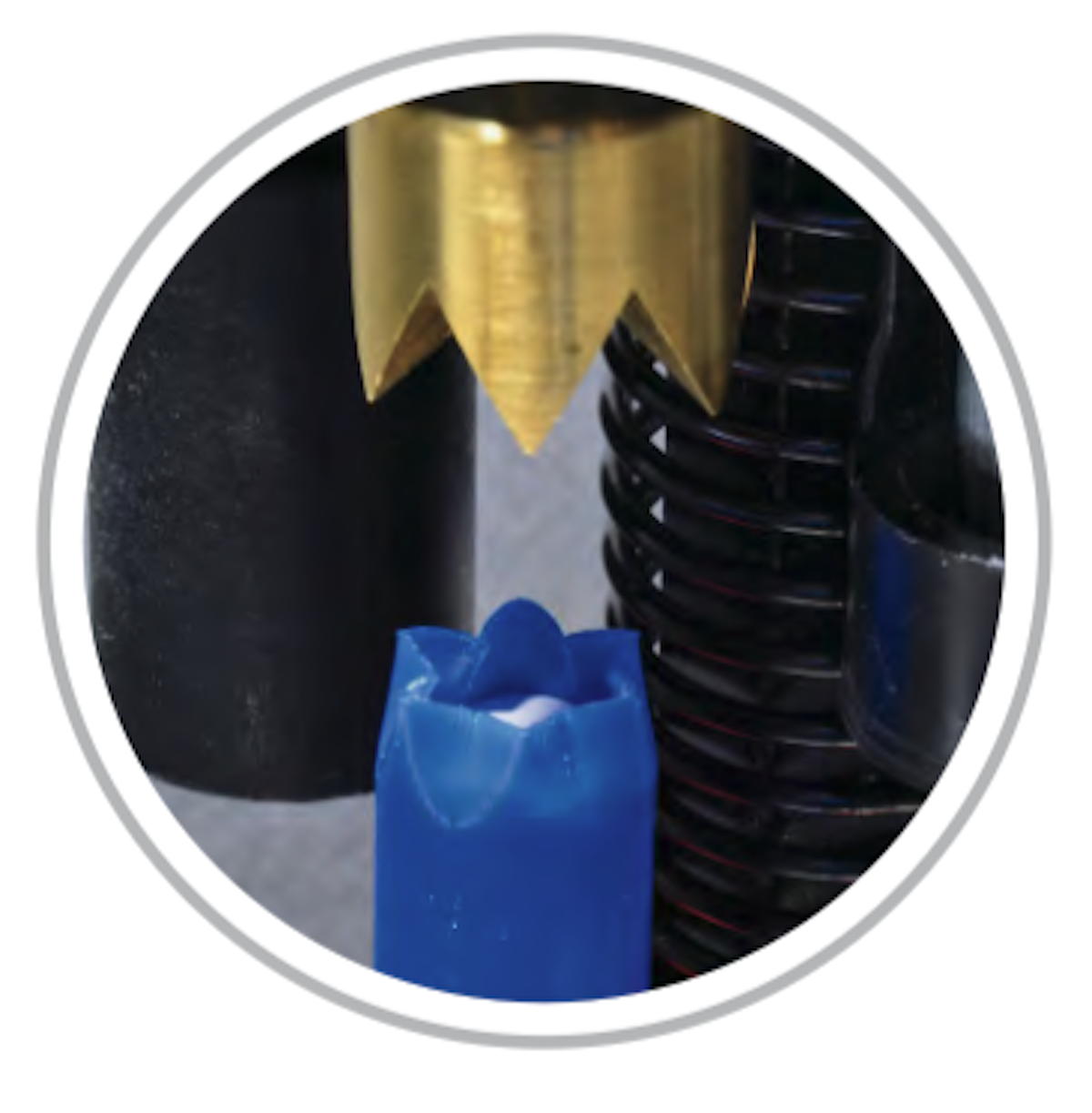
Of course, starting with new hulls requires a skiving tool and a premium crimp-starting tool.
The next step is to pick out one load that looks like it will serve your purpose, then acquire all the necessary components. I chose one from the Ballistic Products data that is very close to a load also found on the Hodgdon website, the difference being that Ballistic Products calls for both a buffer and an over-shot wad, with half a grain less powder, for 1,300 fps versus 1,350 fps. The load is one ounce of bismuth with 25.5 grains of Longshot.
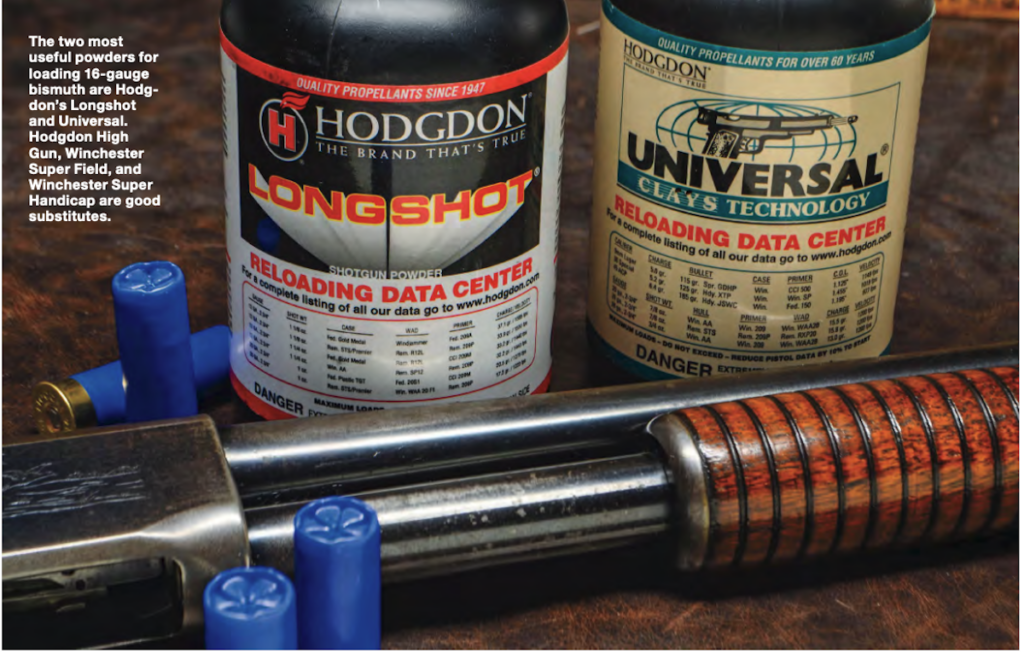
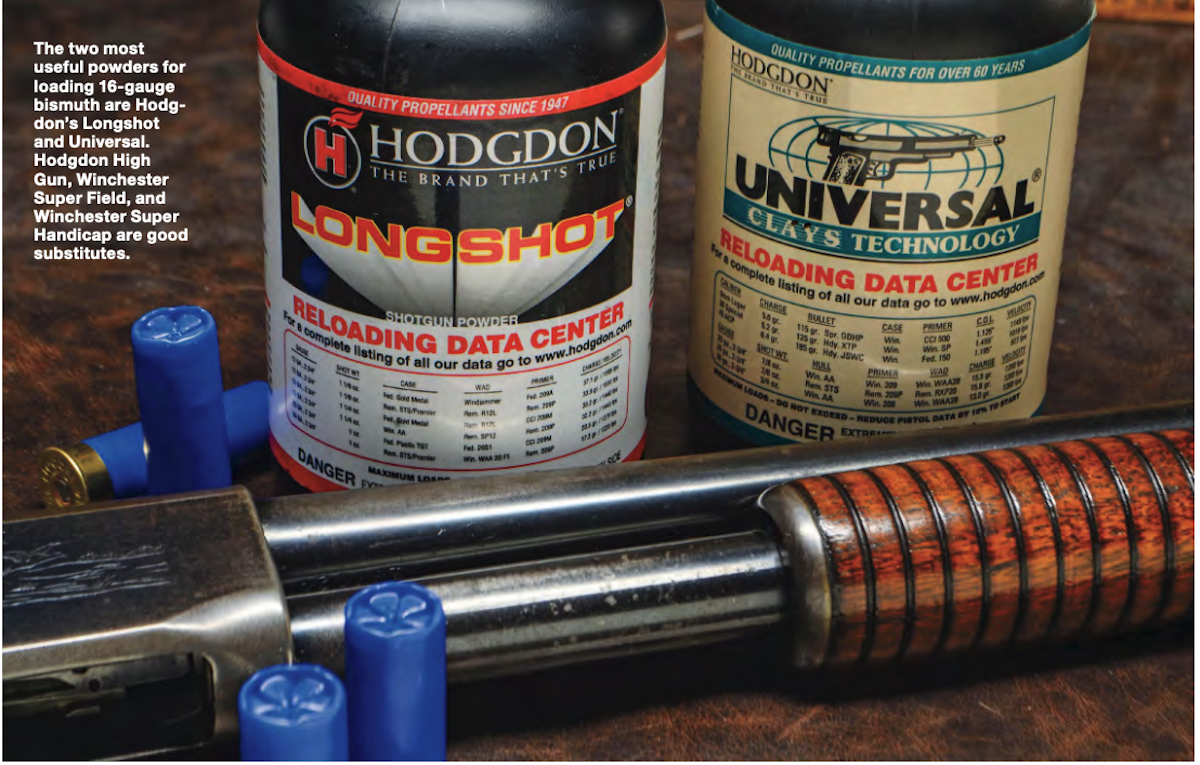
Incidentally, the two powders that have the most applications with bismuth are Hodgdon’s Longshot and Universal, followed by International. The good folks at Hodgdon tell me that the availability of Universal and International is going to be limited, but they indicate that High Gun is an excellent alternative for International, and Winchester Super Handicap and Super Field could be able substitutes for Universal. Of course, for safety, you’ll want to check with Hodgdon for their recommended powder charge weights if you substitute these powders.
The two most useful powders for loading 16-gauge bismuth are Hodgdon’s Longshot and Universal. Hodgdon High Gun, Winchester Super Field, and Winchester Super Handicap are good substitutes.
Loading Process
Setup takes a while, mainly adjusting the charge bar to throw one ounce (437.5 grains) of shot, then 25.5 grains of Longshot. Starting with new, primed Fiocchi hulls, you eliminate the first three steps (depriming, sizing, and repriming) and go straight to the charging station. Drop the powder, seat the wad, then the shot.
On Ballistic Products’s advice, I treated the wads with some of their “Wad Slick” to make everything, well, slicker, and it worked well.
After dropping the shot, you then tap in 10 grains of “BSB Buffer.” If you have a set of the Lee powder scoops, one is sure to measure 10 grains; otherwise, it’s a matter of figuring something out. Ideally, you would weigh 10 grains to get it exact. Tap the case gently as you pour it in, and the buffer sorts itself out among the pellets. Then comes the over-shot wad, which not only gives you the ideal size for a perfect crimp, but it also keeps the buffer from leaking out. Ballistic Products also recommends a dab of crimp sealer, which is always a good idea anyway with cartridges that will jostle around while hunting.
Fiocchi hulls come already skived, so I was able to skip that step. Ballistic Products’s brass crimp starter—a “deluxe” item—did an excellent job on new plastic hulls, and the resulting crimp looked like the shell rolled off Fiocchi’s assembly line. The Cheddite hulls show no indication of skiving, but the walls are sufficiently thin at the mouth to allow an excellent crimp.
And there it is. Voilà! Sixteen-gauge bismuth.
To say the least, loading bismuth shot in the 16 gauge is a challenge. But the efforts can result in top-notch handloads.