



The 10mm Auto story begins in the 1960s when John Adams and Whit Collins, with the assistance of gunsmith John French and barrelmaker Irv Stone, decided to develop a cartridge that increased the power of the Browning Hi Power pistol far beyond that of the 9mm Luger for which it was chambered. They started by shortening the 30 Remington case to a bit less than an inch. The initial load pushed a 180-grain bullet made by Remington for the 38-40 Winchester to 1,200 fps for 570 ft-lbs of energy. At that point, the cartridge delivered considerably more punch than the 9mm Luger, but the goal became even greater power.
When the new cartridge proved to be more than the Hi Power could handle on a regular basis, the decision was made to develop a pistol specifically for it. Jeff Cooper, who was fond of the CZ-75, became involved, and the Czech-built pistol strongly influenced the design of a prototype pistol built around the 10mm cartridge by Thomas Dornaus. At the time, Dornaus was a pistolsmith at Pachmayr Gun Works, but he eventually formed a partnership with former police officer Mike Dixon to manufacture the new autoloader under the name of Dornaus & Dixon. Cooper suggested calling the pistol the Bren Ten, with the acronym "Bren" referencing Brno, the Czechoslovakian armsmaker, and the Enfield Arsenal of Great Britain.
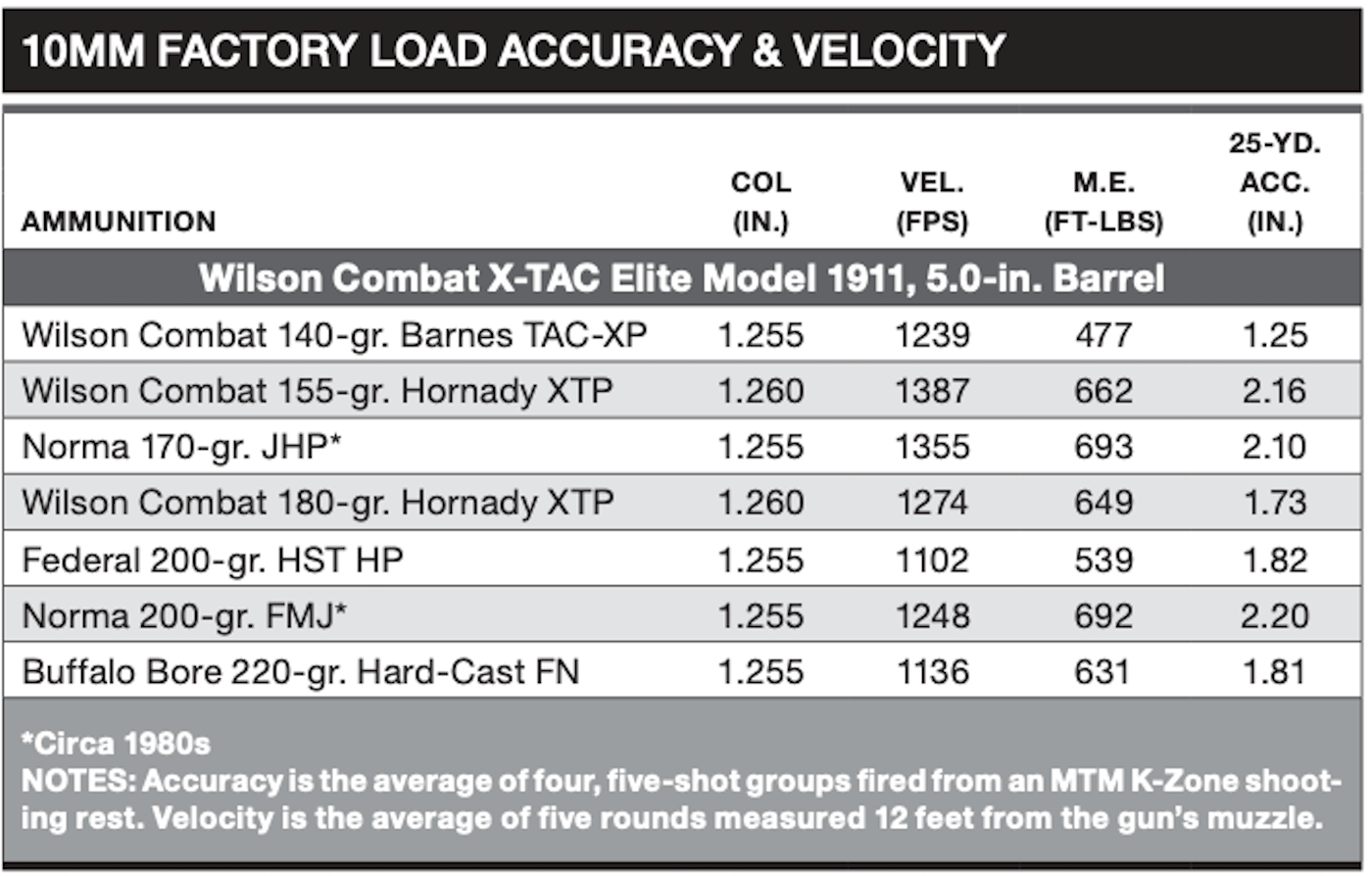
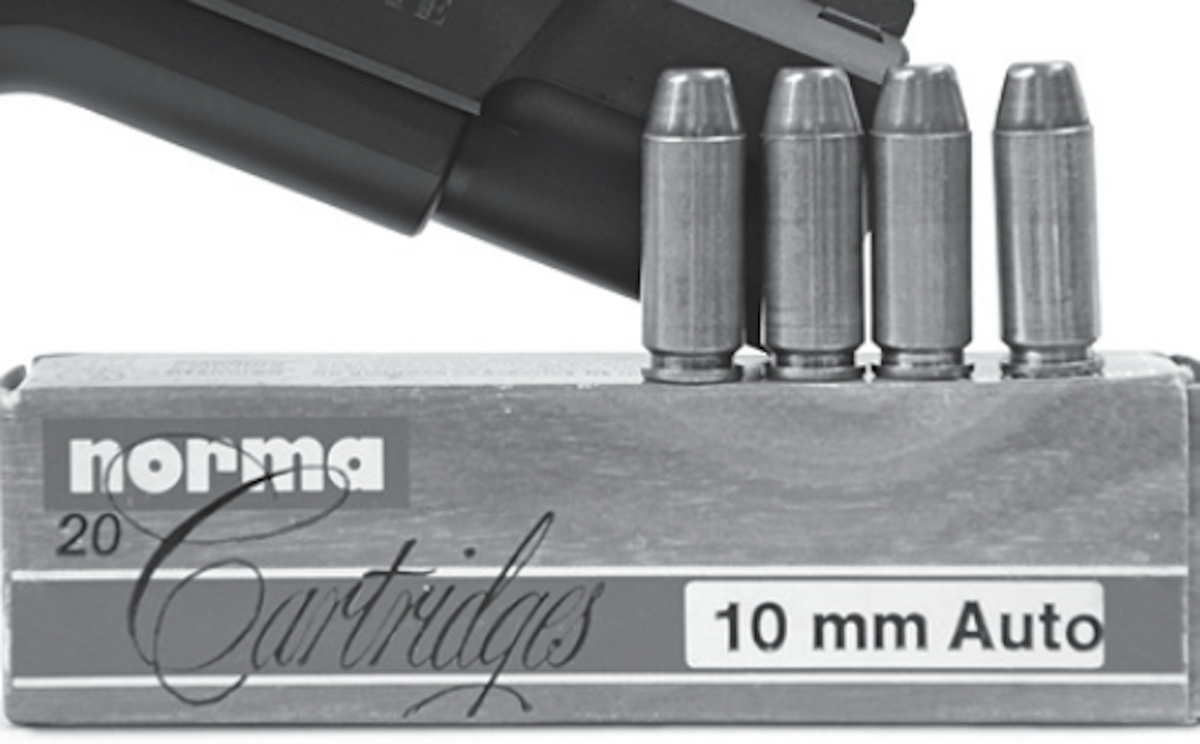
Norma was contracted to load 10mm Auto ammunition. A couple of years after the cartridge was introduced, I was in Sweden for a moose hunt and visited the Norma factory. I met with company ballistician Sixten Holmquist, who was involved with its development from the beginning. According to him, initial Dornaus & Dixon specifications called for 170- and 200-grain bullets at respective velocities of 1,400 and 1,300 fps. Upon receiving the first lot of test ammo, Dornaus & Dixon discovered that chamber pressures were too high for the pistol, so they instructed Norma to back off on the throttle of future shipments. I still have a few 20-round boxes of the early Norma ammo, so I fired a few rounds in the Wilson Combat pistol for this report. As you can see in the factory ammunition accuracy and velocity chart, it was slower than advertised but still quite fast for factory ammo.
The Bren Ten and Norma ammunition were introduced with great fanfare in 1983, but for various reasons, including scarcity of magazines, production of the gun ceased in 1986. Estimates vary on how many were shipped, but it may have been fewer than 2,000. Despite an enormous amount of publicity given to the 10mm Auto by shooting publications around the world, it was suddenly teetering on the brink of failure.
Colt came galloping to the rescue in 1987 by offering the 10mm chambering in the Delta Elite version of the Model 1911 pistol. Soon thereafter, Colt followed up with the double-action Double Eagle pistol in 10mm. Springfield Armory hopped aboard the wagon with a linkless-barrel version of the Model 1911 called the 10mm Omega. Federal Ordnance, Auto-Ordnance, Smith & Wesson, Irwindale Arms, L.A.R. Mfg., Glock, and others eventually followed with 10mm autoloaders. Today, just about all major handgun makers have 10mm guns.
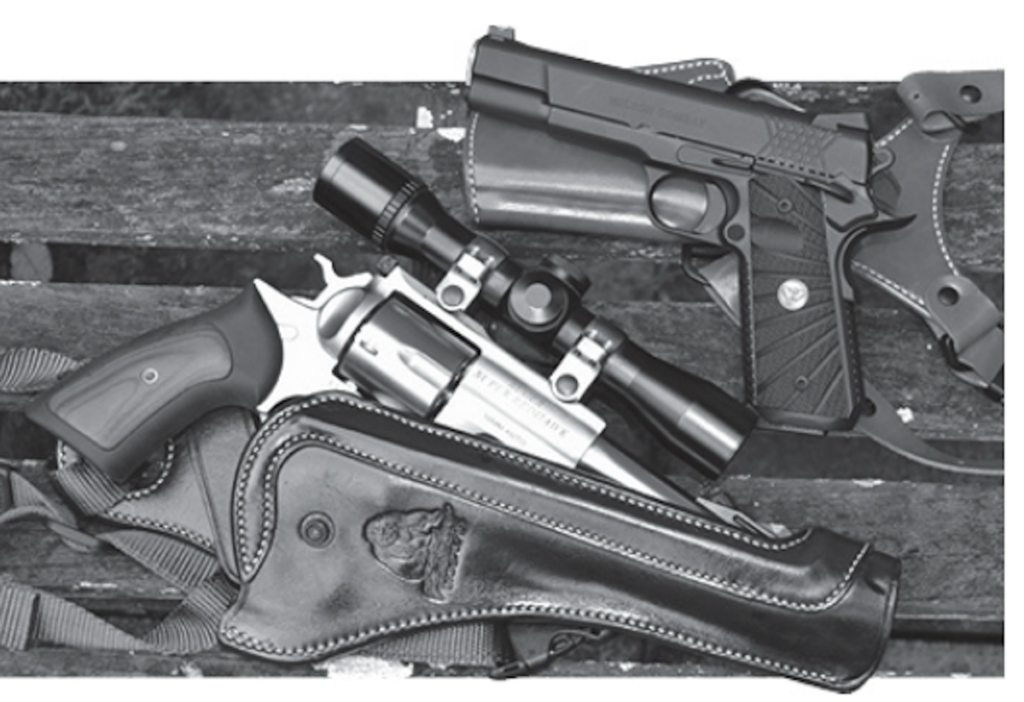
When choosing a couple of handguns to shoot for this report, my first move was toward the X-TAC Elite version of the Model 1911 pistol from Wilson Combat. Quality does not get any better, not to mention top-level accuracy and reliability along with a crisp 3.5-pound trigger pull. Other impressive features include Wilson's Bullet Proof hammer, grip safety, magazine release, and magazine well funnel. Small, diamond-shaped surface cuts on the frontstrap, mainspring housing, and the slide offer no-slip grasping while also being easy on the hands. The top and rear of the slide have 30-lines-per-inch striations. Black G10 grip panels with a starburst surface treatment are held in place by Torx-head screws. A Wilson windage-adjustable Battlesight at the rear with a 0.150-inch notch combined with a 0.126-inch-wide blade up front offers an excellent sight picture. The 5.0-inch, bushing-style, stainless-steel barrel has a dished crown at the muzzle. Empty weight with magazine is precisely 40 ounces when measured on a digital postal scale. The Wilson pistol is also available with a 6.0-inch barrel.
Wilson Combat also has a line of ammunition, and not long after I received the pistol, three 10mm Auto loads arrived. I decided to shoot it and factory loads from other sources to see how accuracy and velocities compared with my handloads. All fared quite well.
While the 10mm Auto is most often thought of as a cartridge for semiautomatic pistols, it has been available in several revolvers through the years. Back in 1990 Smith & Wesson introduced the N-Frame Model 610 with 5.0- and 6.5-inch barrels. It was discontinued around 2009, but the 6.5-inch version was reintroduced in 2019.
Ruger built special-order single-action Blackhawk Convertible revolvers with interchangeable cylinders for the 10mm Auto and 38-40 Winchester in 1990. Not many were produced, and that makes the double-action Super Redhawk and GP100 Match Champion, both introduced in late 2018, the first standard-production revolvers in 10mm offered by that company.
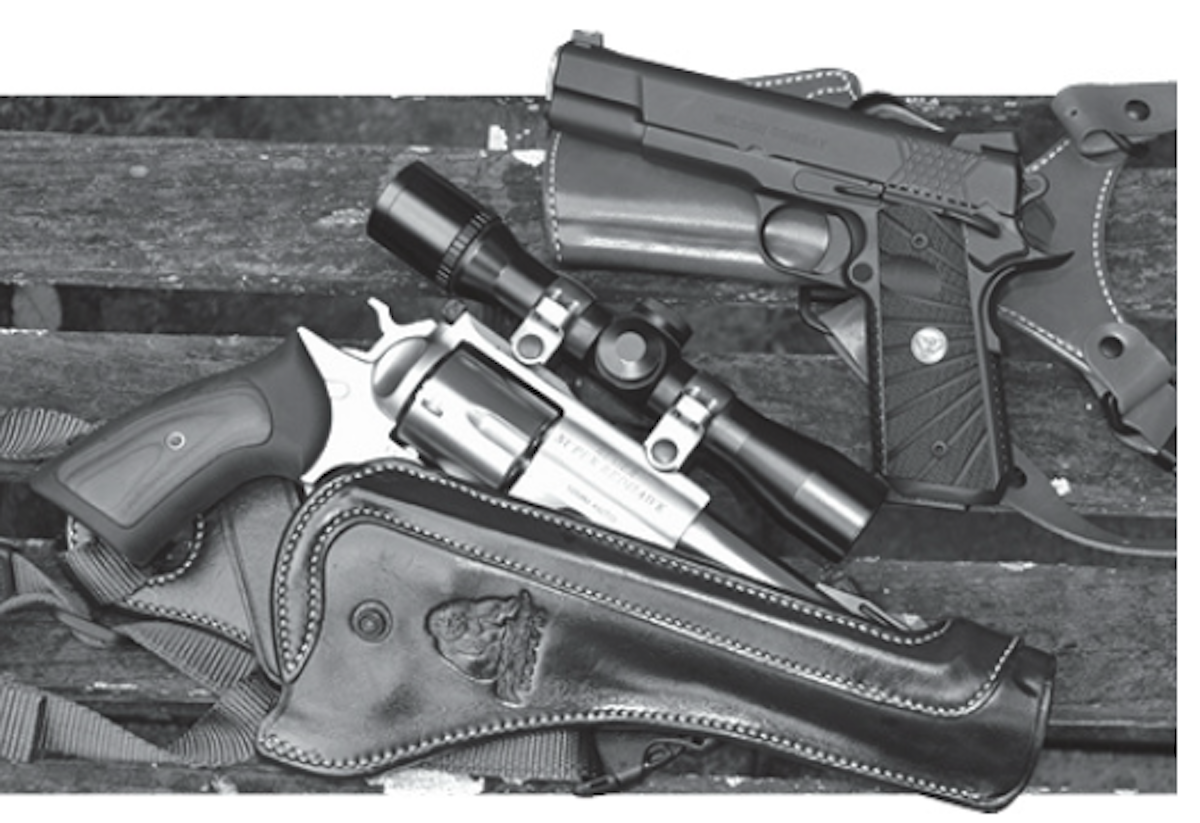
The Super Redhawk featured in this report has a 6.5-inch barrel and weighs 54 ounces. In addition to fully adjustable sights, the top of its extended-length frame has notches for attaching a scope. Due to the rimless 10mm Auto case, the Super Redhawk comes with moon clips. Headspacing shoulders in its chambers make it possible to fire 10mm Auto ammunition without the moon clips with no effect on accuracy. The clips speed up loading, but as I discovered, when a large amount of ammunition is to be fired during accuracy-testing, shooting the Ruger without the clips saves a lot of time because loading live ammunition into and removing fired cases from the moon clips is time-consuming. When not using the moon clips, a fingernail quickly plucks spent cases from the chambers. (The gun also fires 40 S&W ammo, but not without the moon clips.)
Sometime back, I compared 10mm Auto velocities in Model 1911 pistols with 5.0- and 6.0-inch barrels. The expansion ratio of the 10mm Auto is extremely high, so we can't expect a lot of velocity gain with the longer barrel. It also varies depending on the load.
During those previous tests, velocity gain in the longer tube ranged from 12 fps to 39 fps. More important than such a small gain in power is the 6.0-inch gun's longer sight radius, which can make aiming a tad more precise. The extra weight up front also reduces muzzle jump, although I doubt if the difference is enough to be noticed by most shooters.
On the other side of the argument, being a bit lighter and more compact, a 5.0-inch gun holds an edge for field carry, especially if it rides in a shoulder holster. I prefer that type of holster when hunting because the weight of the gun is on the shoulders rather than the waist. Equally important, when worn beneath a weatherproof coat or shirt, the gun is protected from rain, snow, and field debris. My hunting holsters are from Galco, and in addition to being quite comfortable and secure when walking and climbing many miles day after day, the quality is top notch. My Great Alaskan holster is for 5.0-inch Model 1911 pistols, but it is also available for revolvers. My Kodiak Hunter is for the Super Redhawk wearing a scope, but an open-sight version is also available.
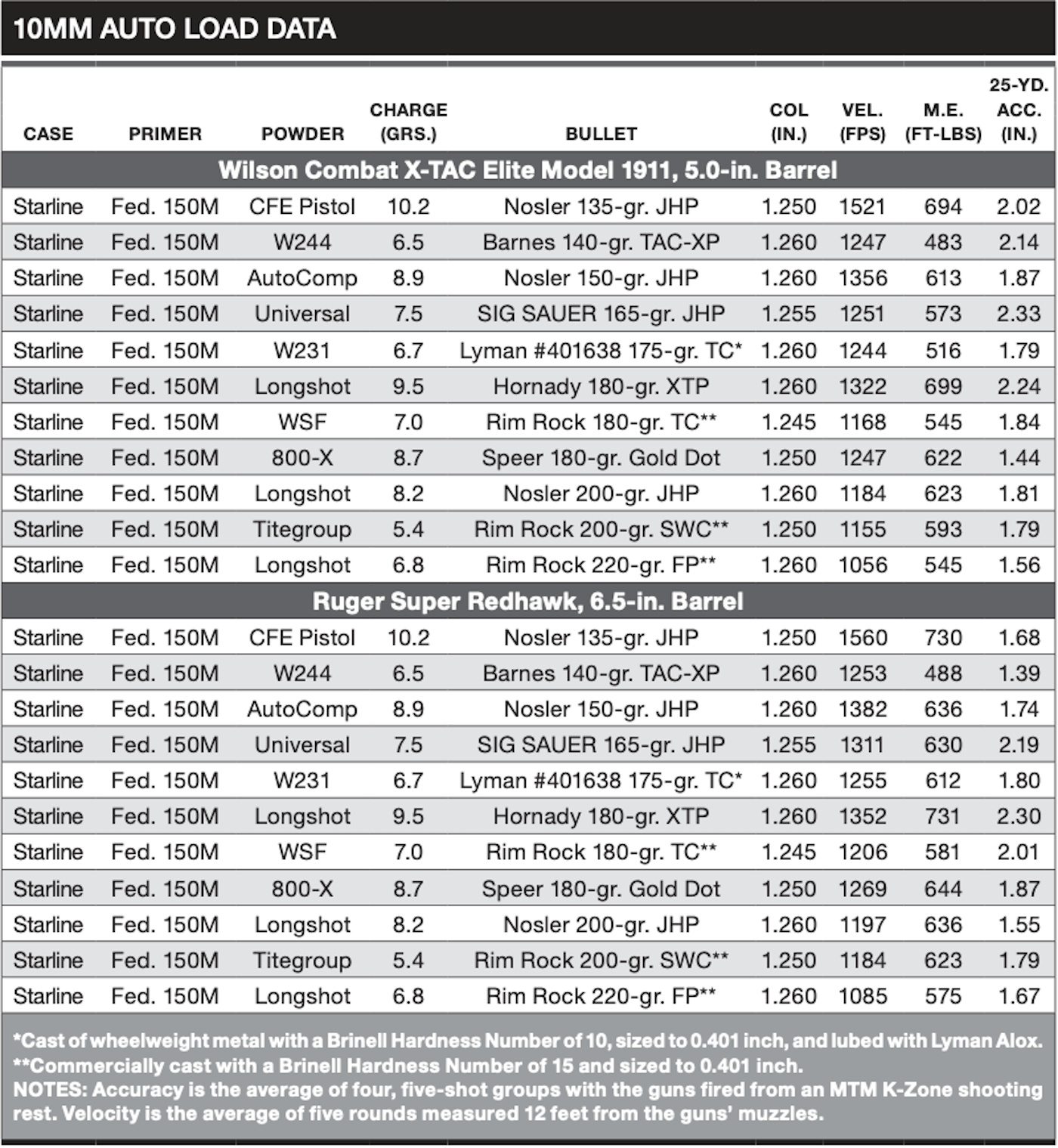
Back to the Wilson and Ruger guns used here, actual bullet travel in the 5.0-inch barrel of the Model 1911 is 4 inches because its chamber is about an inch long. Bullet travel in the Super Redhawk is 6.5 inches, and based on my past velocity tests, I expected to see around 50 fps higher velocities from its barrel. That did not turn out to be true, and the difference varied considerably among the loads used. The handload with the Nosler 135-grain JHP was 39 fps faster in the revolver, whereas the velocity difference between the two guns with the Barnes 140-grain HP load was a mere 6 fps. The average difference between the 11 handloads fired in each gun was only 23 fps in favor of the revolver. Some propellant gas exits the barrel-cylinder gap of a revolver rather than pushing on the bullet, but I have no idea how much that affects velocity.
Loading the 10mm Auto is no different than for other straight-wall pistol cartridges. Keep in mind that the internal diameter of virgin cases can be too large to exert adequate tension on seated bullets, allowing them to be pushed deeper into the case when making their way from the magazine to the chamber in a semiautomatic pistol. This can increase chamber pressure to a dangerous level. When the 10mm Auto is fired in a revolver, bullets can creep forward and tie up cylinder rotation. The internal diameter of cases should be 0.003 to 0.004 inch smaller than bullet diameter. Full-length resizing followed by a trip through an expander die of the correct diameter accomplishes that.
The expander die is also used to flare the mouth of each case just enough to allow a bullet to enter smoothly during seating. The 10mm Auto headspaces on the mouth of its case, so after bullets are seated, the cases should be taper crimped just enough to remove the flare. When loading on a single-stage press, I always seat bullets and crimp in two steps. This is accomplished by backing out the seater stem of the bullet-seating die and turning the die into the press far enough to apply a taper crimp. Adding a specific taper-crimp die to the set makes the process more convenient. Seating and crimping in two steps can also be done on a progressive press if it has enough stations for the four dies.
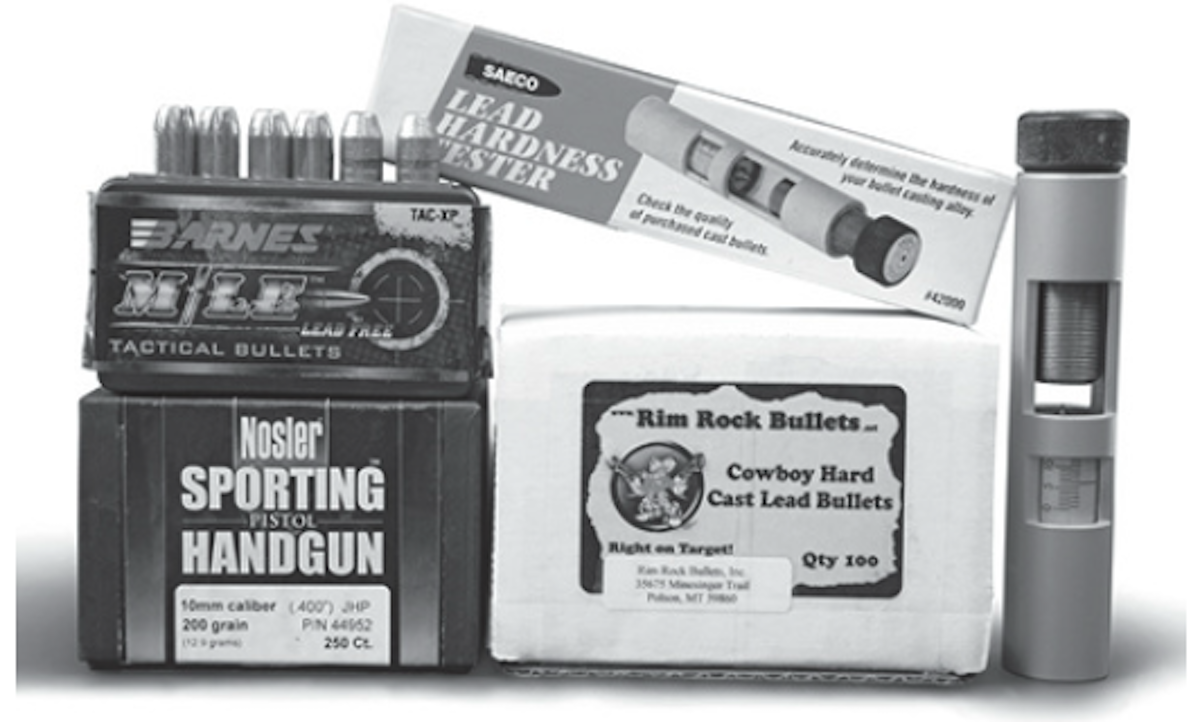
The nominal diameter for jacketed bullets is 0.400 inch, but actual diameters can range from slightly smaller to a bit larger, usually with no negative effect on accuracy. Sizing cast bullets to 0.401 inch or close to it delivers the smallest groups. The Rim Rock bullets I used measured a hair over that and delivered excellent accuracy from both test guns. My 175-grain bullets cast with a Lyman four-cavity mold were equally accurate.
A good hard-cast bullet with a large flat on its nose penetrates deeply and is a great bone-crusher when placed into the shoulder of a deer or wild pig (expanding bullets are better for lung shots). A 200-grain bullet is hard to beat as an all-around weight in the 10mm, but a couple of friends who chase pigs with hounds prefer Buffalo Bore ammo loaded with a 220-grain hard-cast bullet. That prompted me to develop a handload with the Rim Rock 220-grain bullet that has a hardness rating of 15 on the Brinell scale. Starting with 6.3 grains of Longshot, I carefully worked up to 6.8 grains for an average velocity of 1,056 fps from the 5.0-inch Model 1911.
I wanted to include that load in this report, and when I asked Hodgdon Product Manager Ron Reiber about pressure-testing it, he went one better by expanding the 10mm Auto section of the Annual Manual to include the Rim Rock 220-grain bullet with several powders. As it turned out, our maximum loads and velocities with Longshot were quite close. The Hodgdon pressure gun clocked 1,053 fps with 6.9 grains. As far as I know, Hodgdon is the first to publish pressure-tested data for a 220-grain bullet in the 10mm Auto.
For those who cast their own, the hardness of the Rim Rock bullet can be duplicated with Lyman's No. 2 alloy by mixing 9 pounds of wheelweights with 0.5 pound of pure lead and 0.5 pound of tin. That should yield around 300, 220-grain bullets. The Lyman alloy can be purchased already mixed in 40-pound lots from Action Bullets & Alloy, Inc. in Quinter, Kansas. For a mold, try Accurate Molds, LLC in Salt Lake City, Utah.
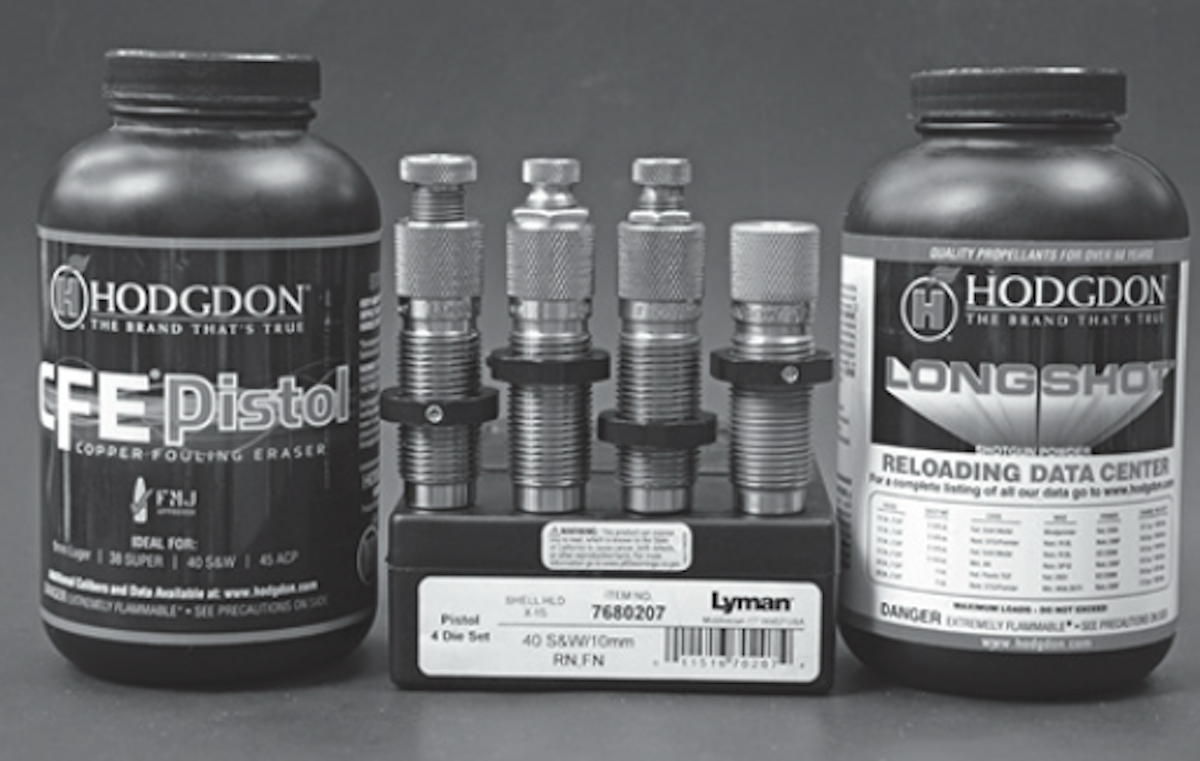
Hodgdon offers a number of great 10mm Auto propellants, and as long as burn rate is a good match for bullet weight, you won't go wrong with any of them. All that I have tried flowed through my Redding Competition Model 10X Pistol/Small Rifle measure with minimal variation in charge weight. For those who cannot afford or don't have room to stock every one of them, I will add that if I could have only two sitting on the shelf in my loading room, they would be CFE Pistol for the lighter bullets and Longshot for those weighing 180 grains and up. Both burn cleanly and deliver excellent accuracy at top velocities. I also prefer Federal 150 and CCI 300 primers. As for 10mm Auto cases, you'll have a hard time finding better than those made by Starline.
When loading ammunition for this project, I used a four-die set from Lyman. A shellholder is included in all Lyman die sets, and the 10mm Auto bullet seater die comes with two stems, one for roundnose bullets, the other for flatnose bullets.
Whether you're shooting the 10mm in a Model 1911 (or other pistol) or in one of the several newly introduced revolvers, handloading the cartridge enhances its versatility. It's an excellent handgun-hunting round as well as a dandy defensive cartridge.