


If you’ve wondered how the 22 Creedmoor and the 22-250 compare performance-wise, then we have the answer.
This is a tale of two cartridges. One, an old-timer with creaky joints but still second only to the 223 Remington in popularity among varmint shooters, began life soon after rifle designer and builder Charles Newton developed a cartridge adopted by Savage Arms and introduced in 1915 as the 250-3000 Savage. Ever the experimenter, he decided to neck down a few of those cases for 0.228-inch bullets. Why that bullet diameter? Well, around 1910 Newton had necked down the 25-35 Winchester case for a 0.228-inch bullet weighing 70 grains, and he picked up a bit of spending money when Savage bought the idea and introduced it in 1912 as the 22 Hi-Power. Unfortunately, Savage had no interest in another .22-caliber cartridge, so Newton’s creation on the .250 Savage case sat on the shelf gathering dust until a gunsmith by the name of Jerry Gebby paid him a visit in 1919.
Gebby took one of the cartridges home, pondered it for just over 10 years, and eventually got around to necking down a batch of 250 Savage cases for bullets with the more common diameter of 0.224 inch. Ammo put together for him in 1930 by friend and custom loader J. Bushnell Smith proved to be quite accurate. Bullet trajectory was banjo-string flat, and long-distance varmints toppled over like bowling pins. In an effort to discourage others from chambering rifles for the new wonder cartridge, Gebby called it the 22 Varminter and paid good money to have the name trademarked. Once word about the cartridge and how easy its case was to form got around, gunsmiths across the country smiled as they stamped “.22-250” on the barrels of rifles built for their customers.
I began shooting the 22-250 when it was a wildcat, and due to the scarcity of 250 Savage cases, the custom rifle came with two RCBS die sets. One set was for the laborious task of forming 22-250 cases from unfired military-surplus 30-06 match brass, and the other was for loading the cartridge.
A company affectionately known as “Big Green” tamed the old wildcat in 1967, called it the 22-250 Remington, and began loading the ammo and chambering very accurate rifles for it. A friend of mine bought the first Model 700 BDL Varmint with a heavy 24-inch barrel in 22-250 to show up at a local gunshop, and he and it gave me and my Remington 40X in 220 Swift a good run for our money in Kentucky groundhog country, where my wife Phyllis and I lived at the time.
The 22 Creedmoor also has a past, but it is far less storied and quite short. Throughout the history of modern cartridges, when a new case is introduced, wildcatters scramble to their loading benches and neck it both up and down for bullets of various diameters. (I plead guilty as charged!) The 284 Winchester is an example. In my collection are 10 wildcats on that case, and they range from the 6mm-284 to the 411-284. With the exception of the latter cartridge, more than one person has staked claim to creating the other nine. Necking down the 6.5 Creedmoor case for 0.224-inch bullets was such a natural thing to do it had to have been quite tempting to a number of varmint shooters, but Texan Derrick Ratliff, founder of Horizon Arms, has to be given a lot of credit for getting the 22 Creedmoor to where it is today. Hornady sponsored the cartridge with S.A.A.M.I. sometime during 2023, and it gained approval in early 2024.
A Special Test Requires Special Equipment
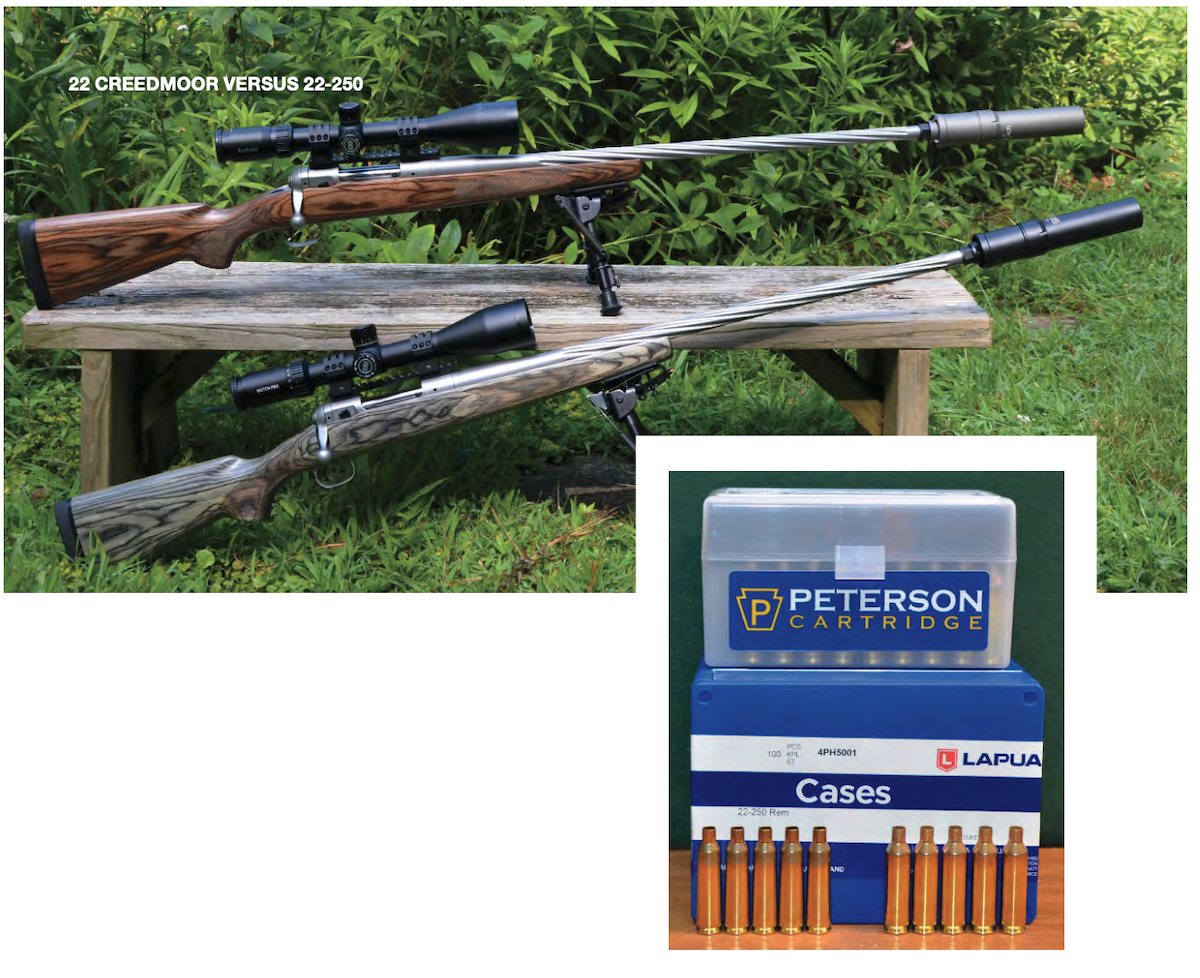
With the history lesson behind us, I will now get down to the business of comparing these two great cartridges. But first, let’s look at the rifles I used.
When I was asked to write this article for the 2025 issue of the Hodgdon Annual Manual, the very first thought flashing through my mind was the need for two accurate rifles as identical as possible in every way except the cartridge for which they were chambered. My friends at E.R. Shaw did a great job of delivering exactly what was needed with two Mark VII rifles from their custom shop.
Savage makes the action to E.R. Shaw’s specifications and indicates so by giving each a serial number with ERS prefix. Upon receipt at the Bridgeville, Pennsylvania, factory, each action is fully blueprinted, including lapped locking lugs and trued boltface and receiver. Shaw engineers have developed a precision chambering technique for 100 percent concentricity with the bore of the barrel. The familiar Savage barrel retention nut is not used, and the precision-ground recoil lug is much thicker than on Savage rifles. Triple honing of all engagement surfaces, as Shaw describes the process, transforms a good AccuTrigger into an excellent AccuTrigger. The pull weights on my rifles were easily adjusted to a consistent 30 ounces, with neither creep nor overtravel.
When placing an order for the two rifles, I specified match-grade, 26-inch, stainless-steel barrels with the optional varmint contour and 1:7 rifling twists. The diameters are 1.250 inches at the receivers and 0.720 inch at the muzzles, heavy enough for excellent accuracy while being light enough to carry on varmint shoots where a lot of walking is required. All Shaw barrels are button-rifled and lapped. I would be shooting the rifles with Nosler SR-30Ti and SR-30ALTi suppressors and specified 5/8-24 threads.
The two barreled actions were hand-bedded in Shaw’s special laminated wood stocks with barrels free floating. The rifles differ only by their serial numbers and by the colors of their stocks—Nutmeg for the 22-250 and Pepper for the 22 Creedmoor. Their weights on my digital postal scale were 8 pounds, 9.9 ounces for the former and 8 pounds, 10 ounces for the latter.
With the exceptions of the 338-06 Ackley Improved and several other wildcats, Shaw technicians ream all chambers to S.A.A.M.I. dimensions. Back in the 1930s the 22-250 was designed to push fairly light (short) bullets weighing 50 to 55 grains to maximum velocities, and chamber throat length was cut accordingly. The 22 Creedmoor was designed to push heavy-for-caliber bullets, and for this reason, chamber throat for it is a bit longer. Further on I will illustrate how this is far less important than is often touted by fans of the 22 Creedmoor in their comparisons of the two cartridges, but first let’s take a close look at them and toss in the popular 22-250 Ackley Improved for good measure.
The Cartridges Compared
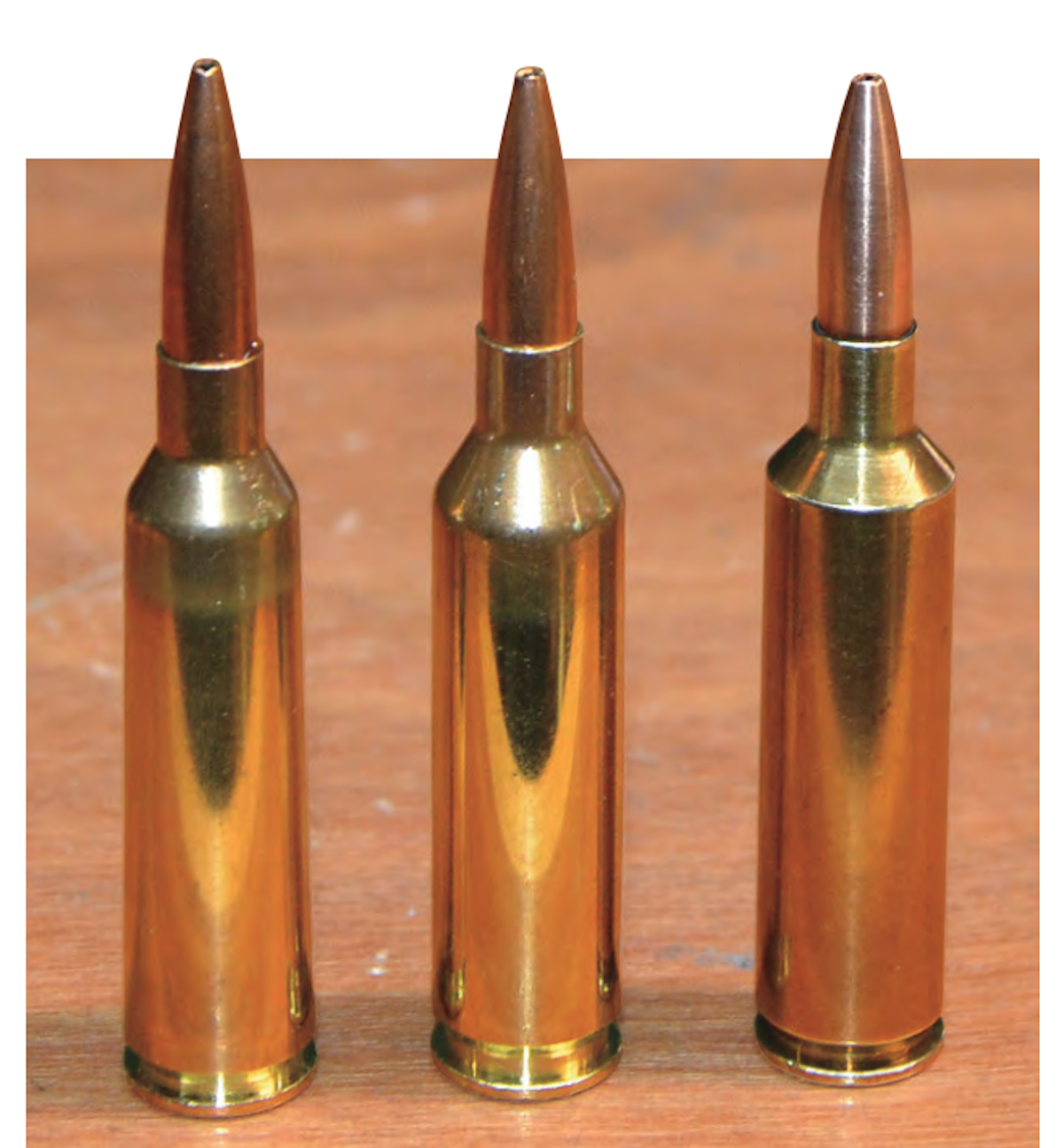
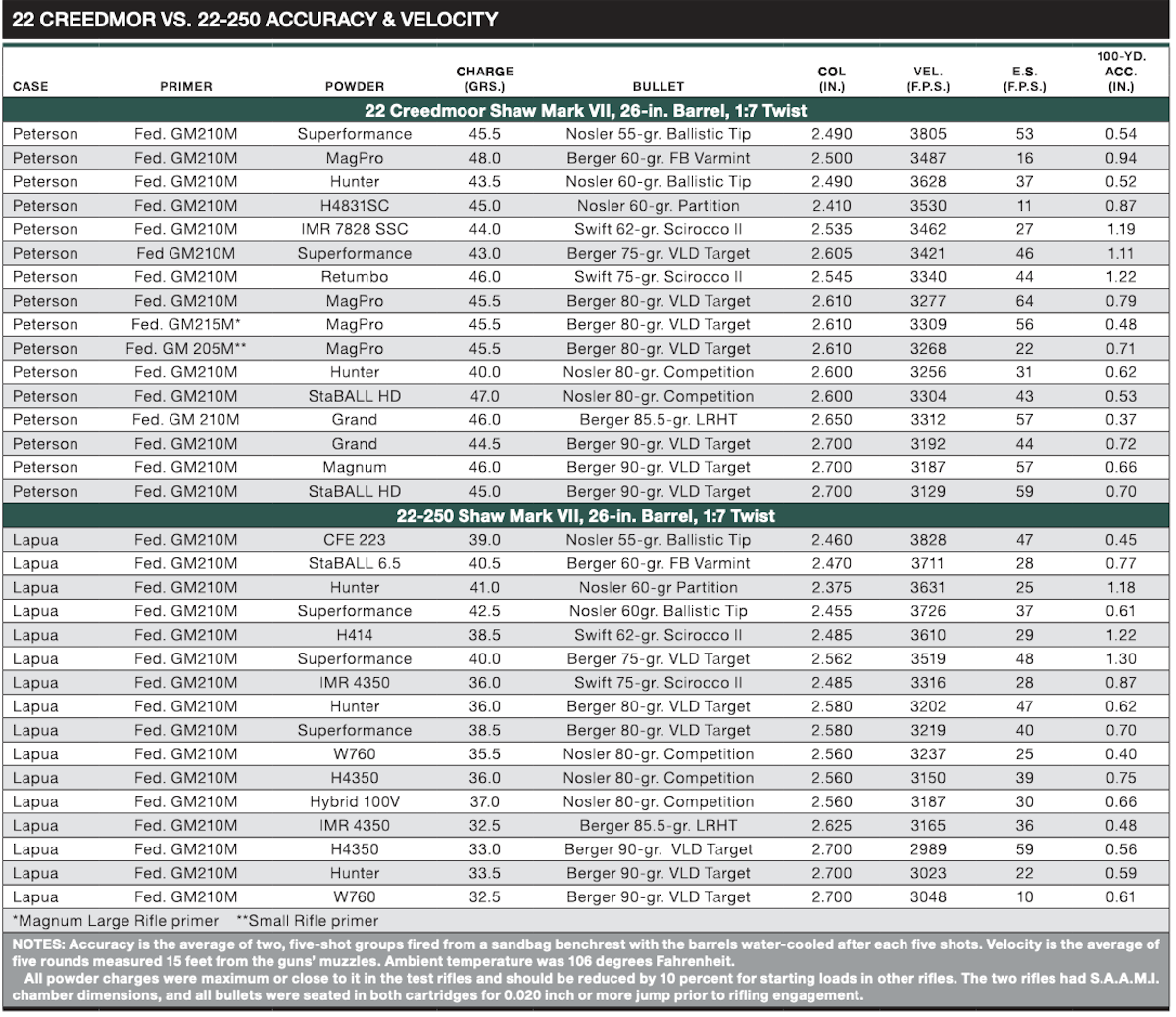
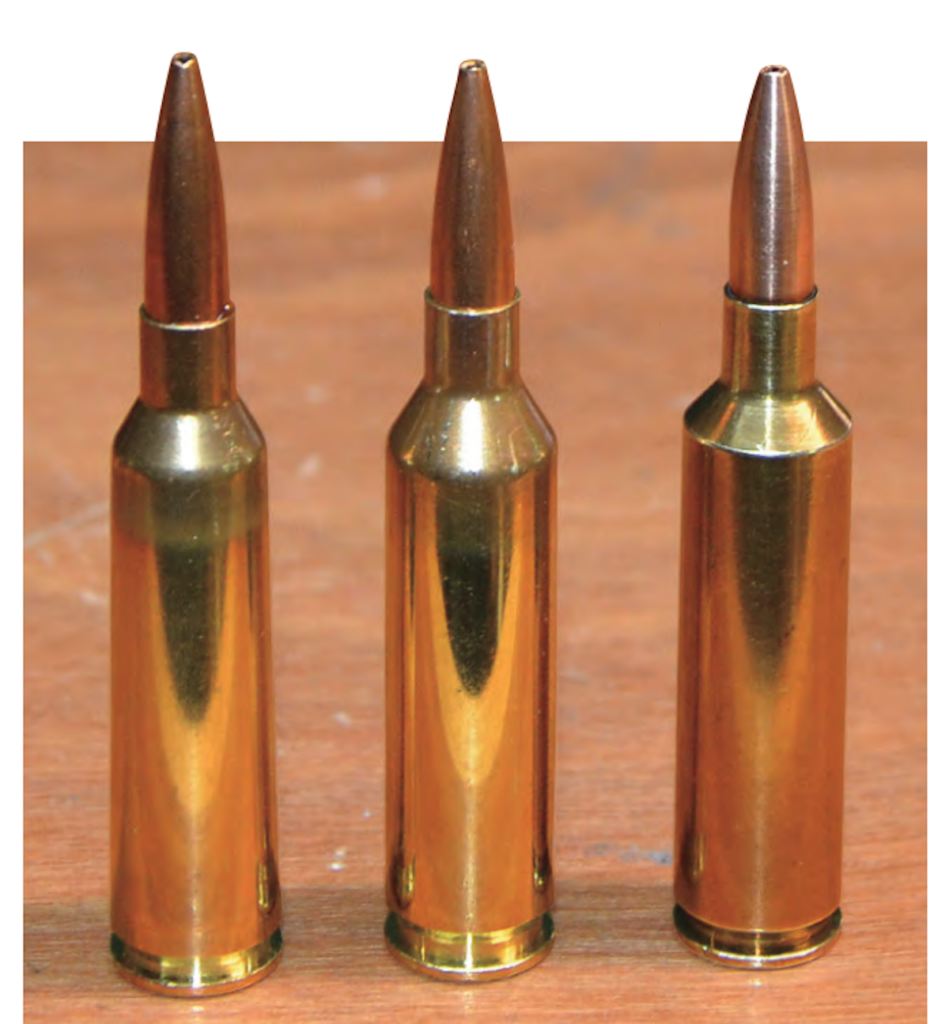
I checked gross capacities of the three primed cases by weighing them and then weighing again after they were filled to the brim with water. Capacities were 50.2 grains for the 22-250 Improved (Federal fire-formed case), 49.3 grains for the Peterson 22 Creedmoor case, and 44.3 grains for the Lapua 22-250 case. The comparisons will differ a bit with other brands of cases, but capacity rankings should remain the same. For all practical arguments and purposes, the 22 Creedmoor is nothing more or less than the grand old 22-250 Ackley Improved with a 30-degree shoulder rather than 40 degrees. The 22-250 case has a 28-degree shoulder, almost the same as the 22 Creedmoor. Peterson offers the 22 Creedmoor case pocketed for Large Rifle or Small Rifle primers, and I tried both with MagPro powder and the Berger 80-grain VLD bullet. And since some competitors commonly use magnum primers in the 22 Creedmoor and other relatively small cartridges, such as the 6mm Dasher and the 6.5x47mm Lapua, I tried the Federal GM215M with the MagPro-VLD combination. Determining which of the three primers is best is a rather lengthy project for another day.
As popular opinion goes, the 22 Creedmoor, with its longer chamber throat, has a huge advantage over the 22-250 because heavy (long) bullets do not have to be seated as deeply into the powder cavity of its case. While this is true of some bullets of older designs, it does not apply to more modern bullets with sleek shapes and extremely long ogives. Berger began offering that type of bullet in weights ranging from 75 to 90 grains during the late 1990s when across-the-course High-Power competitors were transitioning from .30-caliber M1A rifles to AR-15s with heavy, quick-twist barrels. Palma and Fullbore competitors were also happy to see the company introduce uncommonly heavy 0.224-inch match-grade projectiles.
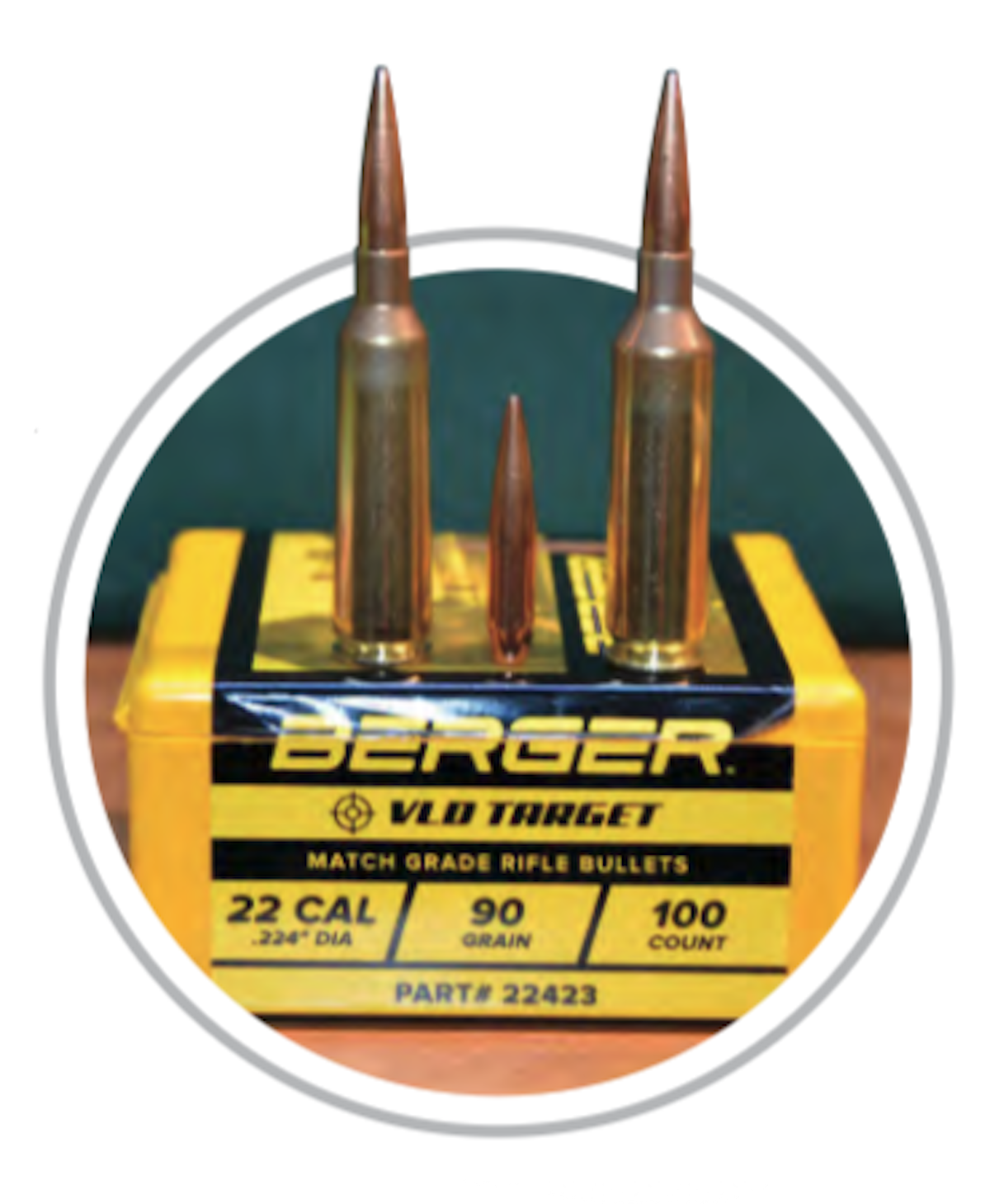
The chamber of the E.R. Shaw rifle in 22-250 featured in this report was precisely reamed to S.A.A.M.I. dimensions, yet when various heavy Berger bullets are seated in the Lapua 22-250 case for 0.020 inch of jump prior to rifling engagement, powder cavity encroachment is minimal to say the least. More specifically, when the finger-long Berger 90-grain VLD Target is seated for a cartridge length of 2.700 inches, its base rests adjacent to the body-shoulder juncture of the case, as it does in the 22 Creedmoor case. Most rifles in 22-250 are built around short actions, the magazines of which are more than long enough to handle that cartridge length. The magazine of my Shaw custom rifle will handle a cartridge length of 2.935 inches, with plenty of space beyond the nose of a bullet remaining for trouble-free feeding. The magazine of the short Remington Model 700 action is also roomy enough for that cartridge length.
Continuing on with keeping everything as close to the same as possible during my cartridge comparisons, when preparing test loads for the two Shaw rifles, I used a pair of die sets made by the same company. Powder charges were thrown with the same powder measure, and bullets were seated with competition-type dies with precision-ground alignment sleeves and floating seating stem systems. When preparing the rifles for accuracy testing, I used Talley Picatinny rails and Weaver 30mm six-screw rings of medium height for attaching two Bushnell 6-24X 50mm scopes. The 22 Creedmoor wore a Match Pro with the Deploy Mil reticle, and the 22-250 wore an Engage with an MOA reticle. For the money, varmint scopes don’t get any better.
During accuracy testing both rifles were snuggled into a Brownells leather bunny-ear sandbag at the rear and a Lyman Match Shooting Bag resting on that company’s quick-adjust Bag Jack at the front. Graham wind flags told me when to shoot and when to stay off the trigger.
While bullets weighing from 80 to 90 grains are fun to play with and are just the ticket for long-distance competitive shooting, I believe those weighing 60 grains are more than enough medicine for bumping off coyotes and other varmints at great distances. They can also be less expensive. Examples are the Nosler Ballistic Tip and Berger FB Varmint of that weight. When launched at 3,600 fps from either cartridge, they shoot flat, buck strong winds, and deliver a deadly blow. Where legal and at reasonable distances, the 22 Creedmoor and 22-250 can be very effective on whitetail deer and pronghorn antelopes, and for that, the Nosler 60-grain Partition, Swift 62-grain Scirocco II, and Swift 75-grain Scirocco II exiting the muzzle at maximum speed would be difficult if not impossible to beat.
So many propellants work so well in the two cartridges, naming just one or two as must-haves in the reloading room is not easy. But I will give it a try anyhow. (Drum roll please.) For pushing bullets weighing from 55 to 75 grains at top speeds with excellent accuracy to boot, I will have to go with Superformance. From this point on, the picking and choosing becomes even more difficult, so I will take the easy way out by nominating MagPro, Grand, and StaBALL HD as top contenders. With that said, you cannot go wrong with old-timers like W760, H414, IMR 4350, and H4831SC. Did I mention CFE 223, IMR 7828 SSC, StaBALL 6.5, and StaBALL Match? It should be noted that the powder charge weights listed in my test results charts were maximum or close to it in the test rifles and should be reduced by 10 percent for starting loads in other rifles. Ambient temperature during my testing was 106 degrees Fahrenheit, and the barrels enjoyed being water-cooled after each five-shot group was fired.
As performance in the field goes, the 22 Creedmoor and 22-250 can be equals in every way, and you are in good company when choosing either. Any difference in accuracy and bullet weight limitations between the two has to do with rifles rather than cartridges. I cannot recall when I did not have a rifle in 22-250, and from this day forward, the same will hold true for the 22 Creedmoor.
As performance in the field goes, the 22 Creedmoor and 22-250 can be equals in every way, and you are in good company when choosing either.
Accuracy & Velocity Chart