



Originally built for war and powered by black powder, when loaded with modern propellants, the grand old 45-70 is great for hunting big game.
The 45-70 Government was adopted by the U.S. military in 1873 and made its debut in the Trapdoor Springfield rifle that was also adopted during that same year. The cartridge also became available in single-shot rifles from Winchester, Bullard, Sharps, Whitney, Marlin (Ballard), Remington (Rolling Block), and others. The initial 45-70 loading for rifles consisted of a 405-grain lead bullet pushed to a velocity of 1,350 fps by 70.0 grains of black powder. A carbine load with 55.0 grains of powder was also introduced. Loads with 500-grain bullets were later developed. When fired from a machine rest, the Springfield rifle was expected to group its bullets in a 4-inch circle at 100 yards, inside 11 inches at 200 yards, and inside 27 inches at 300 yards.
By today’s standards, the old-timer is classified as a close-distance cartridge, but during U.S. Army tests of the Springfield rifle at Sandy Hook, New Jersey, in 1879, the 500-grain bullet propelled by a case full of black powder proved capable of penetrating three, one-inch wooden boards and then burrowing eight inches into sandy soil at 2,500 yards. Angle of rifle elevation was close to 18 degrees, and of 70 rounds fired, five bullets struck a target measuring 12 feet square. Other tests were performed at 3,200 and 3,500 yards.
The first repeating firearm in 45-70 designed for the civilian market was likely the bolt-action Hotchkiss featured in a Winchester catalog in 1880. Two other bolt actions in 45-70, the Remington-Keene and the Remington-Lee, were introduced by Remington during the 1880s. Marlin introduced its Model 1881 lever-action rifle in 1881, and it was followed about five years later by the Winchester Model 1886. The Bullard lever-action rifle in 45-70 came along in 1887 and was produced for about 10 years. Marlin replaced its Model 1881 with the Model 1895 during that year. Model 1895 production ceased around 1917 or 1918, but the Winchester Model 1886 lasted until 1935. By that point, more-modern cartridges had pretty much pushed the 45-70 aside, but it was far from dead, and its bark would continue to be heard in deer woods for decades to come.
Fortunately, for those of us who love to hunt with classic cartridges, Ruger breathed a bit of renewed life into the 45-70 by offering it in the single-shot No. 1 rifle on a special-order basis in 1969 and on a permanent basis the very next year. Harrington & Richardson and other companies followed with single-shot rifles of various designs, but what really caught the attention of a new generation of hunters was the availability in 1972 in a slightly modified Marlin Model 336 lever action called the New Model 1895. It differed from the original Model 1895 in a number of ways, the most important being an action machined from more-modern steel. The 45-70 has also been available in revolvers and in Contender handguns built by Thompson/Center and SSK Industries.
Load Levels
The 45-70 is falling-off-a-log easy to handload, and publishers of reloading manuals wisely separate load data into three levels of chamber pressures for rifles varying in strength. Maximum pressure commonly recommended for weaker rifles, such as the Trapdoor Springfield, Remington Rolling Block, and Marlin 1881 lever action, all in serviceable condition, ranges from 17,000 CUP to around 25,000 CUP.
Moving up to some of the rifles with actions of greater strength, we have the Marlin New Model 1895, the lever action from today’s Henry Repeating Arms, and modern reproductions of the Winchester Model 1886. There is disagreement among various sources on maximum pressures for these rifles, with some putting it at 28,000 CUP and others at 40,000 CUP. This should not be a problem as long as the components specified by the various sources are used.
For much stronger rifles like the Ruger No. 1, Ruger No. 3, and Browning B-78 single shots, recommended maximums range from 35,000 CUP to 50,000 CUP.
Those who handload for 45-70 rifles of various strengths and vintages should adopt an identification procedure to ensure that ammo loaded for one of the stronger rifles is not absentmindedly fired in a weaker rifle. Painting the heads of cartridges with red fingernail polish for a Ruger No. 1 and painting the heads of those loaded for my modern Marlin and Henry rifles black works for me. Cartridges with no color indicate safe to use in any of my rifles.
Powders & Bullets
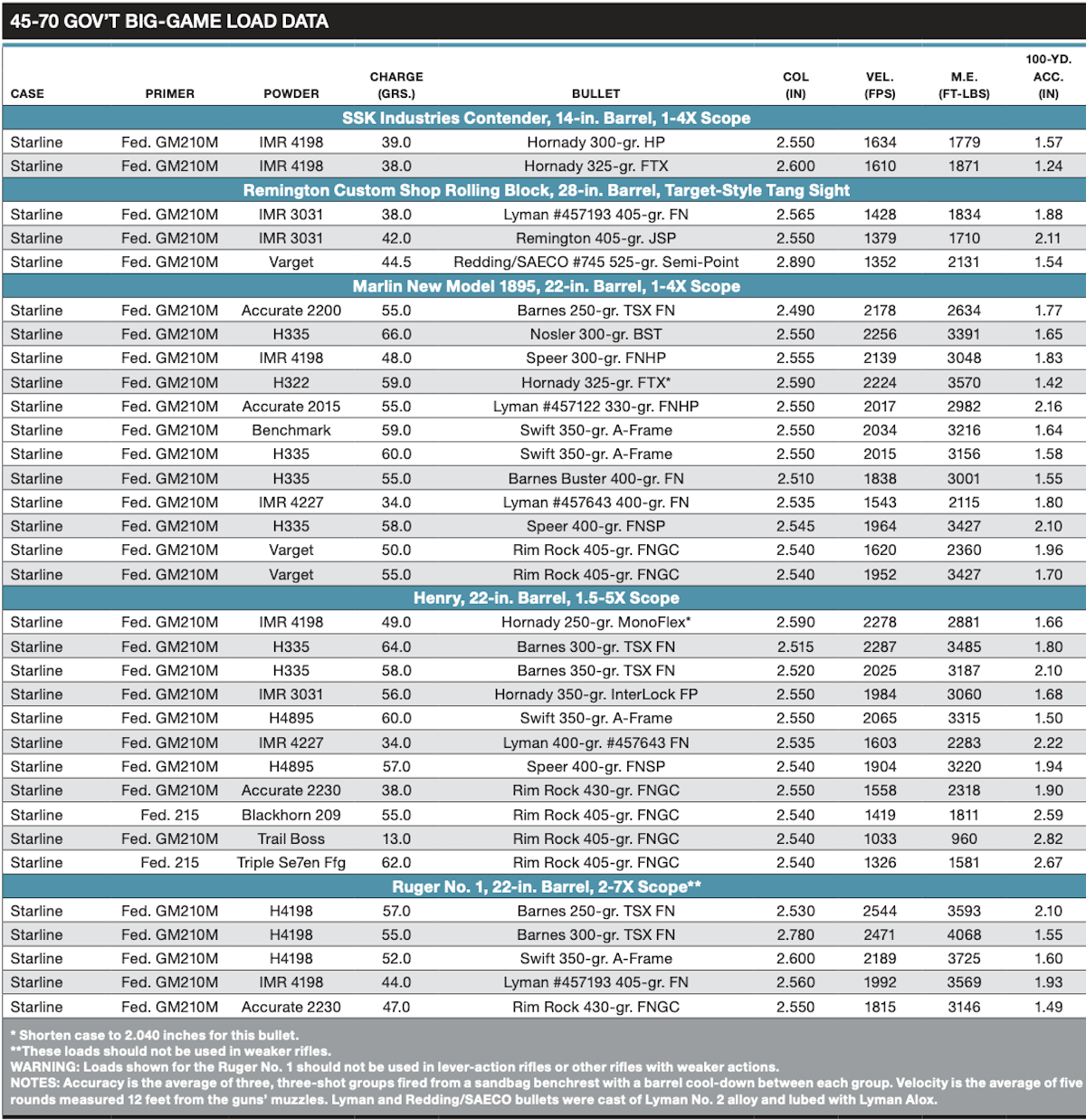
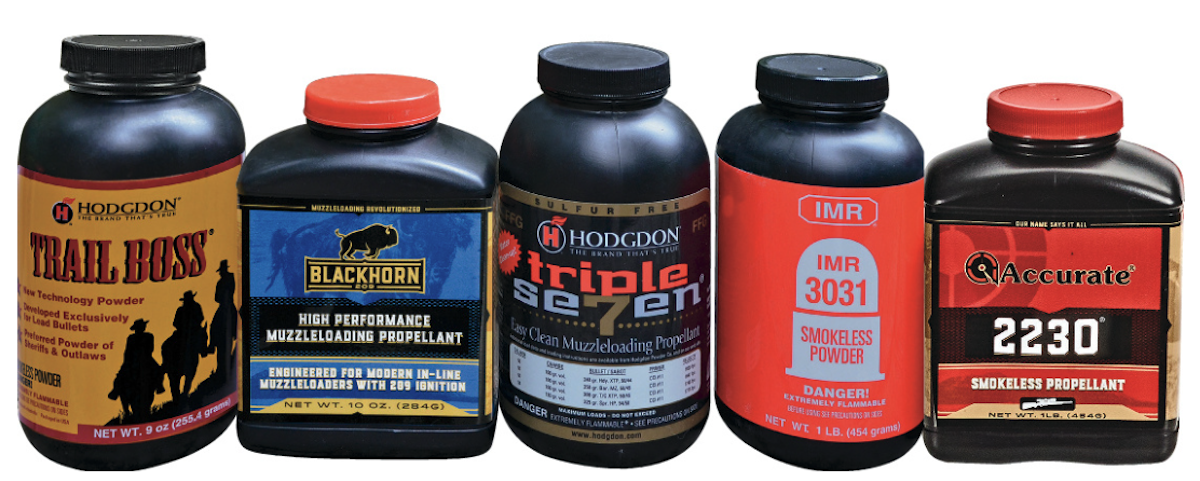
A number of powders are suitable for use in 45-70 handloads. When loading smokeless powder for older single-shot rifles like the 1873 Springfield and Remington Rolling Block, I have mostly used IMR 3031 through the years, but newer propellants, such as Varget and Benchmark, also work quite well. For a low-cost practice load the entire family can enjoy, try 13.0 grains of Trail Boss behind the Rim Rock 405-grain cast bullet or a bullet of the same weight cast of scrap wheel weight metal with a Lyman #457193 mold. When punching paper at serious distances, I find Varget and a 525-grain bullet cast with a Redding/SAECO #745 mold to be quite accurate.
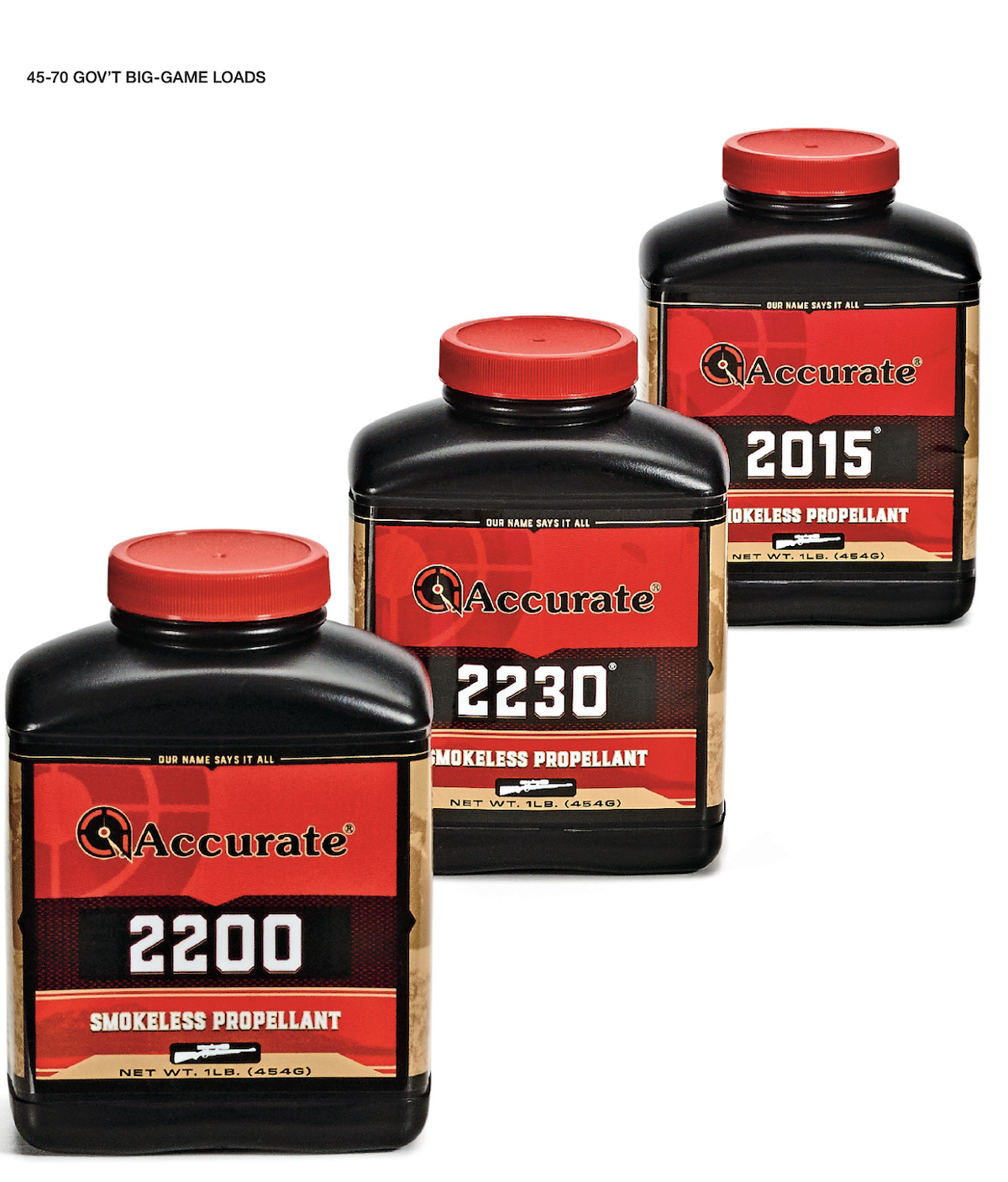
Moving to higher velocities in my Marlin and Henry rifles, H322 and Accurate 2230 have long been favored, although IMR 3031, H335, H4198, and IMR 4198 are also excellent performers.
When putting together ammo that duplicates the performance of black powder without its heavy fouling buildup in the barrel of my Henry lever gun, I have long found Blackhorn 209 to be an excellent choice. TripleSeven Ffg is another excellent candidate for fun loads that fill the air with smoke. When loading jacketed bullets weighing from 250 to 350 grains to higher pressures and velocities for my Ruger No. 1, H4198 and IMR 4198 are the propellants most often used.
Prior to rounding up bullets to be used in any rifle with a tubular magazine, keep in mind that only those of flatnose profile are safe to use. Exceptions are Hornady’s 250-grain MonoFlex and 325-grain FTX, both featuring soft pointed tips that improve ballistic coefficient a bit while being safe to use in tube-magazine rifles. Shortening cases to 2.040 inches for those two keeps overall cartridge length compatible with the actions of lever-action rifles.
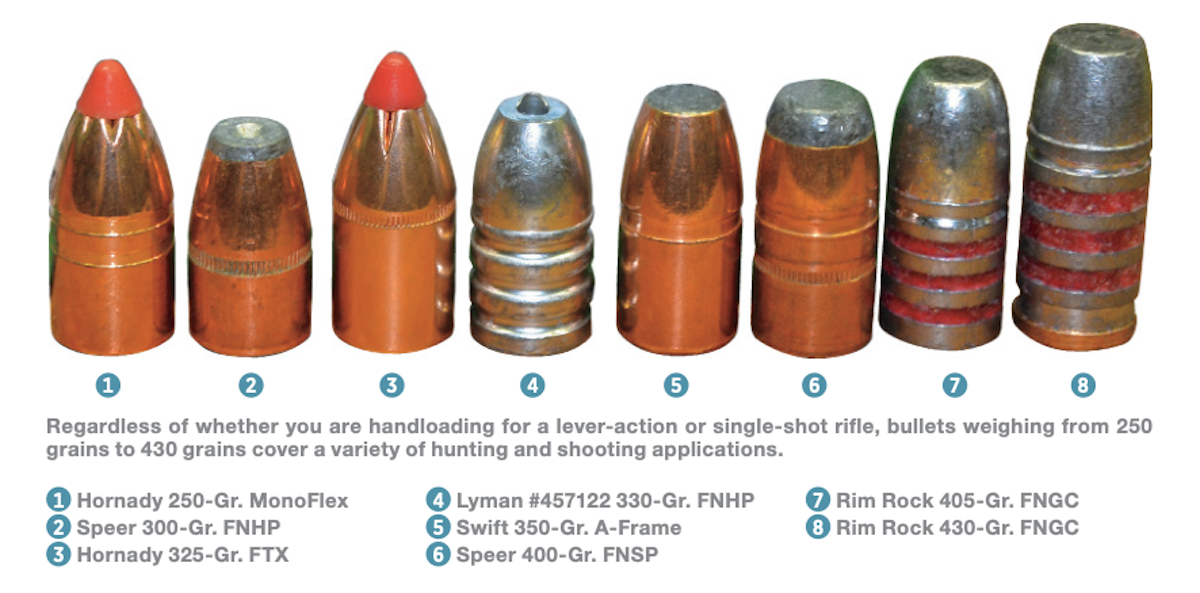
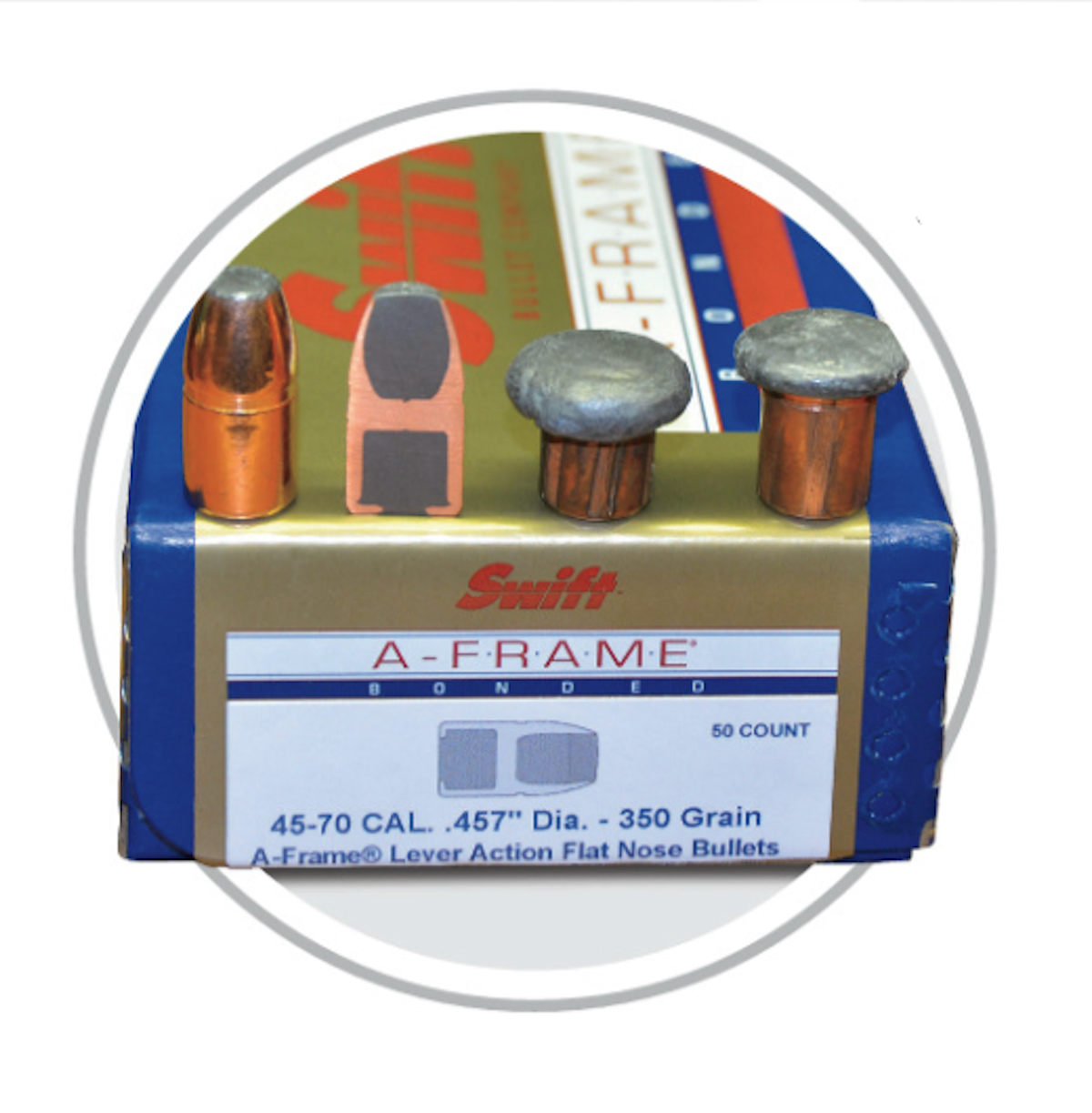
Excellent choices in deer bullets include the Barnes 250-grain TSX FN, the 300-grain hollowpoints from Hornady and Speer, the Nosler 300-grain BST, and the Hornady 325-grain FTX. The Speer 400-grain bullet is also quite deadly on deer but is a bit soft for optimal penetration when taking quartering shots on larger game. The 330-grain Gould with a flat, hollow nose cast of Lyman No. 2 alloy with a Lyman #457122 mold has proven to be an effective harvester of venison among hunters for well over 100 years. Best bets for moose and elk are the Barnes 300-grain TSX FN, Swift 350-grain A-Frame, Hornady 250-grain MonoFlex, or a hard-cast bullet with a wide, flat nose weighing from 400 to 430 grains. My all-time favorite mice-to-moose bullet is the Swift 350-grain A-Frame.
Tips & Techniques
The mouth of a 45-70 case has to be belled slightly prior to bullet-seating, and for this reason, die sets come with a third die. To prevent bullets in full-power cartridges in a tubular magazine from being pushed more deeply into the case during recoil, cases should be roll-crimped into the cannelure of jacketed bullets or into a crimp groove or lube groove of cast bullets. As mentioned earlier, when loading the Hornady 250-grain MonoFlex and 325-grain FTX bullets for lever-action rifles, cases have to be shortened to 2.040 inches. A standard crimp die won’t work with shortened cases, so Redding designed the Special Purpose Profile Crimp Die for use when loading those bullets. It can also be used on cases of standard length.
Keeping cases trimmed to the exact same length ensures uniform crimps. Equally important is choosing a powder of the correct burn speed, the charge of which is compressed enough to assist the roll crimp in preventing recoil-induced bullet push-back.
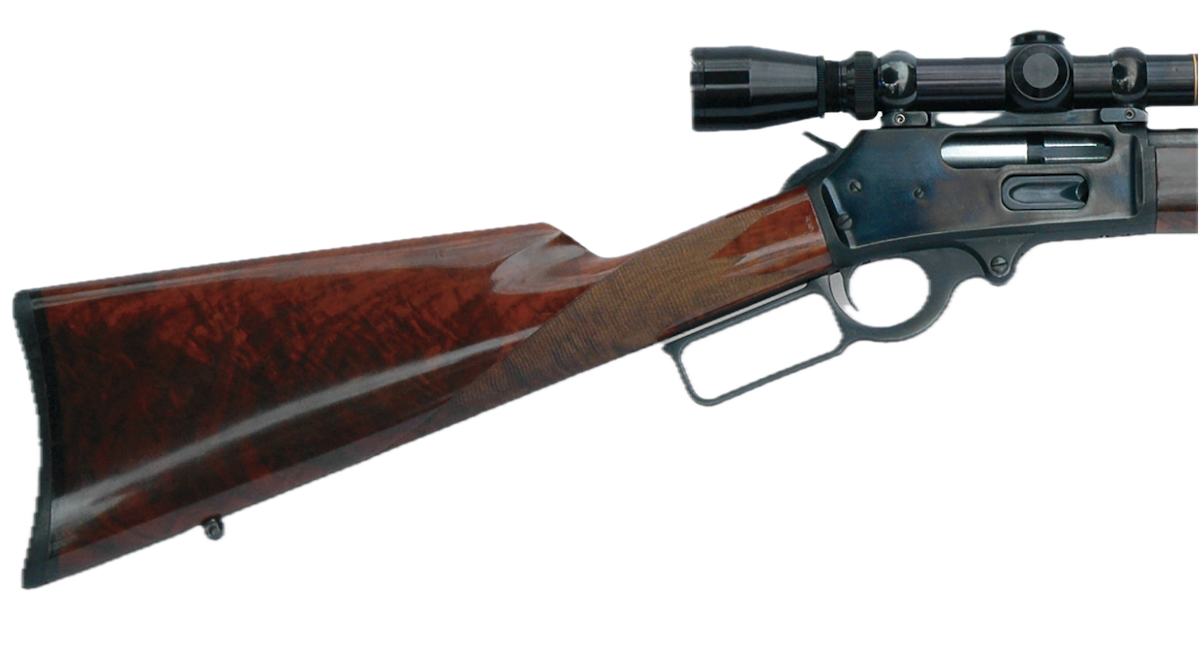
My favorite rifle in 45-70 is a Marlin New Model 1895 purchased about 35 years ago from a friend who had it restocked in nicely figured American walnut by Tennessee stockmaker Bob Cassidy. Otherwise, it is still factory original and easily identified as early production by a front sight dovetailed to the barrel along with a straight grip and a square-shaped finger lever. At the same time, I inletted a nicely figured Fajen stock and forearm for a Ruger No. 1 barreled action in 45-70 and then turned the rifle over to Cassidy who final-shaped and finished the stock with hand-rubbed oil. He also applied flawlessly executed, 22-line checkering in a point pattern with generous coverage. That rifle is also still in my battery, and it is the most accurate 45-70 I have hunted with.
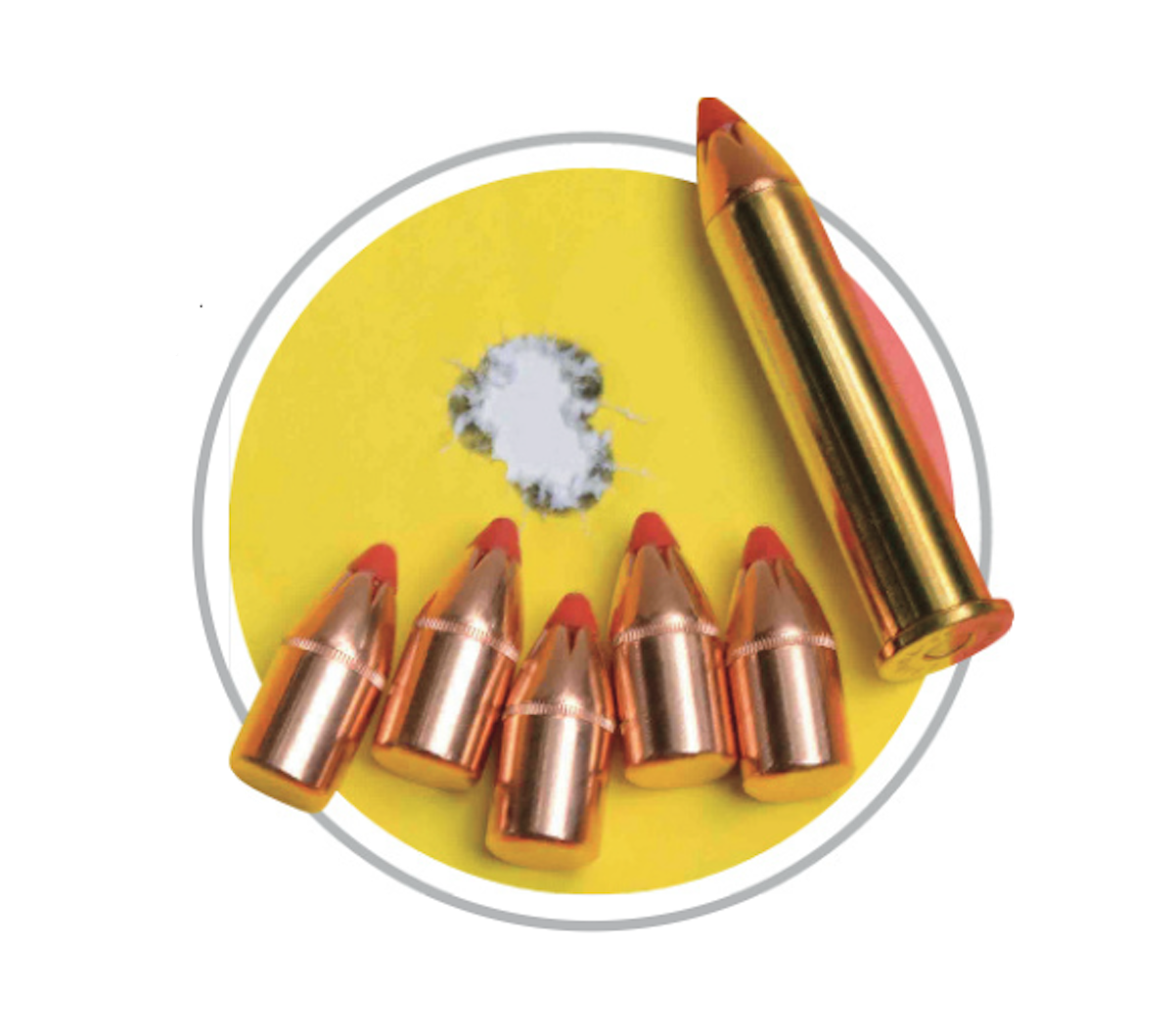
While the Ruger No. 1 is more accurate overall, the smallest individual group I have carved with any rifle in 45-70 was with the Marlin. The load consisted of a Remington case, a CCI 200 primer, and a Hornady 325-grain FTX pushed along by a maximum charge of H322 for an average muzzle velocity of 2,224 fps. When developing loads for a lever-action rifle, I usually shoot three-shot groups, but when the first three bullet holes at 100 yards were touching, I squeezed off two more rounds. I made the enclosed photo of the group but never got around to measuring it. While that one was chalked up to luck, three-shot averages usually run around 1.5 inches with the occasional group measuring less than an inch.
In addition to being accurate, the FTX seldom fails to drop a whitetail buck in its tracks at reasonable distances. When zeroed three inches high at 100 yards, it lands about two inches below point of aim at 200 yards, but at that distance residual velocity is less than 1,600 fps, and expansion is nothing to brag about. At the distances most woods-roaming whitetail deer are taken, 300-grain bullets from Hornady, Nosler, and Speer are just as effective as the 325-grain FTX.
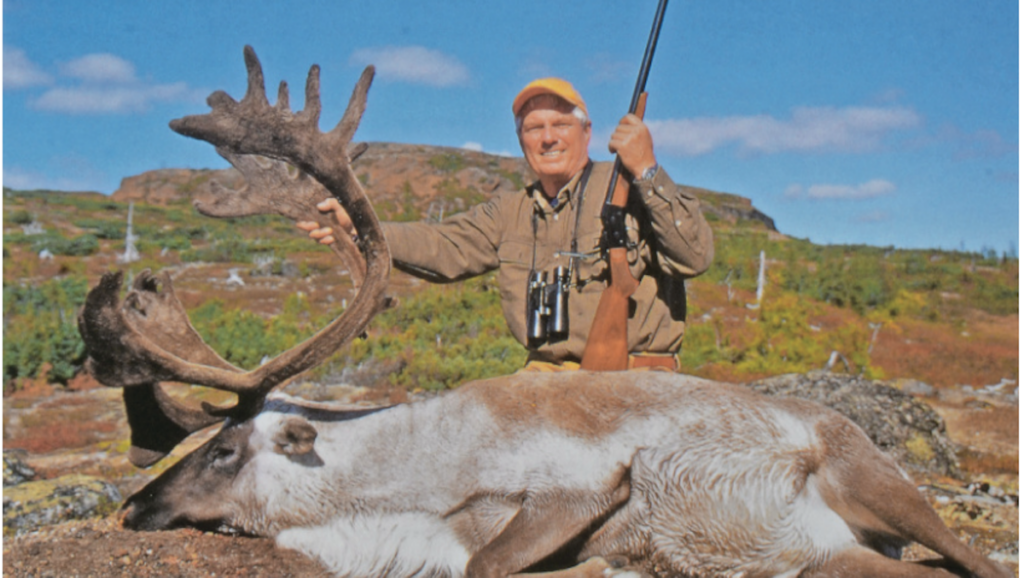
Strong rifles and smokeless powders available today allow the 45-70 to be loaded to considerably higher velocities than in the old days, but due to the large diameter of its bullet, it performs nicely on game when loaded to its original velocity. Several years ago, I used a Rolling Block rifle built in Remington’s Custom Shop on a hunt for caribou in Newfoundland. Elevation adjustments of its target-grade tang sight were both precise and easily repeated. The load I settled on pushed the Remington 405-grain softnose bullet along at 1,379 fps, with average 100-yard group size measuring just over two inches. Having hunted caribou many times in the past, I knew that using a woods cartridge in such open country would be challenging, so prior to the hunt, I confirmed bullet trajectory by shooting paper targets placed at 100, 150, 200, 250, and 300 yards. Sight elevation adjustments for those distances were typed on a business card and taped to the side of the rifle’s stock. After several unsuccessful stalks without a shot, I used a single bullet to drop a nice bull at a laser-ranged 236 yards.
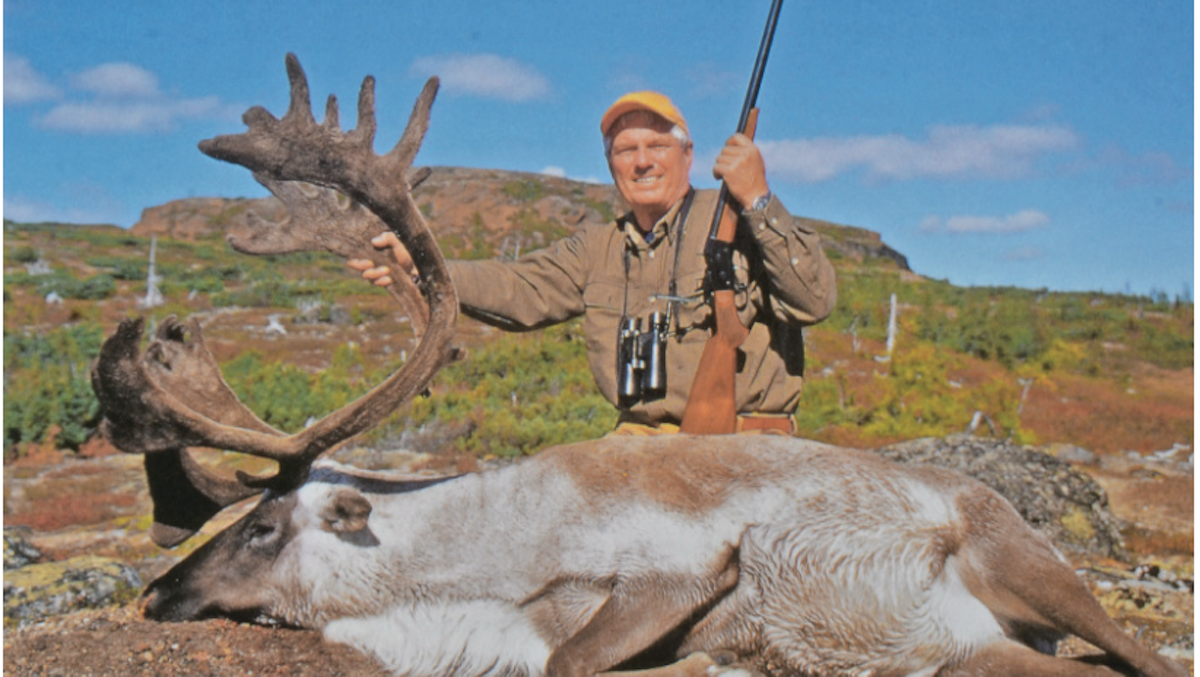
Obviously, the 45-70 Gov’t is capable of downing big game. That hunt also proved the grand old cartridge can get the job nicely done at considerable distance.
Originally built for war and powered by black powder, when loaded with modern propellants, the grand old 45-70 is great for hunting big game.
Load Data Chart