


The 6.5x54 Mannlicher-Schönauer is one of the most interesting cartridges ever created, both historically and ballistically. It has made appearances in literature, enjoyed walk-on parts in movies, and is familiar to people who wouldn't know a rifling pattern from a revolving door. The 6.5x54 Mannlicher-Schönauer is to 6.5mm cartridges what Man o' War is to thoroughbred racing.
That may seem like overstating the case, considering the 6.5x54 M-S is not the fastest or the most powerful cartridge ever created, and it is not noted for particularly great accuracy. However, in the early days of small-bore smokeless cartridges, it, combined with its parent Mannlicher-Schönauer Model 1903 rifle, blazed new trails and conquered new worlds. It has been used in swamps and on mountaintops and has killed everything from chamois in the Alps to brown bears in Alaska to elephants and Cape buffalos in East Africa.
The further one delves into the history and career of the 6.5x54 M-S, the more one feels the need for superlatives. It has been everywhere, done everything, and has nothing left to prove.
The Backstory
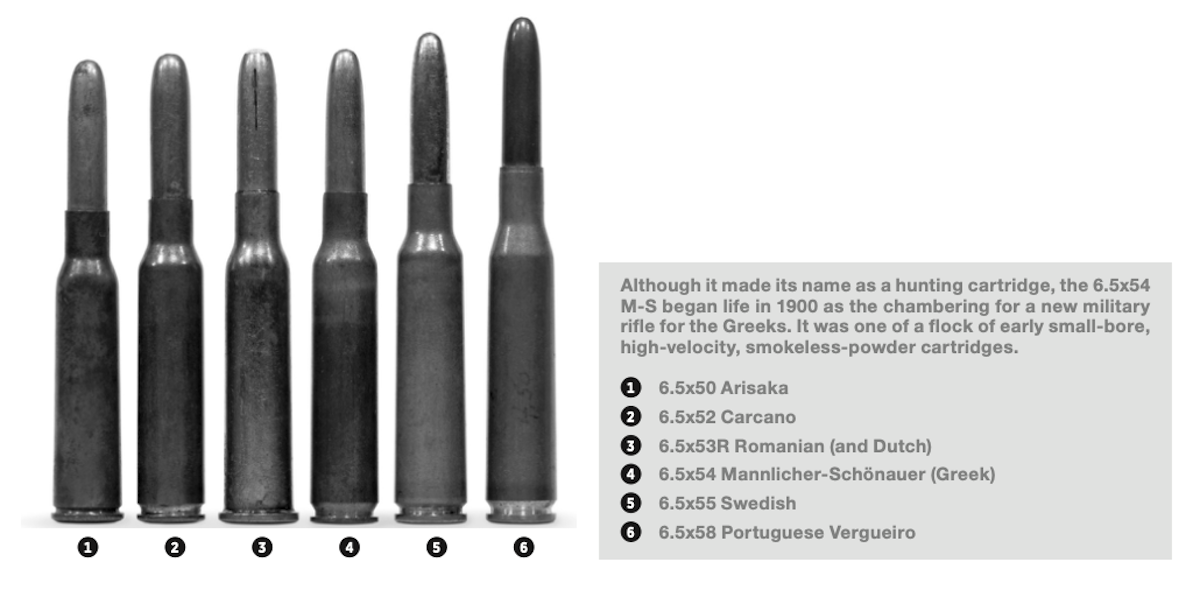
Although it made its name as a hunting cartridge, the 6.5x54 M-S began life in 1900 as the chambering for a new military rifle for the Greeks. It was just one of a flock of early small-bore, high-velocity, smokeless-powder cartridges, and it fired a 160-grain bullet at a rated 2,220 fps.
At the time, Ferdinand von Mannlicher was at the height of his career as the rifle and cartridge designer for the Steyr armsmaking giant in Austria. The Model 1900 Greek Mannlicher, as it came to be known, was a turnbolt design not wildly dissimilar to the Dutch, Portuguese, Romanian, or Austro-Hungarian rifles of the same era, all designed by Mannlicher and manufactured by Steyr. Some were straight-pull, some were turnbolt; most used variations on 6.5mm cartridges, although a few were 8mm.
Like Paul Mauser in Germany, von Mannlicher was refining and perfecting his designs in the midst of the greatest arms race the world has ever seen. In the years before 1914, as tensions intensified in Europe, Europe's armies were increasing their arms reserves. The demand for small arms of all kinds, from all over the world, was intense. As fast as the Steyr factory could build rifles and ship them out the door, von Mannlicher was designing new, improved ones, and the 1900 Greek Mannlicher represented his finest turnbolt design.
In 1903 Steyr decided to offer a bolt-action hunting rifle and chose the Greek military action as the basis. Instead of Mannlicher's "packet system" of loading, in which cartridges were loaded five at a time into a spring-steel clip and the entire clip inserted into the magazine well, it used a rotary magazine designed by Steyr's production manager, Otto Schönauer.
Schönauer's magazine is one of the most elegant ever created. A spool holds each cartridge in a protective cradle, preventing back-and-forth motion under recoil. It's smooth and almost effortless to load but can be emptied with the bolt open by pressing a knurled button on the action rail, allowing the spring-loaded spool to eject the rounds into your hand. The whole mechanism is sculpted and machined like a Swiss watch. Although the rotary mechanism was Schönauer's, a refinement that allows the entire magazine to be removed from the rifle for cleaning was apparently Mannlicher's.
The rotary magazine may not be the best for rough-and-tumble military use, but for a sporting rifle, it's superb. Steyr applied all its gunmaking expertise to the manufacture of the rifle, using the finest steel for the barrel and action, European walnut for the stock, and the skills of the best production gunmakers in Europe.
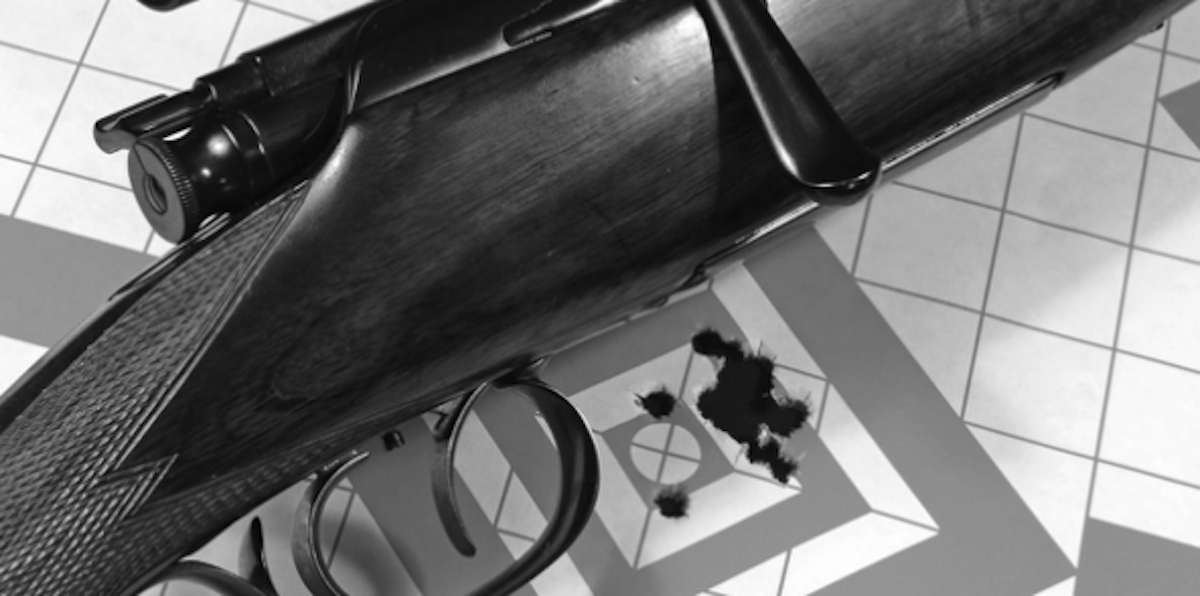
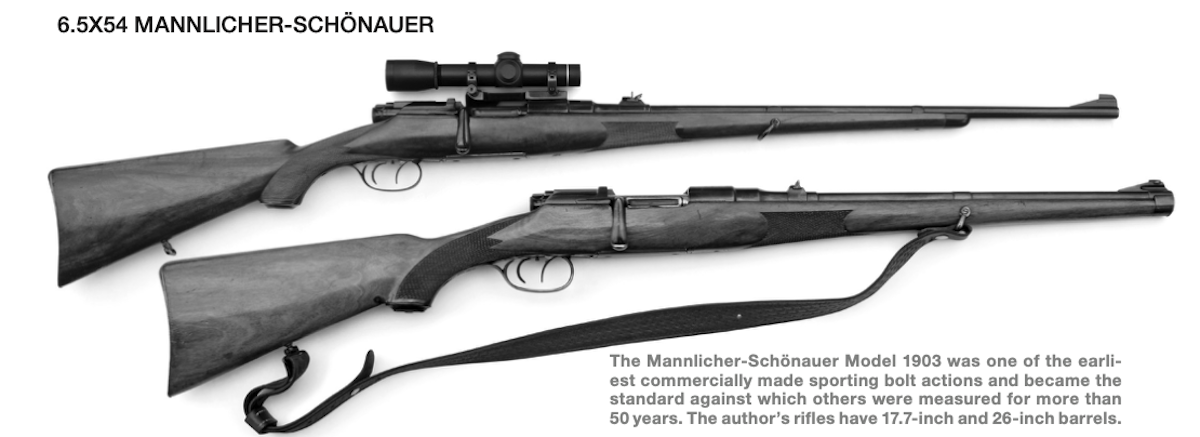
Austria is a country of mountaineers and mountain hunters, and its iconic game animal is the chamois, a petite, goat-like creature that inhabits the high Alps. Hunters carry their own rifles as they scale these peaks, and the Mannlicher Model 1903 was designed for this particular purpose. It was given a 17.7-inch barrel and a stock that stretched to the muzzle. Although Steyr did not invent this style of stock, it was the first to use it on a sporting rifle, and such a stock has been called a Mannlicher ever since. While such a stock does not promote gilt-edged accuracy, it serves a genuine purpose in both protecting and supporting the barrel and providing a better handhold should the hunter need to use the rifle as an alpenstock.
The 6.5x54 (or 53) Greek military cartridge was retained but renamed the 6.5x54 Mannlicher-Schönauer. The commercial load also employed a 160-grain bullet, in both softpoint and solid. Both were long, roundnose bullets. Muzzle velocity was listed at 2,220 fps. Such a long bullet at a low velocity (by modern standards) required very tight rifling to stabilize it, and the twist was rated at 1:7.8 inches.
The resulting rifle and cartridge combination stayed in production for the next 68 years, surviving the Great War (1914 to 1918), the dissolution of the Austro-Hungarian Empire, the Great Depression, the Second World War, and any number of lesser economic and political upheavals.
From its introduction, the Mannlicher-Schönauer Model 1903 was widely admired and acquired by some very prominent people. Beautifully made, and with only minimal competition from other riflemakers, it quickly became the yardstick against which every sporting rifle was measured.
London gunmakers, such as Boss and Holland & Holland, reworked Mannlichers for their clients as carbines, full-length rifles, and takedown models. In Africa W.D.M. (Karamojo) Bell killed elephants with a 6.5; in North America Charles Sheldon hunted mountain sheep and grizzly bears, and biologist Annie Alexander used one to collect brown bear specimens in Alaska. Werner von Alvensleben, a later African professional hunter, used a 6.5x54 M-S to kill more than a thousand Cape buffalos, shooting on control in Mozambique.
Ernest Hemingway was an ardent admirer of the Mannlicher. His first reference to it appears in A Farewell to Arms, in the form of a captured Austrian sporting rifle. Later he arms Margot Macomber with one, and she uses it to kill her husband, Francis. Hemingway had one on his fishing boat, "Pilar," and writes about it at length in Islands in the Stream.
All these examples employed factory ammunition, and that is very important to remember. Commercial ammunition was produced in America until around 1940; thereafter, at various times, imported ammunition made by Norma or RWS was available. Almost all were loaded with a 155- or 160-grain bullet, although some had bullets as light as 139 grains. The point is that the rifle was designed for long, heavy bullets, from its twist rate to the shape of the magazine spool. In some Model 1903s (and I have one) the bullet must be long and roundnose to lift the cartridge out from under its left rail as the round is chambered. Otherwise, it jams.
More than any other commercial rifle I have ever encountered, Mannlichers are individuals. What works in one may not work in another. For example, I have two chambered for the 6.5x54 M-S, and neither will accept brass that has been fired in the other.
Much as they can be a pure pleasure to shoot, it's almost impossible to turn a Mannlicher into something it is not. No 6.5x54 M-S is a long-range woodchuck rifle, and it cannot be turned into one. Certainly, 100-grain bullets are made in 6.5mm, but load one to 2,900 fps, which is easy to do, and the rifle will demand the addition of a scope to put the extra velocity, flat trajectory, and extended range to use. This has never been easy and is less so today since the only mounts available are found on the "used" market. If your rifle is not already drilled and tapped for the Leupold Adjusto mount, or something similar, then drilling it now degrades its value to collectors, which most owners are reluctant to do.
Making 6.5x54 M-S Ammo

Commercial 6.5x54 M-S ammunition is sometimes available. Norma no longer imports ammunition but continues to offer excellent brass. Serbia's Prvi Partizan makes both ammunition and brass (both available from Graf & Sons), and Graf also has some proprietary 6.5x54 M-S made for them by Hornady.
One should keep in mind that the Model 1903 was never intended to shoot handloads. Reloading smokeless ammunition was unknown. Old handloading manuals caution that many (if not most) 6.5x54 rifles have excessive headspace. This presents no problem if you are shooting factory ammo, but it can cause case lengthening and eventual head separations if you load the same brass over and over.
Then there is the pursuit of higher velocity. Let's take the original military specifications as an example. From the beginning, the quoted ballistics of the 6.5x54 M-S were a 160-grain bullet at 2,220 fps. Presumably, this was measured in the original Greek Mannlicher rifle, which had a 28.56-inch-long barrel—almost 11 inches longer than the commercial stutzen. Under the usual velocity-loss formula of 25 fps per inch of barrel, that would mean a velocity 275 fps lower in the short rifle.
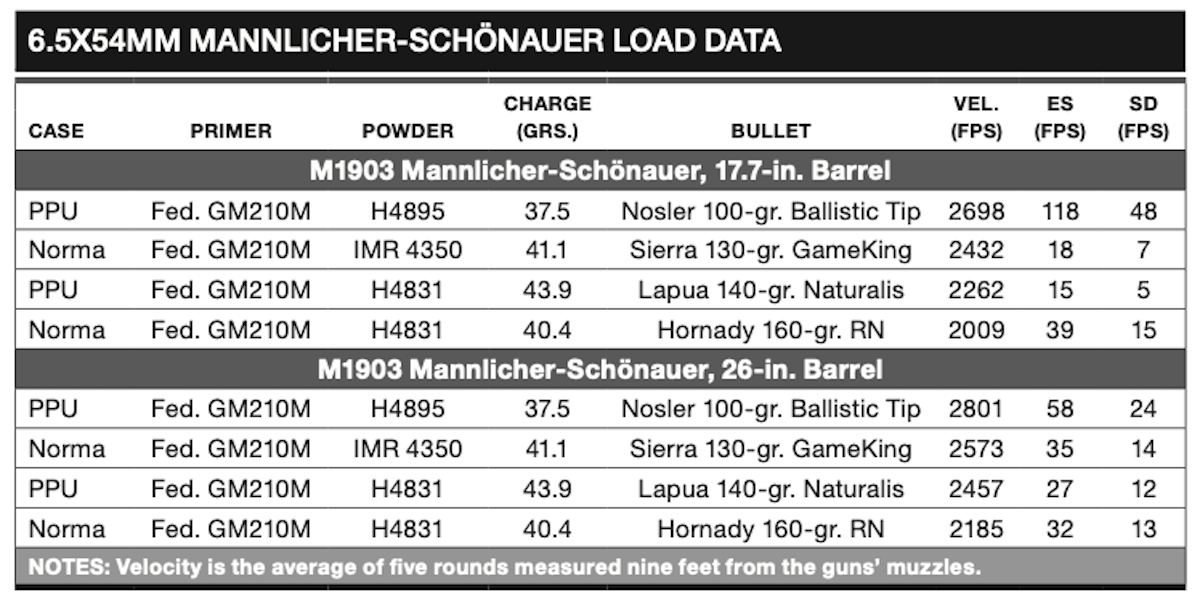
As the accompanying chart shows, there is a considerable difference between what can be achieved in a stutzen and what you get in a rifle with a longer barrel.
The 6.5mm bullets available today range in weight from 90 grains (Speer TNT) to 160 grains. Heavier bullets include long-ogive Spitzer boattails intended for ultra-long-range shooting in such cartridges as the 6.5-300 Weatherby. Fortunately, Hornady still makes the traditional 160-grain roundnose, and Lapua offers 155-grain roundnose bullets that are excellent. Early American .264-caliber rounds, such as the 256 Newton, favored 129-grain bullets, and 140 grains is a favorite weight for almost all 6.5mm cartridges.
A modern development that favors my 1903 is the development of lead-free bullets that are always longer for their weight. Lapua's 140-grain Naturalis roundnose can be loaded for the 1903 and feeds like a dream. It is actually slightly longer than Lapua's lead-core 155-grain bullet and has a blunter nose, both of which work to my advantage.
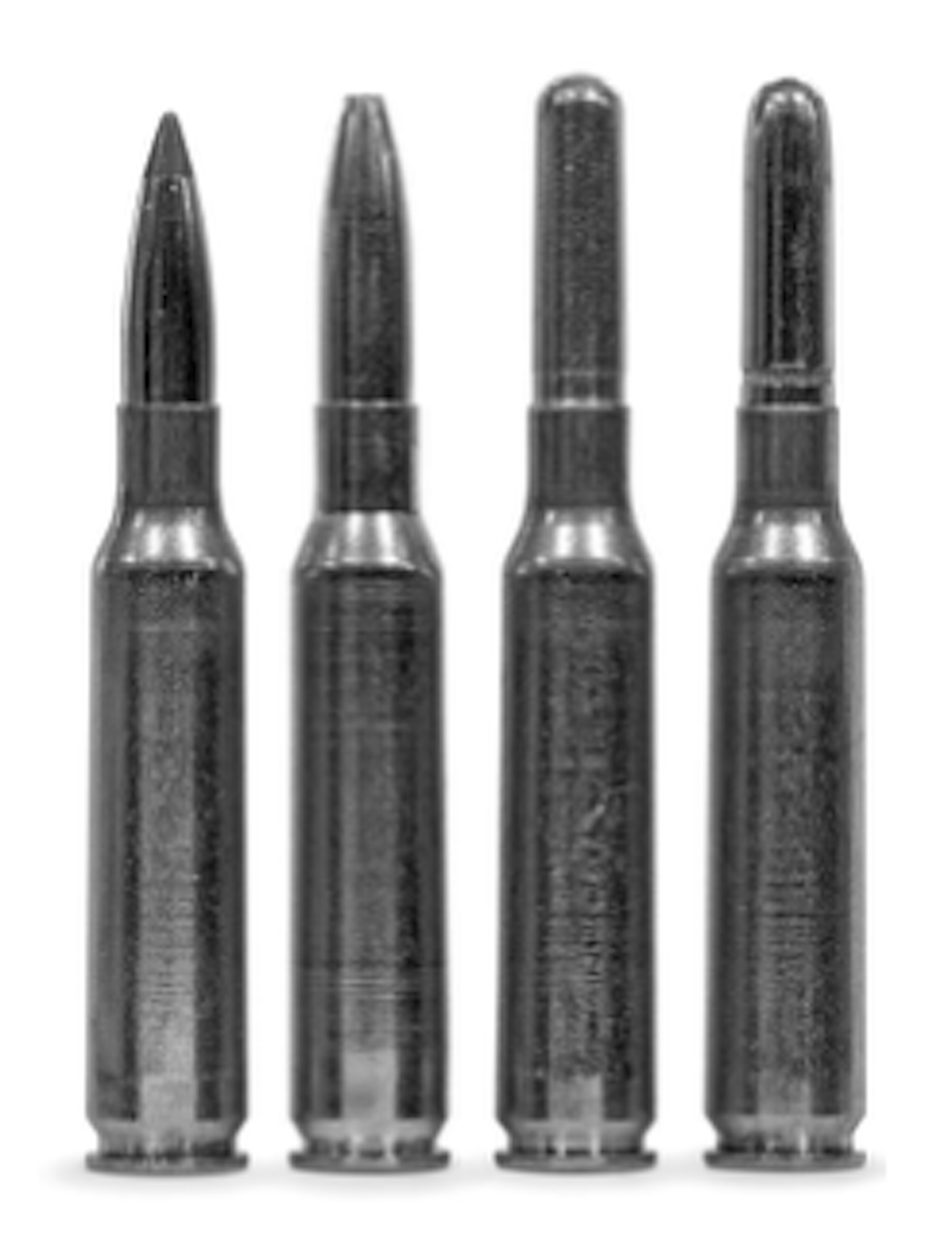
Unless you are prepared to use your Mannlicher as a single-shot rifle, for the vast majority of 6.5mm bullets the first step in any handloading effort is to determine what your rifle will accept and feed from the magazine and what it will chamber. It saves time and effort in the long run if you begin by preparing some dummy cartridges, with bullets of different weights, shapes, and seating depths, to see what works and what does not.
As I mentioned earlier, the only bullets my stutzen will work with are long, roundnose bullets, seated for maximum length. This means most are not even seated down to the crimping groove and are gripped by a minimum of the case neck. My other rifle is an African model with a 26-inch barrel and a three-quarter-length stock. It happily works with just about any bullet I care to feed it.
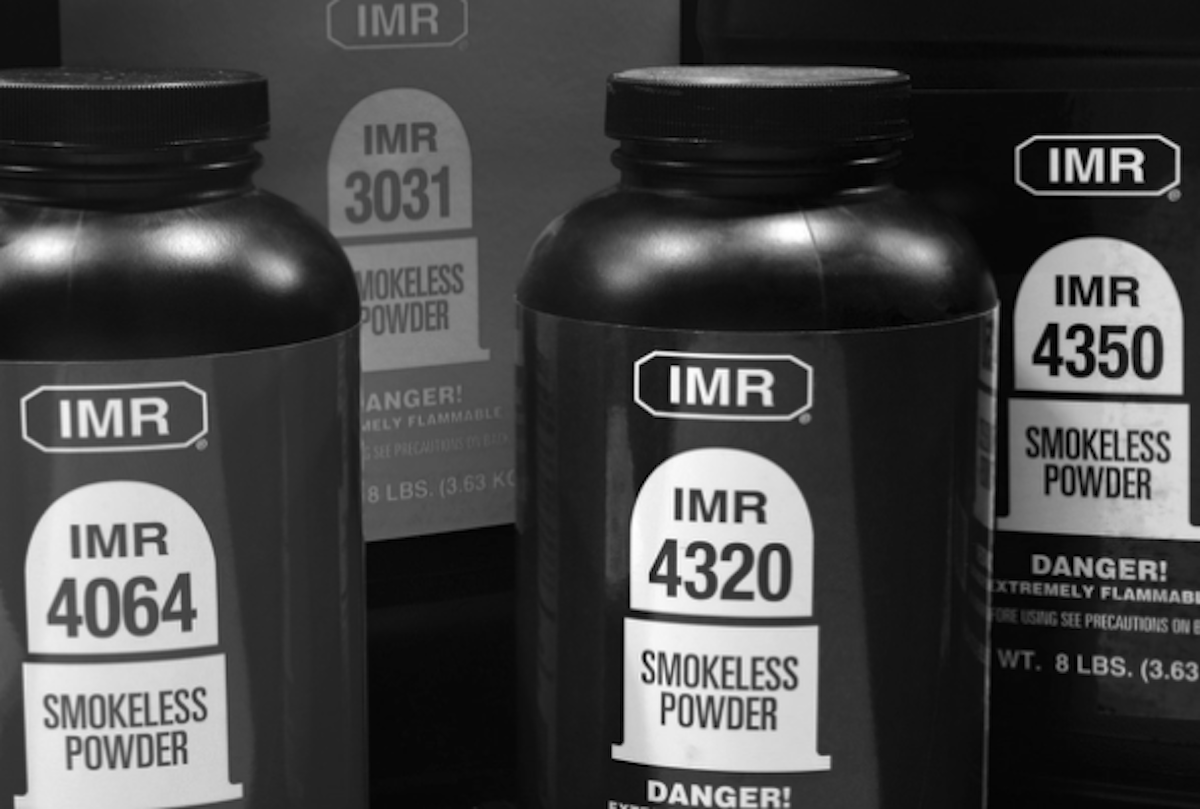
The next obstacle will be a general dearth of loading data, especially anything employing new powders. Fortunately, the older Lyman and Hornady manuals provide data, and almost all call for such readily available powders as the IMR line (3031, 4064, 4320, and 4350) and Hodgdon BL-C(2), H380, H4895, H4350, and H4831. Since the goal will generally be to match the published ballistics of the original factory ammunition, these work well.
For the loads listed in the accompanying chart, I referred to the Hornady Handbook of Cartridge Reloading, Third Edition (1980). These are all maximum loads, test-fired in both rifles (using the stutzen as a single-shot rifle where necessary as noted earlier), and none displayed any adverse pressure signs like sticky bolts or flattened primers.
A problem I did encounter with the African model when I bought it years ago was a flat refusal to accept any handload, of any power, with any bullet. The bolt stuck fast and needed to be opened with a mallet, although the cartridges showed no signs of excessive pressure. This was true even with new cases. I tried different brass, then reduced charges to absolute minimum, then trimmed the case necks short. Nothing worked. Finally, I took the rifle to a gunsmith and had the chamber reamed. The problem disappeared. Presumably, throughout its life, it had digested factory ammunition with no problem, but I have no way of confirming that.
That particular rifle is rather a mystery. African models, with long barrels (usually 26 inches) and three-quarter-length stocks, are rare anyway. Since the Steyr production records were either destroyed or removed by the Russians in 1945, much of what we know about rifle models and production numbers is either pieced together or outright conjecture. This rifle does not have a serial number in the usual place on the barrel just forward of the receiver ring, and there aren't any visible proof marks. Without going into further detail, it all appears that this was either a custom or a special-order rifle, or it has been rebarreled. It's beautifully made and finished to London standards.
My African model was drilled and tapped for a scope mount. There are two holes on the bridge to accommodate either a scope mount or a receiver sight, as well as holes on the ring and left rail to fit a Leupold Adjusto mount. It came with a Weaver scope, which I replaced with a Leupold FX-II Ultralight 2.5X 20mm scope. It gives that extra bit of range and optical advantage without interfering with operation or looking out of place.
While I admire the stutzen as an admirable tool for its intended purpose, which is scaling the Alps, the rifle with the long barrel is more fun and comfortable to shoot, is less erratic, delivers significantly better velocities, and tends to put all bullet weights at various velocities close together on the target. At longer ranges, of course, the different trajectories come into play, but the groups with different bullets range up and down as a result, not side to side. This makes it a very easy rifle to adjust for a different load.
It has long been an accepted tenet of handloading that in smaller calibers, slow powders are needed to coax higher velocities out of heavier bullets. At the same time, slow powders show much greater velocity loss in shorter barrels than do faster-burning ones. Here we have a contradiction, as far as the stutzen is concerned. It is made to take only 160-grain bullets, which demand slow powders, yet the barrel is so short that velocity loss is magnified.
Well, tough. That's the way it is, and while we might like it to be different, it ain't. We just have to live with it.
With its scope, higher velocity, and ability to feed lighter bullets, my favorite load for the African model uses the Sierra 130-grain GameKing HPBT. The stutzen is another matter.
A glance at the ballistics chart shows that from the stutzen, the 6.5x54 M-S delivers performance that barely matches the 30-30 Winchester, and no one has ever claimed the 30-30 is an elephant or grizzly rifle. Where it outdoes the 30-30 is in its combination of bullet weight, sectional density, and conformation. The 160-grain roundnose penetrates in a straight line and keeps on penetrating, whether the target is an elephant skull or the heavy bones and shoulder muscles of a grizzly bear. As long as the bullet is put in the right place, the result is a dependable kill.
If you don't believe it, you can check with Karamojo Bell, Charles Sheldon, Werner von Alvensleben, and Margot Macomber. It certainly worked for them.