


To assess the results of my reloads with the new High Gun powder, the speed of the shot charge is required. Measuring the speed of a projectile is important. The speeds of shot charges in loading manuals only give the reloader the performance of the load in the laboratory. Today’s chronographs handloaders use have photoelectric screens to start and stop a timer to measure the time it takes the shot to travel a known distance. This is then expressed as feet per second (fps).
This process is relatively simple for single projectiles, but it is much different for multi-projectile loads, i.e., shotshells. The problem then is to know when to start and stop the timer. A shot charge starts to change shape as soon as it leaves the muzzle of the gun. It starts to “string out,” and a Full choke tends to “squirt” the shot out, which elongates the leading edge of the shot cloud. Thus, it’s usually the leading pellet that starts and stops the timer, if there is no interference from the muzzle blast, which is going much faster that the shot itself. The blast can start the timer before the shot gets over it or stop the timer before the rear portion of the shot passes over it. Both give erroneous readings. This, I must point out, also applies to the best factory ammunition, as well as to our reloads. I have checked the speed of factory-loaded shotshells, and they vary as much as most reloads.
The skyscreens we handloaders use can be effective for shotshells, with certain modifications to the procedure. The first thing is to use the most open choke you have for the test gun; actually, Cylinder is best. Next, we have to protect the skyscreens from the muzzle blast and extraneous ejecta, such as pieces of wads that come along right after the shot.
Here’s what I use with my Oehler Model 35P chronograph. I gratefully acknowledge the previous writings of Dr. Ken Oehler, Ron Reiber, Don Zutz, Ed Lowry, Dr. Mark Denny, and Ross Seyfried on this subject.
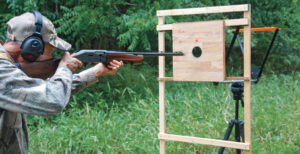
Placing a “baffle” between the skyscreens and the gun’s muzzle protects the screens from the muzzle blast and extraneous ejecta. The baffle I use has a 3.0-inch hole through which to shoot. I have chronographed hundreds of shotshells, and the baffle gives good results.
The skyscreen spacing is much different for shotshells but is essential for good results. Use a skyscreen spacing of two feet. Place the start screen about four to five inches above the line of the shot, and no more than about six to eight inches behind the opening in the baffle. Shoot with the gun’s muzzle about eight inches in front of the opening in the baffle. Be sure to wear eye and ear protection, and be careful not to hit the baffle. (I haven’t hit mine yet!)
The best “yardsticks” with which to assess shotshell performance are factory loads. We all have a “favorite” factory load for a certain use, such as for skeet, trap, quail, or whatever. So chronograph that factory load. Then load reloads with a range of powder charges that will encompass the desired speed. Then chronograph them on your system and compare the results.
Shoot at least five rounds per powder charge. Make up a data sheet and record your results: speeds, extreme spreads (E.S.), and standard deviations (S.D.). Strive for uniformity. A useful statistic that’s easy to calculate is the “coefficient of variation.” This is the standard deviation expressed as a percent of the average speed. It provides an apples-to-apples comparison. Anything under 2 percent is darn good. The load can be fine-tuned to be closer to the desired speed by linear regression, easily done by Excel or on a scientific calculator.
Finally, don’t be alarmed if the speed of the factory load you get is considerably different than the speed (velocity) printed on the box. This is of no consequence. The goal is to mimic the handload to a proven factory load measured on your system.
It is also important to keep the powder where it belongs—under the plastic wad—and not sifting down around the shot. The fit of most plastic wads in the shell casing is pretty loose, and when loaded shells are stored base-up, a fine-grained spherical powder can sift down past the wad and mingle with the powder.
A good approach to this problem also applies to the volume issue noted above. “Nitro card” wads are available in various thicknesses, and if the shell is not full enough, one or more card wads can be placed over the powder, and then the plastic wad can be seated. As a bonus, this usually produces more uniform velocities. Card wads should not be used with tapered cases like Winchester AA and Remington Nitro 27.
For testing I used my Mossberg Model 930 Sporting semiautomatic shotgun. It has a 28-inch ported barrel with Briley screw-in choke tubes. I used the Improved Cylinder choke tube for all testing. I should note that after shooting many High Gun handloads, the bore of the Model 930 had only a few flakes of fouling. I don’t know what’s in this new powder, but I can report that it really burns very cleanly.
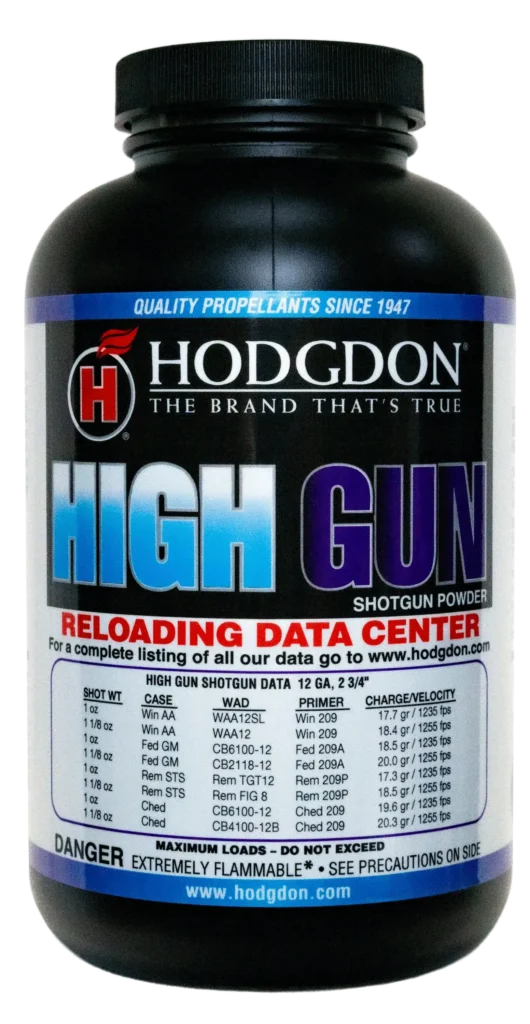
Hodgdon’s data are corrected to muzzle speed, which is somewhat different from the results we get with the system as described herein. But the important point is that your test loads are measured on your system in your gun.
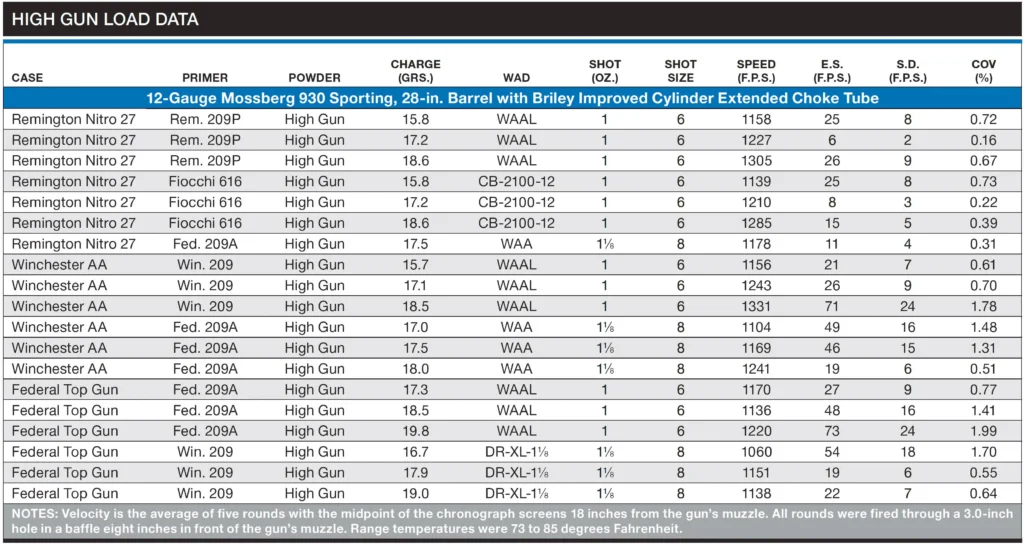
Hodgdon’s data utilized as many as six different primers, three wads, and three to four speed levels. After reviewing this mass of data, I selected 19 load recipes that involved as many different primer, wad, and powder charges as I thought were reasonably possible.
I had several of the plastic wads utilized in Hodgdon’s loads, and I had good luck filling most brands of cases for a good crimp. Winchester AA and Remington Nitro 27 worked best with my test loads, and all test loads cycled the gun’s action. No malfunctions of any kind occurred.
There were virtually no differences in the S.D.s between primers, wads, and cases. However, on average, the 1-ounce loads were somewhat more uniform than the 11⁄8-ounce loads. Remington Nitro 27 and Winchester AA cases worked the best in my tests. Given the excellent results I had with High Gun and Remington Nitro 27 and Winchester AA cases, I can recommend them for High Gun reloads.
As for the chronographing results, let me first say that I have chronographed hundreds of shotshells, and I was prepared for data that varied all over the place. Boy, was I surprised! The High Gun test loads had the most uniform speeds of any group of shotshells I have ever tested. I would put these loads up against any factory load for ballistic uniformity. Plus the gun tossed fired hulls in a neat pile a few yards from the gun, which also is a good indication of extreme uniformity.
My “yardstick” for this project was Fiocchi’s VIP-Target factory ammo. It carried 11⁄8 ounces of No. 7½ shot at a listed speed of 1,200 fps. Note that this load registered 1,151 fps from my shotgun over my system. Most of my 11⁄8-ounce loads with High Gun matched or beat this speed with a charge of 17.2 to 17.5 grains. After reviewing the results, I can pick out several for use on clays or game farm birds.
Here are some loads that stand out. I think a speed of 1,175 to 1,185 fps is nigh on to perfect for shotshells with 1 ounce and 11⁄8 ounces of shot, and there were many loads with High Gun that registered in that range. In the Winchester AA or Remington Nitro 27 cases, a charge of 17.0 to 17.2 grains of High Gun gave the desired speed of around 1,170 to 1,227 fps. For a 11⁄8-ounce load, a charge of 17.5 grains was perfect, coming in at 1,178 and 1,194 fps for the two cases in the same order.
High Gun powder is brand new and is packaged in 1-, 4-, and 8-pound containers. The list prices are $31.99, $121.99, and $237.99, respectively. With a nominal charge of 17.5 grains (perfect for a 1-ounce load), a pound of High Gun will load 400 shells. Coincidentally, there are 400 ounces in a 25-pound bag of shot.
As I look back on my experience with the new High Gun powder, it appears that it may be the perfect propellant for the 12-gauge reloader. A little goes a long way, it meters nicely through the loader, the speeds are super uniform, and it burns very cleanly. Oh, and it’s made in the U.S.A.
The few months I’ve spent shooting reloads with High Gun powder fill me with anticipation of the coming clay target and hunting seasons and make me think of my favorite quote from the great Gene Hill:
“What friends I have, what days I treasure most, what places that I think about and smile. They are because shotguns are.” High Gun gets high marks, indeed.