


A look at how alternate small pistol primers compared against book-load CCI 500 components in midrange 9mm Luger handloads.
If you have been small pistol primer shopping and not found your desired primer on the shelf, you may have opted for a different company’s primer to keep on shooting. Or perhaps you found a cheaper-priced primer than your usual brand and want to give it a try but are nervous about how it will perform. These are common predicaments in which many reloaders find themselves.
Hodgdon is specific on which company’s cases and primers were used in the generation of the load data. In the “Warning” on page 73, you’ll read that “If the reloader makes any changes in components or gets new lot numbers, he should begin again with the starting loads and work up to maximum cautiously.”
It would be impossible to give a blanket statement saying something to the effect of “If you switch to X primer, drop down Y percent grains, and your pressures will be the same.” Instead, the purpose of this article is to provide information that will help create safe handloads no matter what primer brand you have on the reloading bench.
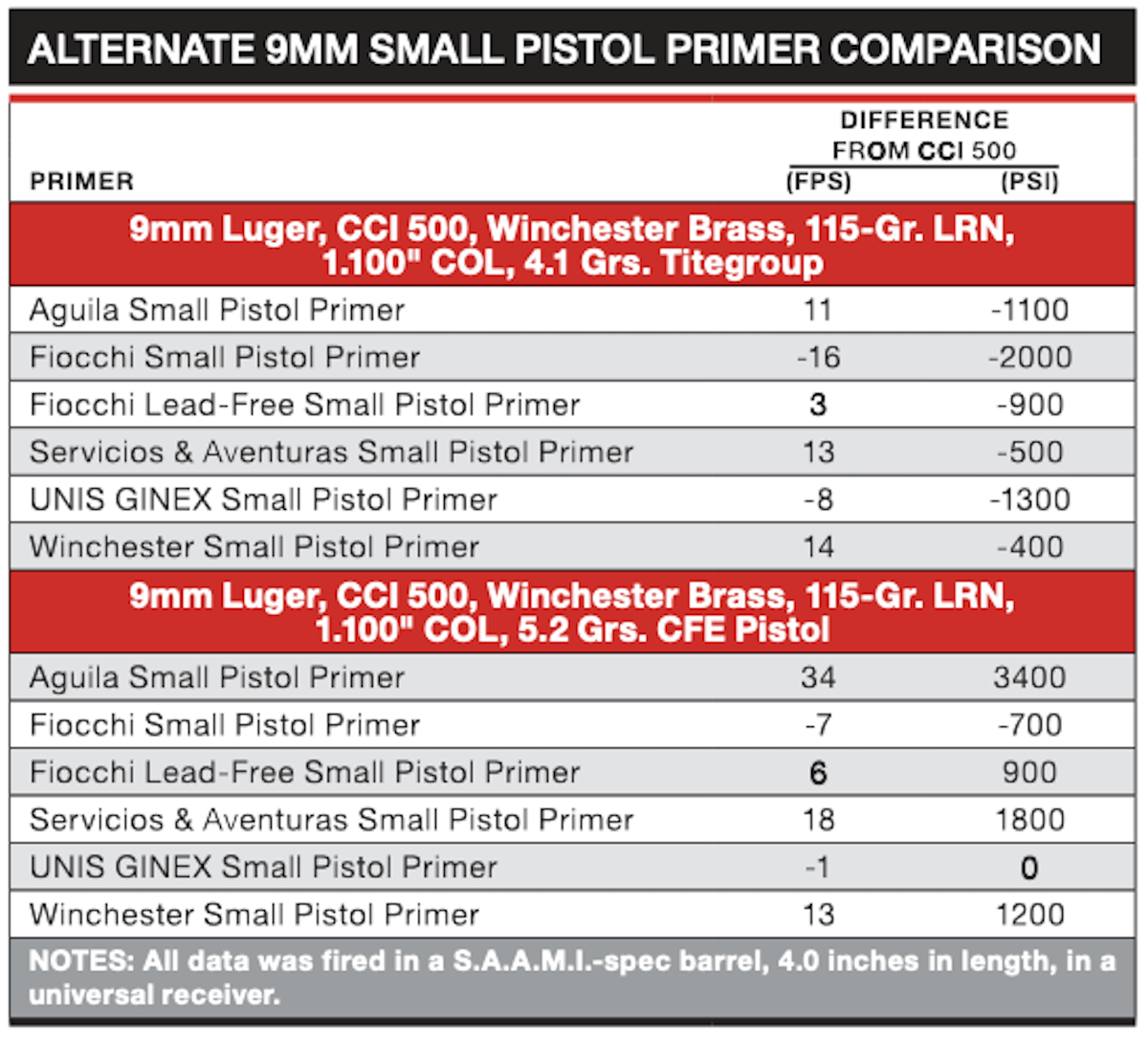
For this test, a midrange 9mm Luger load was selected with a 115-grain lead RN bullet and two popular Hodgdon pistol powders: Titegroup and CFE Pistol. The Hodgdon data was shot at ambient conditions with the CCI 500 Small Pistol primer, but how do other primers perform? Looking at the numbers shows that the results with various primers are promising.
The accompanying table will show the difference for various primers versus the book-load CCI 500.
First, looking at the velocities, it is hard to complain about any differences! The furthest any primer got was 34 fps away from the CCI 500. The rest were within the teens or single digits of the velocity for book-load components. That means your velocity and power factor are going to remain consistent if you change primers.
Second, and more importantly, a look at the pressures reveals that the furthest from the CCI 500 load was 3,400 psi. Almost all the other pressures were less than 2,000 psi away. Many were only hundreds of psi away.
Third, the fact that the same primer varied above or below the mean in the two tests shows that other variations, such as loading tolerances, etc., may play as big a part in the variation as the primer type.
The S.A.A.M.I. Maximum Average Pressure (MAP) for 9mm Luger is 35,000 psi. A cursory look through Hodgdon data shows that many loads leave a buffer of pressure below MAP. We do this to ensure the handloader does not exceed the S.A.A.M.I. max-pressure limit.
If you are trying to push all the way to the published Maximum Load, using the exact components in the Hodgdon data will make for a safe load. Even in this instance, starting low and working up cautiously is the recommended practice, as many variables, such as powder lot, primer lot, and case lot, can change pressure and velocity.
For those who have the goal of changing a component like primer brand, maintain the practice of starting low and working up cautiously. Check for pressure signs and shoot over a chronograph to watch velocities. You will be able to get a load that shoots similarly to your original primer.
Stay safe and enjoy shooting!
Maintain the practice of starting low and working up cautiously.
Alternate 9mm Small Pistol Primer Comparison