Here are the results of some inch-by-inch tests that will give you a practical basis for comparing load data and barrel lengths.
by Staff Report
You just purchased your brand-new firearm and can’t wait to get some loads worked up, so you have been reading all the load manuals at your disposal. One of the first things you notice is that the barrel length of your new firearm is different than the barrel lengths of the firearms used to generate load data. Why do the load manuals all use the same length barrels that are different than the barrel on your rifle? How do you compensate for the difference in your barrel versus the test barrel in the reloading data?
The Sporting Arms and Ammunition Manufacturers Institute (S.A.A.M.I.) sets the standards for test barrels used by the various ammunition, bullet, and powder manufacturers’ ballistics labs. This helps keep the data generated by the various entities uniform from lab to lab. The specified barrel length for most rifle calibers is 24 inches, whereas in handgun calibers, the barrel length varies.
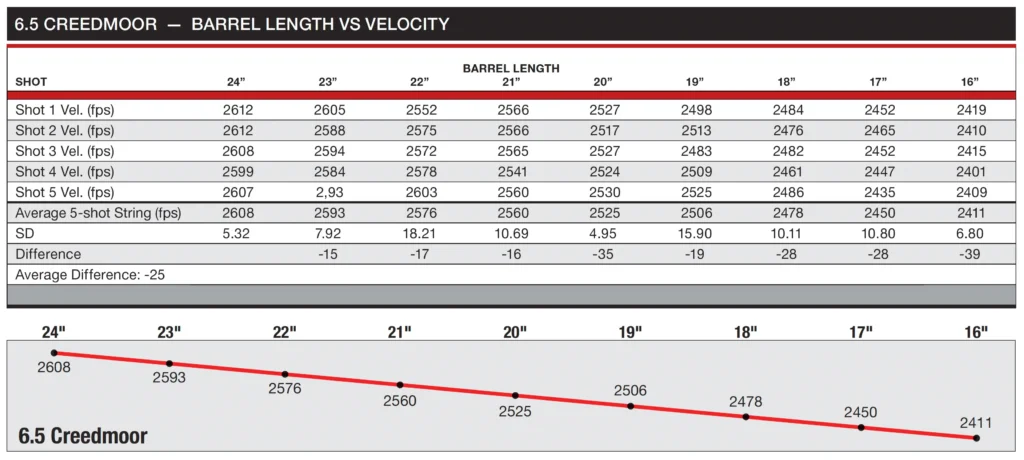
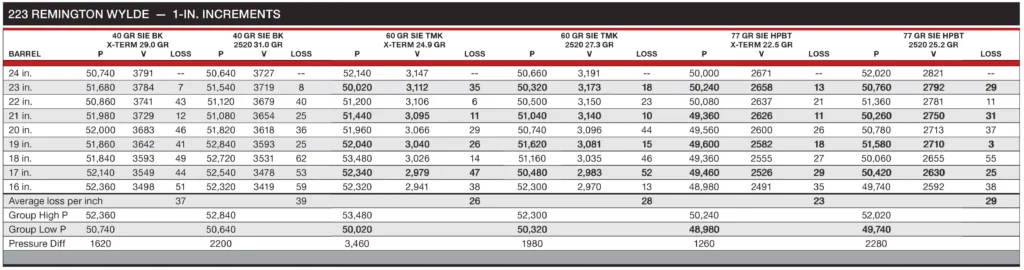
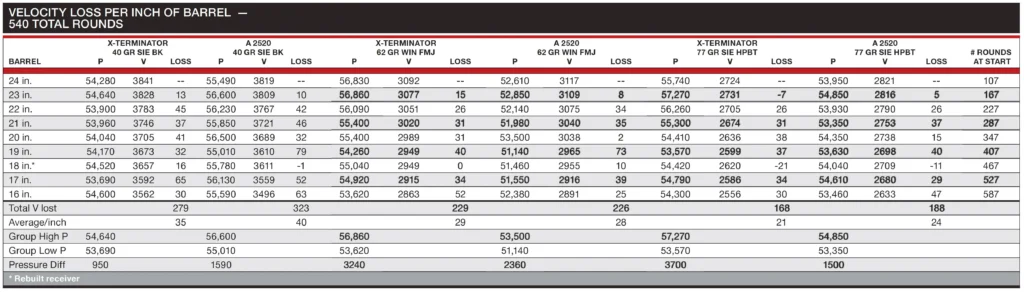
We have on hand the results of three rifle barrel length versus velocity tests conducted by our ballistics lab as well as one handgun study. In the rifle barrel versus velocity tests, we started with a 24-inch 6.5 Creedmoor and two 24-inch 223 Wylde barrels. We fired five-shot groups through each barrel, then shortened the barrels in a lathe an inch at a time after each subsequent five-shot group, going from the original 24 inches down to 16 inches. The barrels were cleaned to remove all fouling each time they were shortened. In the 223 Wylde barrels, we shot three different bullet weights—40, 60, and 77 grains—using a fast for this caliber powder (Ramshot X-Terminator) and a slow for this caliber powder (Accurate 2520).
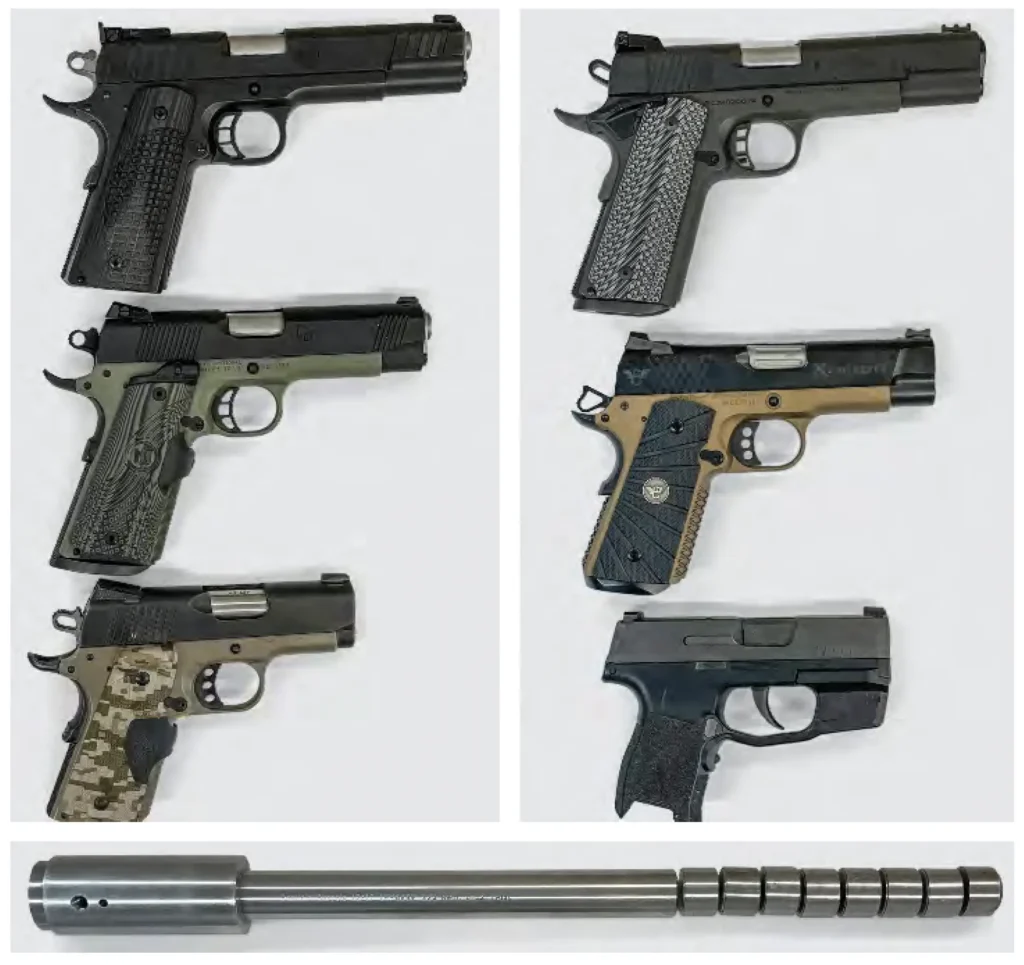
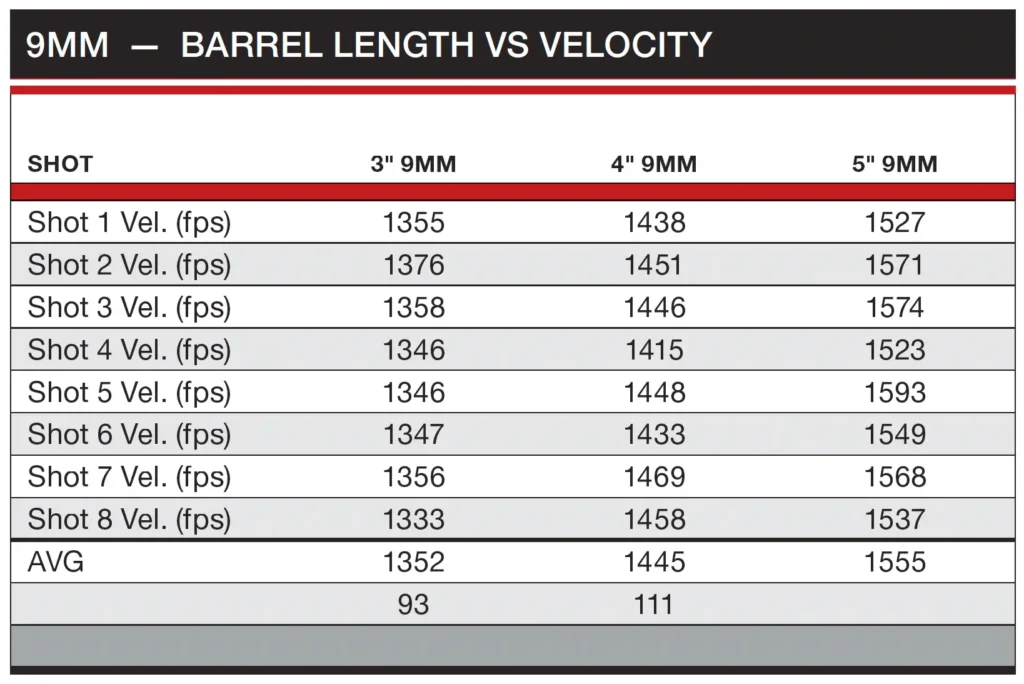
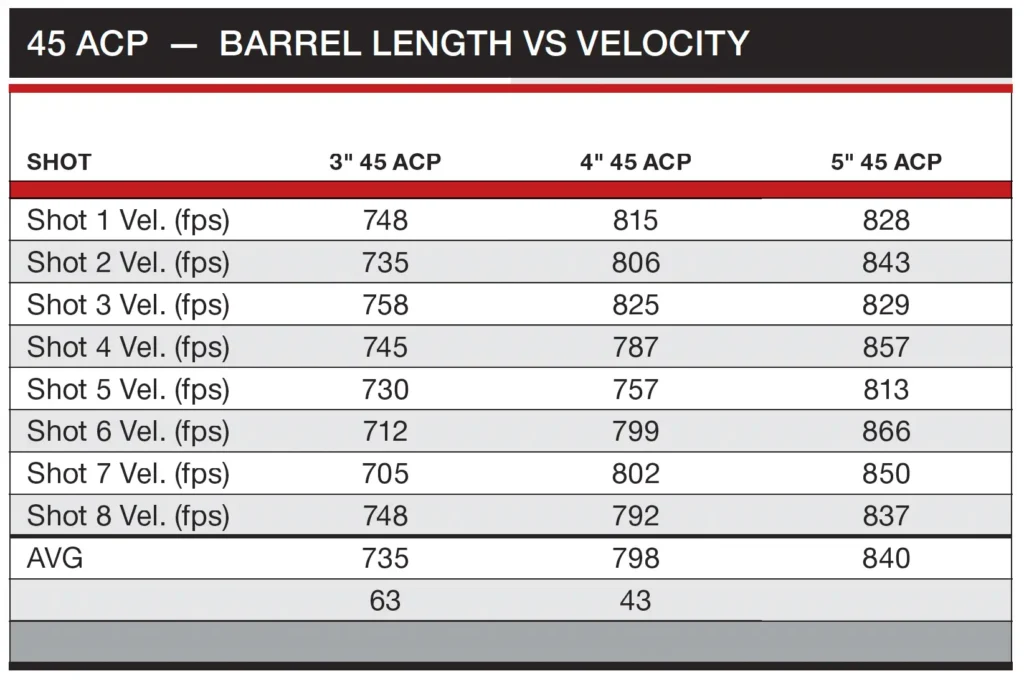
In the handgun test, we fired 9mm Luger and 45 ACP pistols with barrel lengths of 3, 4, and 5 inches for both calibers. The 9mm Luger load was a factory 90-grain +P self-defense load, and the .45 ACP load was factory 230-grain ball ammunition.
While the results of these tests aren’t totally linear, using the average velocity drop for the entire test will get you close to the velocity difference you would expect for a barrel that is shorter or longer than the test barrel used in a ballistic lab. The 6.5 Creedmoor velocity drop averaged 25 fps per inch. The results of the two 223 Wylde tests were very similar, with the light 40-grain bullets averaging about 38 fps per inch, while the heavy 77-grain bullets saw an average close to 25 fps per inch. It would make sense that the heavy compressed loads used with the light bullets would show more velocity difference than the loads used with the 77-grain bullet that did not fill the case.
This shows that there isn’t an exact answer to how much your personal rifle will vary from the reloading manuals, but if you use 25 fps for most standard hunting calibers, you will be close. For overbore cartridges that use a lot of powder for the bore size, 35 fps per inch will get you closer to what you should expect.
The handgun test, while not as extensive, gave us a good idea of what to expect, and the results were very linear. The 9mm +P load came very close to averaging 100 fps per inch of barrel. We have seen the same results with 9mm Luger 125-grain competition loads. The 45 ACP gave us approximately 50 fps difference per inch of barrel. As you can see, there is a much larger variation in the handgun calibers than what we see in the rifle calibers.
While there are no definitive rules as to how much velocity difference you will see, these tests should give you an idea of what to expect with your firearm. In the future, we hope to continue exploring other variables in the velocity difference equation, such as very overbore and straight-wall rifle cartridges. In the meantime, the numbers from these tests will get you in the ballpark.
The Hodgdon Ballistics Lab measured velocities in 6.5 Creedmoor and 223 Wylde rifle barrels and in 9mm Luger and 45 ACP pistols, reducing the barrel lengths one inch at a time to derive an average velocity difference per inch of barrel.