




You remember that old Barbara Mandrel song "I Was Country When Country Wasn't Cool"? Yeah, well, that's me with the 300 AAC Blackout.
Right now this is one of the hottest cartridges in the AR-15 platform, and it's up there riding the cutting edge of "cool." But my association with it goes back way before it changed its name and was "discovered" by the cool kids.
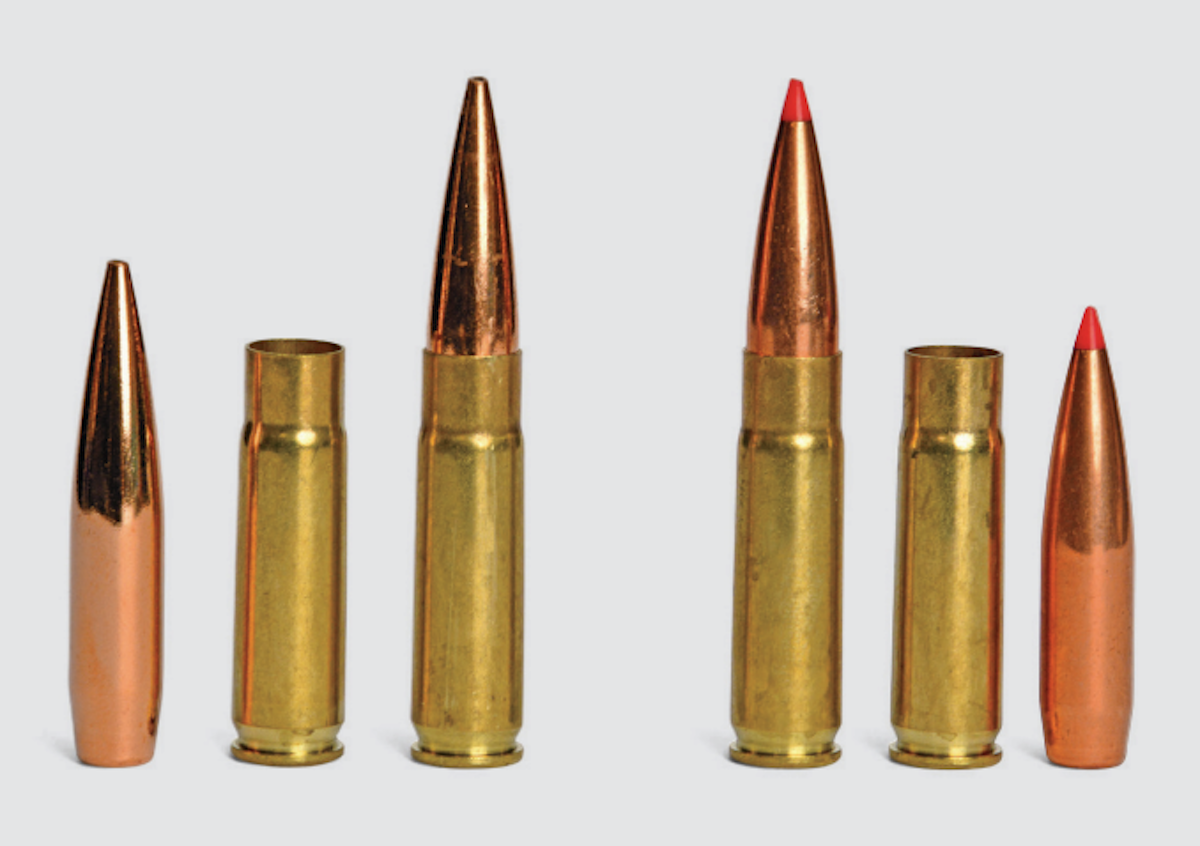
Back during the Mesozoic Era, this cartridge was called the 300 Whisper. It was developed by J.D. Jones of SSK Industries in the early 1990s by necking up the 221 Remington Fireball case to take a .30-caliber bullet. Jones designed the cartridge to be used in guns with suppressors at subsonic velocities with heavy 200- to 220-grain bullets. It was the first, and arguably the most successful, of his "Whisper" line of subsonic cartridges.
That was well before the current surge in AR-15 rifle popularity and when hardly anybody was hunting with that rifle platform. Jones was well known in handgun-hunting circles and was one of the modern-day founding fathers of the sport. He hunted the world with handguns and created some very big developments in firearms and cartridges. He published a magazine on handgun hunting and wrote articles and columns on handgun hunting for some of the largest national magazines. He was presented with Pistolsmith of the Year and Outstanding American Handgunner awards and was inducted into the Handgun Hunters Hall of Fame.
As could be expected, the 300 Whisper quickly found its way into the circle of handgun hunters. SSK Industries chambered barrels for the Thompson/Center Contender. Hunters soon found that using 125-grain bullets going well above the speed of sound worked to shoot deer and similar game.
I was writing about handgun hunting quite a bit back then, and J.D. asked me what I thought of the cartridge. I told him I was inclined to think it was a bit small for hunting deer and similar big game.
"You ever shoot anything with it?" he asked. I admitted I had not.
The next day there was a Contender barrel and a set of dies on my front porch. J.D.'s note said, "Go shoot some stuff with the cartridge and get back to me."
So I did—deer and hogs mostly, but some coyotes, woodchucks, prairie dogs, and other game, too. I experimented with handloads and bullets until I thought I knew the cartridge pretty well. As I recall, T/C later brought out a factory barrel, and I shot one quite a bit. I am not really a record keeper, but I am confident that over the years I fired several thousand rounds of 300 Whisper at the range and at game from those single-shot handguns.
Cartridges come and go; that's just the way of this business. After a few years of hunting, handloading, and shooting with the cartridge, focus shifted, and I moved on to the next project.
Years went by, and in 2011 I was at the DPMS "Outbreak Omega 4" gathering at Ahlman's Gun Range in Minnesota. At the prize ceremony some lucky guy won an AR-15 chambered for 300 AAC Blackout. When they announced that, there were a lot of puzzled looks in the crowd. "The 300 what?"
I was the gun writer at the table, so everybody expected me to know these things. All eyes turned to me, and somebody said, "What's a 300 AAC Blackout?" I had to admit I didn't have a clue, but you can bet I found out as soon as I could.
The 300 Blackout
The 300 AAC Blackout was "developed" by Advanced Armament Corporation's Research and Development Director Robert Silvers and presented as a S.A.A.M.I. cartridge. It's pretty much the same cartridge as the 300 Whisper, except with a different name. I have looked at the drawings, and the differences are minuscule. The point is we now have a standardized S.A.A.M.I. cartridge that manufacturers can work with.
S.A.A.M.I. (Sporting Arms and Ammunition Manufacturers Institute) sets and controls the standards for manufacturing firearms and ammunition—standards like dimensions and pressure levels. Members all use the same guidelines and standards, which eliminates compatibility issues. The 300 Whisper was a wildcat cartridge without S.A.A.M.I. standards. S.A.A.M.I. set the dimensions for the 300 AAC Blackout cartridge and firearms. It also set the mean average pressure (MAP) at 55,000 psi, the same as for the 223 Remington.
The 300 Blackout has two advantages over the Whisper. Timing is the first. It came along just as the tactical side of shooting was taking off with the mainstream. The second is good marketing. With some powerhouse names behind the cartridge, the public awareness went through the roof. The "tacticool" name didn't hurt, either.
I gotta admit, no matter what you call it, it's a lot more fun shooting this cartridge in a semiauto AR-15 than it was from a single-shot handgun.
I concluded again that I wasn't far off with my first opinion. It clearly will take down deer, hogs, and similar game—that's been more than proven—but it's at the low end of the "acceptable" power level for hunting this class of game. However, it whacks smaller game with authority, and it brings a lot to the table for defensive use. It's also a fun cartridge for target shooting.
Hunting or defense, subsonic or Mach II, the 300 Blackout is just not a powerhouse, and it lacks the case capacity to ever claim that title. But with bullets that are engineered specifically for this cartridge, I liken it to a well-trained lightweight MMA fighter who uses every single bit of the available potential to deliver a knockout blow.
It shines most where Jones designed it to be used: with heavy bullets running subsonic. The interest in owning suppressors is growing every day. States are changing regulations to allow them, often for hunting, and there is even a push now to remove silencers/suppressors from the National Firearms Act. That will make them even easier to own and cause an explosion in their use.
In the parts of Europe and Africa where I have hunted, suppressors are common. It puzzles me and many others why they are so difficult to own here. They are nothing more than a muffler, not unlike the one required by law on your car, motorcycle, or lawn mower. If I had used them more over the years, I probably wouldn't need these expensive hearing aids I wear every day. Suppressors and subsonic ammo make good neighbors, and gun ranges will have far fewer complaints with their use. Additionally, they are just fun to shoot!
Handloads Need the Right Powder
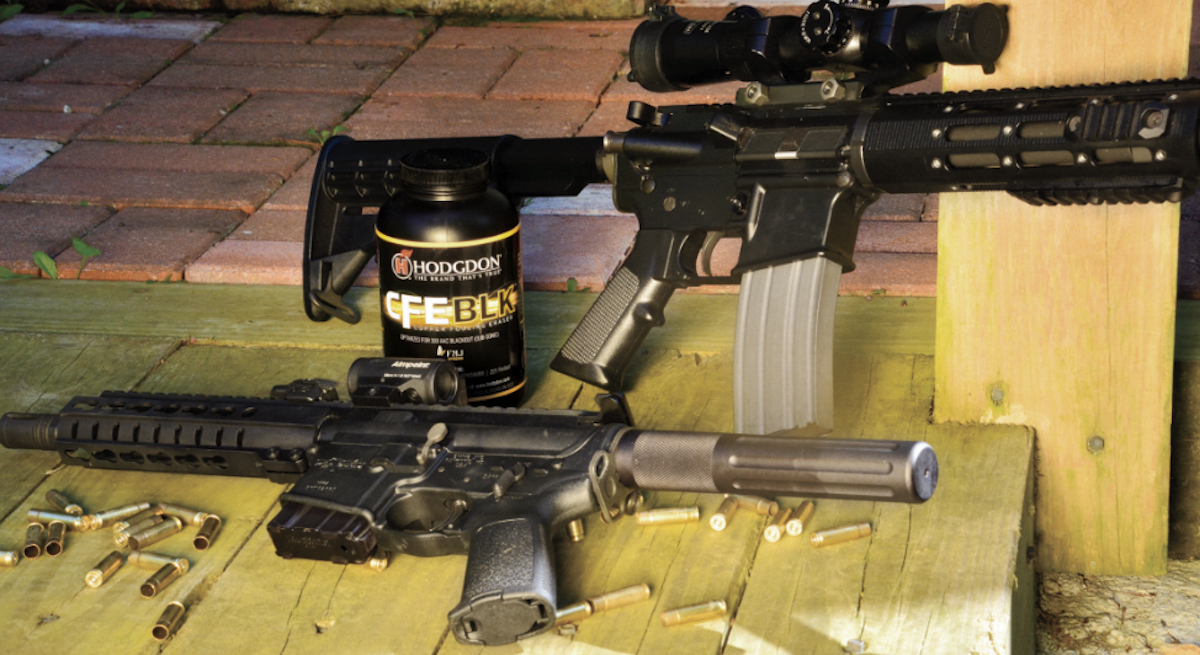
Life is not perfect, though. This is a low-volume cartridge, and as a result it doesn't always play nice with handloads in gas-operated, semiauto rifles—particularly with subsonic loads using heavy-for-caliber bullets and pixie dust powder charges. Remember, any cartridge must produce enough propellant gas to fill the barrel to the gas port while maintaining enough pressure and volume to cycle the rifle's operating system. The AR-15 was designed to operate with a 223 Rem./5.56 cartridge, and when you wander off that path, it can become problematic. Anytime you reduce the case capacity, you reduce the gas volume from a fired cartridge. You can tweak the firearm with adjustable gas ports and modifications to the operating system, but in the end, the ammo does the work, not the gun.
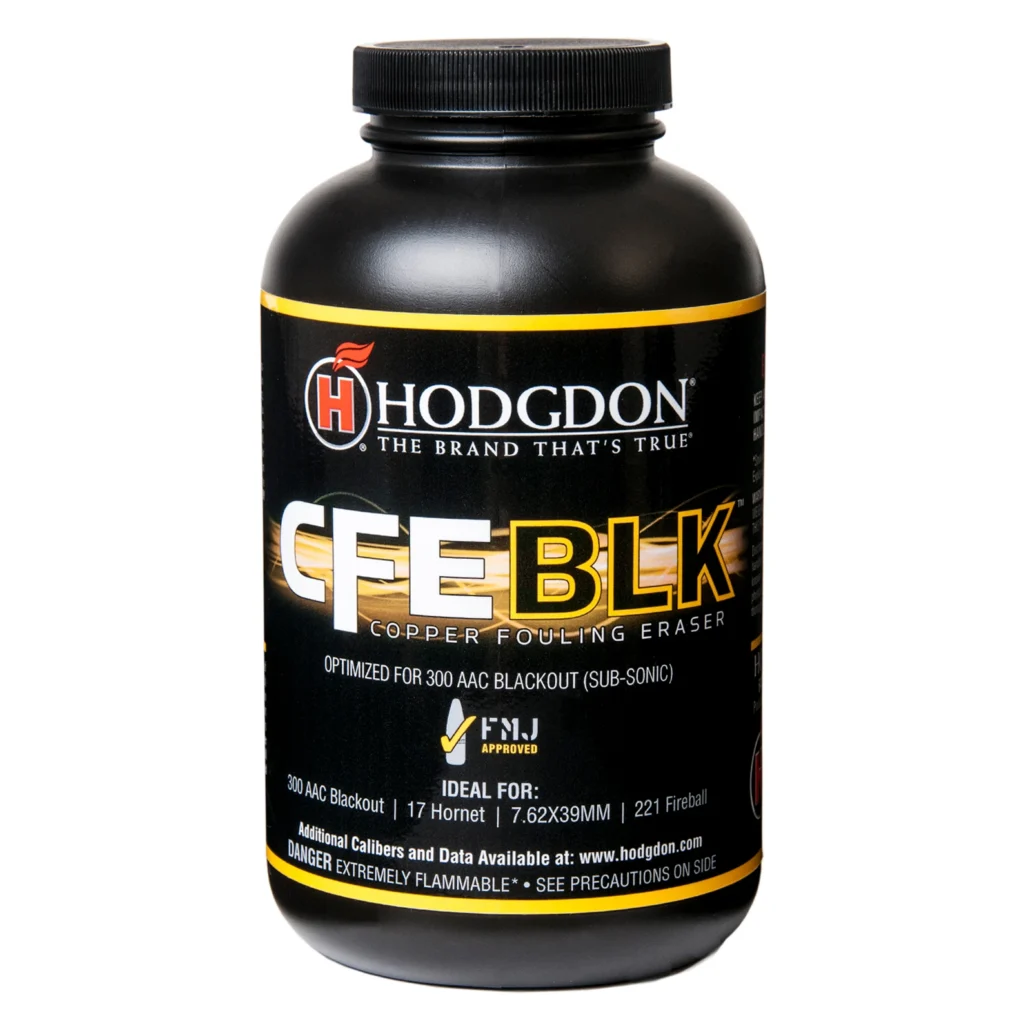
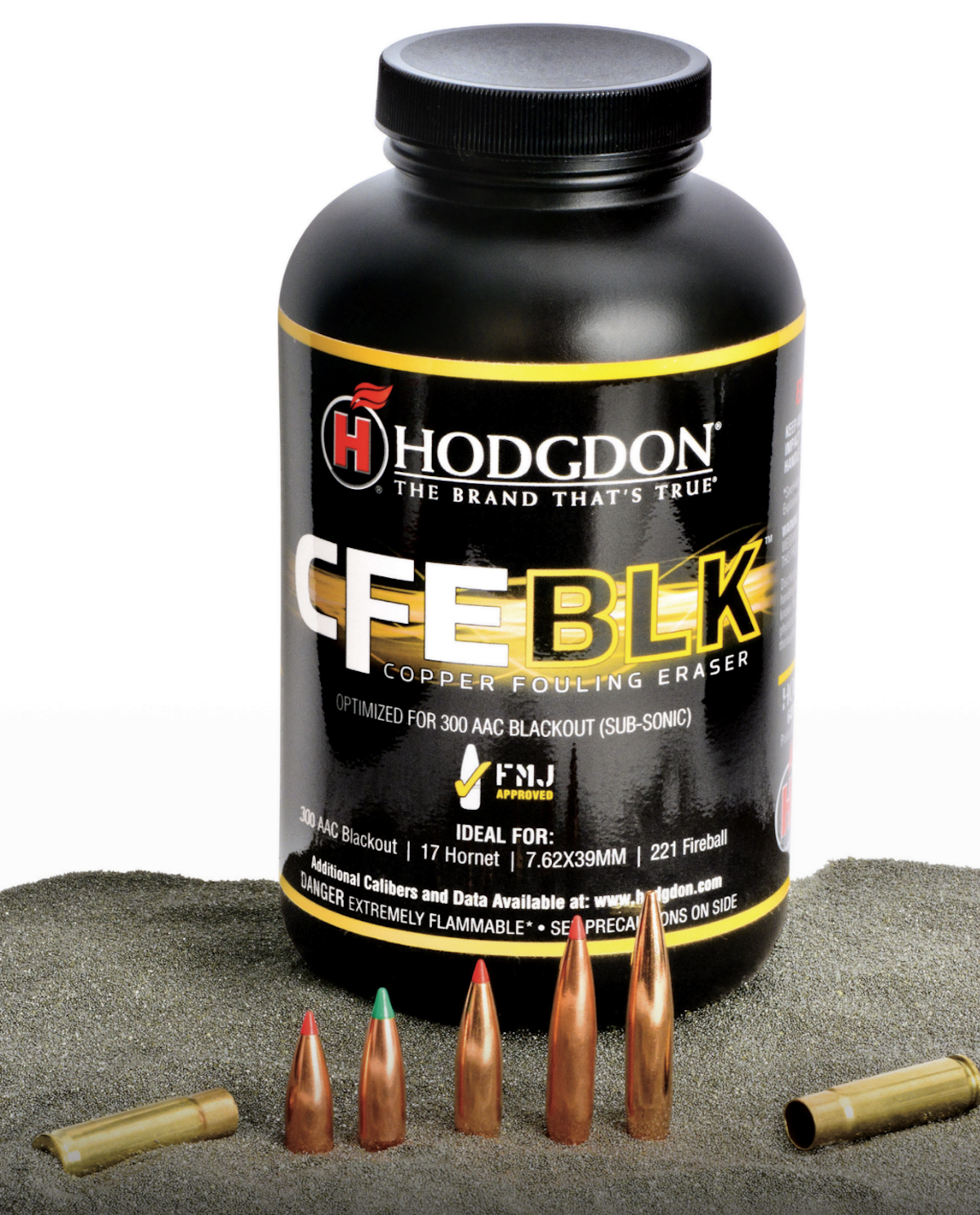
The folks at Hodgdon recognized this and decided to create a new powder designed specifically for the 300 Blackout cartridge. Even more specifically, it was designed to cycle an AR-15 reliably with heavy-bullet subsonic loads. But they didn't want to limit the powder to only that use and developed a propellant that would work across the spectrum of bullet weights used for the 300 Blackout.
The new powder is in the Copper Fouling Eraser (CFE) family of powders. This started in 2012 when Hodgdon introduced CFE 223. I wrote the article on that powder that appeared in that year's Annual Manual. I was truly amazed at how well it worked. It reduced fouling as expected, and it was an incredibly accurate powder. Usually, it would provide the highest velocity of any powder I tested in appropriate cartridges. It became my powder of choice in 223 Rem., 204 Ruger, and similar cartridges. It was the first powder I turned to when I built a new 223 Ackley Improved rifle. I just finished the first round of testing with that cartridge using Hornady 55-grain V-Max bullets and could not be happier. It produced excellent accuracy and 3,400+ fps from the first load I tried!
Hodgdon followed in 2014 with CFE Pistol powder, and now for 2017 we have CFE BLK, which is designed for the 300 Blackout but also has shown to work in a wide range of small rifle cartridges and a few handgun cartridges.
How exactly this powder reduces copper fouling is a well-guarded secret—as it should be. When you invent something that's game-changing, you don't tell your competitors how you do it. What we do know is that the powder has an ingredient that greatly deters copper fouling by acting as a shield to the pores of the metal.
I questioned why we needed that in a relatively low-velocity cartridge like the 300 Blackout, and Hodgdon's Ron Reiber replied, "Any cartridge that has high-speed firing rates, or high velocity, benefits from CFE, so it was perfect for the 300 Blackout, and in all those speedy little varmint cartridges, too!"
I guess the 300 Blackout fits the category. It's like the old Lay's potato chip commercial, "Bet you can't eat just one." When shooting the 300 Blackout in an AR-15, you can't just shoot one.
I am amazed at how, time after time, I show up at the range with twice as much ammo as I think I will shoot and suddenly it is all gone. High-volume cartridges can indeed benefit from CFE technology. Believe me, nobody hates cleaning guns more than I do, so this powder is a blessing.
Proof of the Pudding
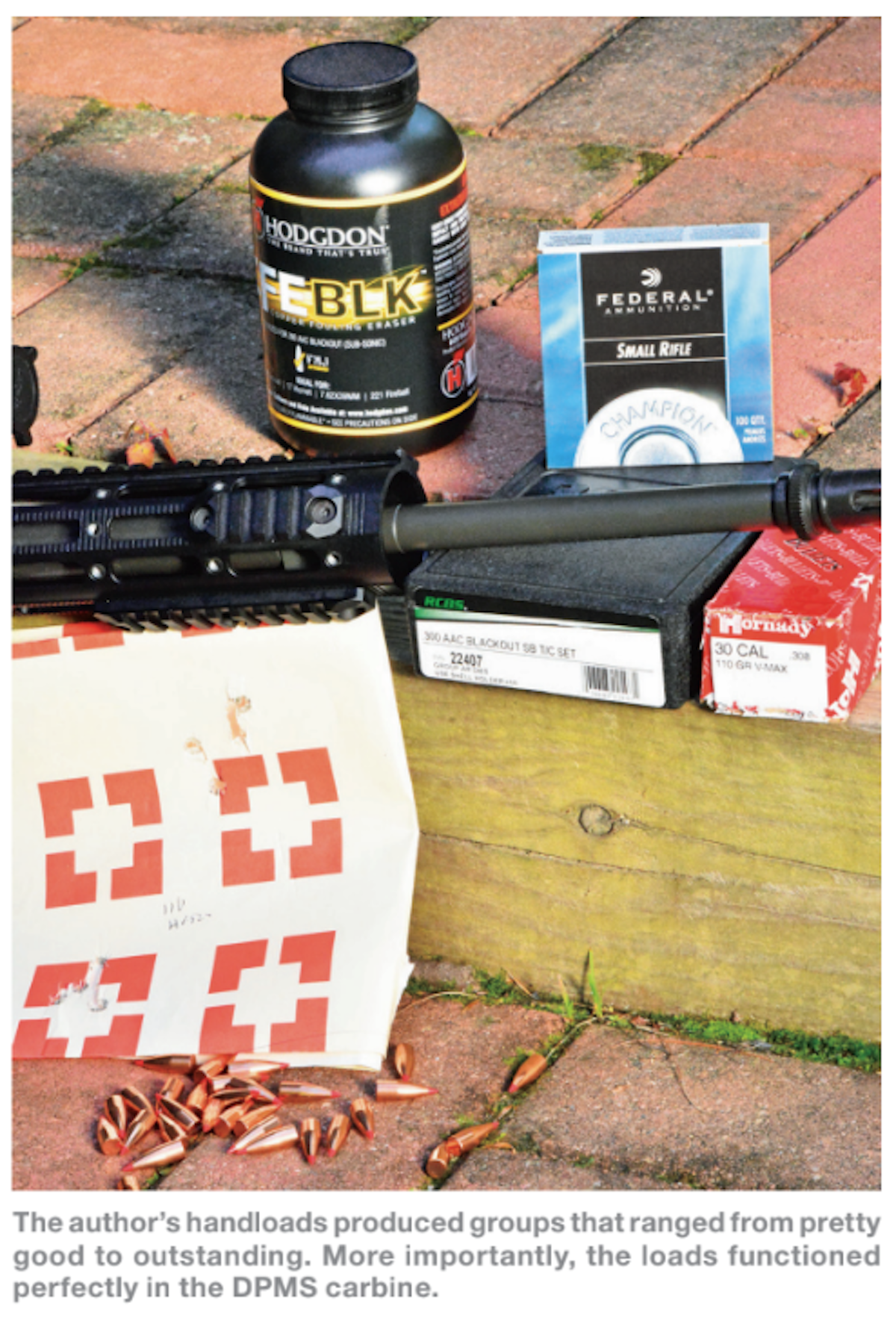
I know that Hodgdon has tested CFE BLK extensively, but I am the kind of guy who wants to see for himself. Using this powder and Hodgdon's data, I loaded 300 Blackout ammo using bullets across the weight spectrum. I used RCBS dies and new Hornady cases primed with Federal Small Rifle primers. The bullets included Hornady 110-grain V-Max, Nosler 125-grain Ballistic Tip (a longtime favorite bullet with handgun deer hunters in the 300 Whisper), and Hornady 150-grain InterBond and 208-grain A-Max bullets.
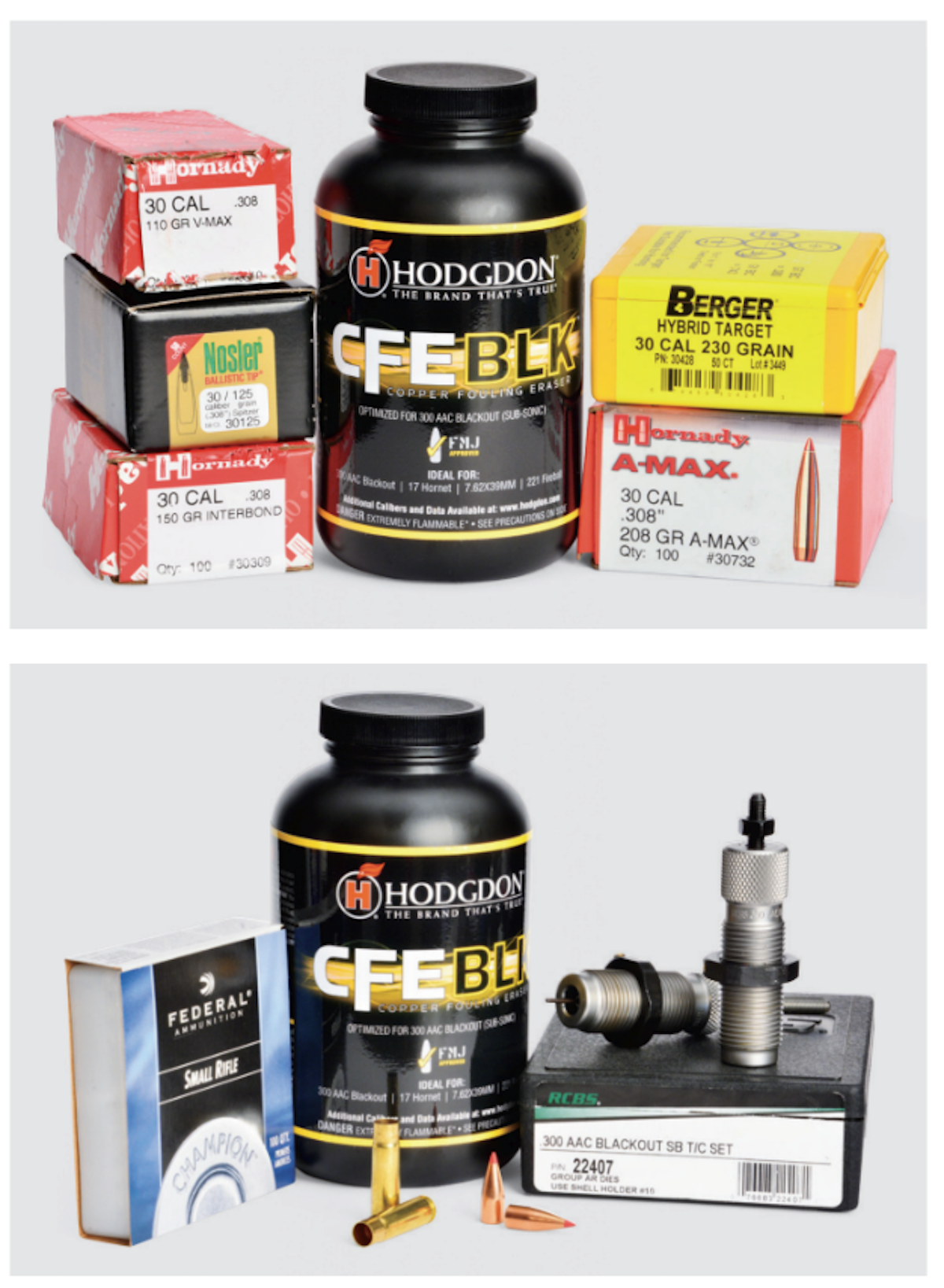
I shot them across my Oehler 35P chronograph for velocity and consistency, using a DPMS A-15 carbine with a 16-inch barrel and a 1:7 twist rate. I also shot the ammo for velocity from a CMMG MK4 AR-15-type pistol with a 7.5-inch barrel. The velocity results are shown in the accompanying chart. There were no surprises with the carbine; velocities were pretty much as predicted from the load data Hodgdon supplied. What did surprise me were the relatively high velocities from the handgun. Clearly this propellant is "short barrel" friendly.
I shot a few five-shot groups with the rifle and each of the loads while I was measuring velocity and consistency. I don't have a base line of accuracy with this rifle as it's new to me and this is the first ammo I have fired, but groups ranged from pretty good to outstanding. The best was five shots in 0.8 inch with the Hornady 110-grain V-Max bullet. Considering the gun's horrendous "mil-spec" trigger, I think the accuracy speaks well for the potential of this powder.
I was more interested in function with a gas gun, so that was my main focus. The load data I had was developed for a carbine-length gas system, and each and every one of these loads cycled the DPMS carbine flawlessly. I did not have a single failure during the course of testing a multitude of loads, amounting to several hundred rounds in total. After I finished the range testing, I mixed all the remaining ammo up in one big pile and loaded it randomly into 30-round magazines. I fired them into a Savage Range Systems Snail Trap as fast as I could squeeze the trigger on the DPMS carbine. While it was easy to tell the subsonic loads by the different sound and recoil, every round ran without a single issue, that is, except for a very hot barrel and my shop floor littered with brass.
With their short gas systems, AR-15 pistols are finicky beasts, but this pistol ran well with everything except the subsonic loads. I was shooting without a suppressor, and the folks at AAC tell me that if I added a suppressor, the gun should cycle fine. Not to point out the obvious, but what's the point of subsonic ammo if you are not using a suppressor? Reiber told me that it is safe to increase the powder charge with the subsonic loads until the pistol is producing 1,070 fps velocity, which will ensure proper function.
Reiber also explained that this powder's main goal was to function reliably with subsonic loads in carbine-length gas systems, so I went back to the loading bench. I found the heaviest bullets I had on my shelf (Berger 230-grain Hybrid Target monsters that look like an ICBM missile). At 1.65 inches, the bullets are much longer than the 300 Blackout case. I loaded 50 rounds and shot them through the carbine. As expected, they cycled without a single hiccup. I should note that I was not using a suppressor on the carbine. So if all the ammo, including the subsonic loads, will cycle with nothing but a squirrel cage flash hider on the muzzle, there should be no issues with a suppressor and the added gas system pressure helping to function the action.
CFE BLK performed exceptionally well in the 300 Blackout with bullets weighing from 110 grains to 230 grains, which is a very wide bullet weight range in a case this small. Accuracy was excellent, and as expected, even in a new barrel, copper fouling was almost nonexistent. This chrome-lined barrel cleaned up with a few patches and Barnes CR-10 solvent. When I can clean any AR-15 that has had hundreds of rounds through it in less time than it takes Hillary to tell a lie, it makes my heart do its happy dance.
If you are loading and shooting the 300 Blackout, this is sure to become your "do-anything," go-to powder. If you are loading subsonic in this cartridge, you now have the mission-specific propellant you have been waiting for.