



With certain powders bearing similar label numbers, you may be wondering how they compare performance-wise. Here’s one set of comparisons.

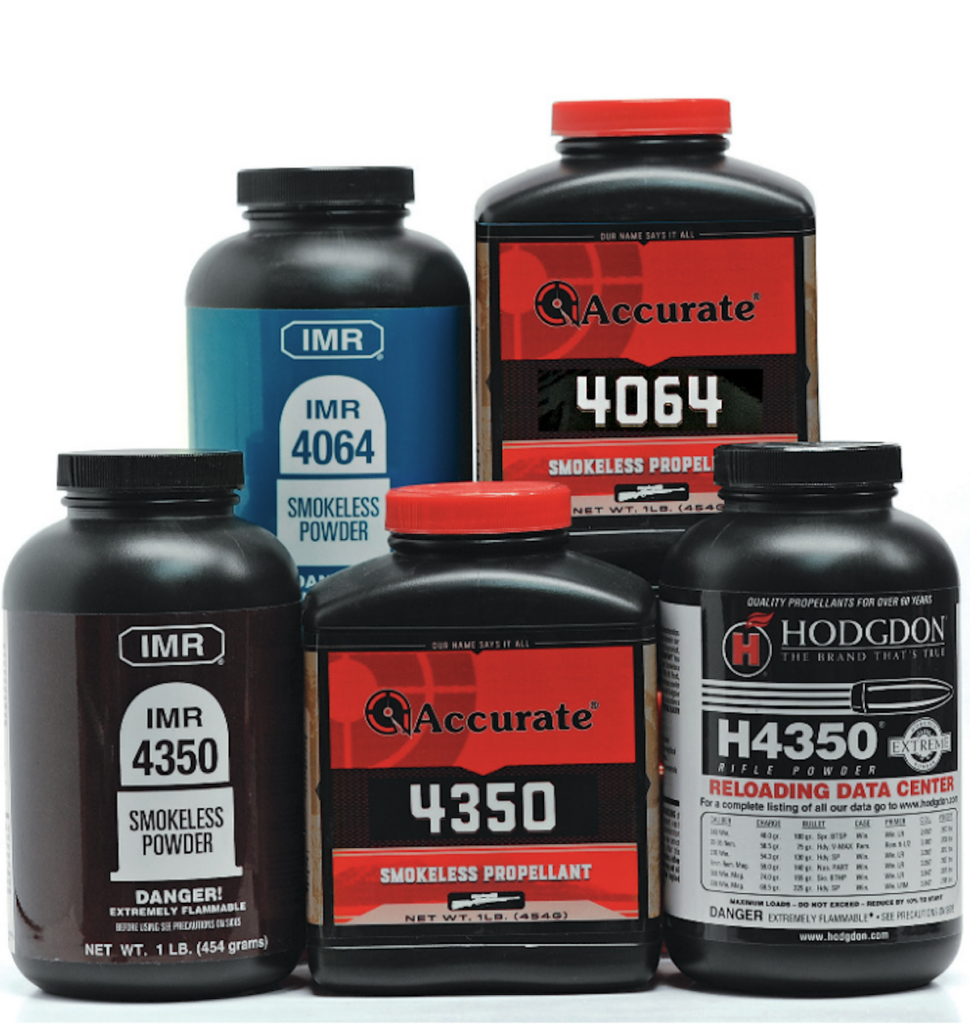
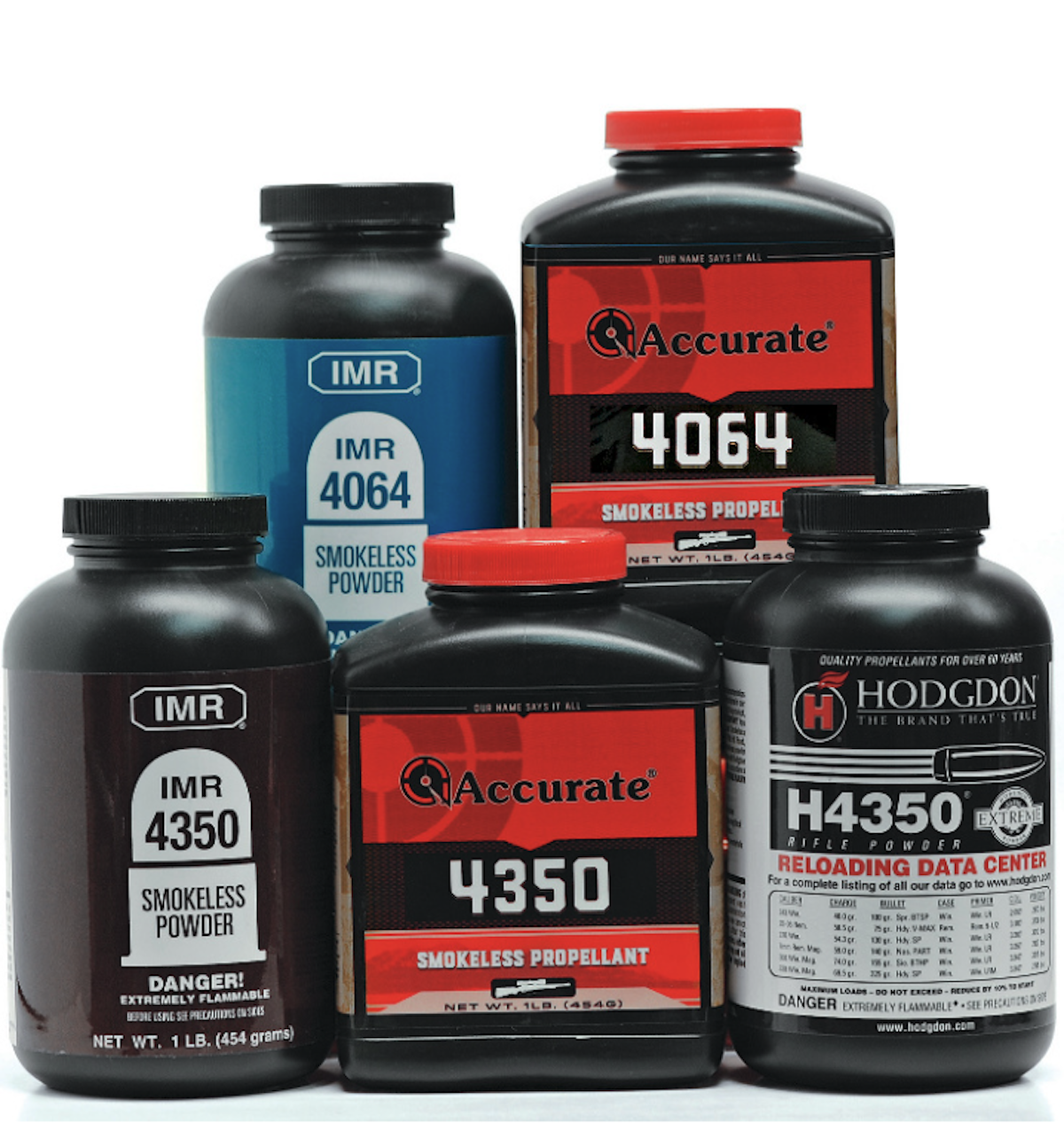
IMR and Accurate powder brands offer rifle propellants labeled 4064. Each brand also offers powders numbered 4350, and so does Hodgdon. Until you open the containers and look inside, the only apparent difference is the company brand. They’re all extruded stick powders, but they do differ in size (diameter and length) and in one case in color.
The same numerical product labeling suggests the contents are also the same. They definitely are not. Depending on the specific cartridge-load recipe, the different propellants’ internal ballistic performances may not be! You cannot simply substitute recipes for propellants having the same numerical identity.
The purpose of this report is to demonstrate the differences between the 4064 powders and the 4350 powders in a limited selection of popular rifle cartridges.
Soon after the turn of the 19th century, DuPont started manufacturing black gunpowder. Nearly a century later, it and other companies began experimenting with smokeless propellants that would eventually allow the development of significantly more powerful and more user-friendly firearms.
DuPont remained a leader in the industry and, in the early 1900s, introduced its new “Improved Military Rifle” propellants. Thirty years later, the firm began to replace those initial products with a series of further-improved IMR brand propellants. Two of these single-base, extruded powders (IMR 4064 and IMR 4320) were the “slowest” burn-rate canister powders available at the time. In 1940 IMR 4350 gained that distinction and held it until IMR 4831 was reintroduced to the commercial market in 1973. Although they’ve been with us for nearly a century since, both IMR 4064 and IMR 4350 are still popular choices for handloaders.
Bruce Hodgdon, patriarch of Hodgdon Powder Company, bought tons of U.S. military surplus propellant from the government after World War II. He repackaged and sold it under the labels 4831 and 4895 to gunshops and hobbyist reloaders. As Hodgdon’s business grew, he introduced new products to compete with the “big three” other brands—IMR, Winchester, and Hercules. The expanding product line of Hodgdon rifle, pistol, and shotgun propellants were sourced from established domestic and foreign makers, including Olin Corp., General Dynamics, Australian Defence Industries, etc.
Other entrepreneurs followed Hodgdon’s business model. Accurate and Western Powders companies were established and thrived. Years later, Alliant acquired the Hercules propellants, and just a few years ago, Western bought the Accurate product line. In 2006, Hodgdon Powder Co. acquired the IMR brand, adding several popular propellants to the portfolio. Not too long after that, Hodgdon began distributing Winchester brand powder. And just last year, Hodgdon purchased Western, thereby adding dozens more Accurate and Ramshot brand powders.

Although these events surely benefited the hobbyist handloader, the increasing propellant choices also caused some confusion. DuPont had made the surplus powder sold by Hodgdon after World War II. Years later, when IMR 4831 and IMR 4895 were reintroduced, Hodgdon added an ”H” to their canister labels to distinguish them from DuPont’s products. Later, Hodgdon introduced H4227 and H4350 to compete with IMR 4227 and IMR 4350 propellants.
The similarly labeled powders’ burn rates are different enough that brand-specific load recipes are recommended to ensure safe handloads. For example, when I first reloaded 270 Winchester, I purchased surplus Hodgdon 4831 powder repackaged in a paper sack for 75 cents a pound. Years later, “new” IMR 4831 powder was introduced, and its burn rate was significantly faster, so maximum charge weights differed by several grains.
Jack O’Connor, famous for promoting the 270 Win., among other things, touted a favorite load (it’s too high to safely quote) of the surplus 4831 topped with Speer’s 130-grain HotCor bullet. Today, Hodgdon’s max H4831 or H4831SC (short cut) recipe is a compressed load about 2 grains less. And that amount exceeds the recommended maximum safe charge of IMR 4831 by nearly 10 percent.
Prior to all of the many recent acquisitions I’ve detailed, the companies were active competitors. So, it’s not surprising when a new product “borrowed” an already popular moniker. Hodgdon introduced H4350 in 1982. Accurate later offered its versions of 4064 and 4350 to capitalize on the popularity of the IMR and Hodgdon similarly labeled propellants.
Comparing the Powders
The obvious way to compare propellant performance is to develop and test handloads in the same cartridge-rifle platform. The results might also be more meaningful if the cartridge-bullet combinations selected are especially compatible with the specific propellant. So, to compare IMR 4064 with Accurate 4064 and IMR 4350, H4350, with Accurate 4350, I chose three sets each that were most suitable for the respective propellants.
Using my vintage Powley slide rule “computer” as a predictive tool for determining safe load data for IMR propellants (see the accompanying sidebar), I determined the 250 Savage, 308 Winchester, and 8mm Mauser cartridges best fit the bill for IMR 4064. Similarly, I selected the 243 Winchester, 280 Ackley Improved, and 300 WSM as excellent candidates to evaluate and compare the performance of IMR 4350 propellant.
For each cartridge I compared load data from Hodgdon’s most recent reloading manual, Western Powders’s load manual, and several other reliable sources. I recorded the maximum charge recommendations and then assembled a series of test loads in ascending half-grain increments. In a couple of cases, the preliminary test data and my observations suggested the results were quite safe.
Developed in the early 1960s by Homer Powell and Bob Hutton, this simple cardboard slide rule device will still accurately predict safe charges of IMR propellants for popular rifle cartridges. Calculations are initially based on case capacity and bullet caliber/weight. Adding in barrel length (measured from the base of the bullet to the muzzle), the expansion ratio is indicated. Comparing the expansion ratio to the powder charge/bullet weight ratio yields the estimated velocity.
An additional slide rule is used to calculate chamber pressure. The reviews in those days referred to pressure as psi (pounds per square inch). However, measuring pressure then employed small, calibrated copper cylinders that were crushed when the round was fired in a specially configured universal receiver. The length of the crushed copper cylinder was correlated to a previously determined data set called a tarage table. The corresponding pressure value was recorded in CUP (copper units of pressure).
Modern pressure barrels are fitted with piezoelectric or conformal pressure transducers that measure chamber pressure in psi. Unfortunately, there is no reliable algorithm to correlate CUP results to actual psi values. The Powley tools were set up to indicate load recipes that would yield approximately 45,000 CUP. At that time, typical cartridge pressures maxed out at about 50,000 CUP or approximately 60,000 psi to 62,000 psi in current terms. My results chart validates that feature quite well (except for the high-performance 300 WSM cartridge, which is rated at 65,000 psi), and the predicted and actual velocities were quite close.
4064 Load Development
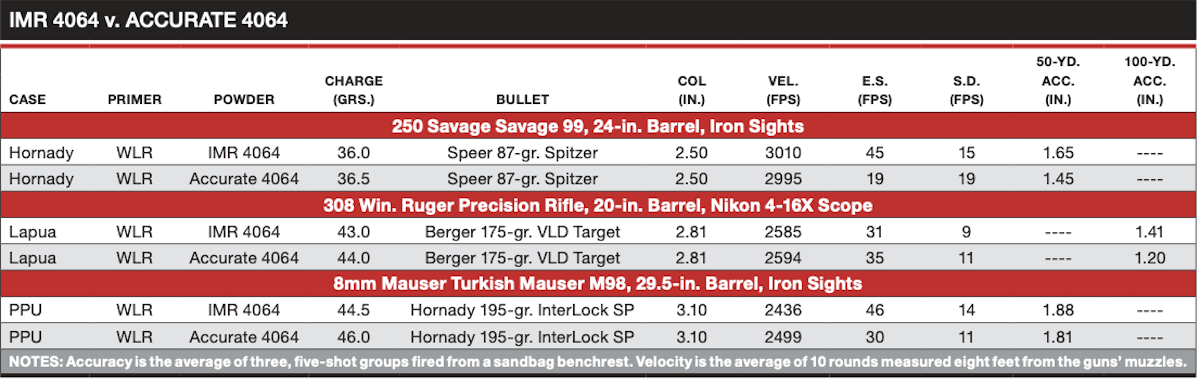
Hodgdon’s maximum charge weight for IMR 4064 in the 250 Savage with an 87-grain bullet is 35.5 grains. Another source also listed the same amount, and yet another indicated a half-grain more. The S.A.A.M.I. maximum average pressure limit (MAP) for this cartridge is 45,000 CUP, with a nominal velocity of 3,010 fps.
My preliminary test loads stopped at 36 grains with an average velocity of 3,019 fps. Extraction was nominal; cases looked fine; and the bullets and powder gases exited the muzzle without mishap. So I charged the record test loads with 36 grains of IMR 4064. I initially fired the Accurate 4064 test loads with the same incremental range of charges. Average velocities for equal charge weights lagged approximately 120 fps. So, in order to achieve a more comparable velocity to the IMR results, I charged the Accurate 4064 handloads with 36.5 grains.
I used the RCBS Uniflow mechanical measure to “throw” the powder and then weighed each charge before adding or removing powder to obtain the exact desired amount. I achieved the final charge weight of Accurate 4064 without further adjustment about 80 percent of the time. My experience indicated just the opposite results with the longer-grain IMR 4064.
I followed the same method for the 308 Win. and the 8mm Mauser. Because my Savage 99 and M98 Mauser rifles are equipped with iron sights, I fired those groups at 50 yards to minimize shooter error. Almost every 250 Savage five-shot group had four rounds striking in or near half an inch. One of the five rounds pierced the target at least an inch away from the other four.
I bumped up the Accurate 4064 charge for the 308 Win. test loads by one grain and matched the IMR test load’s average velocity within 10 fps. Velocity variations between the two propellants were closely similar. The 1.5-grain charge weight delta for the 8mm Mauser handloads was a bit too much, and the Accurate handload’s velocity jumped 60+ fps. Accuracy of both loads was also identical.
4350 Load Development
The Powley tool indicated 43 grains of IMR 4350 as a safe charge for 243 Win. handloads topped with a 95-grain cup-and-core bullet. Hodgdon’s data listed 42 grains as the maximum recommended charge. Of course, I started lower and worked up to Hodgdon’s limit in half-grain increments with all three 4350 propellants. I recorded velocities and found the IMR results trailed the other two by nearly 100 fps. I decided I could safely bump up the charge to the Powley prediction.
The 280 Ackley is a sharp-shouldered, blown-out “improved” version of the 280 Remington, which bumps case capacity up to approximately 64 grains of water. The MAP is 65,000 psi compared to 60,000 psi for the parent round. The Powley computer indicated 55 grains of IMR 4350 was a safe load for a 150-grain bullet. Again firing incrementally stepped charges with all three propellants, I concluded the Powley prediction was safe to use to charge all of the record test loads.
For the 300 WSM, I loaded Federal 180-grain Trophy Bonded Tip bullets. Hodgdon’s load data for the same weight and similarly constructed Swift Scirocco bullet indicated 64 grains of H4350 and 65 grains of IMR 4350 as the maximum charges. Western’s data for Accurate 4350 listed 67 grains as the max charge behind a Sierra 180-grain GameKing bullet.
I concluded I would back off 2 grains of Accurate 4350 to accommodate the expected different results caused by firing Federal’s stoutly constructed bonded bullet and Sierra’s less robust cup-and-core design. After all preliminary test loads were fired, I concluded loading 63.5 grains of each propellant to fire for record was enough.
I did not attempt to optimize the test load for any cartridge. In fact, after recording a disappointing 2-MOA accuracy in my Ruger Model 77 rifle, I belatedly realized the 95-grain Berger VLD Hunting bullet could only be marginally stable in the Model 77’s 1:10 twist rate sporter barrel.
I conducted a similar powder dispensing exercise with the three 4350 propellants. The average IMR and Accurate charge weights and variations were almost identical with the same Uniflow volume setting. The H4350 charge weights were about 3 percent greater. Since the H4350 granules appear to be somewhat smaller than the other two powders, I expected less variation and fewer hang-ups as I operated the measure. Not so…all three averaged about one stoppage in five cycles.
The H4350 propellant is one of Hodgdon’s Extreme powders, and that means its performance is less sensitive to ambient temperature. Therefore, velocity deltas in hot and cold hunting conditions are significantly reduced compared to the similarly labeled IMR and Accurate powders.
IMR 4166 and IMR 4451
I just couldn’t complete this report without commenting on the fairly new IMR 4166 and IMR 4451 Enduron propellants. In these examples, Enduron technology was developed to complement the vintage IMR 4064 and IMR 4350, respectively, and these powders are chemically formulated to significantly reduce copper fouling (making it easier to clean the barrel), ensure ignition-velocity stability over a broad temperature range (lowering velocity variation), and achieve improved propellant load density (eliminating compressed loads). They are also formulated with eco-friendly ingredients.
I chose to fire a five-round batch of test loads for each cartridge loaded with the Enduron propellants and record velocity results to compare with the corresponding 4064 and 4350 data. Because of previous extensive test data, I charged the Enduron loads at max or near-max levels listed in the Hodgdon Annual Manual.
The IMR 4064, Accurate 4064, and IMR 4166 test loads recorded very similar results. Propellant lot-to-lot burn rate differences would be expected to cause similar velocity variation. Substituting a different Large Rifle primer may also cause similar minor ballistic performance differences. That’s the purpose for and challenge of reloading—experimenting with suitable components to develop the best load for your firearm.
The IMR 4451 results suggest that its burn rate is a bit faster than IMR 4350, but the 300 WSM data indicates IMR 4451 performed almost identically to Accurate 4350 in my Kimber rifle.
You cannot simply substitute recipes for propellants having the same numerical identity.
Load Data Charts