



Carrying a concealed handgun is now legal nearly everywhere in the United States, but there are more than a few controversial issues, legal and moral, involved. I'm not a lawyer, and shoot/don't shoot decisions are almost always controversial. For most of my adult years, I wore a badge and never once fired a shot in anger. That doesn't stop civilians from asking and giving sideways glances when I tell them none. If they persist and ask why, my standard reply is, "Because they believed me when I told them I was gonna."
Sadly, a lot of folks seem to think that merely being armed is enough. (A friend at Smith & Wesson once told me he felt that the vast majority of S&W's ubiquitous J-Frame revolvers were never fired again after they left the factory. That's probably true.) Others think they must have the most powerful, smallest, lightest, meanest thing they can find. However, velocity and energy are meaningless if they cannot be applied when and where they're needed.
I don't want to start the handload versus factory ammo for defense debate all over again but rather suggest that strapping on a gun brings with it a ton of responsibility. Once launched, that bullet is yours until it comes to rest—safely or otherwise. Handloading is the most cost-effective way to acquire and maintain the needed skills.
Handloading Considerations
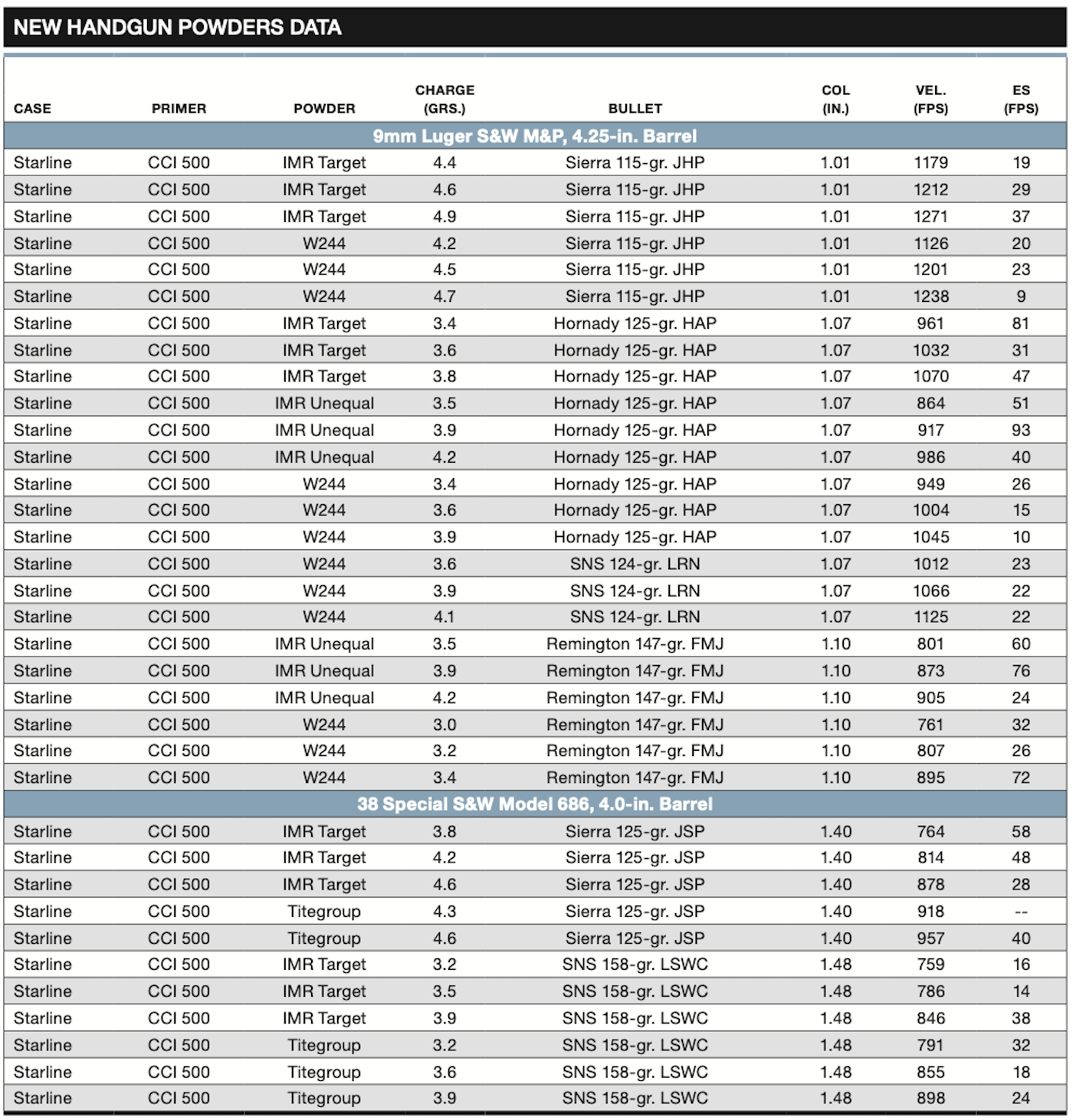
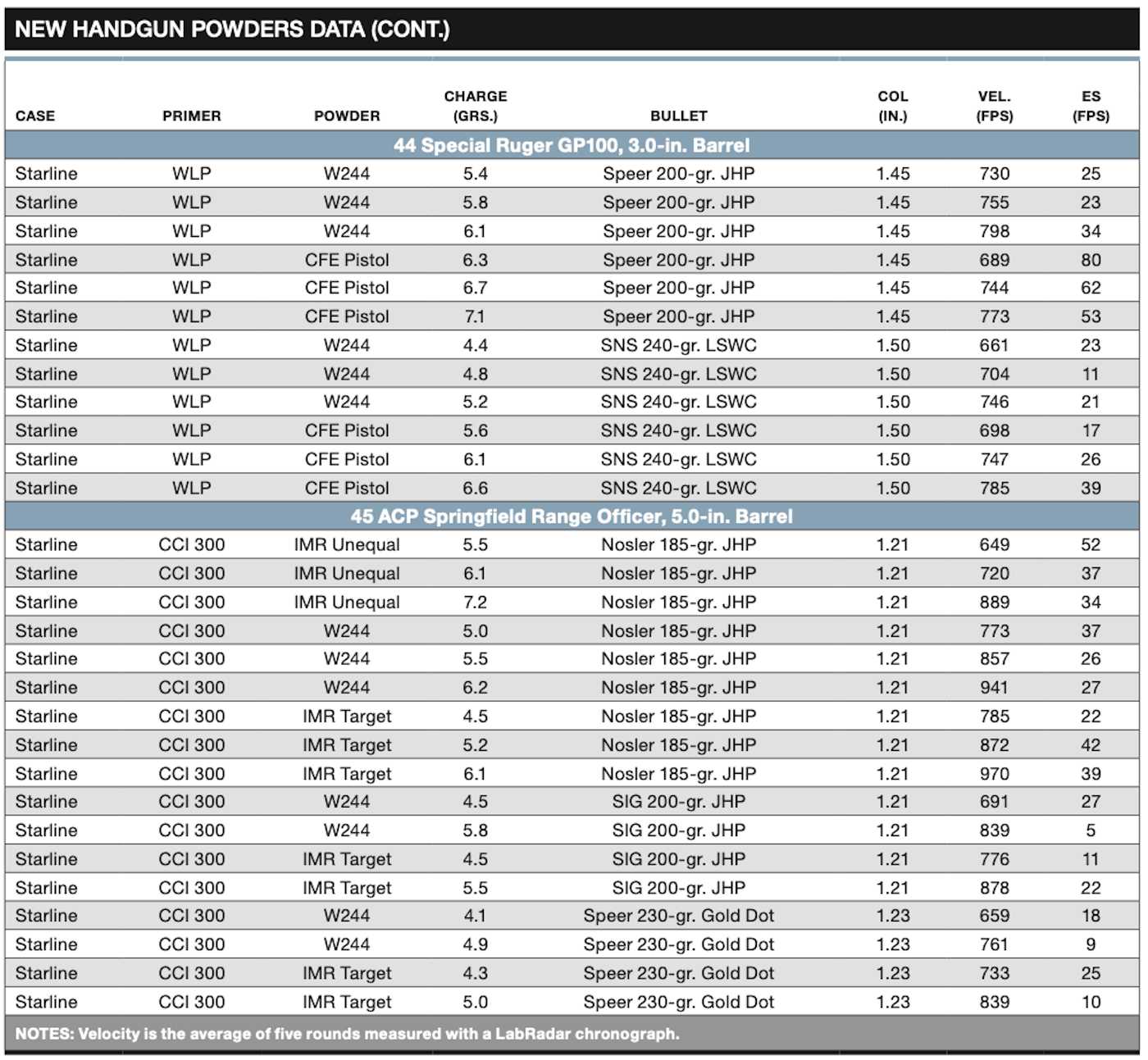
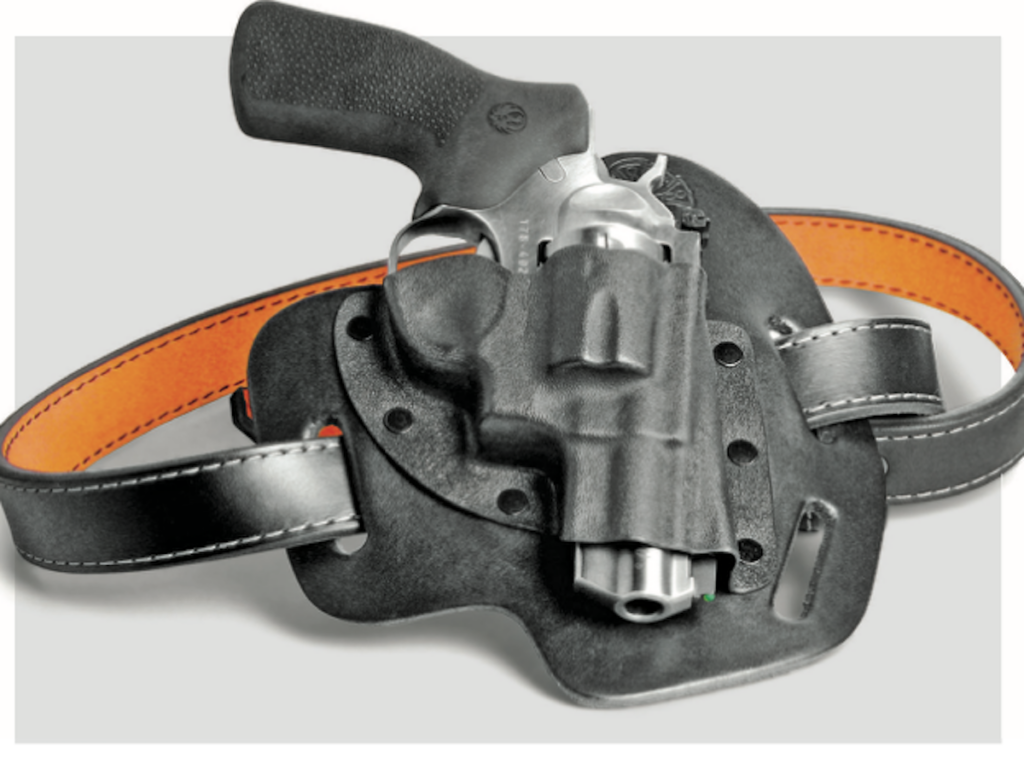
When it is time to pick cartridges to test for a project like this, it's obvious that we can't test all the possible candidates. However, there are three easy choices: 38 Special, 9mm Luger, and 45 ACP. Ruger's recent introduction of the GP100 in 44 Special with a 3.0-inch barrel made it another easy choice for me. As a longtime fan of the 44 Special, I shoot older models from S&W and Colt, but shooters today are forced to buy a magnum if they want to shoot it.
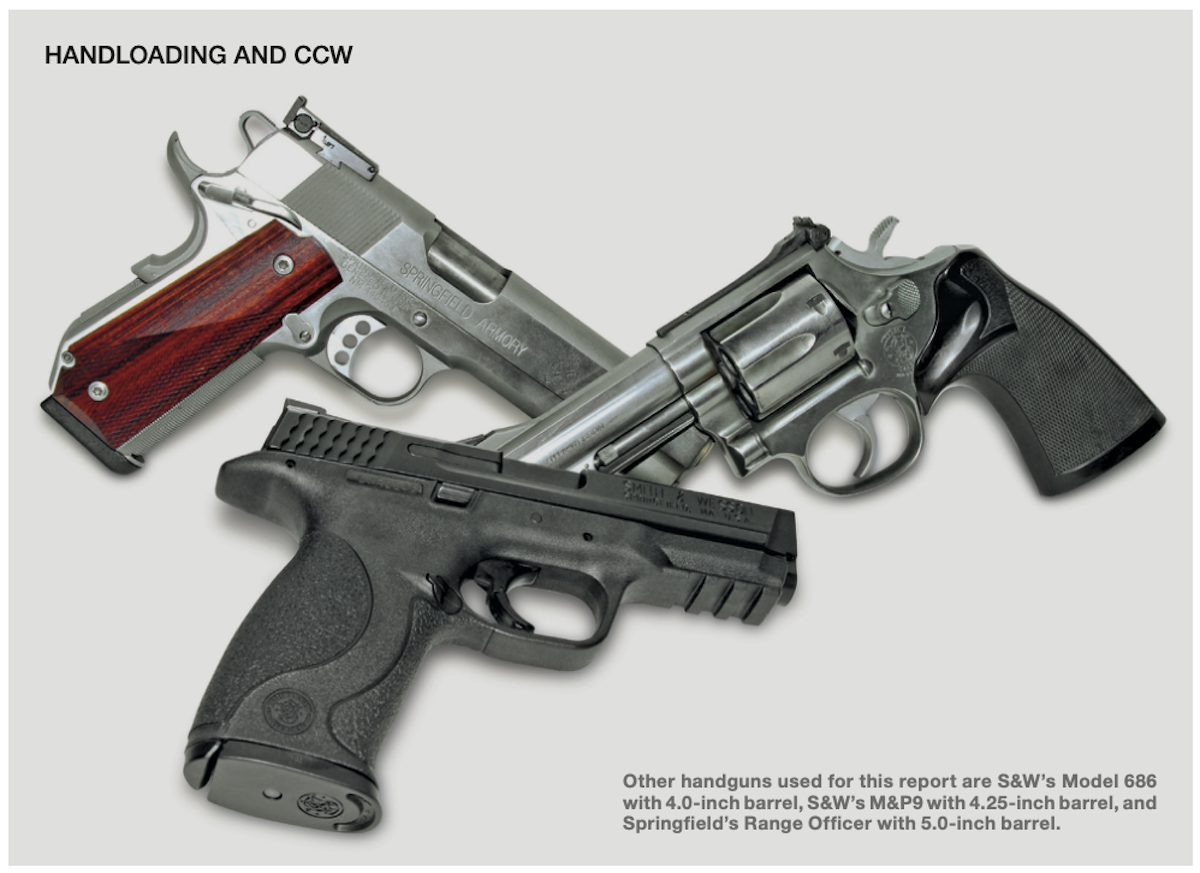
The other guns used for this report were a Smith & Wesson Model 686 with a 4.0-inch barrel, a Smith & Wesson M&P with a 4.25-inch barrel, and a Springfield Range Officer 1911 with a 5.0-inch barrel. The Model 686 is a good representative for shooting the 38 Special handloads because there are countless 686s in service across the country. The fact that it will also handle the 357 Magnum cartridge makes it very versatile as a self-defense gun. With its double-stack magazine, the striker-fired, polymer-frame 9mm M&P is extremely popular with shooters these days, as are just about all the modern semiautos of this type. And the venerable 45 ACP Model 1911 is as popular today as it was 100 years ago, with the Springfield Range Officer pistol being one of the best values in that category. In my opinion, these guns are great examples of the most popular firearm platforms for the most popular self-defense cartridges. Now to some considerations you should keep in mind when you're making handloads for such guns.
Some handloaders obsess about cartridge overall length (COL), but with most handguns it isn't the issue it might be with rifles. Most published data lists the COL, and as long as you use the same bullet all is well, but not all bullets of the same weight are the same length, and seating too deep can lead to pressure problems.
Most revolver bullets have cannelures or crimp grooves to guide us, but pistol bullets don't. I may go overboard with this, but I field strip the pistol, clean the chamber, and use it as a gauge. I start with the seating stem backed out and gradually adjust it down until the rim is flush with the hood and add a modest crimp until it passes the "plunk" test. By that I mean, if the cartridge falls freely into the chamber, it is fine. This is not the same as measuring headspace.
As for crimping, the easy way is to measure the diameter at the case mouth of a few factory rounds and adjust your crimp die accordingly. Inadequate crimp can be a major cause of feeding problems, so I also use my pistol's barrel and the plunk test for checking crimp. Again, if the round drops freely into the chamber, it's good to go.

There is some reasonable concern about bullet setback due to a light crimp, but if the round passes the plunk test, it is not likely to be moved back enough to raise pressure. I like to adjust the die with the seating stem backed out so I can feel when the case first starts to contact the crimp area and then begin to seat a bullet until it's close to the desired length. Then tighten the die a quarter-turn and check again. I like to feel a bit of resistance at the end of the stroke to know I'm getting an adequate crimp.
A secure crimp is equally important when handloading cartridges for self-defense revolvers. The crimp prohibits the bullets from jumping and binding up the cylinder. After all, you don't want the cylinder to bind up after one shot and stop you from being able to deliver follow-up shots if the need arises. This is especially important when the revolver is lightweight.
Another more important consideration has to do with charging the cartridge cases, especially for the 38 Special and the 44 Special. You must take extra care to ensure you do not inadvertently double or triple charge a case. Theses cartridges were originally sized for a case full of black powder under the bullet. Modern smokeless propellants are much more energetic, so a typical charge barely fills a quarter or so of the case volume.
One technique is to throw powder for a loading tray full of cases and, using a bright light, carefully inspect each one to see that each case has the same amount of powder. Randomly selecting a few and weighing them on a scale just to be sure is advised.
New Powders
I claim no expertise in the area of gear and gadgets for concealed carry, but I do claim to have more than a little knowledge in the whys and wherefores of guns and ammo. Today, the push for smaller/lighter CCW handguns continues, and we see some specialty bullets, but the most change is in the propellants. Every year we see several new names or numbers.
Of course, the basics of smokeless powder haven't changed in a century or so. Single-base powders are largely nitrocellulose, and adding a little nitroglycerine makes it double-base. But beyond that is a whole world of additives that are proprietary information no manufacturer wants to talk about. I call it pixie dust. There are names, like centralite, that mean nothing even to graduate chemists. But it is the work in the field of additives that brings us powders that are less sensitive to temperature changes or those powders that resist copper fouling.
Several new powders have the IMR brand. IMR stands for Improved Military Rifle, which was DuPont's trademark. DuPont got out of the powder business rather suddenly due to a big bang, and production shifted to Canada where it continues today as General Dynamics Canada. Some of the new powders are named for colors. The colors of the rainbow can't be trademarked, so if one wishes to call their powder "pink" or any other color, they're free to do so. The fact that IMR's "color" labels have properties very similar to another maker's powders is not accidental.
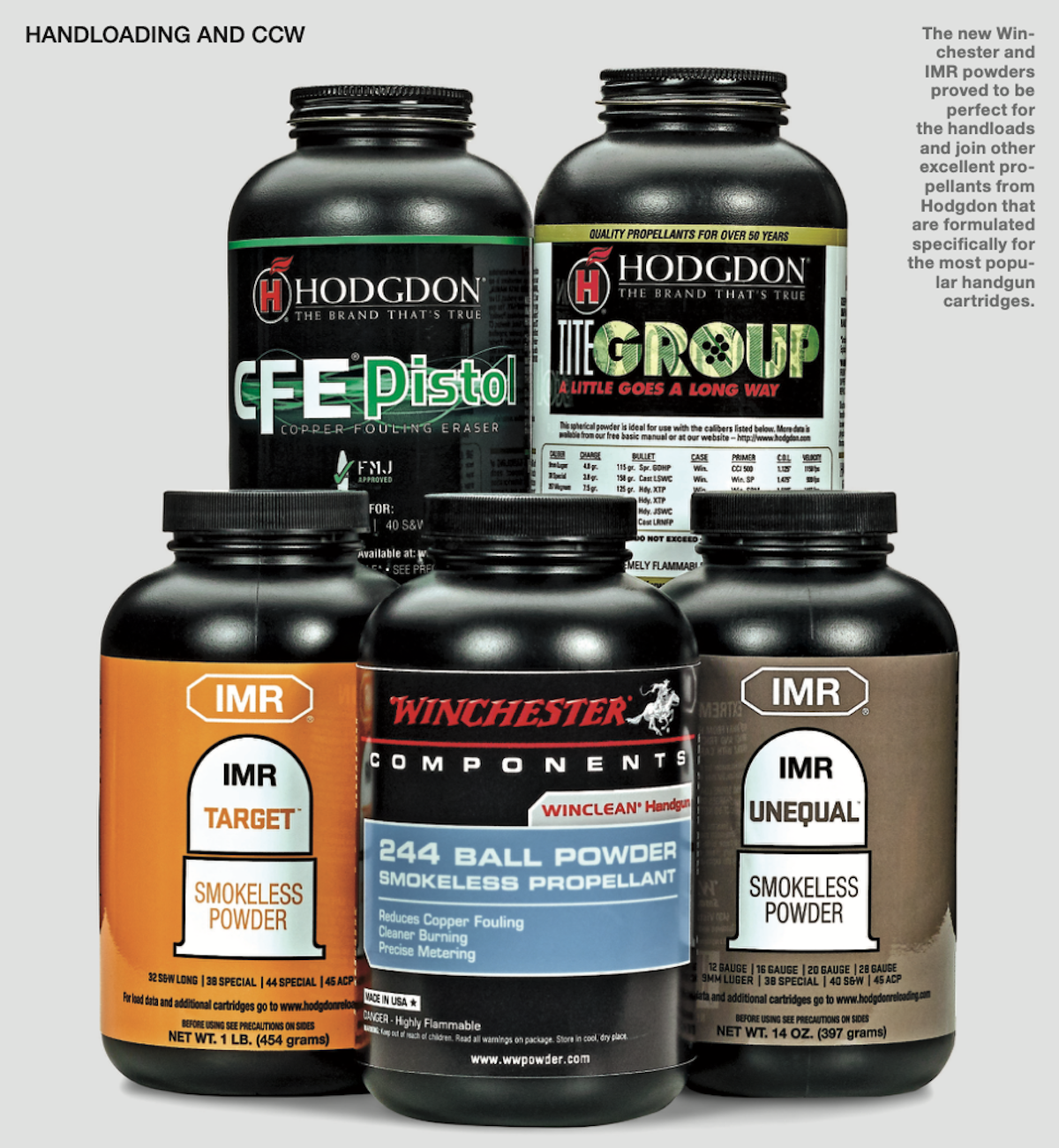
For this report, I used IMR's new Target and Unequal powders and Winchester's new 244 powder. There are some interesting properties in Target and Unequal. Within the last few years IMR has made some process changes (secret new pixie dust) that give better control over the finished product and improved quality control procedures that do the same. You can read more about those two new powders in articles elsewhere in this publication.
Winchester 244 Ball powder, one of Winchester's WINCLEAN propellants, has all the latest features for a midrange burn speed powder. One of its attributes is reduced copper fouling. This new pistol powder is also very clean burning, and it meters through powder measures precisely. And during my shooting, I found it to produce excellent accuracy, especially in the 9mm Luger. That cartridge positively loves W244.
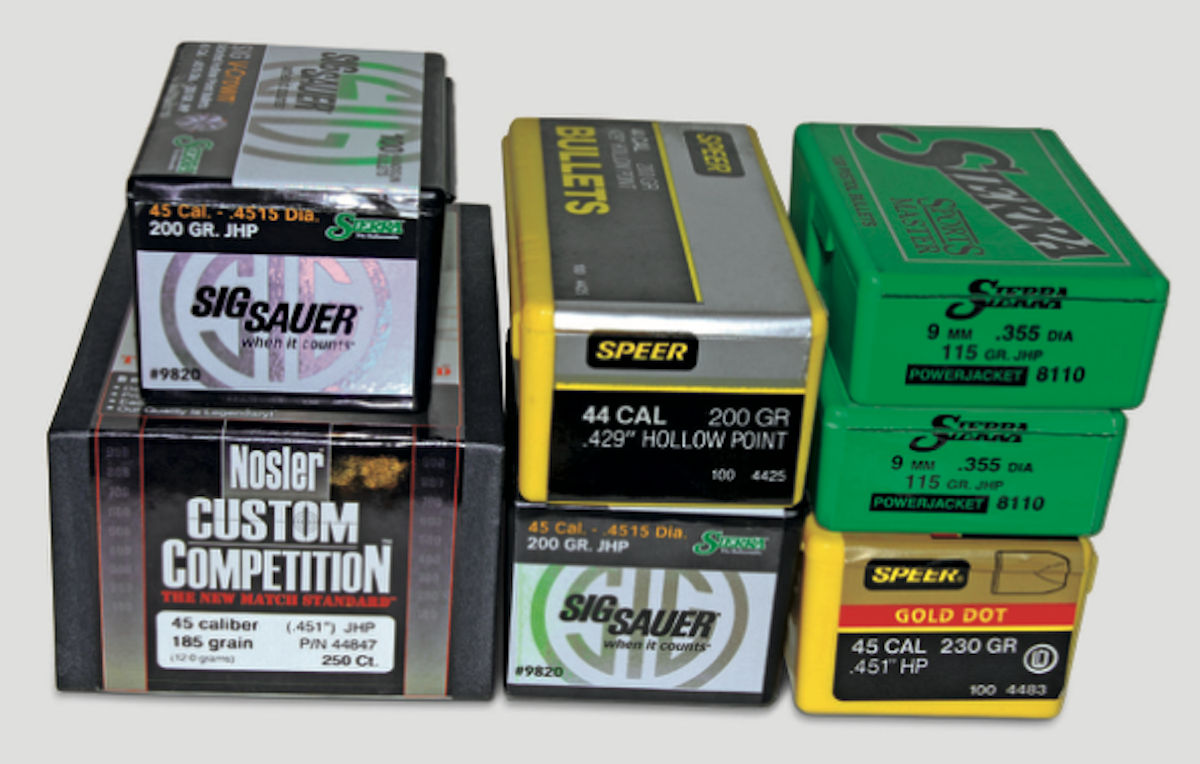
When handloading for self-defense guns, the critical aspect is selecting a proper powder-and-bullet recipe because we are trying to balance two opposing performance criteria: bullet penetration and expansion.
As most readers of this manual know, an FMJ bullet penetrates deeper because it doesn't expand, so all of the bullet's energy is expended on penetration. Depending on point of impact, even the fastest FMJ bullet may not immediately disable an attacker.
On the other hand, a similarly speedy bullet having the thinnest possible jacket with multiple skives surrounding a large hollow cavity in the nose may not penetrate at all and could likely blow up upon impact.
Even the best personal-defense bullet must be launched at a muzzle velocity that ensures it will impact fast enough to properly expand. In most handguns, the propellant is fully combusted in the first couple of inches of the barrel. A longer barrel allows the propellant gas pressure to continue to accelerate the bullet until it exits the muzzle. Short-barreled concealed carry guns sacrifice ballistic performance for personal-defense considerations, such as concealment and ease of carry.
But there's no need to further limit cartridge performance by using less-than-optimal components, such as a propellant that can't transfer the most muzzle energy possible to the bullet. The new IMR Target, IMR Unequal, and W244 are perfect powders for the 9mm Luger, 38 Special, 44 Special, and 45 ACP self-defense cartridges.