
When what we call monolithic bullets first came to be, developing handloads was a little tricky. Today, the situation is much easier.
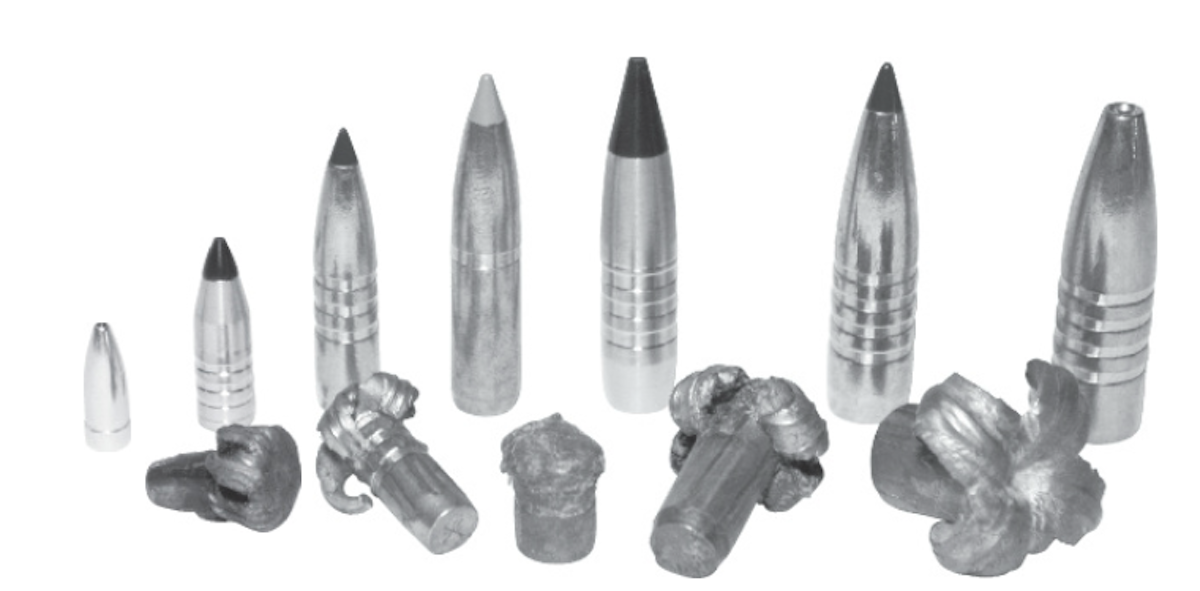
Once upon a time, all hunting bullets were homogeneous, made entirely of one metal, but lead proved too soft for the higher velocities of smokeless powder, so we inserted the lead into a cup of harder metal. In expanding bullets, the open end of the cup pointed forward, exposing the lead core, and non-expanding bullets had the open end in the rear.
Eventually, some people decided to make all or most of the bullet from copper or copper alloys. P.O. Ackley, the well-known 20th-century gunsmith, made copper bullets with a tiny bit of lead in the tip to help start expansion. Apparently, they weren’t very accurate, but they penetrated deeply. Years later, some companies started producing solid bullets for hunting thick-skinned African game made entirely of hard copper alloys, so they actually were “solid,” not made of two different metals.
Early Homogeneous Bullets
The first widely successful expanding homogeneous bullets (also commonly known as monolithics) were developed in the 1980s. In 1967 Randy and Coni Brooks purchased a small company named Colorado Custom Bullets, which was formerly the Barnes Bullet Co. started by Fred Barnes in 1932, when he made bullets in his home in Bayfield, Colorado. Barnes used pure lead cores and pure copper jackets, believing their relative softness kept bullets from fragmenting less than more brittle alloys.
Randy and Coni moved the machinery to their native Utah, but kept the Colorado Custom name for a while, before changing it back to Barnes. (I know this because they sent me some Colorado Custom bullets in the mid-1970s for testing.) In 1979 they introduced the homogeneous Barnes Banded Solids, which were made of hard brass with several circumferential grooves machined into the bullet’s shank to reduce pressures.
Randy eventually came up with an idea for a hollowpoint bullet made of pure copper, and it mushroomed into four “petals” on impact. He killed a big Alaska brown bear with one in 1985 and started selling what the company named X-Bullets (after the shape of the four expanded petals).
I first tried Barnes X-Bullets in 1989, handloading .30-caliber 165-grain bullets in an Ultra Light Arms 300 Winchester Magnum rifle. I’d already worked up handloads using three lead-core bullets weighing 165, 180, and 200 grains, and all grouped three shots well under an inch at 100 yards.
The X-Bullets worked differently than lead-core bullets in several ways. First, they developed more pressure due to the longer, solid copper shank, so the powder charge for the lead-core 165-grain bullet had to be reduced a couple of grains. X-Bullets also copper-fouled the bore quickly. That’s the reason Barnes eventually introduced CR-10, an aggressive ammonia-based solvent.
Those X-Bullets also did not shoot very well—three-shot groups averaged around two inches, no matter what powder or charge I tried.
That seemed odd, but our ancestors thought two-inch accuracy worked fine for big game, and I used one of the X-Bullets to take a whitetail on the local river bottom. The bullet expanded and exited, but I noted that despite a muzzle velocity around 3,150 fps, meat wasn’t jellied nearly as much as with lead-core bullets.
I kept trying X-Bullets in different rifles, and they tended to either be very accurate or not so much. The first super-accurate load featured .25-caliber 100-grain bullets, handloaded to around 3,300 fps in a 257 Roberts Ackley Improved rifle. By 1999, a decade after I first tried X-Bullets, almost all shot well—but still created more pressure and fouled bores quickly.
In 2005 I shared a Sonora mule deer camp with Randy, and one evening he explained that when they first started making X-Bullets, the company couldn’t afford really consistent copper. As a result, the bullets varied some, especially when the source of copper changed. But by the mid-’90s, they could afford top-grade copper, whereupon accuracy improved and the bullets expanded more consistently.
Randy also mentioned the X-Bullet’s reputation for retaining 100 percent of its weight. He originally thought losing petals might result in quicker kills, due to peripheral damage along the bullet’s path. However, as more hunters used X-Bullets, some complained if a recovered bullet lost even one petal, apparently believing 100 percent weight retention meant the animal was 100 percent dead. Randy re-tweaked the bullets to help retain petals, but they can still lose some, especially when hitting heavy bone. A few recovered X-Bullets in my collection even lost all their petals but still killed game from deer to elk very quickly.
Reducing Fouling & Improving Accuracy
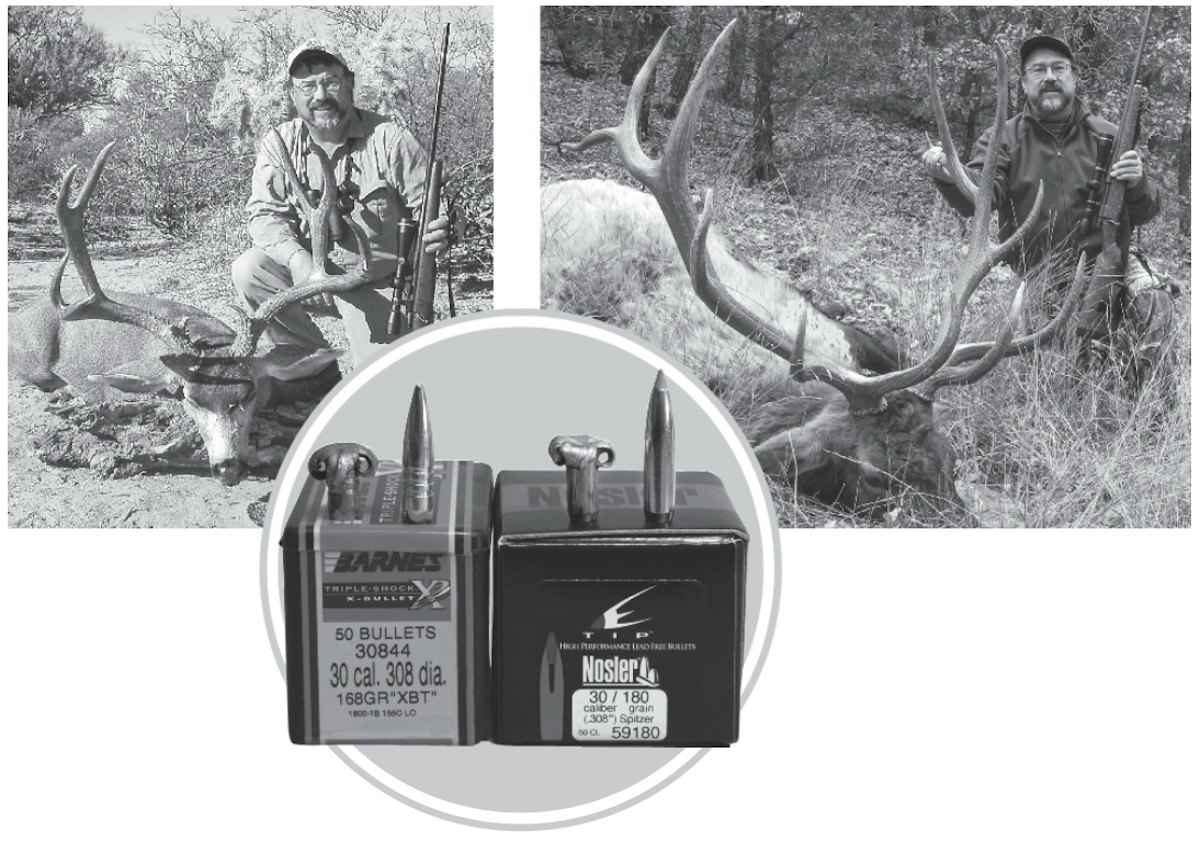
In 2004 Barnes really fixed the X-Bullet, machining circumferential rings around the shank like those in Banded Solids. This reduced copper-fouling and pressures, and accuracy became even more consistent. I used a 300 Winchester Magnum with handloaded 168-grain Triple-Shock X-Bullets (TSX) on that Mexico hunt, taking a big buck as it ran angling away through the desert thornbrush. The bullet nicked the buck’s left hip and was later recovered under the hide over the front of the chest. It weighed 167.8 grains. (I had full faith in the new version of the X-Bullet since my wife had killed a Montana elk the previous fall with a 140-grain TSX from her 270 Winchester. It turned out to be the first elk TSX-report made to Coni Brooks.)
Today, every monolithic hunting bullet I’m aware of has at least one to several grooves on the shank. Since they’re also made of everything from pure copper to different copper alloys, pressures can vary considerably in bullets of the same diameter and weight. It often helps to use pressure-tested data for a specific bullet.
In 2007 both Barnes and Nosler introduced plastic-tipped monolithic bullets. Barnes put tips in the TSX, calling it the Tipped TSX (TTSX). The plastic tip essentially eliminated the rare expansion problem. Nosler basically took the lead out of its popular Ballistic Tip bullets, using the same gilding metal for the body, and called the bullet the E-Tip.
I spent a month in South Africa that spring, part of the time shooting plains game from springbok up with prototype 180-grain E-Tips on plains game with another 300 Winchester Magnum rifle. Eventually, professional hunter Rob Klemp deliberately selected a blue wildebeest as a suitable medium for recovering an E-Tip. Until then, all had exited, including one that broke both shoulders of a gemsbok bull.
So we looked for a wildebeest quartering toward us and found one at about 125 yards. I aimed for the shoulder joint and squeezed the trigger, whereupon the wildebeest staggered 25 yards and went down hard. We found the lump of the expanded bullet under the hide at the rear of the ribcage on the opposite side. Later, when we weighed the recovered bullet, it weighed exactly 180 grains. This sounds perfect, but Nosler forgot to include the weight of the plastic tip, so the prototypes actually weighed 182 grains.
The production bullets did weigh 180 grains, and I used one that fall to take a 6x7 bull elk in New Mexico, with the same shot placement, again recovering the bullet. It weighed 178 grains, and it looks so much like the wildebeest bullet the only way I can tell them apart is weight.
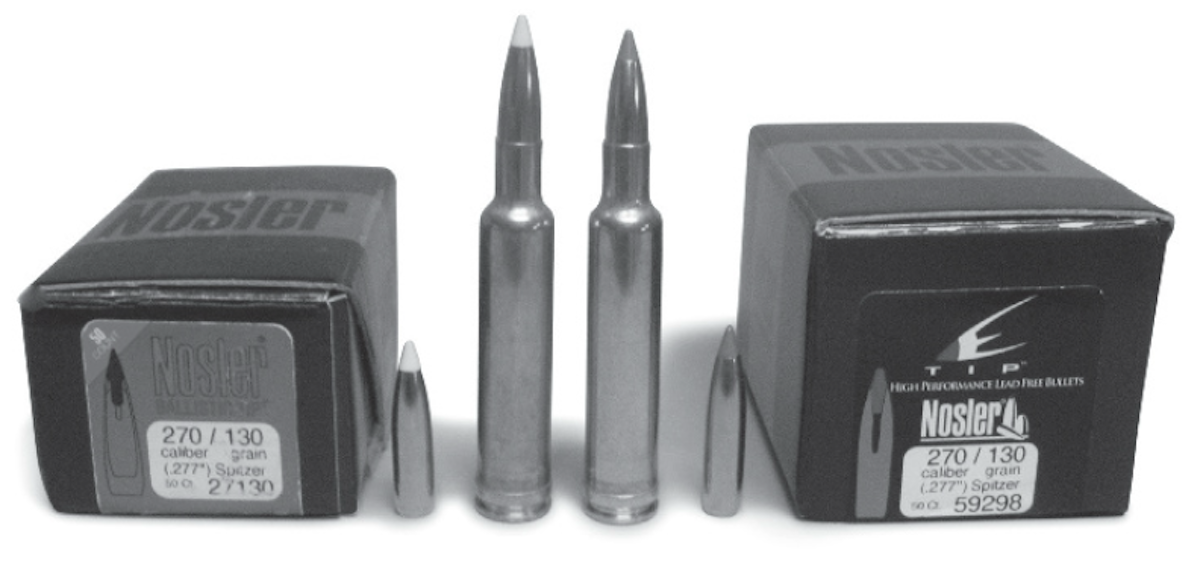
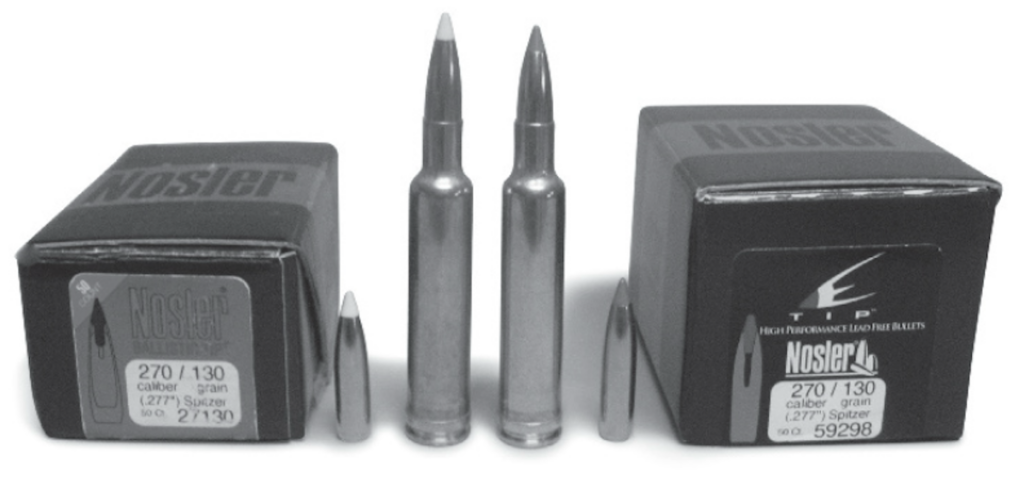
During this development period, it was discovered that homogeneous bullets often grouped more accurately when seated deeper than lead-core bullets. One of my early experiences involved a new 270 Weatherby Magnum walnut-stocked Mark V, purchased right after Nosler introduced the E-Tip. I started load development with the 130-grain Ballistic Tip, a less expensive bullet with the same frontal shape, figuring the same powder would probably work with both bullets—though the charge might have to be reduced with the longer, harder E-Tip.
The rifle shot well during its first range session, grouping three Ballistic Tips into slightly over a half-inch at 100 yards. Man, this was going to be simple! Unfortunately, E-Tips at the same seating depth grouped from 1.5 to 2.0 inches. Due to the “freebore” (long chamber throat) of most Weatherby Magnums, the E-Tips were already quite a ways from the lands, but I tried seating them even deeper, using the same powder charge.
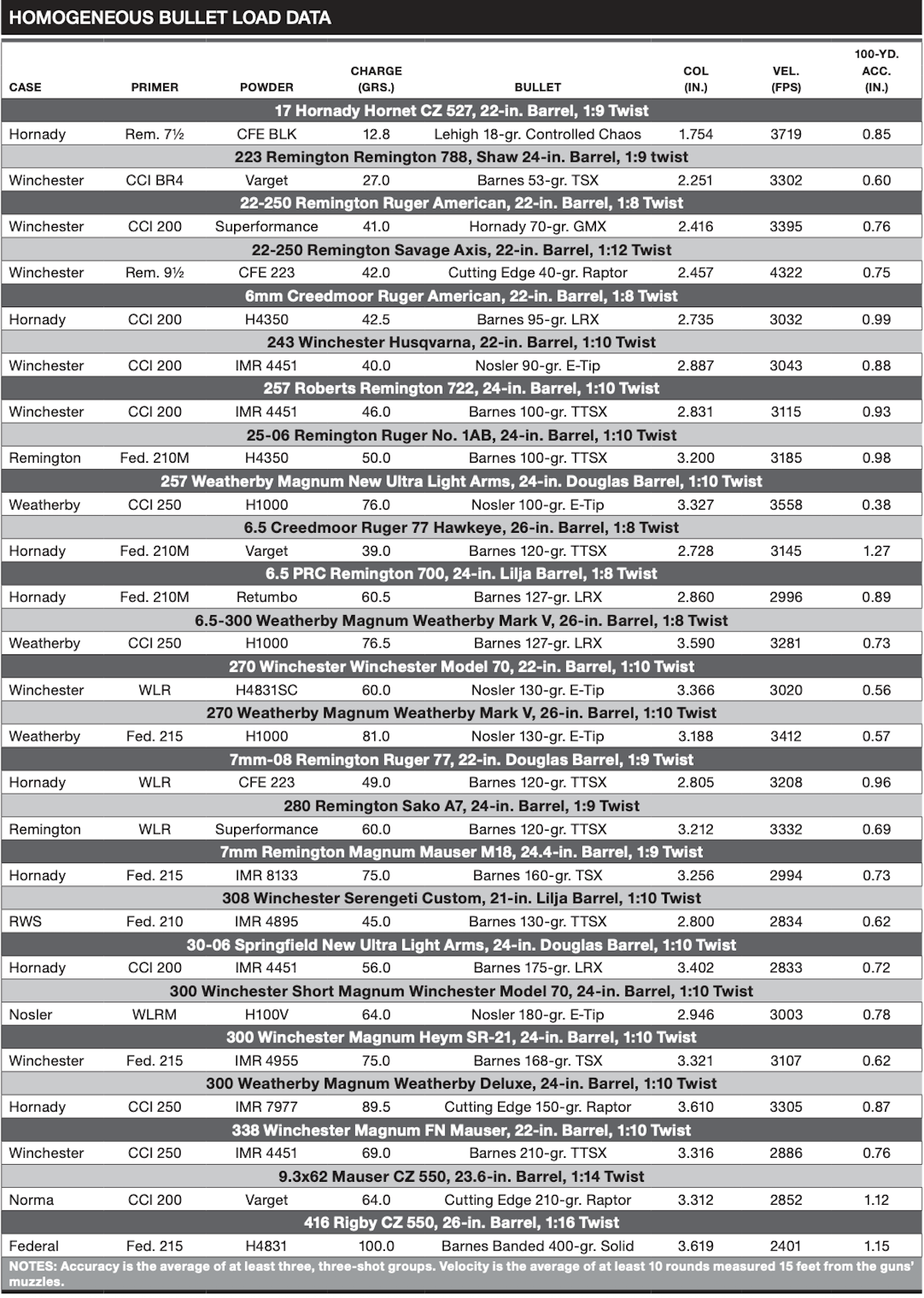
First up was a batch with the bullets seated one turn of the seating stem deeper (0.05 inch in that particular brand of dies). The second batch was seated two turns deeper, a full tenth (0.1) of an inch. The first load resulted in the smallest group to that point (1.26 inches), and the second averaged 0.57 inch, just about exactly the same as the Ballistic Tip load.
At the time, most handloaders believed the finest accuracy always resulted with bullets seated about 0.02 to 0.03 inch off the lands. However, not only bullets but also rifles had changed since the years immediately after World War II, when handloading first became really popular. Back then many hunting rifles were “sporterized” military surplus that typically had generous throats, allowing rounds to chamber in dirt, rain, and snow. Consequently, bullets seated more than 0.03 inch from the lands could tilt before entering the rifling, which does not enhance accuracy.
In recent decades, however, many commercial rifles have much tighter chamber throats, barely above bullet diameter, so they often shoot accurately even when bullets are seated what used to be considered too far from the lands. Plus, monolithic bullets have the potential to be even more accurate than lead-core bullets, since there’s no jacket to possibly vary slightly in thickness affecting the bullet’s balance.
But why do homogeneous bullets often shoot better when seated deeper? The most common theory involves the fact that they can accelerate more before hitting the lands, engraving easier. This deeper-seating trend became “official” a few years ago, when Barnes started suggesting handloaders begin working up a load with their bullets seated 0.05 inch from the lands, then seat the bullet increasingly deeper if accuracy wasn’t what they desired.
Some handloaders believe seating bullets deeper increases pressures, but that’s primarily true with handgun cartridges, due both to the limited powder space and the way most handgun powders burn. With the progressive-burning powders used in rifles, pressure drops as bullets are seated slightly deeper—normally reflected in slightly lower velocities. (Pressures can rise again with rifle bullets seated really deep—but only well beyond the parameters suggested by Barnes.)
Monoliths Are Not Monolithic
After the TSX, TTSX, and E-Tip appeared, many other companies started making expanding bullets out of copper and various copper alloys. This abundance makes testing every new brand almost impossible for gun writers; all we can do is try.
Some are designed to lose their petals, due to the same notion Randy Brooks had about peripheral damage. The first I tried were Cutting Edge Raptors, with a huge hollowpoint. You can either shoot them as-is or insert one of the click-in plastic tips that come with each box. My wife helped with this testing, partly because she’d started developing recoil headaches, so she started shooting rifles chambered for lighter-kicking cartridges—including the 22-250 Remington, legal in Montana for hunting big game.
She bought her Savage 22-250 not long after Cutting Edge Raptors appeared and decided to try the 40-grain on coyotes to minimize hide damage. I worked up an accurate load that got a little over 4,300 fps, and we never recovered a Raptor. When she drew a doe pronghorn tag later that year, she decided to use the same load, ending up 150 yards from a big doe, standing almost facing her. The little bullet entered just inside the left shoulder, and the doe crumpled. We found the shank under the hide at the rear of the opposite shoulder blade.
A few years later, I drew a buck pronghorn tag and decided to use a special-run Ruger American rifle from Whittaker Guns in Kentucky. It’s a 22-250 with a 1:8 rifling twist. This would stabilize heavier monolithic bullets, and the load I eventually settled on used the Hornady 70-grain GMX and Superformance powder. Muzzle velocity was around 3,400 fps.
Before the season, we located one of the bigger bucks we’d seen in the area. His harem comprised numerous does, so it took a couple of weeks to get within range. The buck stood angling away at 350 yards, and the expanded GMX ended up in the far shoulder—weighing 70.5 grains, due to antelope particles trapped by the six curled-back petals.
The 70-grain GMX has a G1 ballistic coefficient (BC) of .350, which is among the best for monolithic .224-caliber big-game bullets, but in general, monolithics don’t have exceptionally high BCs. Copper is lighter than lead, and an all-copper or copper-alloy bullet is longer than a lead-core bullet of the same weight. While many hunters still believe bullet weight controls whether a certain rifling twist will stabilize a bullet, I have found bullet length is the major factor.
This is why the heaviest .35-caliber Barnes TSX only weighs 225 grains, rather than the 250 grains common among lead-core Spitzers. The traditional .35-caliber rifling twist, used for over a century in many factory rifles, is 1:16. It’s too slow to stabilize a 250-grain copper Spitzer; however, some hunters prefer to use lighter monolithic bullets in any caliber because they can be driven faster, flattening trajectory, yet still penetrate deeply.
On the other hand, bullet stability is also highly dependent on air density. In the thinner air of higher elevations, many bullets will stabilize that won’t at lower elevations—and vice versa. A local Montana friend worked up a Barnes TSX load at over 5,000 feet above sea level for a South Texas hunt, and after arriving at the ranch he shot the rifle at a target to check the zero—but couldn’t because the elongated bullet holes scattered all across the target.
It’s easy to calculate potential bullet stability these days, due to several twist-rate computer programs available on the Internet. However, the plastic tips of many of today’s bullets don’t count as much in overall bullet length because they’re so light. The only program I’ve found with an “input” for plastic-tip length is on the JBM Ballistics site.
Other than that, it’s pretty easy to work up accurate ammo with today’s homogeneous hunting bullets. The last handload I developed, just before the 2020 Montana big-game season, combined the .30-caliber Barnes 175-grain LRX and IMR 4451 in my New Ultra Light Arms 30-06 rifle. The rifle’s magazine is just long enough to accommodate bullets seated to the industry-maximum overall length of 3.34 inches. After putting together a dummy round that fit inside the magazine, I found the ogive was almost 0.10 inch from the lands. This didn’t present any problem because the first three-shot group with the maximum charge measured 0.57 inch, and subsequent groups were very similar, well under minute-of-elk (or even pronghorn) at several hundred yards.
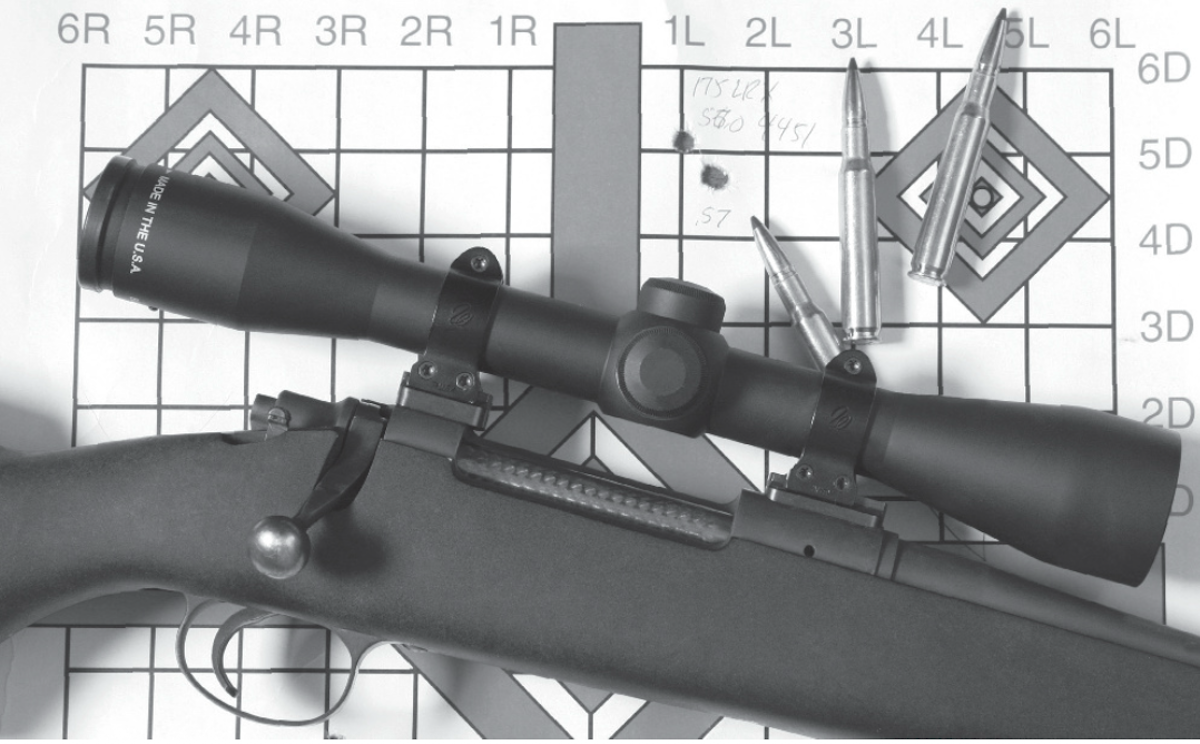
Other than that, it’s pretty easy to work up accurate ammo with today’s homogeneous hunting bullets.
Load Data Chart