



Nosler has introduced several new cartridges in recent years, most of which are designed to surpass existing rounds of their caliber, i.e., the 26, 28, 30, and 33 Nosler. Each of these, however, is bigger and billed to be better than the rest of the pack. These thumpers feature fat, non-belted cases with the same rim diameter as the case body.
Now Nosler has entered the realm of cartridges for varmints and smaller big game with the introduction of the 22 Nosler, especially designed for the ultra-popular AR platform. The 22 Nosler is an entirely new case that cannot be conveniently made from another, and unlike the other Nosler rounds, the 22 has a rebated rim. American shooters may not recognize the term "rebated rim," but it has been used for years in many countries and is a feature common to a host of popular modern-day cartridges. The WSSM and WSM series and the 284 Winchester, 30 Remington AR, SAUM, and Ultra Mag series, plus oldies like the 425 Westley Richards and the 500 Jeffery have rebated rims, to name just a few.
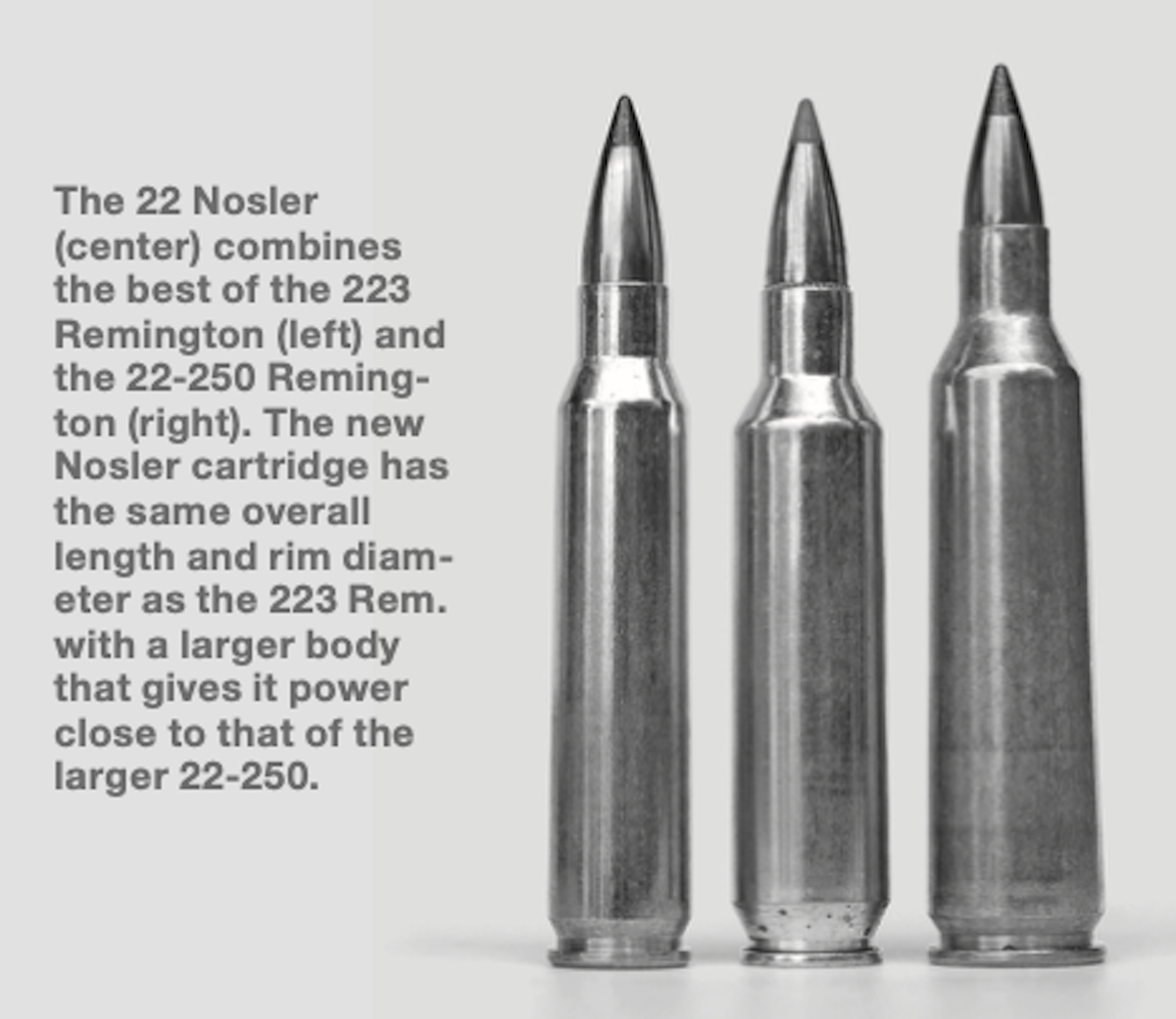
The rim diameter of the new 22 Nosler case is 0.378 inch, the same as the 223 Remington, but the body diameter ahead of the extractor groove is 0.420 inch and tapers to just 0.400 inch at the start of the shoulder. This gives the Nosler case plenty of powder capacity to get the most out of a .22-caliber bullet.
Convenience is a concern, too. The clever quirk of the rebated rim allows the bazillions of ARs in 5.56mm in existence to be easily converted to the 22 Nosler by simply switching the barrel and the magazine. (A magazine designed for the 6.8 Remington SPC is required for the chubby 22 Nosler case to feed properly in an AR.) Also, Nosler engineers moved the case shoulder back a few thousandths so that a 204 Ruger, 17 Remington, or 223 Remington round can't be chambered. The shoulder angle is a sharp 30 degrees, and at 0.245 inch, the neck length is over a full caliber long. In addition, the folks at Nosler figured with all that powder capacity, shooters just might like to shoot some heavy bullets in the cartridge—either at long-range targets or at game animals—so the standard twist is one turn in eight inches, good for just about any .22-caliber bullet available. And, as we all must acknowledge, today's superb flyweight bullets shoot just fine in "fast twist" rifles.
Nosler has introduced two factory loads for the round, and given the company's extensive stable of bullets, more loads are sure to come. (The 60-grain Partition and 64-grain Bonded Solid Base are likely candidates.) For now, shooters have the 55-grain Ballistic Tip and 77-grain Custom Competition HPBT bullets in factory loads. The Ballistic Tip is listed at 3,350 fps out of a 24-inch, minimum-spec S.A.A.M.I. test barrel. The 77-grain HPBT is rated at 2,950 fps. Nosler says the velocity from an 18-inch AR barrel will be about 150 fps slower. And handloaders will be delighted to learn that Nosler has empty, prepped cases available right now.
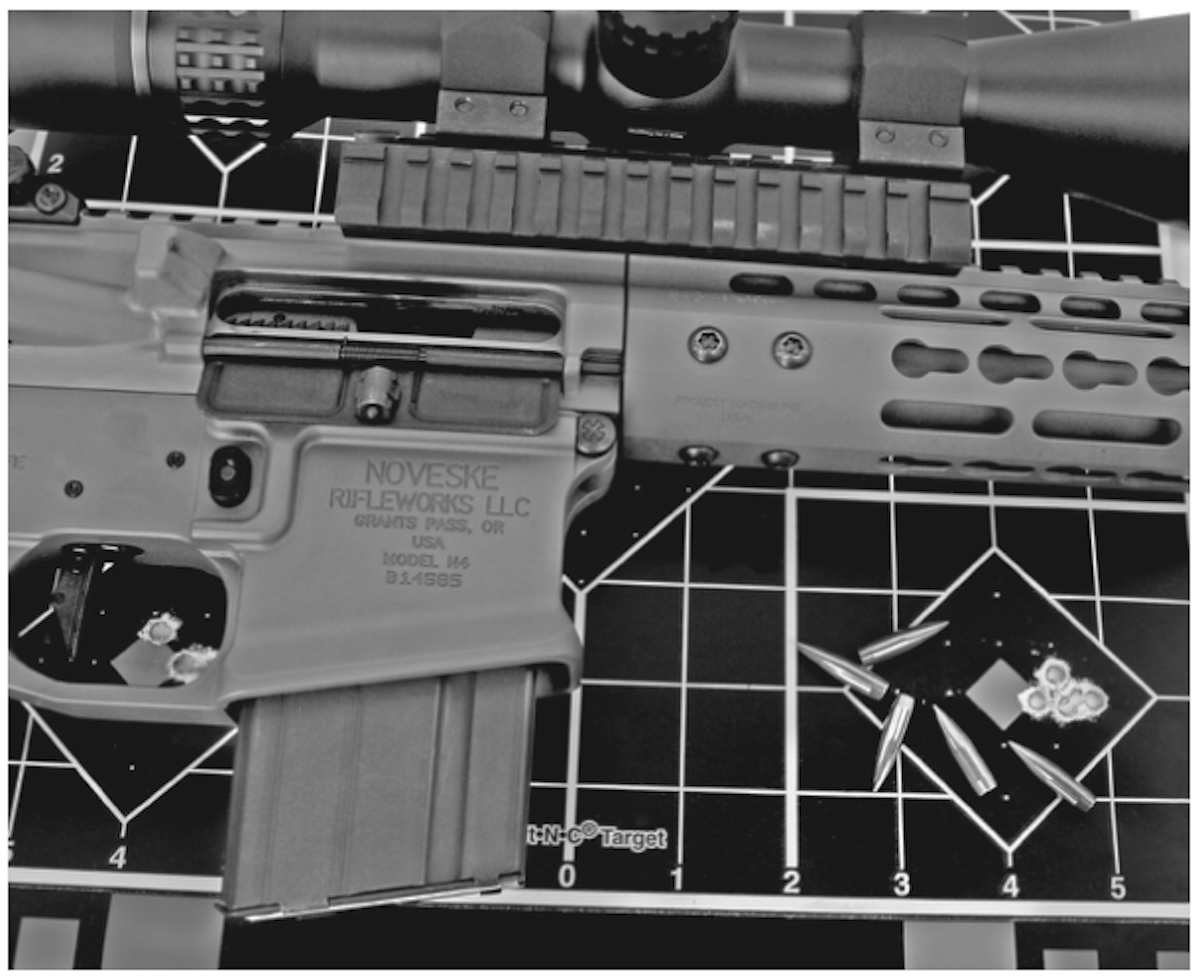
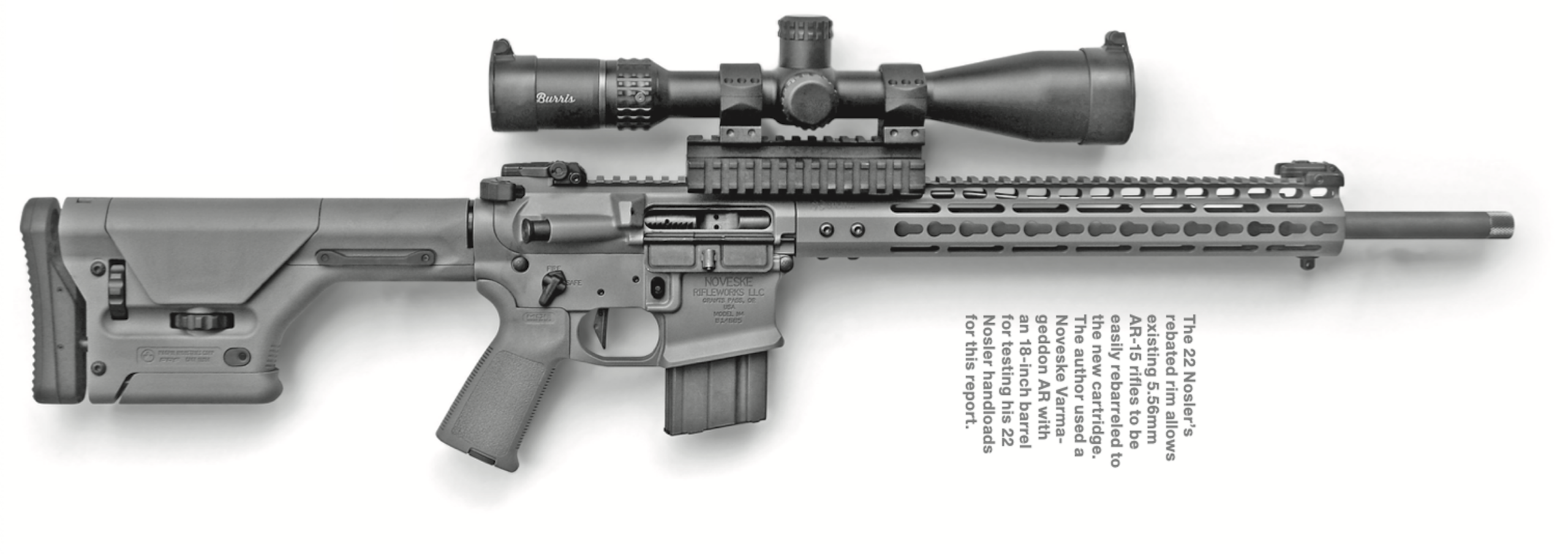
Late last year, I received a new Varmageddon AR-15 rifle in 22 Nosler for testing. The Varmageddon is made by the renowned Noveske Rifle Works of Grants Pass, Oregon. Noveske has an enviable record of producing some of the finest MSRs in existence, and my test gun is no exception. Its 18-inch barrel has a 1:8-inch twist that is perfectly suited for heavier .22-caliber bullets at the higher velocities capable from the 22 Nosler's large case capacity. Of course, such a tube shoots today's high-quality 36- to 55-grain bullets perfectly fine, too. The muzzle is threaded 1/2-28, so should the sky fall and our benevolent government allow us subjects to possess a noise suppressor without the onerous tax-stamp bite, the Varmageddon owner is ready.
The rifle comes with all the accoutrements befitting a premium AR: a flat-top upper with a nine-slot Picatinny rail, an ambidextrous safety, a free-floated barrel with a KeyMod handguard, a "Badass Charging Handle," and a stock that's adjustable for length of pull and drop at the comb. The trigger is glass smooth and breaks at an incredibly crisp 4 pounds, 0.1 ounce. The rig comes in a soft case along with a sling and a nine-shot magazine. Oh, yes, and a Varmageddon patch, too.
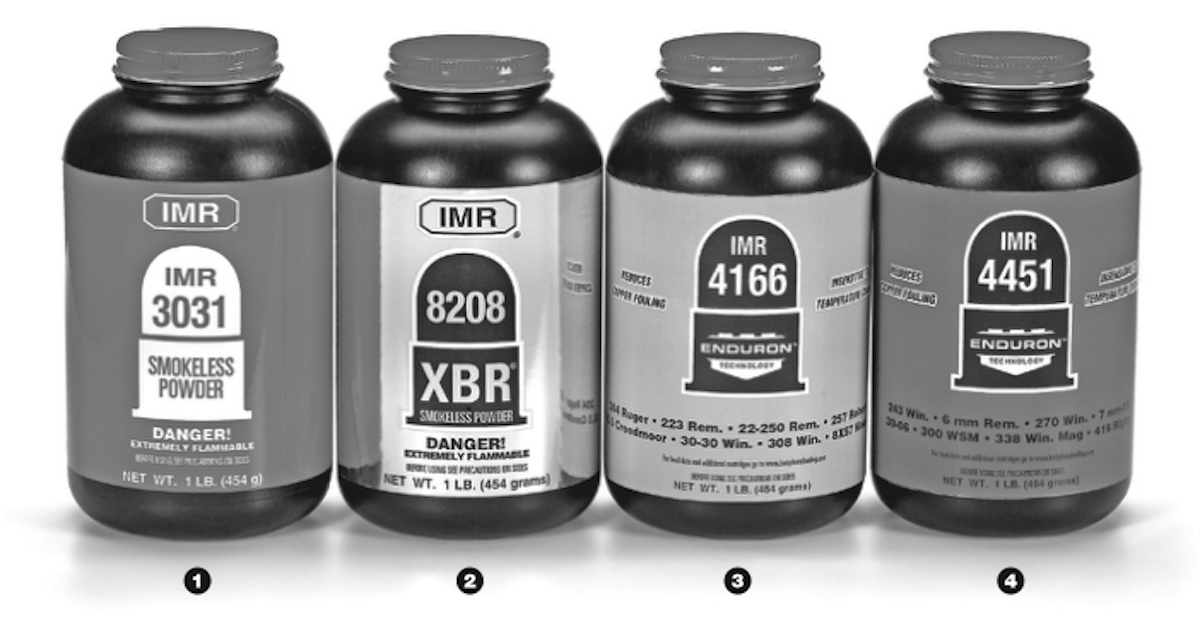
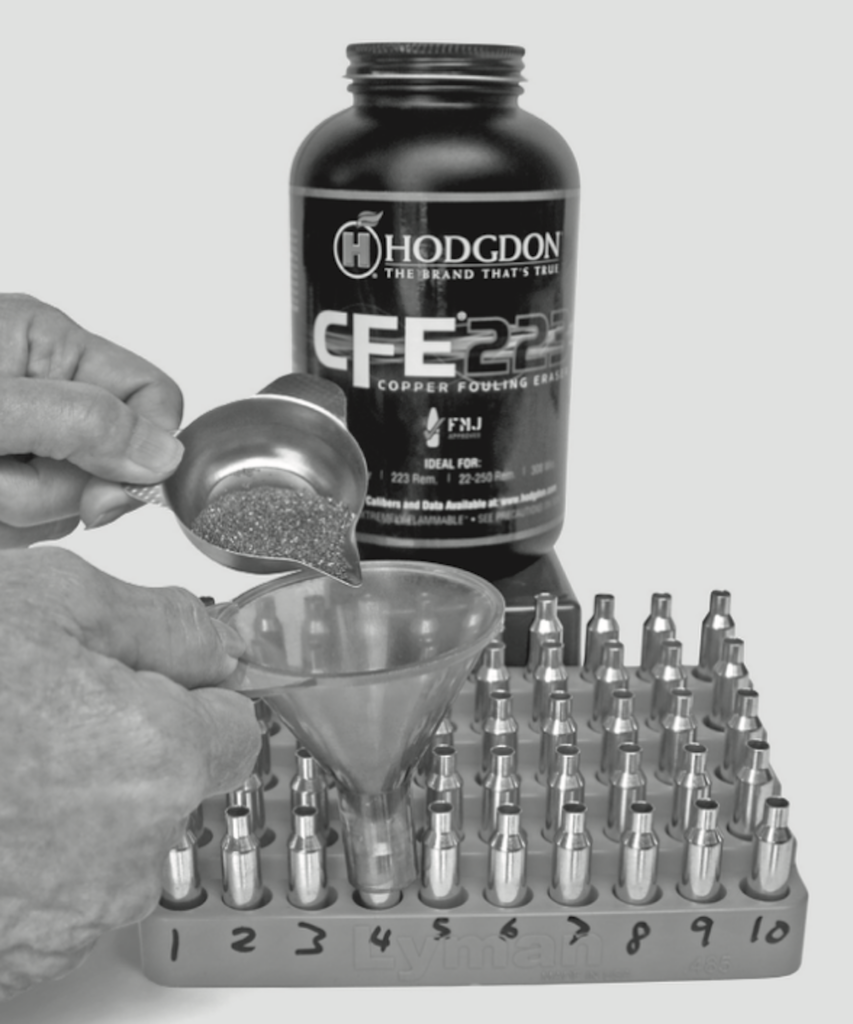
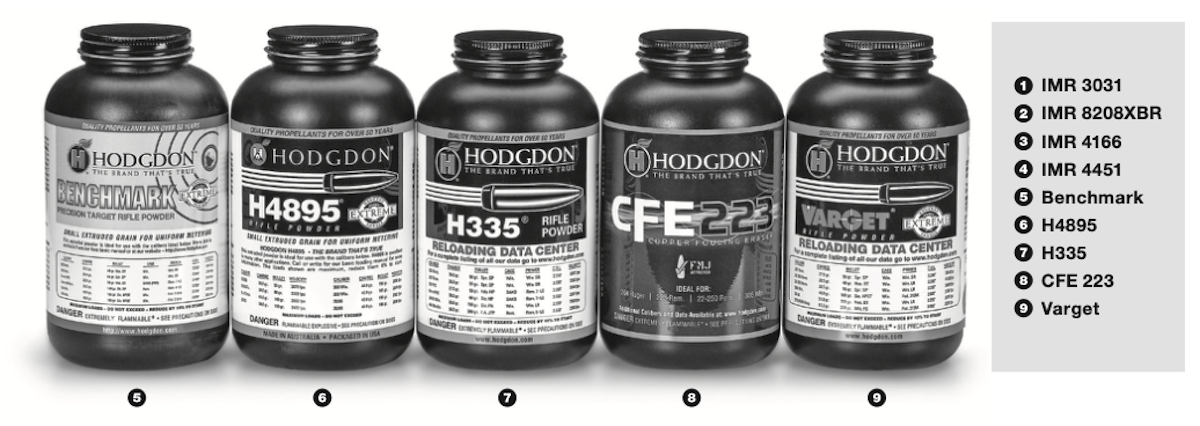
Reloading the 22 Nosler is a pure delight. There aren't any unusual techniques to fuss with—just size, stuff, and enjoy. The folks at Hodgdon's ultra-modern ballistics lab have been busy with the cartridge, too, and have developed over 280 different loads for a bunch bullets with 14 powders. (Okay, you figure up the potential combinations!)
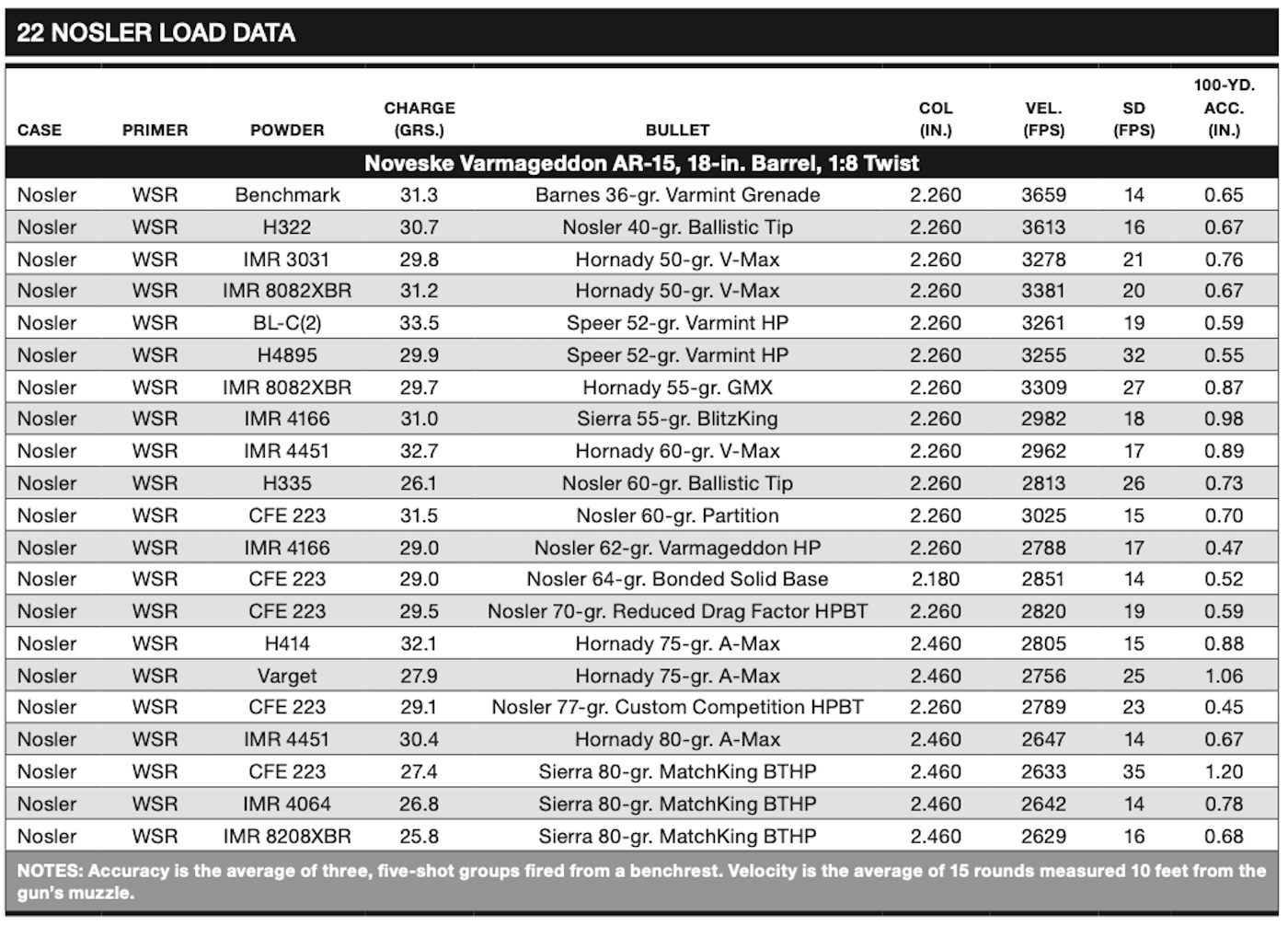
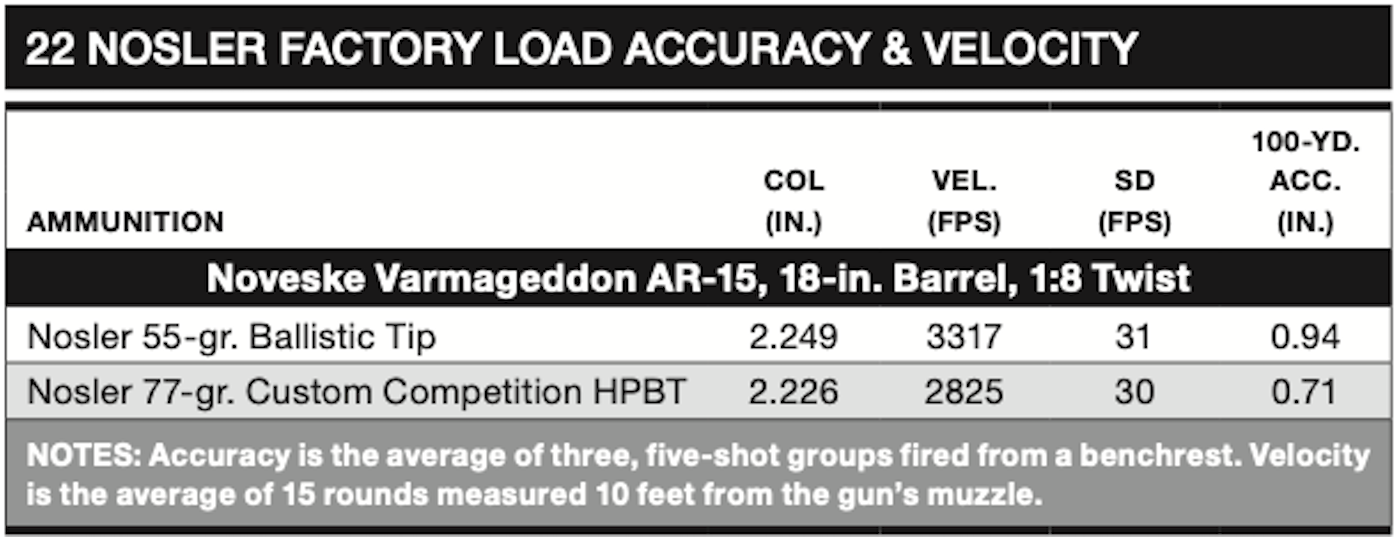
After building ammunition using a bunch of those recipes, I gave the Varmageddon 22 Nosler a workout from my shooting building off of a Lead Sled DFT. Velocities were measured with an Oehler Model 35P chronograph with lighted diffusers over the Skyscreen II sensors. Three five-shot groups were fired, and the results were averaged. The details are listed in the accompanying chart.
First, I fired Nosler factory loads for velocity and accuracy. The 55-grain Ballistic Tip ammo registered 3,317 fps and averaged 0.94 inch. This velocity is pretty darn close to Nosler's advertised speed of 3,350 fps. The 77-grain Custom Competition rounds clocked 2,825 fps and grouped into 0.71 inch. That velocity is just 4 percent slower than the listed speed.
I used Redding dies in a Redding T-7 Turret press to prepare handloads with 16 different bullets from my "bullet barn" and paired them with what looked like the "best" powders for each bullet's weight. Actually, the term "best" is misleading because there really weren't any "bad" loads, some were just better than others.
I first worked up to Hodgdon's maximum loads and found that all shot fine, and none showed the slightest hint of high pressure. Velocities of Hodgdon's maximum loads from the Varmageddon's 18-inch barrel averaged 8.3 percent less than from Hodgdon's 24-inch test barrel.
The S.A.A.M.I. MAP (maximum average pressure) for the 22 Nosler is 55,000 psi, and none of Hodgdon's loads exceed that figure. The Varmageddon rifle ate up all ammo and spit it out, with nary a malfunction of any kind over the course of shooting hundreds of test rounds. All rounds loaded to a COL (cartridge overall length) of 2.26 inches or less were fed from the magazine. The longer loads with the Hornady 75- and 80-grain V-Max bullets were single-loaded with the aid of a Bob Sled single-shot converter.
All cases were full-length sized, but the sizing die was set with the Hornady Lock-N-Load Headspace Comparator to set the shoulder back only 0.002 inch to prolong case life. I used Winchester Small Rifle primers for all handloads, and all powder charges for all handloads were weighed on an RCBS electronic scale. From a clean barrel, I fired one fouling shot and then fired three, five-shot groups. The barrel was cleaned, and the procedure was repeated for the next test load.
Observations
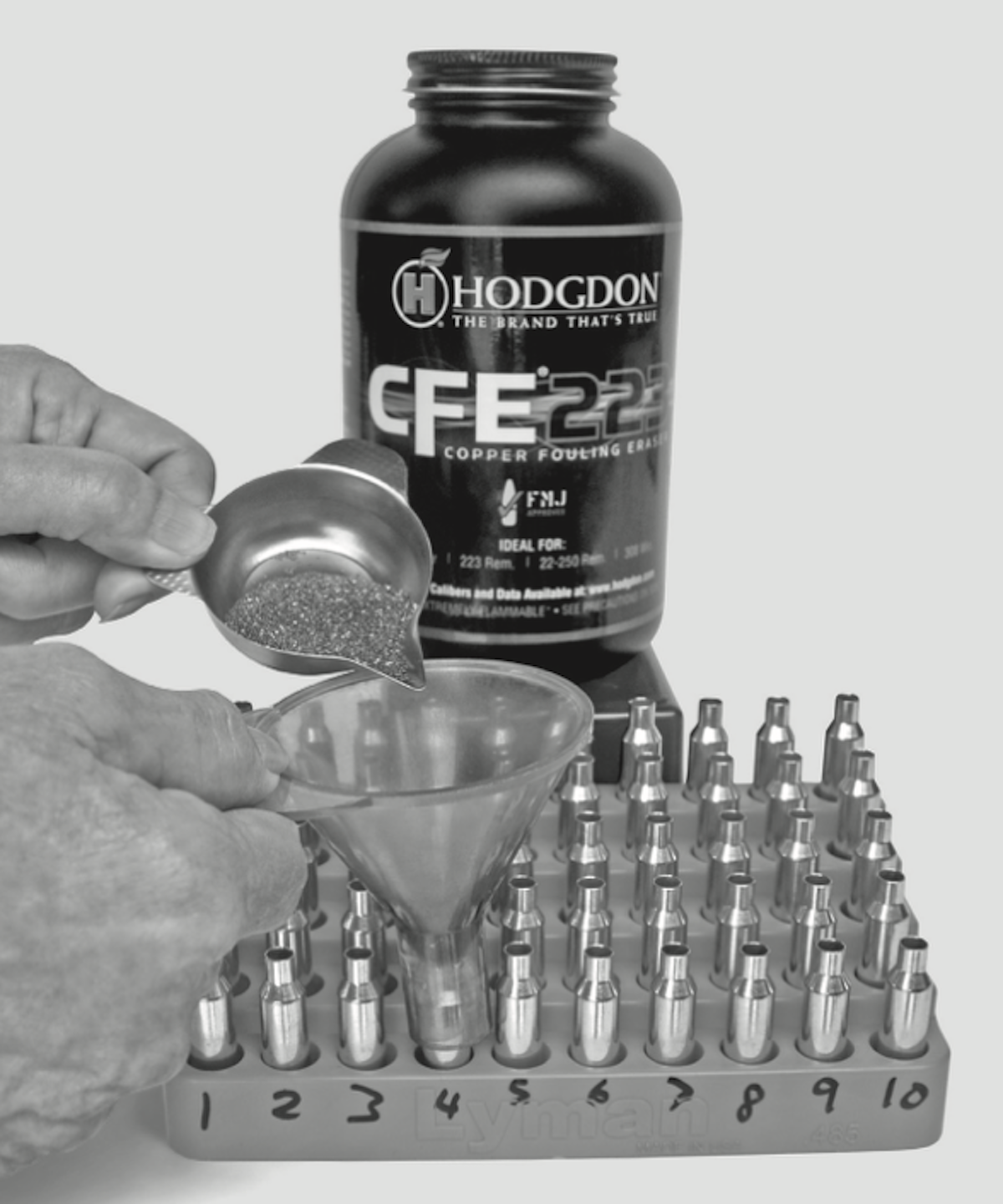
I'll deal with specific loads in a minute, but a few general observations can be made on the pairings of bullet weights and powders. Although many powders gave excellent ballistic performance and accuracy, I think the following recommendations may be helpful. For the 35- to 45-grain bullets, IMR 8208XBR, Benchmark, IMR 3031, H322, and H335 are probably best. The 50- to 55-grain bullets work well with IMR 8208XBR, Benchmark, IMR 4895, H4895, IMR 4166, Varget, BL-C(2), and CFE 223. For the long, heavy 80- to 90-grain bullets, the slowest powders, like H414, W760, and IMR 4451, work well. Readers who dote on IMR 4350 will note that I did not use it in any handload. That is because with even a minimum charge, the case was so full that seating a bullet was darn near impossible. No matter. There are plenty of other, denser powders that do the job.
Overall, the results with IMR 8208XBR and CFE 223 over the entire spectrum of bullet weights were so good that I could live happily ever after with either of them for loading the 22 Nosler. Specific recipes that I really like almost all use those two powders. Loads that rose to the top of the heap were with the Hornady 50-grain V-Max over 31.2 grains of IMR 8208XBR. Velocity was 3,381 fps, and groups averaged 0.67 inch. Another winning quartet was with the Nosler 60-grain Partition, Nosler 64-grain Bonded, Nosler 70-grain Reduced Drag Factor BTHP, and Nosler 77-grain Custom Competition HPBT bullets. All of these loads were with CFE 223 powder. For my money, the 77-grain bullet over 29.1 grains of CFE 223 might be the overall champ for this rifle. However, Texas deer hunters will appreciate that the Partition load at a muzzle velocity of over 3,000 fps produces more than 1,200 ft-lbs of muzzle energy and might just do a number on Texas whitetails and similar medium-size game.
Additionally, both IMR 8208XBR and CFE 223 meter with great uniformity, deliver top-notch accuracy, and foul very little. In fact, at one shooting session, I fired 50 rounds without cleaning the bore, only letting the barrel cool between groups. At the end of the shooting, I pushed a solvent-soaked patch and a dry patch through the bore and then examined it with my Hawkeye borescope. There were only a few slight hints of the dreaded copper fouling here and there, and a couple of patches with Otis Copper solvent took care of them. High-volume varmint shooters will note that this does not bode well for prairie dogs!
The new Enduron powders shot well, too, and, of course, also reduced fouling. With the Hornady 60-grain V-Max, a charge of 32.7 grains of IMR 4451 gave a velocity of 2,962 fps, but the group average, while very good at 0.89 inch, was "ruined" by a dreaded flyer. Moving on to the Hornady 80-grain A-Max and 30.4 grains of IMR 4451, the velocity was 2,647 fps, and groups averaged 0.67 inch. IMR 4166 paired with the Nosler 62-grain Varmageddon HP proved to be an excellent load. It produced a modest velocity of 2,788 fps but grouped into 0.47 inch.
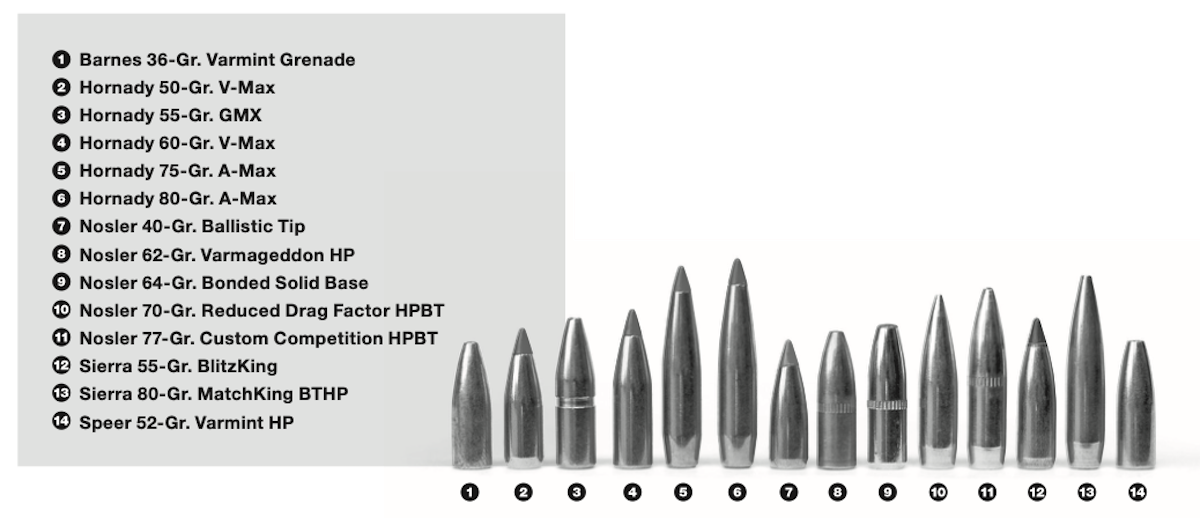
The fastest load was a sizzling 3,659 fps with the Barnes 36-grain Varmint Grenade over 31.3 grains of Benchmark; it averaged 0.65 inch. The highest muzzle energy (1,330 ft-lbs) was with the Nosler 77-grain Custom Competition HPBT and 29.1 grains of CFE 223.
You will note that the group averages of some otherwise great loads are considerably larger than other groups. This is because every now and then, a flyer would ruin an otherwise excellent group. I am pretty sure that these are due to what I call "loose nut" (the nut at the end of the stock) shots, not the ammo. However, I did not reshoot these loads because that would statistically skew the results, possibly in either direction, and give an unfair advantage to the other loads. So the results are what they are.
The 22 Nosler will inevitably be compared to the 223 Remington and the 22-250 Remington, not to mention the 6.5 Creedmoor and the new 6mm Creedmoor for long-range shooting, so I ran a few loads through the Oehler Ballistic Explorer computer program. In a nutshell, the 22 Nosler easily outclasses the 223 Remington due to its velocity advantage of 250 to 350 fps and the fact that its fast-twist barrel can shoot heavy-for-caliber bullets like the 22-250 Remington. Almost every 22-250 rifle has a 1:14-inch twist barrel (although Savage and perhaps other makers offer the round in rifles with 1:9-inch twist barrels) that just can't stabilize heavier and longer bullets.
The story of the 6mm and 6.5 Creedmoor cartridges is simple. Their trajectories are similar to the faster loads of the 22 Nosler, but the heavier .24- and .26-caliber bullets provide a punch that can't be matched by the smaller-diameter .22-caliber bullet. Of course, they have substantially more recoil, and their availability in ARs is more limited.
After much reloading and shooting, I can honestly say that the 22 Nosler is one of the most rewarding cartridges I've had the pleasure to work with in many years. It doesn't kick your head off, bellow like an irate water buffalo when you shoot it, or gobble up gobs of powder with every bite. It just works. Now if other rifle manufacturers will offer additional guns chambered for it, including some "value-priced" models, its popularity will rise. The excellent results achieved with IMR 8208XBR, CFE 223, and other propellants will contribute to a bright future for this promising newcomer.