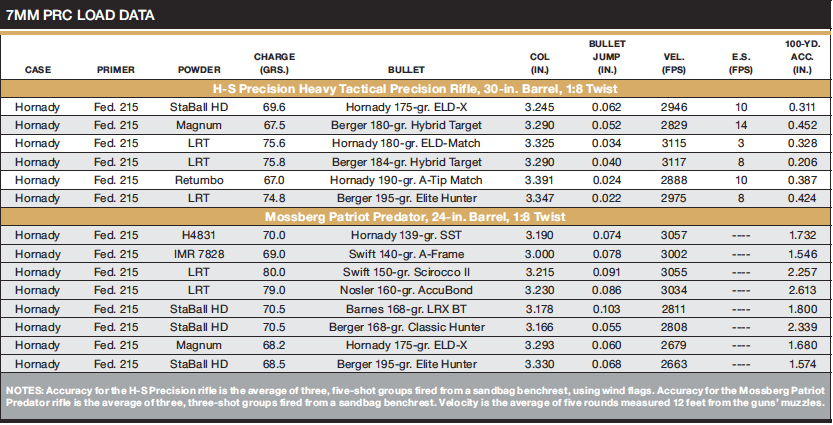



S.A.A.M.I. maximum average chamber pressure for the 7mm PRC is 65,000 psi with a specified instrumental velocity of 2,950 fps for a 180-grain bullet. A rifling twist rate of 1:8 inches is recommended. Minimum chamber throat diameter is 0.2846 inch, a mere 0.006 inch larger than nominal bullet diameter. S.A.A.M.I. minimum chamber neck diameter is 0.318 inch. Neck diameter of the Hornady factory-loaded ammunition I have is a very uniform 0.314 inch—or 0.004 inch smaller than S.A.A.M.I. chamber neck minimum. Such close fits ensure precise alignment of bullet and bore axes, and that goes a long way toward delivering match-winning accuracy. The barrels of mass-produced hunting rifles can and often do vary considerably from S.A.A.M.I. minimum dimensions, but it is also commonly seen in precision-built target rifles.
S.A.A.M.I. released cartridge and chamber drawings for the 7mm PRC on June 7, 2022, and the race was on to gather everything needed for this report. As expected, Hornady was first to respond. Precision Hunter ammunition loaded with the 175-grain ELD-X at a muzzle velocity of 3,000 fps and match ammo with the 180-grain ELD-Match at 2,975 fps were first to arrive. Soon thereafter, a generous supply of virgin 7mm PRC cases along with 175-grain ELD-X and 180-grain ELD-Match bullets were in my reloading room. A Hornady Deluxe die set also was included. Pressure-tested data for 10 different powders arrived from Hodgdon in late July.
When accepting this assignment for the Annual Manual, I knew that rounding up a factory-built rifle in 7mm PRC could be my most challenging hurdle. To meet the editor’s deadline for my report, I needed to start sending bullets downrange no later than mid-August, which was a mere 10 weeks after most chamber reamer grinders and rifle manufacturers across the country had received chamber dimensions from S.A.A.M.I. Pushing my luck is putting it mildly.
While contemplating the project, I mentioned to longtime friend Gary Turner, owner of Talley Scope Mounts, my concern about having enough time to find a rifle. He suggested I contact Josh Cluff, vice president of Marketing at H-S Precision in Rapid City, South Dakota. A serious long-distance competitive shooter, Cluff had recently completed building his company’s very first rifle in 7mm PRC.
With its heavy 30-inch, cut-rifled barrel, Kahles 6-24X 55mm K624i scope, and Atlas bipod, the Heavy Tactical Precision Rifle (a member of the H-S Precision’s Pro Series) weighed just over 20 pounds. Short and long actions are available for numerous cartridges, ranging from 6mm Creedmoor to 338 Lapua Magnum. The 7mm PRC is built on the long action, and the detachable magazine will handle cartridges as long as 3.640 inches. Every part of H-S Precision rifles, including the action, barrel, stock, and trigger, are made in-house. Then came really good news. Jeff would ship the rifle to me immediately upon its return from the Hornady factory in Nebraska, where it was being used in a promotional video. As I soon learned, its trigger broke crisply at a consistent 12 ounces.
While the 7mm PRC may prove to be quite successful among long-distance target shooters, it is likely to become even more popular among big-game hunters. So when Linda Powell at Mossberg mentioned sending me the first Patriot Predator rifle chambered for the new cartridge, I wasted no time in accepting her offer. On my digital postal scale, it weighed six pounds, 13 ounces. Weaver six-hole skeleton rings used to attach a Bushnell Elite 4500 4-15X 50mm scope to the rifle’s Picatinny rail brought its huntready weight to 8.75 pounds. While S.A.A.M.I. maximum length for the 7mm PRC is 3.090 inches, the detachable magazine of the Mossberg rifle is roomy enough to accept handloads as long as 3.330 inches. It has an average trigger pull weight of 2.5 pounds with no detectable creep or overtravel, and that is not bad for a rifle in its price range.
Accuracy guru Kenny Jarrett once opined that a good muzzle brake, properly attached, often will improve the mechanical accuracy of a rifle. Equally important during my tests from a benchrest, it also can make a rifle easier to shoot accurately. A brake from Little Crow Gunworks attached to the muzzle of the Patriot Predator increased barrel length only by an inch and virtually eliminated muzzle rise.I did not compare the accuracy of all loads with and without the brake, but average group size fired with the two Hornady factory loads was about 0.030 inch smaller with the brake installed.
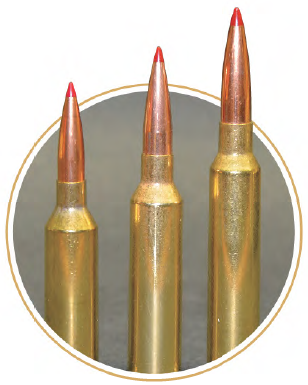
Rim diameter of the PRC trio of cases is the same as for the 7mm Remington Magnum, 300 Winchester Magnum, and other cartridges on the Holland & Holland-style belted case. When case capacities are compared, it’s easy to see that the 7mm PRC is actually a modern, non-belted version of the grand old 7mm Remington Magnum. This is good because the 7mm Remington Magnum cartridge long ago proved capable of handling most big-game animals around the world at a level of recoil easily tolerated by most experienced hunters. To make a gross-capacity comparison, I filled five each of Hornady 7mm PRC and Remington 7mm Magnum primed cases to the brim with water and came up with respective averages of 80.4 grains and 82.7 grains respectively. In cases of their sizes, such a small difference in capacity has virtually no bearing on the difference in velocity potential. In other words, the performance of the new 7mm PRC is every bit as good as the 7mm Remington Magnum has been for 60 years.
Net capacity is more important than gross capacity, and the first step in that comparison was accomplished by seating the 180-grain Hornady ELD-Match bullet in an unprimed 7mm PRC case at a cartridge length of 3.290 inches. This duplicated the length of Hornady Match ammunition loaded with that bullet. Doing so put the base of the bullet 0.095 inch behind the shoulder/neck juncture of the case for very little encroachment on its powder cavity. After weighing the case, I used a hypodermic syringe with a needle small enough to enter the flash hole of the case and filled it with water. Weighing it again revealed a net capacity of 68.5 grains.
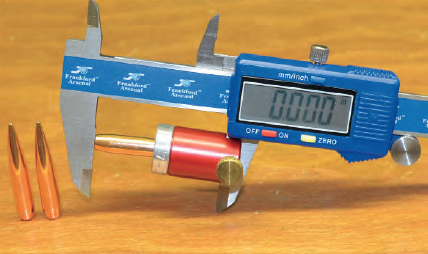
The 7mm Rem. Mag. was up next. I first seated the 180-grain ELDMatch to the longest cartridge length that would chamber in a new Remington Model 700 rifle. It turned out to be 3.460 inches, but since the bullet was touching the rifling, cartridge length was reduced to 3.440 inches. That put the base of the bullet 0.245 inch behind the shoulder/neck juncture of the case for a net water capacity of 72.9 grains. Again, not enough difference in capacity to greatly matter in cartridges of their sizes. For those who do not know, the nominal interior magazine box length of the standard-length Model 700 action is 3.700 inches. This is considerably longer than the maximum length of 3.290 inches established by Remington for the then-new 7mm Rem. Mag. when it was introduced back in 1962.
Seating extremely long bullets for minimal encroachment on the powder cavity requires an uncommonly long chamber throat. Seating a flatbase bullet backwards in the 7mm PRC case for light contact with the rifling when the dummy was chambered put the base of the bullet 0.330 inch from the mouth of the case in the H-S Precision rifle. Respective bullet jumps for Hornady ammo loaded with the 175-grain ELD-X and 180-grain ELD-Match were 0.020 inch and 0.050 inch. Due to a 0.040-inch longer chamber throat in the Mossberg rifle, bullet freetravel for the two loads was 0.060 inch for the 175-grain bullet and 0.090 inch for the 180-grain bullet.
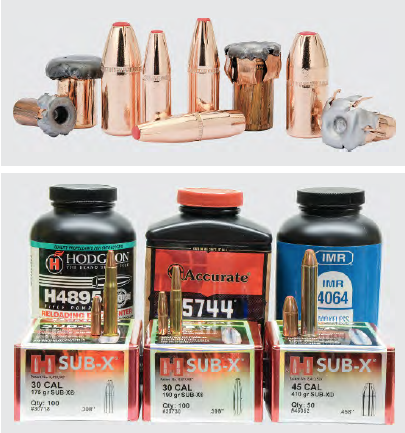
Load density indicates the amount of empty space inside a case from its web to the base of the bullet occupied by a powder charge. A charge that completely fills that space is considered to be a 100 percent density load, and velocity variation is likely to be low. If it fills only half the space, it is a 50 percent density load, and depending on the powder being loaded, velocity variation can be quite high. Due to the varying densities of various powders and variations in powder charge weights, load density in subsonic ammunition will vary considerably. Subsonic data with the highest load densities developed by Hodgdon that I received for several cartridges were 35 percent for the 223 Rem. (Accurate No. 2 powder), 38 percent for the 308 Win. (also Accurate No. 2), and 76 percent for IMR 4064 in the 45-70. Since Trail Boss is far more bulky than the other powders, load density for 13.5 grains behind the Rim Rock 405-grain cast bullet that I shot is 99 percent. Unfortunately, Australian Defense Industries (ADI) has not delivered any Trail Boss to Hodgdon for several years, and this is why staff members at Hodgdon’s ballistics lab have spent many hours developing subsonic loads with a variety of other powders. Increase expansion ratio beyond that of the 45-70 by switching to the 458 SOCOM, and for nine of the powders used by Hodgdon with the Hornady 410-grain SUB-X and ACME 576-grain bullets, load density slightly exceeds 100 percent due to slight powder charge compression. Those powders are Benchmark, IMR 3031, Accurate LT-30, Accurate LT-32, IMR 8208 XBR, Accurate 2495, IMR 4198, Accurate 2200, and Accurate 5744.
At the short distances slow-poke loads are usually shot, load density does not appear to be a determining factor in producing the best accuracy. Load density for 8.7 grains of Titegroup behind the Hornady 175-grain SUB-X in the 308 Win. is only 26 percent, yet when that load was shot in my Jarrett custom rifle, it averaged 0.46 inch at 100 yards. That rifle, by the way, has a Remington Model Seven action, McMillan stock, and a medium-heavy Shilen Select Match Grade barrel. It consistently shoots inside half MOA with a variety of full-power loads, and I have used it to take a lot of game. Due to the small charges of powders used in subsonic loads, a short section of wooden dowel should be used to check each case for an accidental double charge prior to bulletseating.
It should be noted that powder charges shown by Hodgdon under the “Maximum Loads” heading indicate the heaviest charge that could be used in the company’s pressure gun without exceeding subsonic velocities. It does not indicate a maximum-pressure charge. This becomes quite clear when comparing maximum pressures shown for full-power loads in the 300 Blackout and those listed for subsonic loads in that cartridge. Due to the absolute minimum chamber and bore dimensions of a pressure barrel, pressure and velocity of a particular powder charge/bullet weight combination can be higher than in many offthe-shelf, mass-produced rifles. A velocity ranging from 1,000 fps to 1,075 fps is the goal, and in order to reach that, the subsonic charge listed by Hodgdon may have to be increased slightly when loading for the typical factory rifle. On the other hand, some rifles may require a slight decrease in Hodgdon’s recommended charge weight.
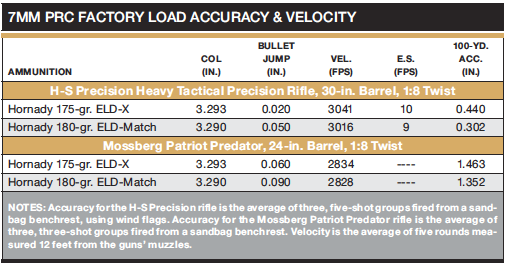 When putting together ammunition for the Mossberg and H-S Precision rifles, I took the two approaches commonly used by most shooters who handload for off-the-shelf big-game rifles and for precision-built rifles used in competitive shooting. A standard Deluxe die set from Hornady was used for the Mossberg rifle, and after maximum charge weights were established for various propellants, the amount of freetravel for each bullet is what has worked for me when handloading various other 7mm cartridges.
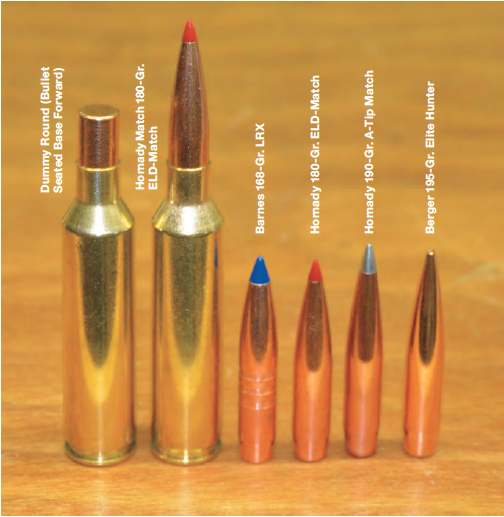
Preparing precision handloads for the Heavy Tactical Precision Rifle took a lot longer. Full-length resizing and trimming all cases to the exact same length came first. Capacity sorting was next. After inserting an O-ring-type primer pocket plug from 21st Century Innovation into a case, they were weighed together on a digital scale and then weighed again after the case was filled to the brim with water. Subtracting the former weight from the latter gave me the gross water capacity of that case. Repeating the process through a batch of cases resulted in smaller groups of cases with identical capacities that were kept separate during their trip through a Lyman Cyclone Dryer and during loading and firing.
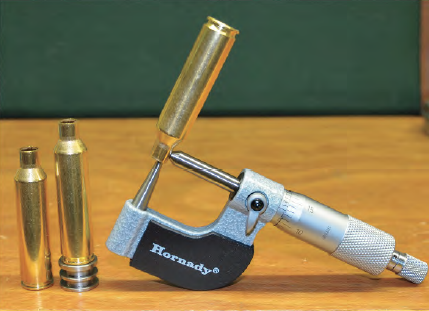
A ball micrometer revealed variations in neck thickness of cases, so they were outside turned just enough to remove the high spots. That put cartridge neck diameter with a 0.284-inch bullet seated at 0.3126 inch. After each firing, a Redding Type S die with a 0.311-inch bushing was used for neck sizing.
Other improvements included making the primer pocket depth uniform and deburring of the interiors of the flash holes. A Hornady Bullet Comparator was used to ogive-sort all bullets. Each powder charge was dispensed by a precision-built measure from Neal Jones of Custom Products and then verified on an Ohaus 304 scale sold by RCBS many years ago. Hornady’s excellent die with a floating alignment sleeve was used to seat bullets. Cartridges were assembled on a Corbin CS-1 bullet-swaging press converted for ammunition loading. Bullet runout of all rounds did not exceed 0.001 inch. Case necks were trimmed and annealed after each firing. Graham wind flags were used when shooting groups with the Heavy Tactical Precision Rifle.
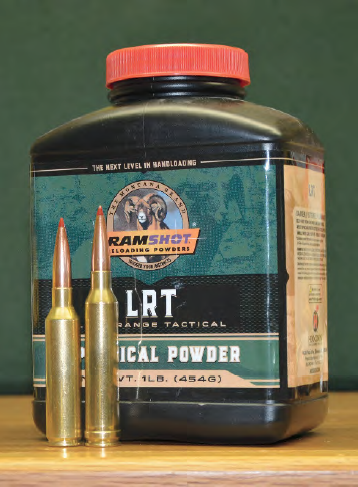
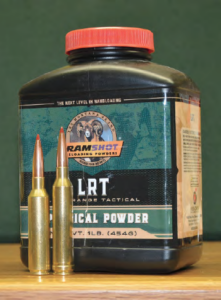
When Hodgdon Ballistician Justin Schrader was questioned about the best choices in powders for the 7mm PRC, he mentioned the brand-new Winchester StaBALL HD and the well-known Ramshot LRT as being standout performers with the heavier bullets while H4831 and H1000 ranked high among his picks for the lighter bullets. All things—including accuracy and low velocity spread—considered, the H-S Precision Heavy Tactical Precision Rifle chose LRT as the clear winner. As to be expected of spherical propellants, LRT, along with Winchester StaBall HD and Ramshot Magnum, flowed through my Custom Products powder measure with practically no variation in charge-to-charge weight.
So where does the 7mm PRC fit in the world of centerfire cartridges? In F-Class competition, where 20 rounds are often squeezed off as rapidly as possible during a chosen wind condition, the 7mm PRC may burn a bit too much powder for acceptable barrel accuracy life. The 6mm Dasher and other small cartridges now dominate PRS competition, so I don’t see the 7mm PRC making an impact there, either.
Move to Extended Long Range competition with targets beyond 2,000 yards and the 7mm PRC may be destined for a good showing. According to a recent match report by Cal Zant, the 300 PRC was the third most popular cartridge among competitors, and the 7mm Remington Magnum was also in the fray. Only time will tell how popular the 7mm PRC becomes among elite riflemen who manage to consistently connect on steel targets at distances most of us consider impossible.
Moving to big-game hunting, a look into my trusty crystal ball reveals a very bright future for the 7mm PRC. Older hunters like me who have been quite happy and content with rifles in 7mm Rem. Mag. for several decades are not likely to rush out and switch, but among generations of shooters who grew up (and will grow up) in a world of magnum-performance cartridges without a belt, Hornady’s latest tackdriver is sure to become a huge hit.