




Today, the family-owned company celebrates 75 years of continuous business.
The seeds for what would grow into the Hodgdon Powder Co. were planted in 1947 when Brewster Eltinge “Bruce” Hodgdon returned home from serving in the U.S. Navy during World War II. His idea was to purchase mass quantities of unused U.S. military surplus gunpowder, repackage it in small quantities, and sell it to a burgeoning market of hobbyist handloaders. Today, the family-owned company celebrates 75 years of continuous business.
This article includes excerpts from The Gunpowder People, a book detailing the history of this legendary company that was published in 2017 for the company’s 70th Anniversary, as well as new information about the achievements made over the last five years. For details on many of the numerous innovations the Hodgdon Powder Co. is responsible for, see the tandem article entitled “A History of Innovation,” beginning on page 46 of this special publication.
1940s & ’50s

After Bruce returned from the war, he was convinced there was a previously untapped demand at the consumer level for propellant. He had heard the stories of some of the U.S. warships literally dumping tons of powder into the world’s oceans once World War I had ended. He was absolutely certain that many Americans would take a small portion of their hard-earned weekly wages and buy propellant to build their own ammo.
So he began writing letters to everyone he could think of, including the President of the United States and U.S. Senators and Congressmen, to find out how, when, and where surplus powder could be obtained. Working through an arduous pile of government regulations, Bruce remained persistent and was finally able to purchase 50,000 pounds of government surplus 4895 powder. His bid was 4 cents per pound.
In order to pursue his dream of creating his own company, while still working as a salesman for the Gas Service Co., Bruce took a huge gamble and borrowed $1,500 from his life insurance policy. Banks at the time were unwilling to loan money on gunpowder. With that money he was able to lease the land, put a couple of railroad boxcars on it for powder storage, and buy the surplus powder from the U.S. government. He took possession of the powder in November 1947.
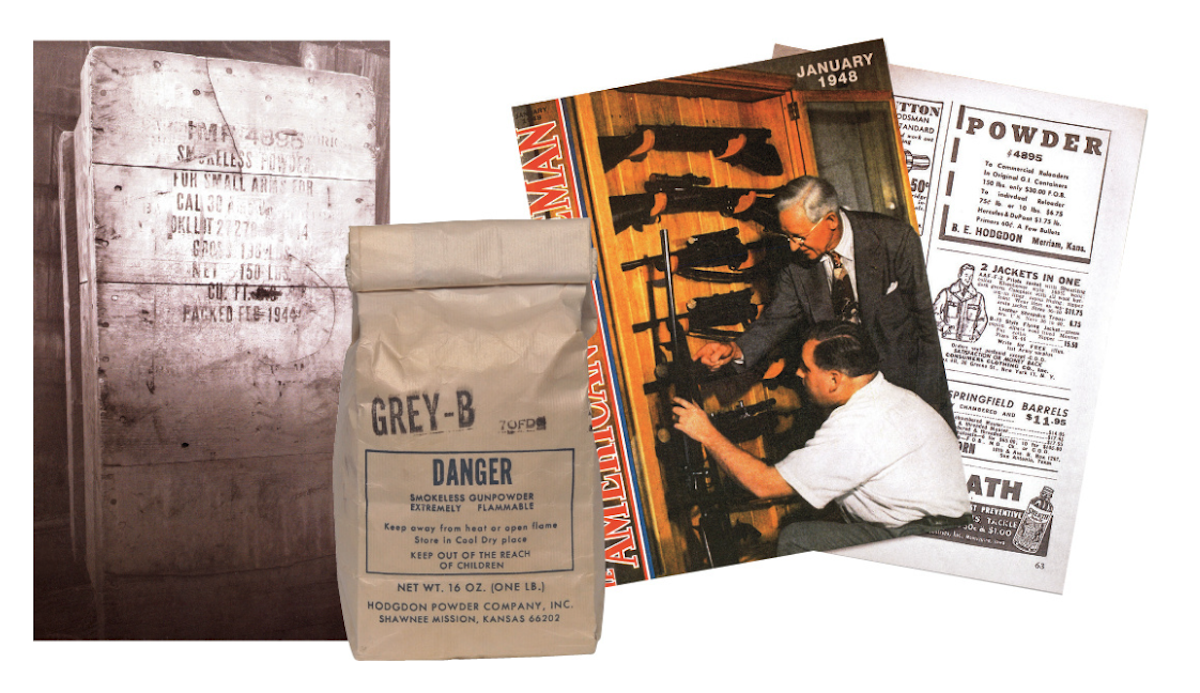
The following January, Bruce placed his first advertisement for the repackaged powder in the American Rifleman. The ad listed 150 pounds of 4895 powder in original G.I. containers for just $30.00 F.O.B. It also offered the powder at a price of 75 cents per pound or 10 pounds for $6.75. B.E. Hodgdon was in the powder business.
And the business quickly flourished. So much so that Bruce’s wife, Amy, served as bookkeeper and saleswoman, and his two sons, J.B. and Bob, who were in grade school at the time, weighed and filled one-pound bags of 4895 powder by hand in the family home’s basement. They also glued on labels, loaded the bags into the trunk of the family Ford, and delivered the packages to the nearby train station.
By the time 1952 rolled around, Bruce’s sideline powder business was making three times his gas company salary. When the gas company implemented a dress code (meaning Bruce would have to wear a tie while calling on clients), Bruce decided to pursue the powder business full-time. The following year, the Hodgdon Powder Co. was officially started.
Handloading was beginning to gain traction. And the mid-1950s marked a period of growth unmatched in handloading to this day.
1960s
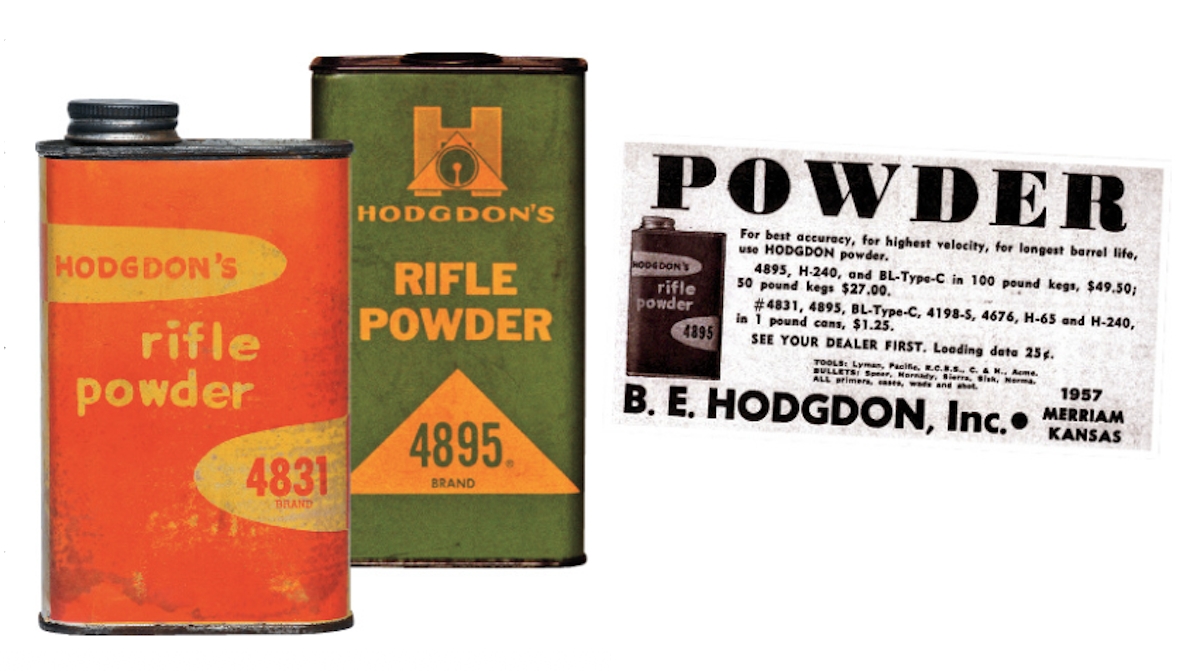
During the 1960s, the Hodgdon family business really began to make its mark in the shooting sports on a variety of fronts. A significant achievement was Bruce’s first talks with Winchester to buy and sell its powder under his own brand. These talks would eventually be the foundation of a very long relationship.
In 1960, the Hodgdon Powder Co. first began selling newly manufactured powder in canisters instead of military surplus powder. Over the years, Bruce’s purchases of military powder amounted to more than 4.5 million pounds. Most of it was what is now known as H4831. Other propellants of lesser quantities were H4198, H4227, H4895, and Ball C.
Another Hodgdon major achievement was getting the Department of Transportation to change its regulations on shipping powder. During 1963 and 1964, Bruce, along with Ray Speer of Speer Bullets, Homer Clark of Alcan, and Dave Wolfe of Wolfe Publishing, enlisted the aid of Senator Frank Church (D-ID) to set up a meeting with the Interstate Commerce Commission in Washington, D.C. They were successful in persuading the Department of Transportation to downgrade certain packages of smokeless powder to the much-easier-to-ship “4.1C Flammable Solid” classification. As a result of their efforts, propellant containers under eight pounds each and in approved packaging of shipments weighing less than 100 net pounds could be handled by any common carrier, including UPS. Prior to this, all smokeless powders were considered Class B explosives.
Bruce also had been selling guns and shooting accessories along the way, and he had been developing and designing a massive shooting complex to provide a safe and enjoyable environment where shooters and their families could participate in the shooting sports. Consequently, the Bullet Hole shooting range opened to the public in 1967, and it promoted recreational shooting as a family sport.
1970s
The 1970s saw the introduction of the black powder substitute Pyrodex, which was announced at the 1976 NRA Meetings in Indianapolis, Indiana. The importance of Pyrodex to the Hodgdon company history cannot be overstated. It was a technological marvel and gave the industry the first totally new propellant since the invention of smokeless powder. (You can read more about the technology in the accompanying “A History of Innovation” article.)
The original agreement was that Dan Pawlak, the co-inventor of Pyrodex, and his folks would manufacture the new propellant at their facilities in Washington State, and Hodgdon, based in Kansas, would be the sole distributor marketing it worldwide. Unfortunately, on January 27, 1977, after Pyrodex was launched, an explosion at Pawlak’s plant killed Pawlak and three others. In addition to the human tragedy, which the Hodgdons felt on a very personal level, the setbacks experienced put the Hodgdon company on the brink of bankruptcy.
Even though the industry was abuzz with excitement over the prospects of the black powder substitute—and, in fact, Hodgdon had received an industry award for the best new product of the year as well as selling 250,000 pounds of it during its first year of production—a new business plan had to be developed and implemented. Quickly, Pyrodex production was moved to a facility in Herington, Kansas.
But the Hodgdon family was facing a serious crisis. They had invested heavily into the launch of Pyrodex, and the accident changed everything. Once initial production caught up with orders, business gradually fell to one-fourth of plant capacity due to a combination of depressed business conditions throughout the country, runaway interest rates, and vendor problems. On top of that, Hodgdon discovered that the consumer packaging being used was faulty (it was not moisture-tight), and the company had to recall upwards of 100,000 pounds of the propellant. As the situation got worse, Bruce and sons J.B. and Bob were advised by bankruptcy attorneys to let the company sink.
1980s & ’90s

The Hodgdons wouldn’t hear of letting the company sink, so they laid off workers at the sister company, B.E. Hodgdon Inc.; liquidated it in 1983; sold off lots of assets to keep the powder company afloat; and took no salary for about four years. They scrimped, saved, and sold off unnecessary assets. After 12 years of struggle, things slowly got better with increased Pyrodex business and continued decent smokeless powder sales. In 1990, when the plant industrial revenue bonds were paid off, relief came, and the business began to prosper once again.
The 1990s also saw significant new products being introduced by the company. One was Clays powder, which was announced in 1991. Clays turned out to be a stroke of genius, a real business builder. Bob and J.B. realized the market demanded a new shotgun powder. They literally searched the world over to find a 12-gauge target powder that was clean burning, produced less muzzle blast, had ideal bulk density with optimal fit in the most popular gauges, and was competitively priced. They found what they were looking for in a new propellant being worked on by their powder producer in Australia. Hodgdon had begun working with the company, named Australian Defense Industries (ADI), in 1989 when their previous supplier in Scotland closed.
ADI’s new shotgun powder had uniform grain size, macro-controlled micro porosity, and a nitroglycerine glaze that gave it a consistent burn. (Again, you can read more about the technology in the accompanying “A History of Innovation” article.) As a bonus, Clays turned out to be an excellent choice for 38 Special, 9mm Luger, 40 S&W, and 45 ACP handgun cartridges as well. It virtually set the handloading world on its ear.
For rifle reloaders came Varget in 1995. Varget was the first of what Hodgdon termed Extreme powders, and it was developed as a mid-range burn speed propellant. It is an extruded rifle powder, and during its development the ballistic department discovered it is very insensitive to changes in temperature. The name “Varget” stands for varmint (Var) and target (get). Its characteristics include small extruded grains for uniform metering and higher energy for improved velocities over other powders in its burning speed class. Shooters found its easy ignition and clean burning translated into better accuracy.
This technology was applied to subsequent rifle powders, and in addition to Varget, Hodgdon’s Extreme rifle powders today include Benchmark, H322, H1000, H4198, H4350, H4381SC, H4831, H4895, H50BMG, and Retumbo.
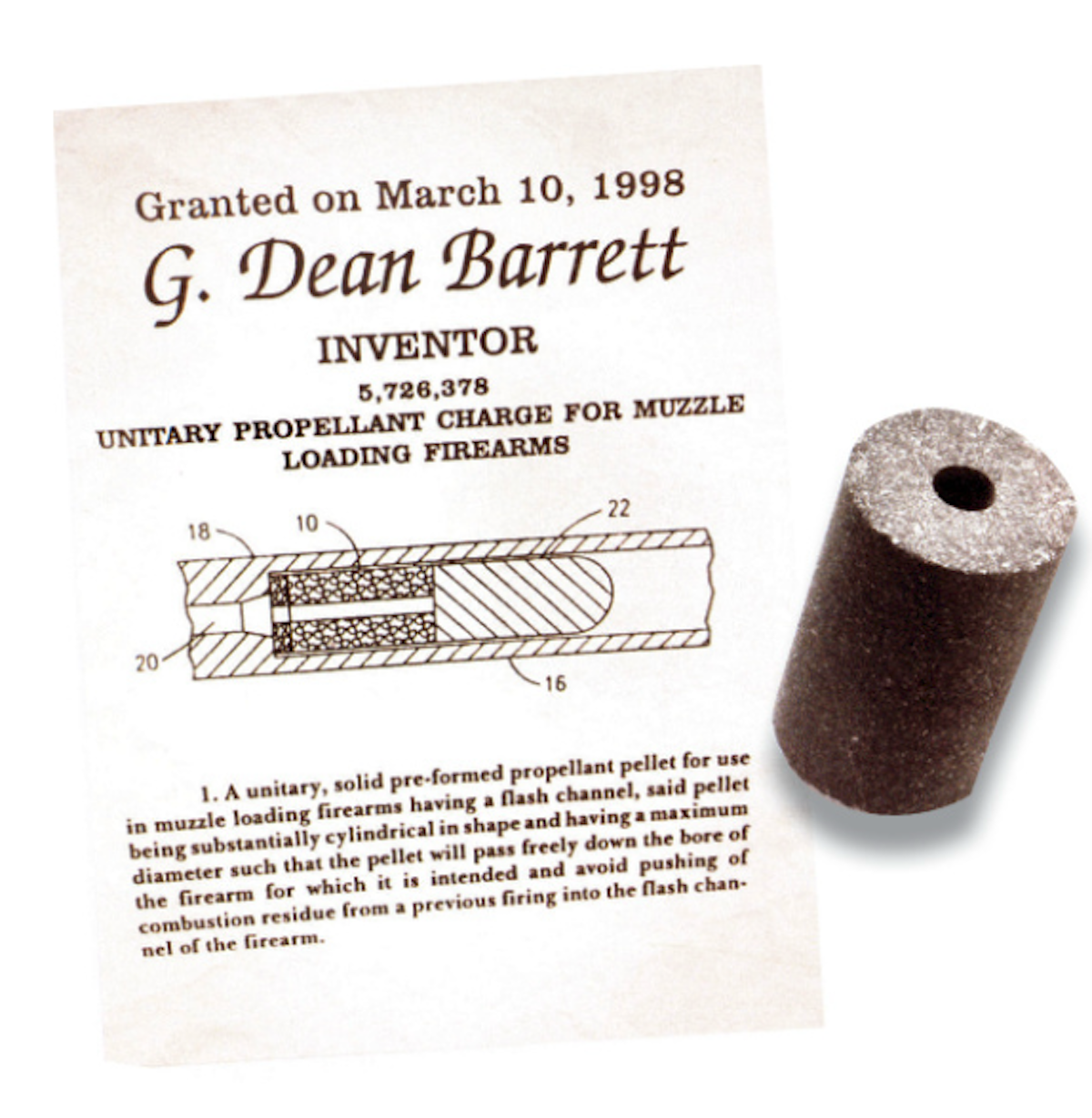
Another major development came in 1996, with the creation of Pyrodex Pellets. Almost 20 years after loose Pyrodex was invented, Hodgdon transformed it into a 50-grain pellet that would simplify the loading process of percussion firearms. Hodgdon engineer Dean Barrett, upon being asked by Bob Hodgdon if he could make a military black powder mortar igniter disk out of Pyrodex for use in sporting muzzleloaders, designed the pellet and drove the process to produce it. Coinciding with the development of the Pyrodex Pellet was the rise of inline muzzleloading rifles. The fast-growing popularity of inline muzzleloaders created a market for the Pyrodex Pellet, and in the words of then-president of Hodgdon Tom Shepherd, “…we were selling Pyrodex Pellets like popcorn.”
2000s
You could easily call the decade from 2000 to 2010 a period of acquisitions. In 2003 Hodgdon acquired IMR Legendary Powders. This added many, many rifle, handgun, and shotgun propellants to the Hodgdon lineup. Then in 2005 Hodgdon licensed and began marketing Winchester smokeless powders. And in 2009, Hodgdon acquired Goex black powder.
2010s & ’20s
The last dozen years in the history of the Hodgdon Powder Co. have seen exceptional growth on the developmental and the acquisition sides of the business. In January 2012, Hodgdon introduced CFE 223, which is a spherical propellant that incorporates Copper Fouling Eraser (CFE). The ingredient was originally used in military propellant, and it greatly deters copper fouling and contributes to longer periods of top accuracy with less barrel-cleaning time.
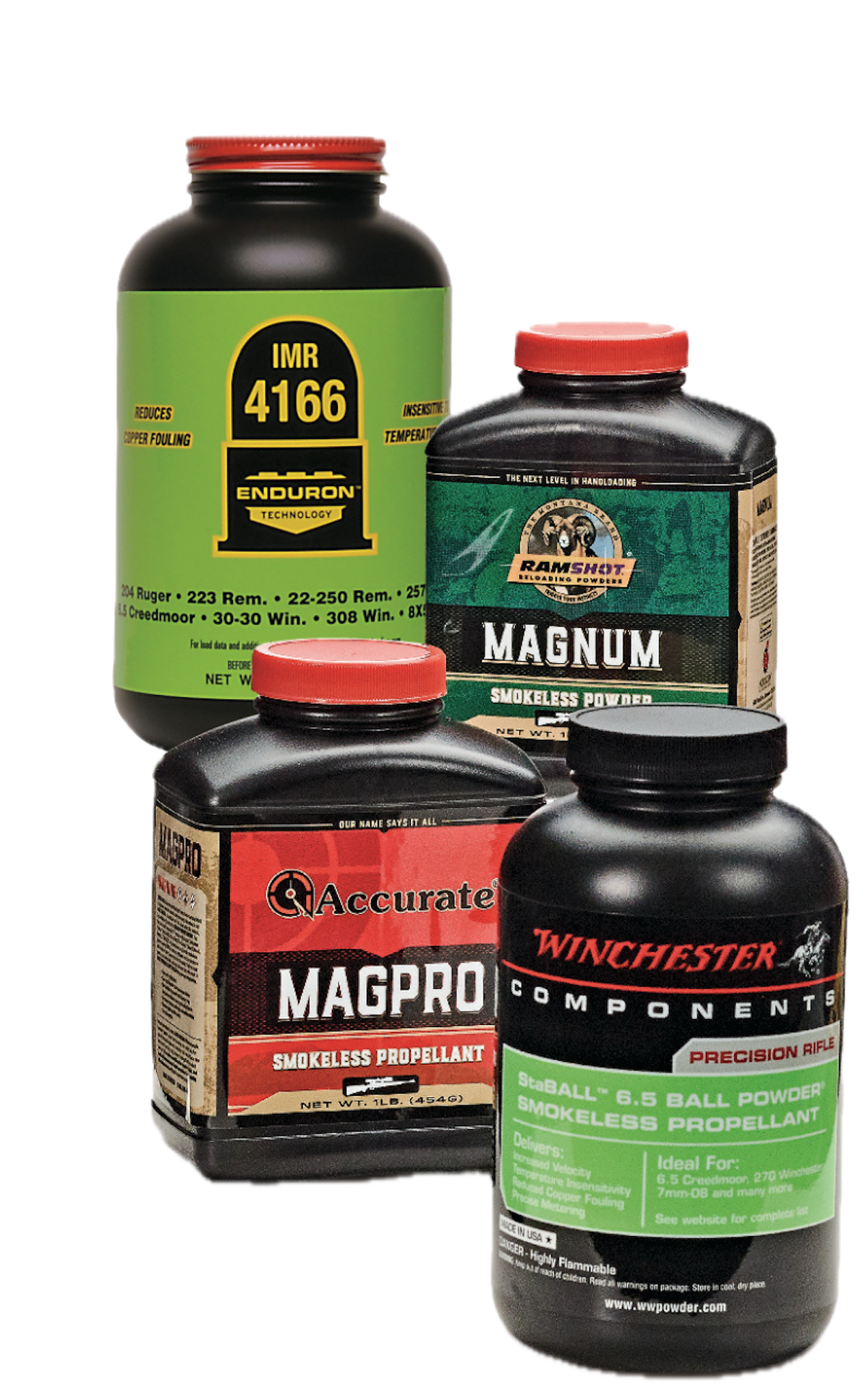
Beginning in 2014, Hodgdon introduced the IMR Enduron technology and offers it in the form of several outstanding rifle propellants. Enduron technology extruded powders feature a copper-fouling eliminator, are insensitive to temperature changes, provide ideal loading density, and are environmentally friendly.
Then Hodgdon applied many of those technological advancements to spherical rifle powder and came up with Winchester StaBALL 6.5, the first spherical powder to be temperature insensitive. Introduced in 2020, Winchester StaBALL 6.5 meters precisely, provides 93 percent to 100 percent case fill/loading density in all cartridges appropriate for its burn speed, and reduces copper fouling due to a special additive.
On the acquisition front, Hodgdon acquired Accurate, Ramshot, and Blackhorn 209 brands of powders in 2020. As detailed in several of the articles throughout this special publication, the Accurate and Ramshot powders add many excellent options to the company’s extensive lineup of rifle, handgun, and shotgun propellants.
And, of course, 2022 marks the 75th Anniversary. Throughout its 75-year existence, the Hodgdon Powder Co. and the Hodgdon family have promoted the shooting sports every step of the way. They were (and still are) instrumental in generating public interest in handloading. Furthermore, they donated property so the largest indoor shooting range in the world could be opened. They created the Hodgdon Foundation, which has helped fund numerous educational programs in the shooting sports. And they have been vocal and outspoken defenders of the Second Amendment. All the while they have provided, developed, and produced innovative gunpowder products that their customers desire.
Throughout its 75-year existence, the Hodgdon Powder Co. and the Hodgdon family have promoted the shooting sports every step of the way.