


There was a time when every serious shotgun shooter reloaded. If you shot enough to create piles of empty hulls, the only affordable way to keep shooting was to reload those hulls.
I can remember loading paper hulls in the ’60s, using felt and cardboard wads. That dates me a bit as Remington introduced the one-piece plastic wad in 1964, although it was a few years before we ran out of felt wads and made the change. By then, plastic hulls were all the rage, and we were loading them, too.
Back then, we all loaded to save money. We were poor, and it was far cheaper to reload than it was to buy loaded ammo. We invested the sweat equity in loading the ammo and were rewarded with more shooting.
Anyone who shoots the sub-gauges in quantity today knows that fact. If you shoot a 16, 20, 28, or .410, you have never had the joy of seeing extremely inexpensive factory-loaded ammo piled in pallets and for sale at the Marts. That was a 12-gauge thing.
So let’s look at 12-gauge ammo. The availability of cheap ammo all but killed 12-gauge shotshell reloading. That was before the ammo market seized up and the supply chain quit working. I fear, now that it’s over, the ammo we used to buy for $4.99 a box has more than doubled. Cheap ammo, if you can find it, is now priced at $10.99 in most places I searched. More important, few places had any in stock.
It seems, too, that components have seen some serious price increases along with the shortages. Lead shot became really expensive after the Obama administration shut down the country’s last smelting plant. The St. Louis-based Doe Run Co. was the world’s third largest producer of lead from mines. As I understand it, the shot we buy today is recycled, mostly from old car batteries. Shooters use lead as a consumable, so clearly this is going to result in shortages and price increases. Imports may be the answer, if the government allows it. But guess who exports the most lead in the world? China. I don’t see good things there. We will be lucky if we don’t go to war with them by the time these fools in Washington are done.
The point is simple: The future for shooters is not looking good. Prices on shot are not coming down, and supply is not going to suddenly increase. My advice is if you want to keep shooting, you need to buy bags of shot when you find them, even if you don’t need them at the time.
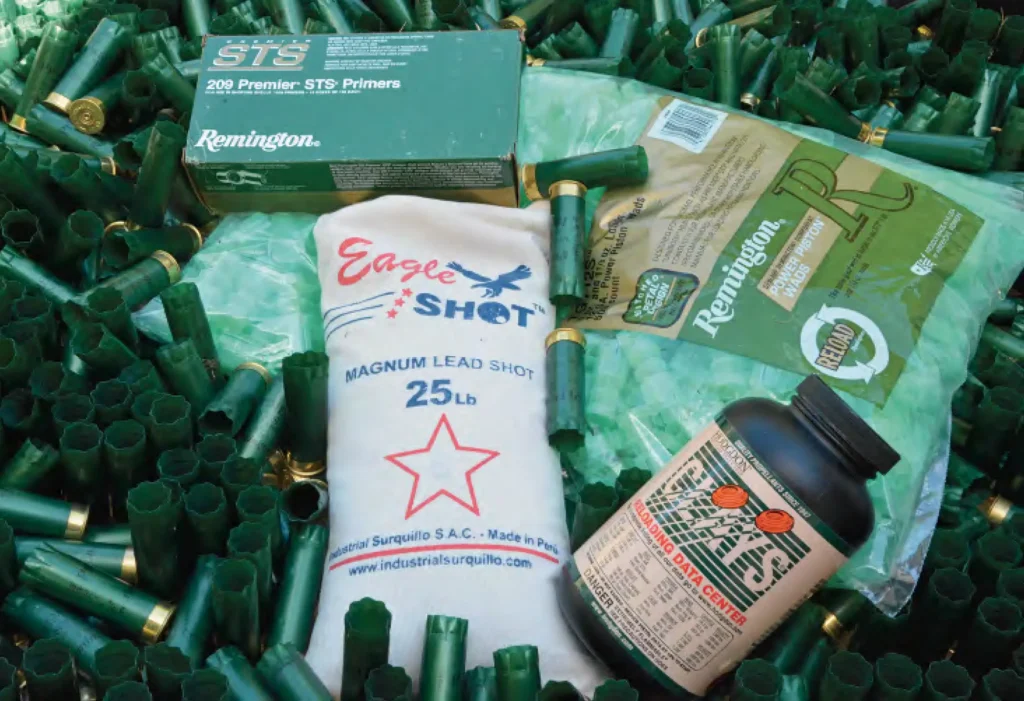
I consider the hulls or cases to be basically free. You can shoot factory ammo and keep the hulls or scavenge them at a shooting range. Primers have been in very serious shortage for several years. In recent times I have been able to acquire some #209 primers, so it appears that market is loosening a bit. But at the time of this writing, they are still hard to find and are expensive. Powder is like everything else. Finding it has been hit or miss. The price has gone up considerably as well. The other component needed is the wad, and for the most part they are still in production, and supply is good.
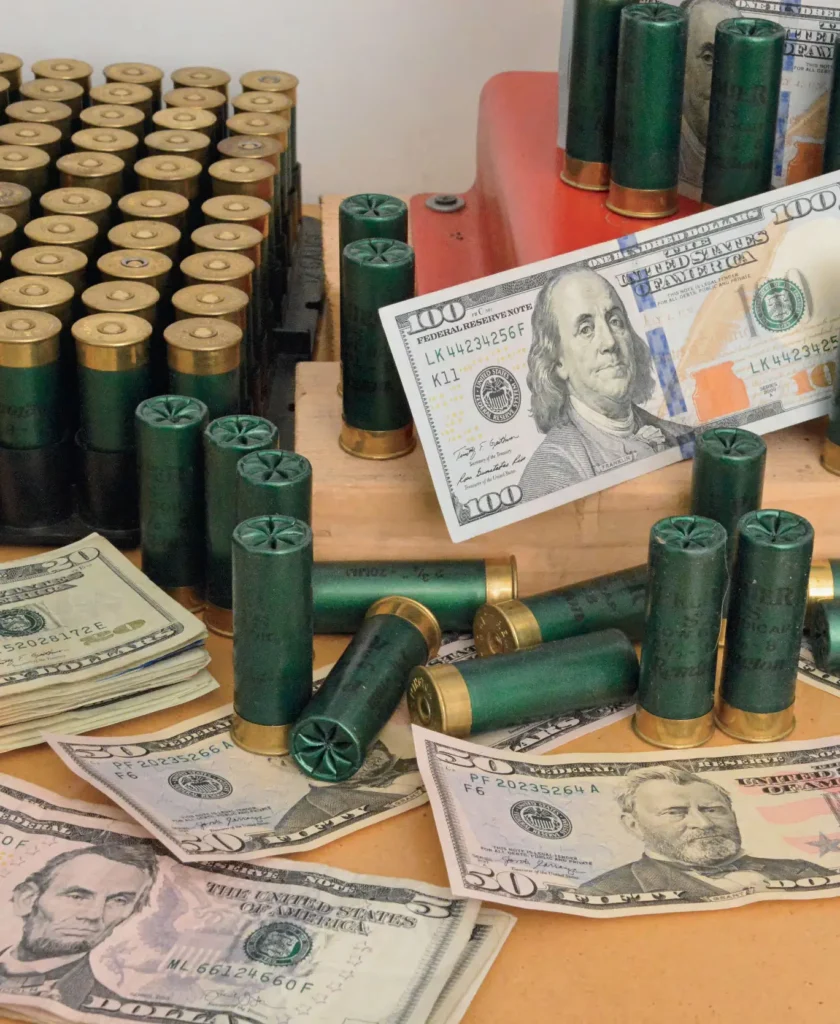
The question here, though, remains will reloading save us money? Let’s look at current prices. As I said, the “cheap” ammo is around $11 a box. The better target ammo is $15 or more, usually more. So let’s compare. To make the math easier, I’ll look at 12-gauge, 1-ounce target loads. Also for the sake of simplicity, I’ll ignore shipping costs. It’s better to shop locally anyway.
Prices for shot vary a great deal. I checked multiple places, averaged prices for a 25-pound bag of shot and came up with $63. Buying online hits you with huge shipping costs, as this stuff is heavy. If you can find free shipping options, that’s good, or you can have several reloaders pool the order. Otherwise, it’s best to buy it in person. A 25-pound bag of shot will supply 400, 1-ounce loads. That breaks down to 15.75 cents per charge.
It’s also best to buy powder locally because shipping powder is very expensive. The government doesn’t mind if you ship it, but it gouges you with extra fees. Again, if you are buying online, it’s better for a bunch of shooters to combine their orders. One hazmat charge has a lot less impact if it’s spread over a half-dozen shooters.
Powder prices right now are all over the map, with a lot of gouging going on. I simply can’t get a good read on pricing online. Too many places are sold out and listing an old price. Prices are changing too fast to keep up with anyway. So I am going to use the MSRP Hodgdon has on its website.
Hodgdon’s Clays powder is $36.99 per pound if you buy an eight-pound keg from the Hodgdon website. It may well be less expensive elsewhere. You can load about 388 rounds per pound of powder, and that breaks down to 9.5 cents per load.
There seems to be a lot of imported Cheddite primers right now. It’s unclear, with so many moving parts in Europe, if these will last. Pricing runs from $60 to $75 per thousand. Most American-made primers are out of stock. A few places will sell 100 primers for $10. I see primers for $100 or more per thousand. But shopping around will find them for less. I took the average from multiple reasonably priced websites and came up with $75 per thousand, or 7.5 cents each.
Wads are down from a year ago and are about $13 for a bag of 500, or 2.6 cents each.
Assuming you have the hulls and the tools, this means each shotshell you load will cost 35 cents to load. That adds up to $8.84 per 25-round box.
Again, most budget-priced 12-gauge target loads run about $11 per box these days, if you can find any, so your savings is $2.16 per box compared to the promotional factory-loaded ammo. It’s not much, but it adds up. Of course, that is assuming you can find any budget ammo. Another important point is that handloading lets you keep shooting when the ammo supply dries up.
Just for the record, I did this same analysis in March of 2019 and came up with 19 cents per reloaded shell. That’s a pretty big increase in component cost.
Let’s look at quality target loads. This is the ammo you are reproducing with your handloads. Homegrown shotgun ammo is much higher quality than the budget ammo. So when we compare to the best target ammo, the savings is much higher. Target loads run $15 or more per box. Actually, it’s usually much more. Using the lowball price of $15 means you are saving $6.16 per box. The true savings may be as much as $10 or more a box. But for now, let’s work with the lower number.
An entry-level, single-stage loader made by Lee Precision costs $80.49 from Brownells. Based on the 12-gauge target loads, you recover that cost with 13 boxes of ammo. For me that’s a long weekend of shooting. You can step it up and buy the most popular shotgun reloading press, the MEC 600 JR, for about $297.57. With that you will need to load about 48 boxes of ammo to pay off the press.
If you want to go full bore with a progressive press, the MEC 900GN is probably the most popular with serious shotgun handloaders. It is listed at $745.95 from Brownells. Break-even is 121 boxes of ammo, or 3,027 rounds. I have seen a lot of years when I shot two or three times that number, and I don’t consider myself to be a serious shotgunner.
Of course, any ammo loaded after you “pay off” the reloading press is straight savings. So, yes, you can save money reloading shotshells. Maybe even more than listed here if you shop wisely for components and beat the average.
Is it worth it to reload shotshells from a money standpoint? The truth is that if you are just looking to make noise and scare targets, probably not. A smart shopper may find budget ammo now and then for about the same cost as reloading. But if you are serious about the quality of your ammo, then the answer is yes.
Of course, you would not be reading this publication if you didn’t love reloading. Reloading shotshells is a hobby that is just as rewarding as loading rifle or pistol ammo.
With all these shortages and no end in sight, reloading will save a bit of money, make you happy, and keep your guns barking when the other guy’s fall silent. So, yes, reloading shotshells is worth it.