



Tungsten shot takes 410 shotshell downrange performance to a whole new level.
TSS, or tungsten shot as it is known by its position on the periodic table of metals, carries a 0.18 density and is 56 percent heavier than lead, with an advanced weight level of 22 percent over well-known HEVI-Shot. TSS, as it will be referred to here, is the second heaviest metal known on earth, bested only by pure depleted uranium. As such, TSS can do things beyond the muzzle of a shotgun never before experienced by smoothbore shooters simply because the raw strike force ballistics associated with TSS are simply off the known performance charts.
When the subject turns to handloading the 410 Bore shotshell and making use of TSS shot, much like the material itself, handloaders are jumping into a whole new world of both loading methods and terminal ballistics results. By working with Hodgdon, Backridge Ammunition, and Ballistic Products, I have prepared the following packaged review of the results I have obtained by way of handloaded TSS shot as paired with the 410 Bore when taken afield as a turkey-harvesting system. The project covers four full years of research and warm target testing. In effect, I have found that the 410 has moved from a novelty, small-bore fun gun/shotshell combo to a viable tool for hunting this big game bird.
Because turkeys are large birds but present very small kill zones or target areas, selecting shot sizes that allow high pellet counts can be critical. In this case, my research and warm target testing utilized TSS No. 9 and No. 9.5 shot for one very good reason. When loaded to 1/2 ounce, the small No. 9.5 “dust” counts out to more than 100 pellets. Now, with a basic individual weight equal to No. 4 pure lead shot, this puts down a nasty swarm of high-pellet-count projectiles into that small target area (head/neck) and will do so well out to 40+ yards when you’re shooting a correctly choked 410 Bore shotgun.
Loading Tips
Loading the 410 versus other shotshell offerings can present some unique challenges. Because the 410 shotshell is 2½ or 3 inches long, it is something more in line with a straight-wall 444 Marlin or 45-70 cartridge versus a shotshell, and any deviation when handloading will affect pressures and performance. Therefore, you should measure and weigh every last component that goes into a 410 shotshell round of ammunition.
While 410 chamber pressures may not seem to be a major issue, be advised that the smaller the gauge, the greater the chance of a fast chamber-pressure spike. The short form here is the 410 just has darn little internal space to work with, and a slight change in components or powder/shot weight can make for major changes when the shotshell is burned off in the small-bore chamber.
All loads referenced here are lab tested or published data in terms of origin. In some cases, loads published here have been offered up by Backridge Ammunition, being I was hunting and harvesting wild turkeys well before anything was on the market as a factory-rolled shotshell or any proven handloading data existed. Today, almost a half-decade down the trail, Hodgdon now offers the 410 handloader data that is nothing less than a game-changer, and believe me, their 49-load offering, as well as others represented in this report, can handle just about anything required of the 410. By the way, Backridge is a company I consult for located in Dover, Tennessee, and it provided data and custom handloads during the lion’s share of my test-shooting against warm targets.
Powder Selection
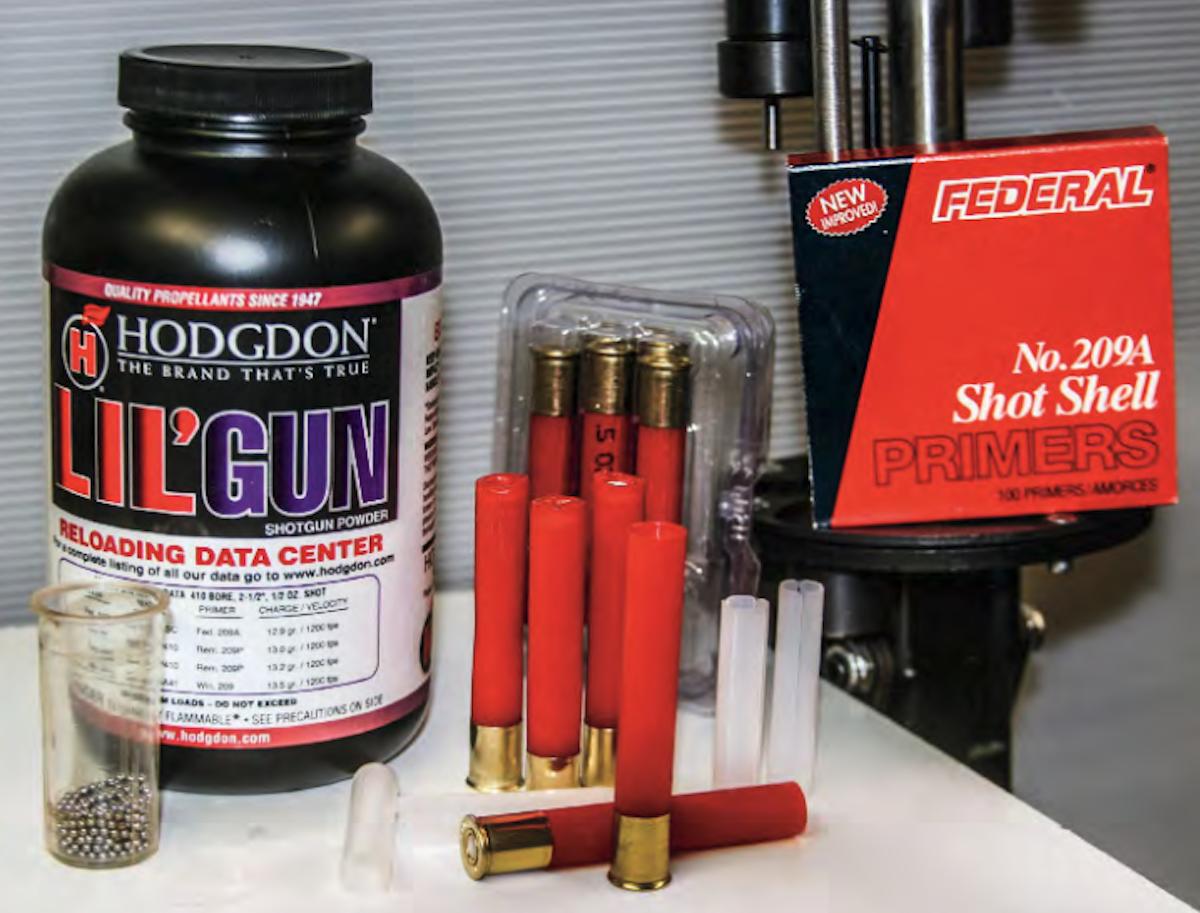
As for powder selection, some of the loads indicated here were generated using Lil’Gun. When I started handloading TSS shot, most of my test and reference loads came through Backridge and used Lil’Gun because right off the propellant match was letter perfect; downrange ballistics performance was very uniform for the most part.
Because TSS shot is very hard and will not transfer energy in a friendly manner against a shotgun’s chamber walls (e.g. chamber-pressure spikes), Lil’Gun was able to generate safe pressures even with some untested components. Ballistics testing in Backridge’s lab confirmed safe pressures and gave me a solid starting point when building some of the very first TSS No. 9.5 shot loads that were to be used on wild turkeys. This testing took place in what you could call a dead space well ahead of any TSS factory loads offered up by the industry in general.
When first developed, the 410 shotshell loads were all half-charge and lightweight 1/2-ounce payload packages. This is because Lil’Gun was spot on as a subsonic load propellant. I wanted 410 loads applied to suppressed shotguns and generating chamber pressures under 9,000 pounds, with most being closer to 8,000 psi. Downrange materials testing (ballistic gel) and assorted recovered cadavers indicated good penetration and kinetic energy dump out to 35 yards. If subsonic loads that moved out of the muzzle at 950 fps could do that on targets, full-house velocities of 1,200 fps regardless of pellet size and payload weight would be in a whole new performance class unto itself. Now, add the fact that of the seven gobblers harvested over three seasons, five were taken with the sub-sound Metro Gun system, and two others were dropped using two full-house loads. Any question as to the effectiveness of the 410 on trophy-class gobblers was clearly answered.
Pattern Performance
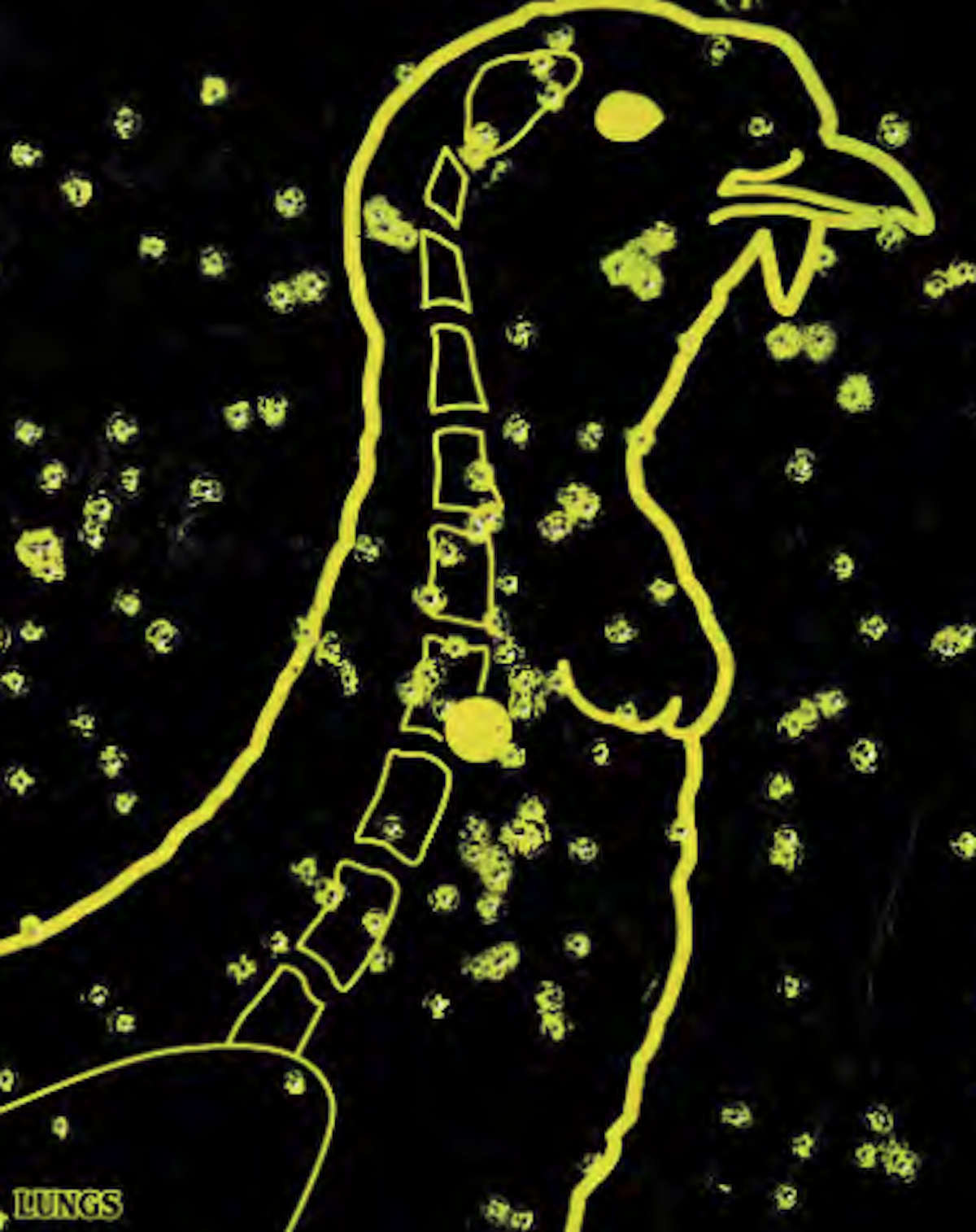
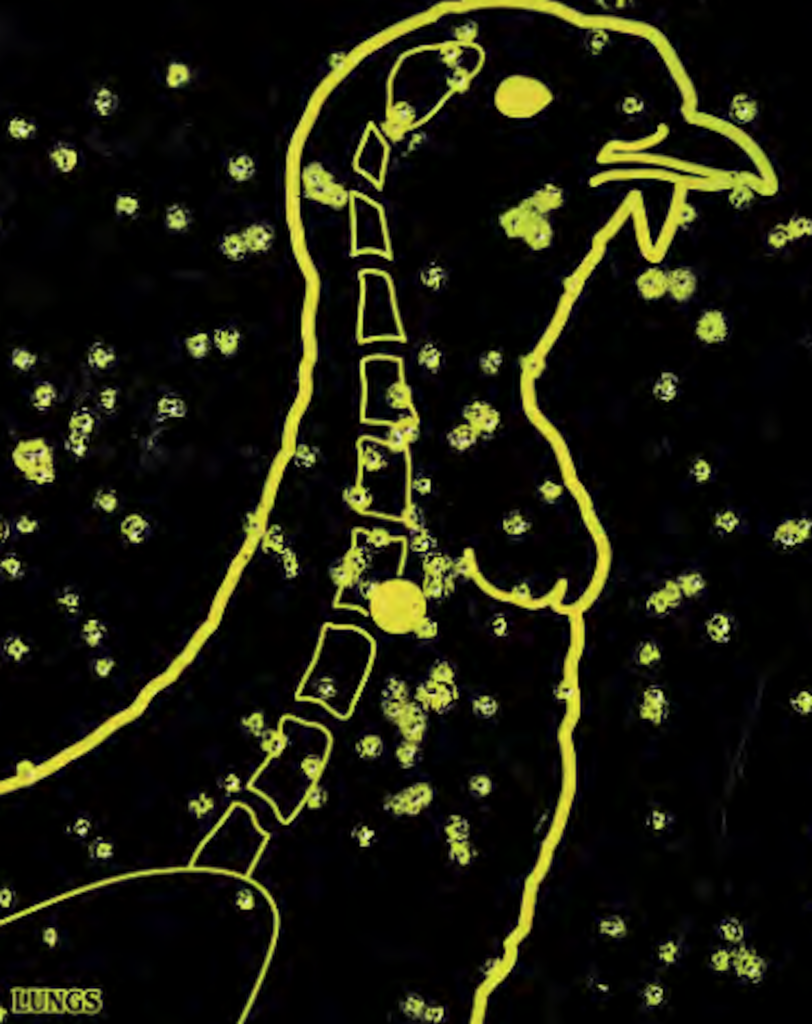
I do not care how good a load looks over chronograph screens or when pressure tested if it cannot pattern well. If it doesn’t do that, it just will not make the grade. As such, the half-charge (8.5 grains of Lil’Gun) loads tested were off the charts good at sub-sound velocities. On average 1/2 ounce of No. 9 TSS consistently printed 53 pellets on a head/neck at 35 yards. There was a time about 30 years ago when building turkey loads for the big 10-gauge magnum and shooting 2-ounce payloads of lead shot that we could not exceed 24 hits on a head/neck target at the same range. Even a move up in velocity, again using Lil’Gun, generated 43 hits on average. I believe for the most part this occurred because of the massive velocity retention of TSS (momentum) and the additional 1/4 ounce of shot sent downrange. (See the accompanying sidebar for more about loads and pattern performances using a commercial head/neck turkey target as a baseline.)
Is it worth your time to handload TSS shot in 410 Bore shotshells? The answer is simple. A pound of raw shot has a price tag of about $76, and a five-round box in the gunshop will cost you over $50. A pound of .18 density tungsten will load 36 1/2-ounce rounds of ammunition. By my calculations, when adding the hulls, primers, wads, and powder, along with the shot, those 36 finished shotshells will cost the shooter about $94.04. The over-the-counter price for the same 36 rounds comes out to $360, as offered in five-round boxes. As for the reloading press and dies, the price drops away with every finished round that comes off the last load station. Being that turkey hunters don’t care much about high-output reloading or busting 100 straight clays, that 36 rounds might possibly be enough for a lifetime of shooting. But if you load that same number of rounds for yourself and maybe even a buddy, over the long haul, everything pays for itself.
Hodgdon can supply the propellants suitable for loading the 410 and Ballistic Products out of Minnesota has all the necessary components to get you up and running in short order. A few words of advice in terms of field equipment: Do not shoot TSS ammunition in high-value shotguns. Do not shoot this ammunition in guns using lead shot choke systems. TSS will weld a choke to the barrel in as little as two rounds.
Safety warning: TSS has a great deal of extended range capability. For example, a 1,400-fps No. 2 load listed in this report is lethal at 60 yards, even with major pattern disruption. Watch your backstop.
In the data, listed field loads for turkeys note a .15 and .18 density tungsten. Because tungsten will react differently regarding its basic density weight, this distinction has been noted and indicated. Know what you are loading as chamber pressure will be different, even with the same powder charge. This is tricky stuff as such, and care in terms of the fine details is necessary regarding a successful experience when loading and using tungsten shot. Be advised, this is not lead or steel shot, and do not use any data as a substitute for actual TSS data when loading pure .15 or .18 density tungsten shot.
Also, you do not have to move TSS at some supersonic speed to obtain an effective load. The density of this metal is so great that by just getting it moving, it seems to take care of those retained energy issues all by itself. There is no need to burn up a shotgun barrel or split a choke tube when you’re loading TSS.
Tungsten shot takes 410 shotshell performance to a whole new level.
410 TSS Load Data
Load #1
(Backridge Ammunition)
Federal or Winchester 3-inch hull. 209 primer. BP extended nontoxic shot wad. 1/2 oz. No. 9.5 or No. 9 TSS shot. 8.5 grains Lil’Gun. BP Bismuth Buffer. B card over/crimp star or roll.
Pressure: 9,000 psi.
Velocity: 950 fps.
Effective range: 30 yards.
Pattern performance: At 30 yards, averaged 47.6 head/neck hits, using Rossi Tuffy with Metro Gun extended sound suppression choke tube system.
Load #2
(Ballistic Products)
Cheddite 3-inch hull. Cheddite 209 primer. 18.0 grains Lil’Gun. TPS410 wad. FC310 in base. 1/2 oz. (218.8 grs.) No. 9 TSS. Roll crimp.
Pressure: 12,774 psi.
Velocity: 1,431 fps.
Effective range: 40 yards.
Pattern performance: At 37 yards, averaged 33 head/neck hits. (Hot load. Shoot this load in steel shot safe chokes and barrels only.)
Load #3
(Ballistic Products)
Cheddite 3-inch hull. Federal 209 primer. 16.0 grains H110. TPS410 wad. FC 310 in base. 11/16 oz. (300.8 grs.) No. 9 or No. 9.5 TSS. Roll crimp over shot card.
Pressure: 11,798 psi.
Velocity: 1,177 fps.
Effective range: 35 to 40 yards.
(Heavy field load)
Load #4
(Ballistic Products)
Cheddite 3-inch hull. Federal 209 primer. 14.0 grains Lil’Gun. TPS410 wad. 5/8 oz. No. 9 or No. 7* TSS
Pressure: 12,650 psi.
Velocity: 1,215 fps.
Effective range: 30 yards.
Pattern performance: At 30 yards, averaged 43 head/neck hits. (Good overall turkey load. This load harvested three birds over the past two seasons.)
Load #5
(Hodgdon)
Winchester 3-inch hull. Winchester 209 primer. 13.5 grains H110. TPS410 wad. 3/4 oz. No. 9 or No. 7 TSS.
Pressure: 12,300 psi.
Velocity: 1,040 fps.
Effective range: 40 yards.
Pattern performance: At 40 yards, averaged 31 head/neck hits. (Solid over decoy turkey load. This load harvested two birds last season.)
Load #6
(Hodgdon)
Cheddite 3-inch hull. Federal 209 primer. 15 grains Accurate 11 FS. TPS10 wad. 3/4 oz. No. 9 or No. 7 TSS.
Pressure: 12,500 psi.
Velocity: 1,030 fps.
Effective range: 30 yards.
Load #7
(Hodgdon)
Cheddite 3-inch hull. Federal 209A primer. 14.4 grains H110. TPS10 wad. 13/16 oz. No. 7 TSS
Pressure: 12,000 psi.
Velocity: 1,040 fps.
Effective range: 30 yards.
Load #8
(Ballistics Research & Development)
Cheddite 3-inch hull. Federal 209 primer. 12.0 grains Lil’Gun. TPS410 wad. 5/8 oz. No. 9 or No. 7 TSS.
Velocity: approx. 1,100 fps. (Approx.)
Effective range: 25 to 30 yards.
Pattern performance: At 25 to 30 yards, averaged 61 head/neck hits. (This is a good overall turkey load. It is a reduced version of Load #4 by two grains, and it will produce 20 percent better patterns at 25 to 30 yards.)
* TSS .15 density
Notes: All test loads listed here were individually loaded totally by hand. Shot weights were hand weighed and double-checked using a gram conversion scale as well as a grain weight system. Crimps were rolled with a Ballistic Products roll crimping drill-mounted tool.
Test guns included the Mossberg 500, the Rossi Tuffy, and the Browning BPS. Factory Full chokes as well as Metro Gun Suppression Systems (subsonic) were applied afield.
Currently, over 60 new loads are offered between Ballistic Products and Hodgdon for use with TSS .18 density shot as applied to the 410 Bore.
Data included in this review has been used under actual field conditions with positive results. Pattern work was produced in clean, still air 3,300 feet above sea level. Temperature averaged 87 degrees Fahrenheit.