
With a gaggle of great slow-burning propellants, Hodgdon is stoking the 27 Nosler fire.
Nosler is well known for its wide selection of bullets, but the recent introduction of several new Nosler cartridges offers an exciting addition to what the late Warren Page called the “cartridge picket fence” for us handloaders. These revolutionary new cartridges are designed to set benchmarks within their calibers. The latest is the 27 Nosler.
The 27 Nosler is designed to duplicate or exceed the ballistics of other .27-caliber cartridges but out of a smaller case and using less powder. Since powder gases are part of the ejecta, a reduction in powder charge weight reduces recoil, and it means you can reload more rounds per pound of powder.
The 27 Nosler case is fat and beltless. It is 2.590 inches long, and the rim diameter is listed at 0.534 inch (the cases I used miked 0.527 inch). This means that the round will fit standard magnum boltfaces, and the overall cartridge length of 3.34 inches makes it compatible with 30-06-length actions. The rotund case body measures 0.547 inch just ahead of the extractor groove and tapers to 0.528 inch at the shoulder junction. This gives a case capacity of 88 to 90 grains of water, and that’s room for plenty of powder to deliver its high velocities.
Okay, you all know the drill: a new cartridge, with stellar ballistics out of a 26-inch barrel, and (as I later learned) a new long-range hunting bullet with a very high ballistic coefficient (BC) designed just for the round. I had to test one.
Rifles & Equipment
I was itching to get started, so I ordered a brand-new Nosler Model 48 Long-Range Carbon rifle. It has a carbon-fiber barrel and a sturdy synthetic stock. By the time the rifle arrived, I had accumulated RCBS dies and shellholder and had set them up on my Redding T-7 Turret press.
Powders
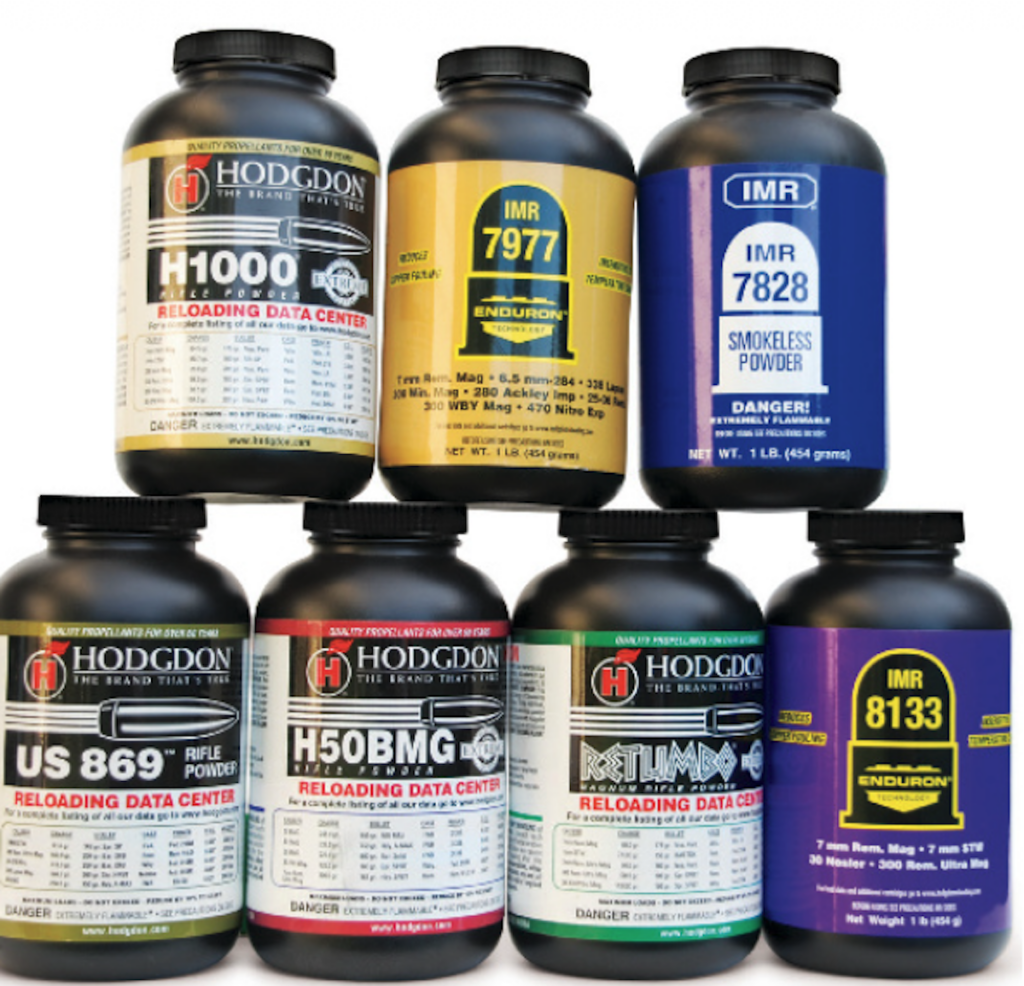
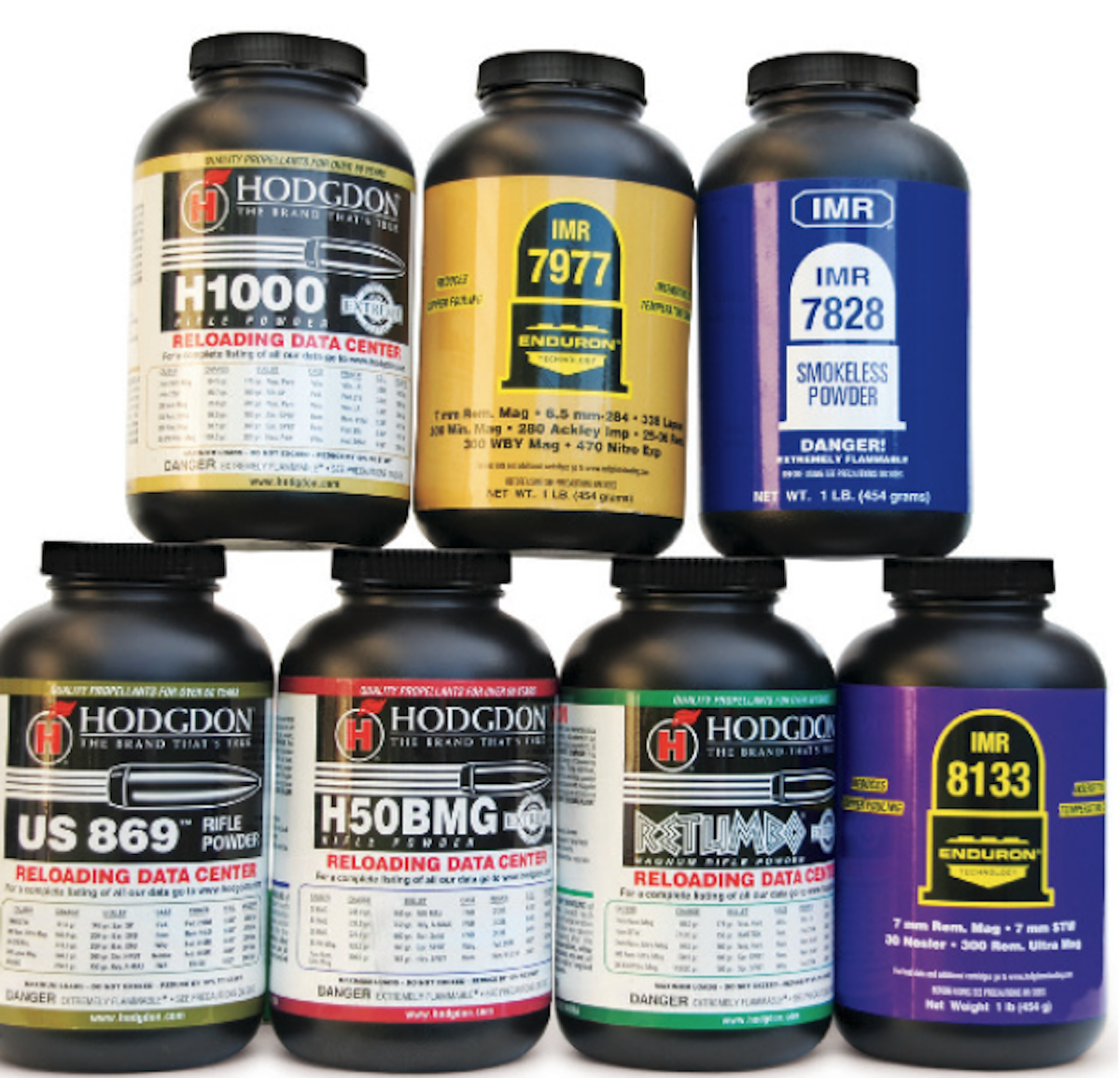
Hodgdon lists 86 pressure-tested loads for the 27 Nosler on its Load Data Center website, all free for a mouse click. The 27 Nosler is seriously overbored, so slow-burning powders work best in it. That’s not a problem, as Hodgdon has expanded its powder offerings in recent years to include several new slow burners, so there are many good matches for just about all bullet weights in the new round. Hodgdon lists seven powders in its 27 Nosler data. In order of burning rate (slowest to fastest), they are: US 869, H50BMG, Retumbo, IMR 8133, H1000, IMR 7977, and IMR 7828.
Bullets
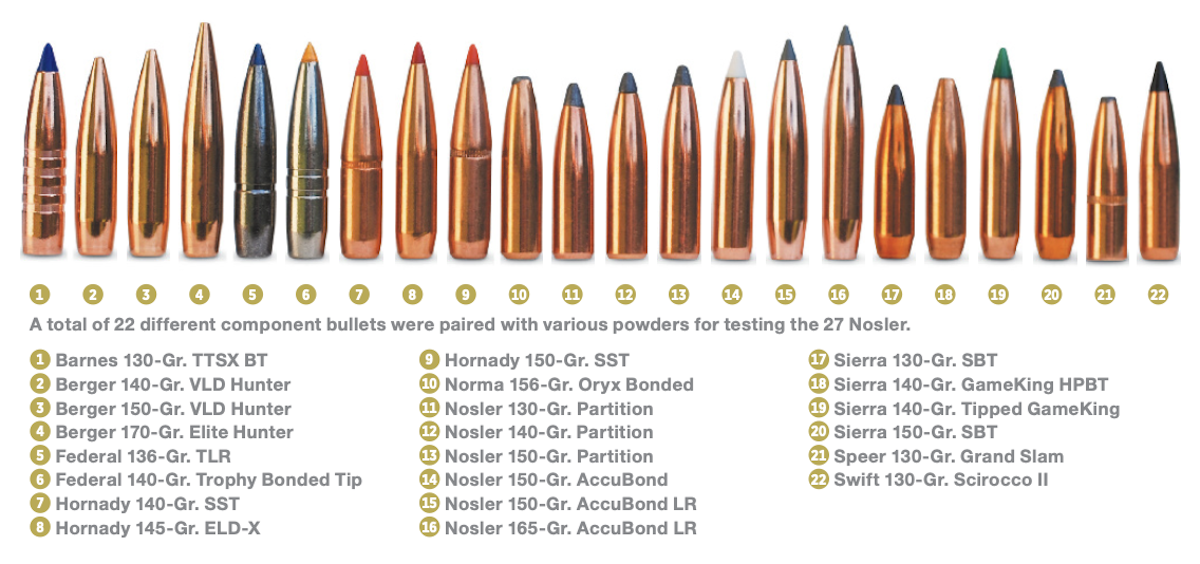
There are many new high-tech bullets available today that are eminently suitable for the 27 Nosler. In addition to Nosler’s classic Partition and AccuBond line, there are also the AccuBond Long Range (ABLR) bullets, and a new 165-grain AccuBond Long Range was developed especially for the 27 Nosler. It has an extremely high G1 BC at .620. The G7 BC is .312. The sectional density is also high at .317. It looks like a guided missile ready for launch.
Other great bullets that can stand up to the 27 Nosler’s high velocities are Hornady’s new 145-grain ELD-X; Speer’s 130-grain and 150-grain Grand Slams; Swift’s 130-grain Scirocco Bonded; and Swift’s 130-grain, 140-grain, and 150-grain A-Frames. In addition, Berger has several uniquely designed target and hunting bullets in this caliber.
You can see my dilemma. There are so many potential bullet and powder combinations that testing could go on indefinitely. But since the Long-Range Carbon rifle in 27 Nosler should be the quintessential hunting rifle, I decided to stick with loads for bullets suitable for big game.
Testing Protocol
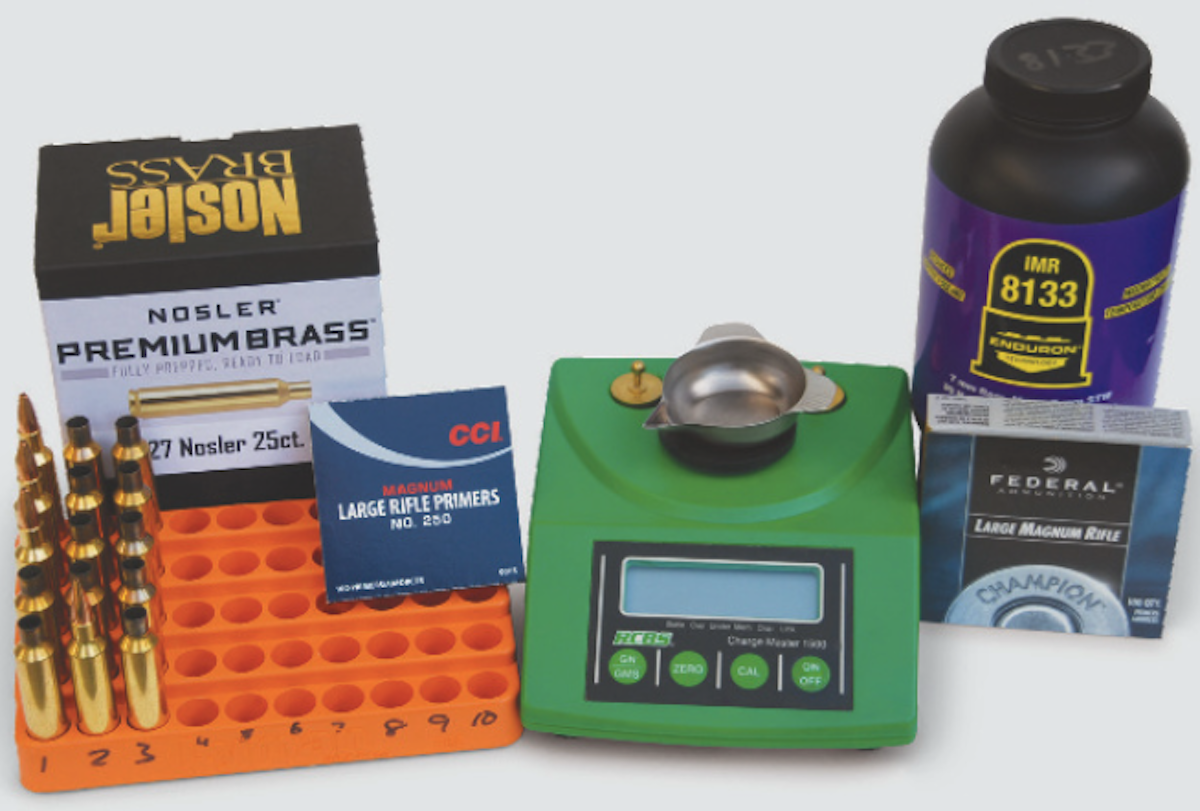
Nosler forwarded a supply of prepped cases and some of the new 165-grain bullets for testing, Hornady sent some 145-grain ELD-X bullets, and I had all the other appropriate bullets. I used either Federal 215 or CCI 250 Large Rifle Magnum primers for all loads, and all powder charges were weighed on an RCBS electronic scale. When fired cases exceeded maximum length, I trimmed them to 2.575 inches.
Groups were fired at 100 yards from a Lead Sled DFT rest from my indoor shooting building, and while the rifle’s carbon-fiber barrel dissipated heat pretty rapidly, I frequently hurried the cooling along by placing the barrel in front of the air conditioner for a few minutes. The bore was cleaned after every 12 to 15 shots, and one fouling shot was fired before shooting each group for record.
I deviated somewhat from my usual testing protocol of three, five-shot groups and fired some three-shot groups. Then, just to collect some “free” data on some of the five-shot groups, I marked and measured the first three bullet holes of a group and then fired the remaining two rounds to complete the five-shot group. I expected the five-shot groups to be about twice the size of the three-shot groups, but that was not the case. The five-shot groups were only 1.19 times larger than the three-shot groups, and some were almost exactly the same size. Due to the 27 Nosler’s 1:8 twist rate, I was not surprised that long-for-caliber bullets stabilized nicely.
Range Results
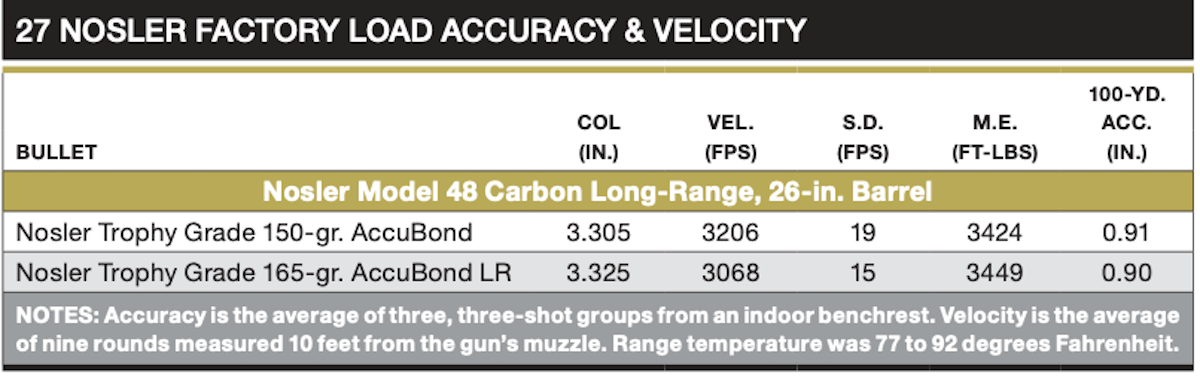
It’s always good to start off with the available factory loads as a baseline for subsequent handloads. Nosler had two loads available at the time of my testing, both in the Trophy Grade line. One features the 150-grain AccuBond at a listed velocity of 3,250 fps. This load registered 3,206 fps over my Oehler M-35P chronograph, and it had a five-shot group average of 1.22 inches. The first three shots went into 0.91 inch.
The second factory load features Nosler’s new 165-grain AccuBond Long Range. The ballistic data on the ammo box lists it at 3,158 fps, and it averaged 3,068 fps in my test. Its five-shot group average was 0.94 inch.
I always approach handloading big, high-intensity cartridges with some trepidation, but the 27 Nosler proved to be well mannered and a delight to reload. There were no surprises and no pressure excursions—just excellent results with the slow-burning powders tested.
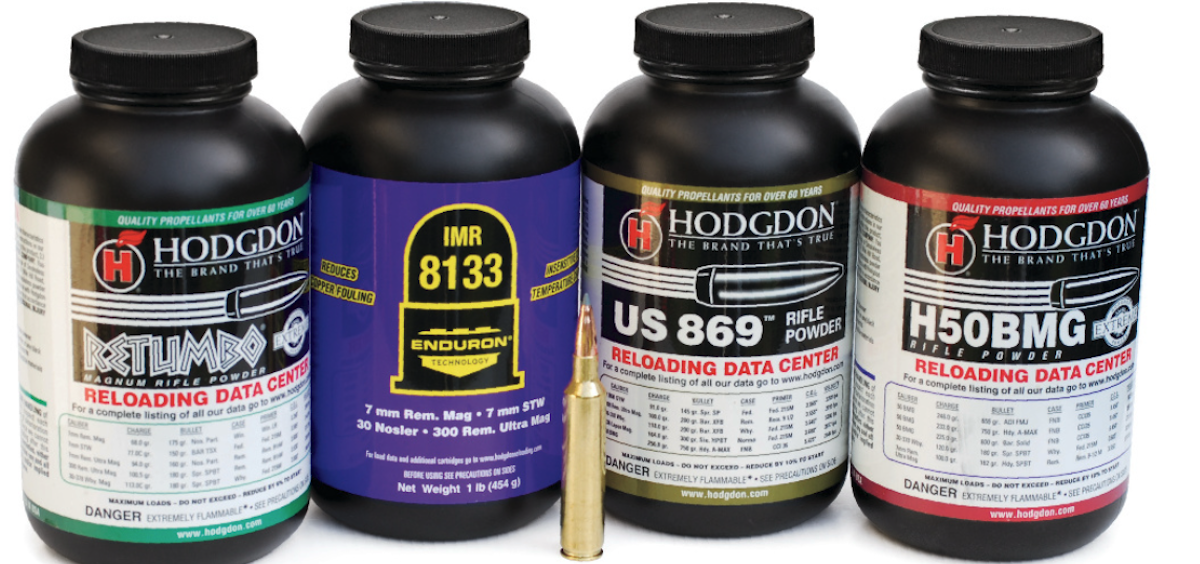
I tried at least one load with each of the seven powders listed by Hodgdon in its data. While all did well with at least one load, if I had to pick a favorite powder, it would be a three-way tie between US 869, IMR 8133, and H50BMG, with Retumbo coming in a close second. And starting loads with IMR 7977, IMR 7828, and H1000 would make fine deer loads, as they closely approximate velocities of the classic 270 Winchester with 130- and 140-grain bullets.
But the 27 Nosler is built for speed, and it certainly delivered. All of the highest velocities with the test bullets were with US 869, IMR 8133, Retumbo, and H50BMG. The handloader can’t go wrong with any of these propellants in the 27 Nosler.
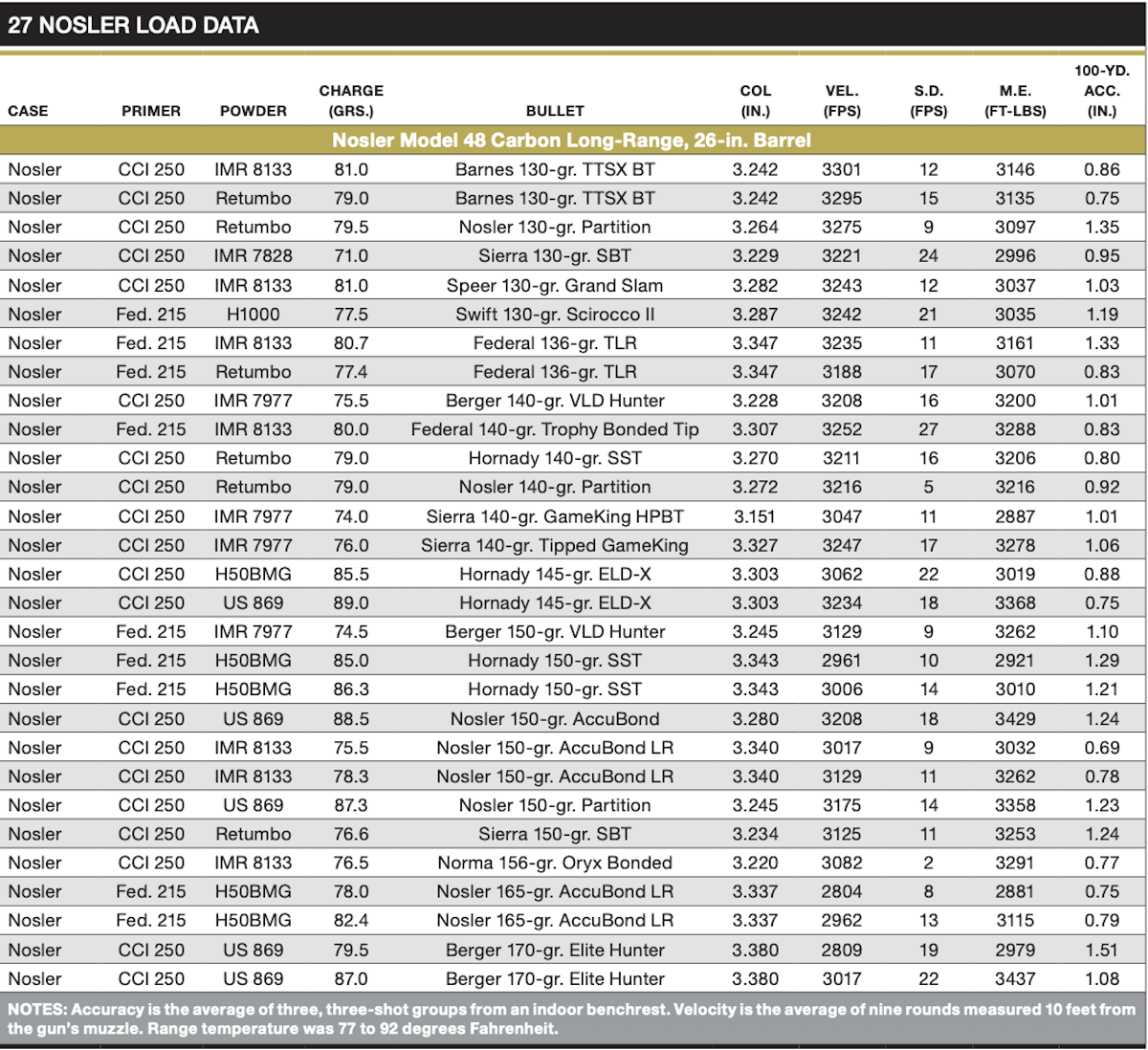
Let’s look at those velocities. The highest velocity of all loads tested was 3,301 fps with the Barnes 130-grain Tipped TSX BT and 79.0 grains of Retumbo. The highest velocities for other bullets tested ranged from 3,235 fps with the Federal 136-grain TLR to 3,017 fps for the Berger 170-grain Elite Hunter. Velocities increased consistently and predictably, and they were quite uniform overall. In fact, the average standard deviation (SD) of the 29 handloads shown in the accompanying chart was a measly 14 fps, and the average coefficient of variation (the SD expressed as a percentage of the velocity) was an impressive 0.45 percent; anything under 1 percent is outstanding. Both of these metrics indicate excellent ballistic uniformity.
But for every action there is an opposite and equal reaction, and such is the case with recoil. The weight of the test rifle with scope was 9 pounds, 5 ounces. This produced an average recoil of 27.2 foot-pounds for the 29 handloads (it ranged from 25 ft-lbs to 33 ft-lbs). This does not seem excessive to me. The average recoil velocity of the gun was 13.7 fps, well below the upper limit for good marksmanship of 16 fps, empirically determined by Sir Major Gerald Burrard many years ago.
Load Specifics
Overall, excellent accuracy was obtained with all powders with several different bullets. The average group sizes for the top four powders were US 869, 1.26 inches; H50BMG, 1.05 inches; Retumbo, 1.05 inches; and IMR 8133, 1.02 inches. Thus, the judicious handloader will be able to develop several specific handloads that deliver superb performance.
Getting down to the nitty-gritty, here are some recommendations. For 130-grain bullets, a charge of 79.0 to 79.5 grains of Retumbo is an excellent choice, with a velocity of close to 3,300 fps and groups of an inch or less. Not to be overlooked, however, is 81.0 grains of IMR 8133, also clocking around 3,300 fps. And don’t forget the added benefit of the Enduron Technology in IMR 8133 and IMR 7977 powders; that’s code for the “magic pixie dust” in them that retards and actually helps remove copper fouling—the bane of accuracy buffs everywhere. This stuff really works!
For medium-sized game, look to Federal’s 140-grain Trophy Bonded Tip or 136-grain TLR bullets and either 80.7 or 80.0 grains of IMR 8133. The Hornady 145-grain ELD-X and 89.0 grains of US 869 at over 3,000 fps is also impressive, and this bullet has the polymer Heat Shield tip that retards bullet point deformation at longer ranges.
With the long-range power potential of the 27 Nosler, it is logical to gravitate toward heavier bullets for such work. While they may start out a bit slower, the heavier bullets catch up downrange and will whack steel targets or big game with authority. The two AccuBond Long Range bullets tested collectively averaged an impressive 0.83 inch, and the best charges for these 150-grain and 165-grain bullets were 78.3 grains of IMR 8133 and 82.4 grains of H50BMG respectively.
The 27 Nosler is a specialized tool; not every rifleman needs one, but those that do will jump on it like a duck on a June bug. It is a consistent performer, and it is powerful and deadly accurate. Superior handloads are easy to prepare with the appropriate Hodgdon propellants, and the availability of new super-bullets adds to its versatility. Western hunters should go gaga over it!
The 27 Nosler is a specialized tool; not every rifleman needs one, but those that do will jump on it like a duck on a June bug.
Load Data Charts