



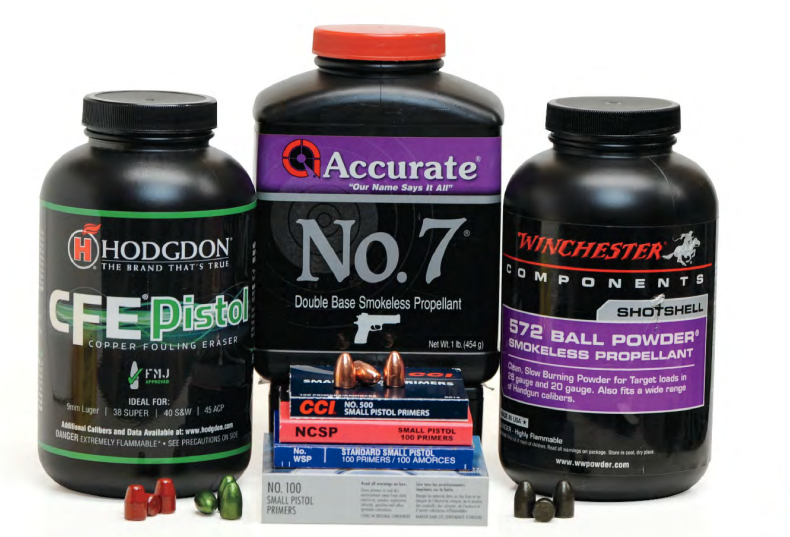
In these days of high inflation, people, including handloaders, are trying to make their hard-earned dollars go as far as possible. One way for handloaders to do that is to load “budget” bullets. When the 9mm Luger is the cartridge of choice, the term “budget bullet” generally means cast, plated, and coated bullets. Loading these less-expensive bullets can save you some money, as long as you shop around and buy them
right. Like last year’s article on reloading shotshells that revealed the way to save money on your reloads is by shopping around and buying components in bulk, you have to do the same when it comes to reloading the 9mm.
Jacketed bullets are complex, so they’re more expensive to manufacture. Plated and coated bullets are like hybrid versions of jacketed and cast or swaged lead bullets. The plating/coating acts as the buffer between the lead core and the rifling while it’s accelerating and spinning down the barrel.
I used Berry’s plated bullets, ACME coated bullets, Missouri cast bullets, and one Clements cast bullet for this exercise. Berry’s plated bullets are formed by first pouring molten lead alloy into multiple mold cavities. Excess material is sheared off to make slugs of uniform weight. Then the slugs are individually inserted into precisely machined dies and struck by a hydraulic punch to form the desired shape. Thousands of these are carefully cleaned and placed in a drum filled with a heated chemical solution and a specific quantity of copper blocks. The container of copper acts as the anode, and over a specific period of time (hours), the electrolysis process leaches copper ions from the blocks and deposits them on the lead slug surfaces.
The plating thickness ranges from four- to nine-thousandths of an inch depending on the bullet’s intended velocity. After plating, the bullets are punched through a sizer die to ensure the specified diameter is achieved.
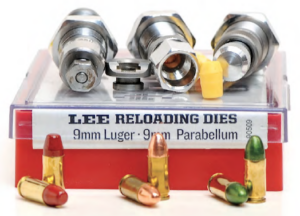
ACME coated bullets are cast from 92-6-2 alloy (BHN 16) and coated with Hi-Tek coating. According to ACME, the benefits of shooting coated bullets include the coating molecularly bonds to the bullet, encapsulating it; the coating prevents lead-to-bore contact; less smoke is produced than with traditional lubed bullets; the coated bullets feed well in automated bullet feeders; coated bullets can be fired at higher velocities than traditional lubed bullets without lead fouling; and coated bullets can be fired through polygonal rifling.
Once you have your budget cast, plated, and coated bullets in hand, you need some proper recipes, starting with proven powders. Hodgdon has many great propellants for the 9mm, and one of the top choices for economical loading is Titegroup. Hodgdon describes Titegroup as a spherical propellant that was designed for accuracy. It provides flawless ignition with all types of primers, including lead-free types. Unlike pistol powders of the past, powder position with Titegroup in large handgun cartridge cases like 45 Colt and 357 Magnum has no effect on velocity and performance. It provides low charge weight, it burns cleanly, it produces mild muzzle report, and it yields uniform ballistics.
In addition to Titegroup, I also used Hodgdon CFE Pistol, Long Shot, and Universal; Winchester AutoComp, W244, and W572; Accurate No. 7; and Ramshot Silhouette powders for the loads listed in the accompanying chart. All propellants performed well, producing consistent velocities with excellent extreme spreads and standard deviations.
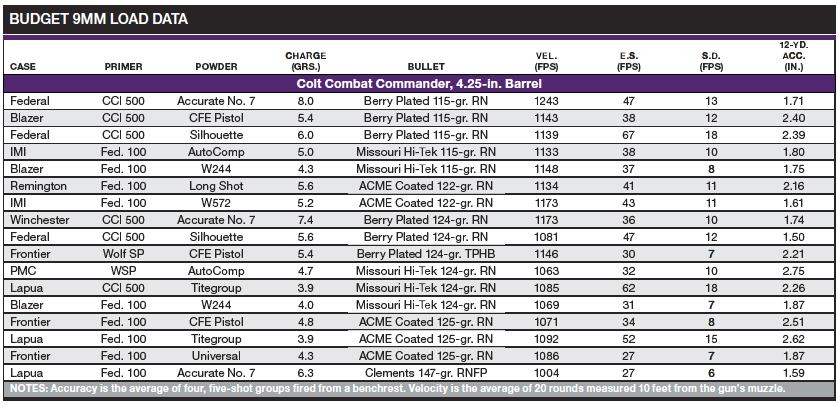
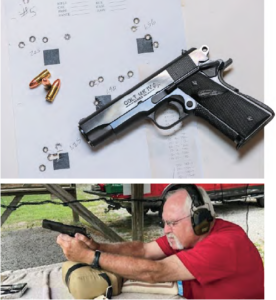
As the chart shows, the budget bullets performed admirably in my handloads. The most accurate load consisted of Berry’s 124-grain plated RN over 5.6 grains of Silhouette. It was loaded into Federal cases and ignited by CCI 500 primers. Average accuracy was 1.50 inches. The load with the highest velocity consisted of Berry’s 115-grain plated RN, 8.0 grains of Accurate No. 7, Federal cases, and CCI 500 primers. The velocity was 1,243 fps measured eight feet from the gun’s muzzle.
I used a vintage Colt Series 70 Combat Commander Model 1911 to shoot the handloads listed here. And I assembled all of the loads on an RCBS Rock Chucker Supreme single-stage press, using Lee Precision 9mm Luger dies.
I typically charge my practice 9mm handloads toward the top end of the recommended propellant range specified in the Hodgdon Annual Manual. That way I’m assured of reliable cycling and avoiding a bullet-in-barrel event. I also usually “throw” pistol propellant with a Redding Competition 10-X pistol measure. Doing that gives me 100 percent confidence the powder charges will vary no more than +/- 0.1 grain.
But just to be sure, I randomly drop an occasional charge into the powder pan and weigh it with my RCBS electronic scale. And I always use a small penlight to inspect the tray of charged cases before seating the first bullet. That’s to verify they all have some and that the powder levels look the same. You can’t be too careful.
My friend Joe accompanied me in the shooting portion of this review, and we spent two eventful mornings at our club range loading magazines, operating an Oehler M35P chronograph, and setting up/shooting targets with 17 different budget 9mm handload recipes. As you can see from the chart, several were quite good. Overall accuracy was about two inches, and just over half exhibited a standard deviation of 10 fps or less.
I did notice something that warrants a note of caution. All of the bullets except Berry’s plated bullets generated a small amount of smoke when the bullet exited the barrel. I could see it in the sunlight after Joe fired each round. Of course, we were outside and there was a light breeze that promptly dispersed the ejecta. However, if you’re shooting in an indoor range, make sure the area is well ventilated to avoid undue exposure to lead particles.
Plated and coated bullets cost about the same as cast bullets unless you pour your own. Even so, there’s no lube or sizing required and no need to wipe your fingers often when reloading. Comparable jacketed bullets cost up to 50 percent more. For plinking, target shooting, and routine personal-defense needs, cast, plated, and coated 9mm bullets work just fine. If you’re trying to stretch your hard-earned dollars as far as possible, you owe it to yourself to try out some of these loads.