



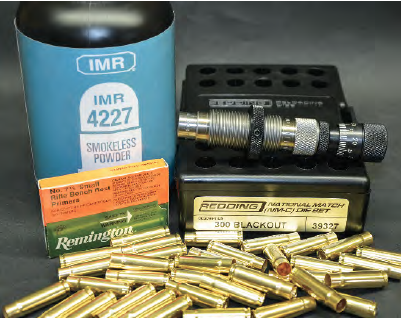
The subsonic movement as we know it today began in 1992 when J.D. Jones of SSK Industries created the 300 Whisper cartridge by necking down the 221 Remington Fireball case and loading it with 220-grain match-grade bullets. Intended for use in AR-15 rifles, the conversion required little more than switching barrels, and it used the same magazine as the 223 Remington. The cartridge picked up more momentum around 2010, when Advanced Armament Corporation renamed it 300 AAC Blackout and teamed up with Remington, who registered it with S.A.A.M.I.
Due to the rapidly growing popularity of attaching suppressors to the barrels of rifles, the 300 Blackout has become extremely popular outside of military circles, and Hodgdon has developed plenty of subsonic and supersonic load data for it and other cartridges, such as the 30-30 Winchester, 223 Rem., 308 Win., 350 Legend, 7.62x39mm Russian, 30-06, 458 SOCOM, and 45-70 Government. If what you are looking for is not in this edition of the Annual Manual, go online and check out Hodgdon’s Reloading Data Center. The gun club that I have been a member of for several decades is approaching 1,000 members, and I am amazed at how many are shooting suppressed rifles. Most are bolt actions, with the 308 Win. probably the most popular, although I also see autoloaders as well as Henry lever actions in 45-70, 30-30, and 44 Magnum.
Some of the smaller, high-expansion-ratio cartridges are ideally suited for subsonic handloads because the extremely small powder charges required for producing drastically reduced velocities occupy a large percentage of the powder cavities of their cases. Optimal examples in .30 caliber are the 300 Blackout, Bill Wilson’s 300 Hammer, the 7.62x39mm Russian, and the 30 Remington AR. The load density for most of the 300 Blackout subsonic loads developed by Hodgdon exceeds 90 percent. Due to its greater capacity, the 30-30 is not as efficient, but it is more so than the larger 308 Win., which is slightly more efficient than the 30-06. Even so, all can be successfully loaded to subsonic velocities, and all can be accurate.
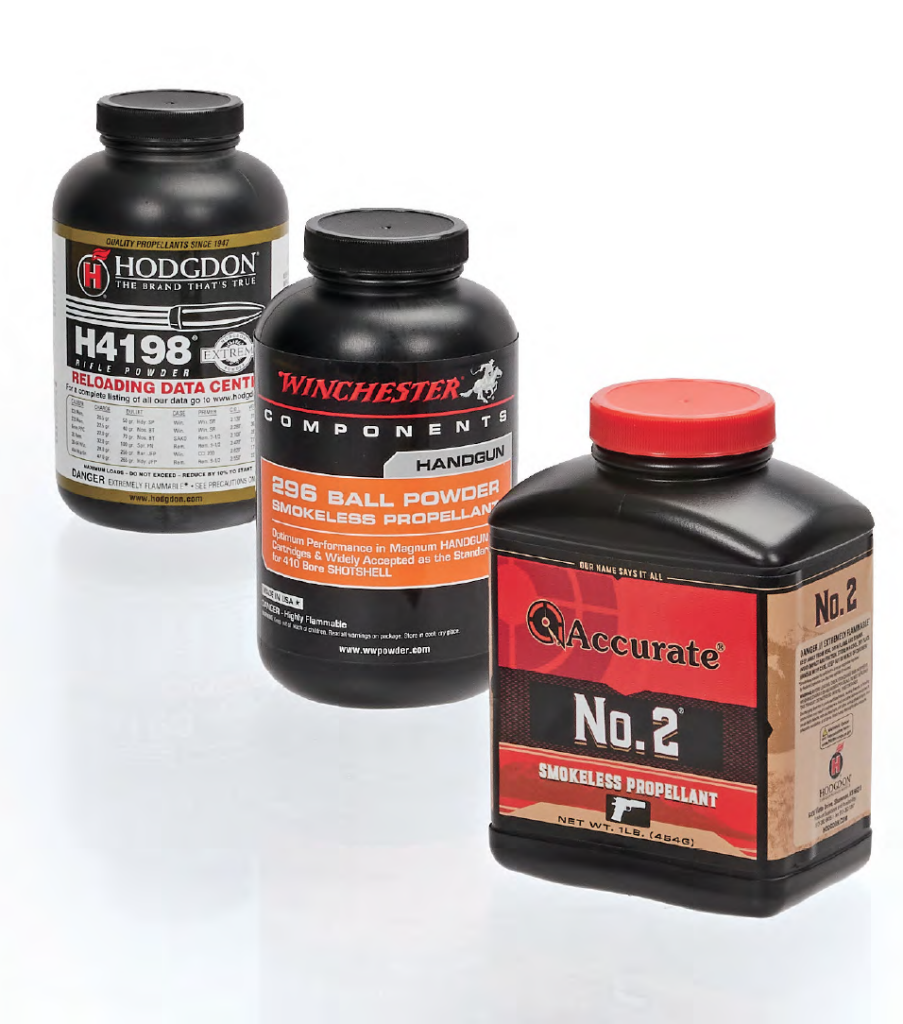
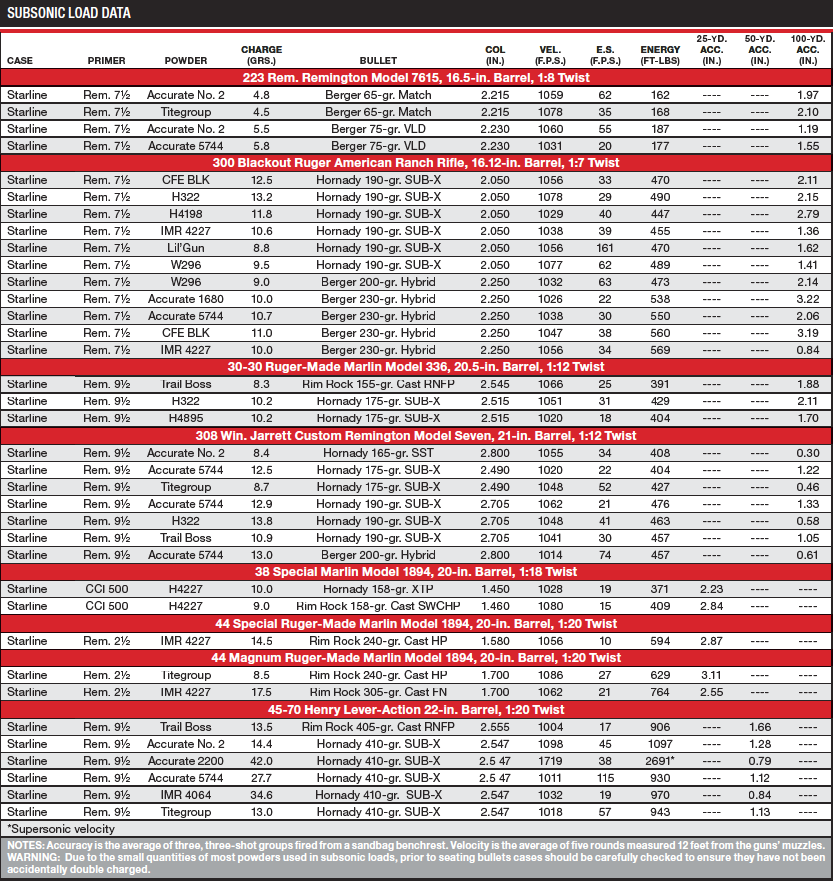
Load density indicates the amount of empty space inside a case from its web to the base of the bullet occupied by a powder charge. A charge that completely fills that space is considered to be a 100 percent density load, and velocity variation is likely to be low. If it fills only half the space, it is a 50 percent density load, and depending on the powder being loaded, velocity variation can be quite high. Due to the varying densities of various powders and variations in powder charge weights, load density in subsonic ammunition will vary considerably. Subsonic data with the highest load densities developed by Hodgdon that I received for several cartridges were 35 percent for the 223 Rem. (Accurate No. 2 powder), 38 percent for the 308 Win. (also Accurate No. 2), and 76 percent for IMR 4064 in the 45-70. Since Trail Boss is far more bulky than the other powders, load density for 13.5 grains behind the Rim Rock 405-grain cast bullet that I shot is 99 percent. Unfortunately, Australian Defense Industries (ADI) has not delivered any Trail Boss to Hodgdon for several years, and this is why staff members at Hodgdon’s ballistics lab have spent many hours developing subsonic loads with a variety of other powders. Increase expansion ratio beyond that of the 45-70 by switching to the 458 SOCOM, and for nine of the powders used by Hodgdon with the Hornady 410-grain SUB-X and ACME 576-grain bullets, load density slightly exceeds 100 percent due to slight powder charge compression. Those powders are Benchmark, IMR 3031, Accurate LT-30, Accurate LT-32, IMR 8208 XBR, Accurate 2495, IMR 4198, Accurate 2200, and Accurate 5744.
At the short distances slow-poke loads are usually shot, load density does not appear to be a determining factor in producing the best accuracy. Load density for 8.7 grains of Titegroup behind the Hornady 175-grain SUB-X in the 308 Win. is only 26 percent, yet when that load was shot in my Jarrett custom rifle, it averaged 0.46 inch at 100 yards. That rifle, by the way, has a Remington Model Seven action, McMillan stock, and a medium-heavy Shilen Select Match Grade barrel. It consistently shoots inside half MOA with a variety of full-power loads, and I have used it to take a lot of game. Due to the small charges of powders used in subsonic loads, a short section of wooden dowel should be used to check each case for an accidental double charge prior to bulletseating.
It should be noted that powder charges shown by Hodgdon under the “Maximum Loads” heading indicate the heaviest charge that could be used in the company’s pressure gun without exceeding subsonic velocities. It does not indicate a maximum-pressure charge. This becomes quite clear when comparing maximum pressures shown for full-power loads in the 300 Blackout and those listed for subsonic loads in that cartridge. Due to the absolute minimum chamber and bore dimensions of a pressure barrel, pressure and velocity of a particular powder charge/bullet weight combination can be higher than in many offthe-shelf, mass-produced rifles. A velocity ranging from 1,000 fps to 1,075 fps is the goal, and in order to reach that, the subsonic charge listed by Hodgdon may have to be increased slightly when loading for the typical factory rifle. On the other hand, some rifles may require a slight decrease in Hodgdon’s recommended charge weight.
Bullet rotation, and therefore its stability in flight, is determined by the rifling twist rate of a barrel and the level of velocity. A small increase or decrease in twist will have considerably more effect on bullet rotation than small increases or decreases in velocity. As an example, at an exit velocity of 1,050 fps, the finger-long Berger 230-grain Hybrid Target will stabilize from a rifle in 300 Blackout with a 1:7.5 or 1:8 twist, but it likely will not when exiting at the same velocity from a rifle in 308 Win. with a 1:10 twist, which is standard for that cartridge. In addition to being inaccurate, an unstable bullet could strike the baffles of a suppressor.
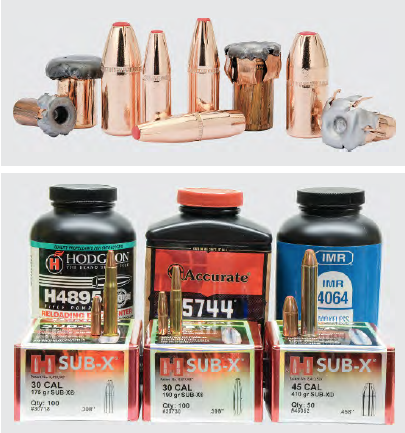
Because they are softer, thin-jacketed bullets are less resistant to being pushed through a barrel than bullets of monolithic construction, and for that reason they are less likely to stick in the barrel should velocity dip too far below the lower end of the subsonic velocity range. Examples would be a relatively soft bullet like the Hornady 150-grain A-Max and an extremely hard bullet like the Hornady 150-grain GMX from a rifle in 300 Blackout or 308 Win.
Due to the noise reduction, I believe having a suppressed rifle on hand for home protection is a good idea, and in that case subsonic ammunition is just the ticket. And for that I can think of nothing more suitable than a short lever-action rifle, such as the Marlin 1894 or Henry Big Boy in 44 Magnum/44 Special. Either carbine in 357 Magnum firing 38 Special handloads with a 158-grain cast or jacketed bullet at subsonic speed should also be an excellent option. A short bolt action, such as my Ruger American Ranch Rifle with a 16.12-inch barrel, in 300 Blackout or 308 Win. would not be a bad choice for repelling home invaders. A stock AR-15 will usually not function with subsonic ammo, although with certain modifications it can be made to do so.
Such a pity that suppressors for rifles were not as easy to find and to acquire while I was growing up as they are today. If they had been, I might still be able to hear the chirp of a cricket.