



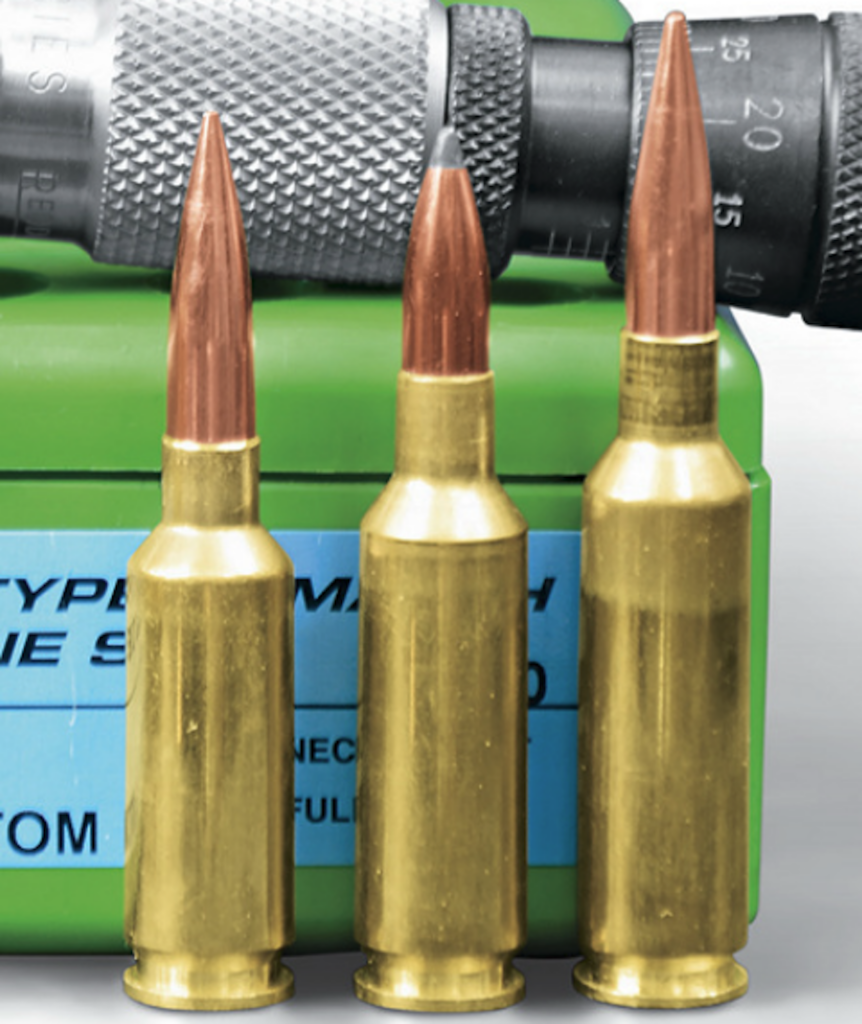

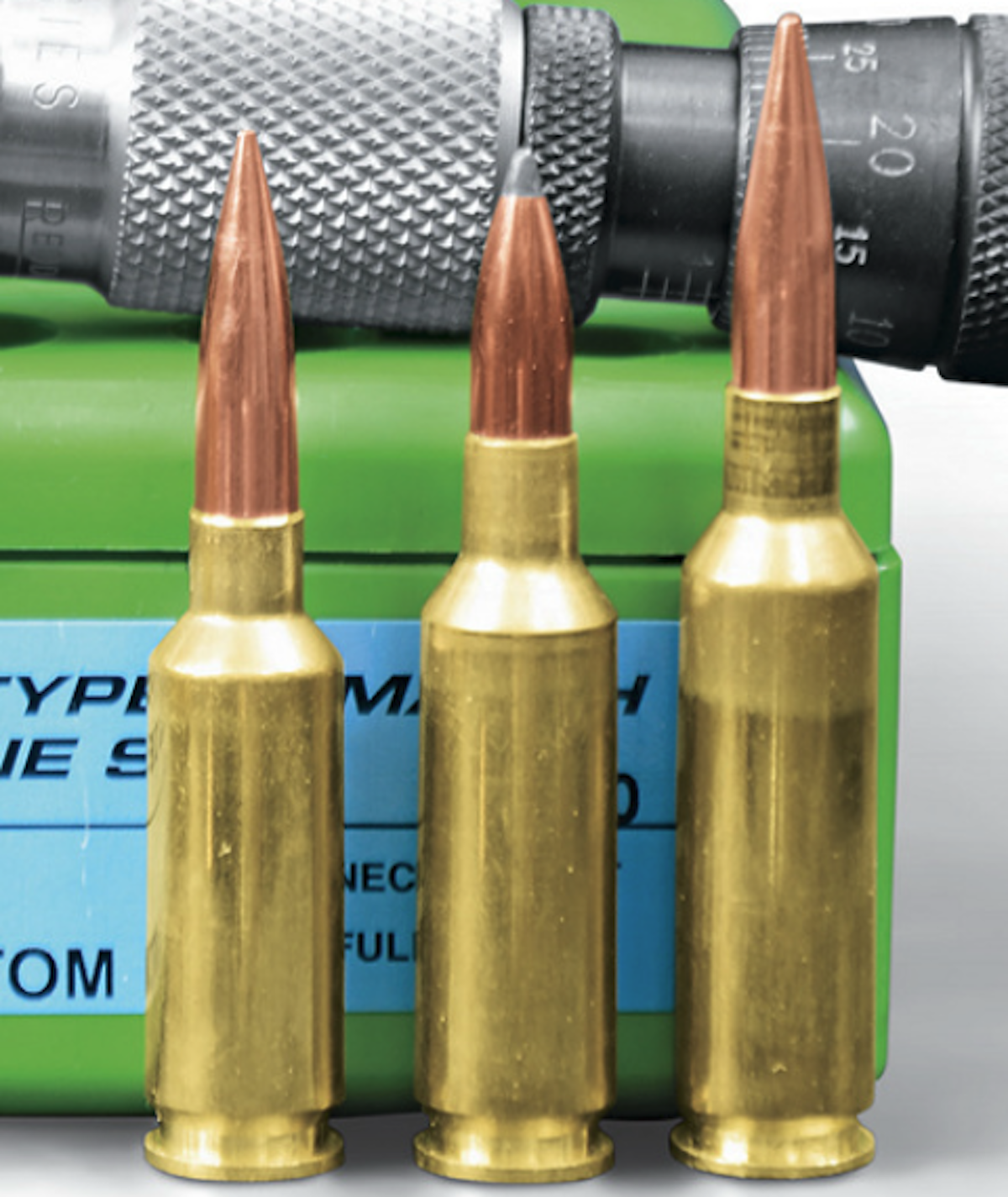
Created to be the optimal long-distance PRS cartridge, the 6mm GT is flat-shooting and super-accurate, plus it burns powder efficiently.
The 6mm GT was created by George Gardner and Tom Jacobs. In addition to owning GA Precision, George is an avid participant in Precision Rifle Series (PRS) competition, where steel targets are engaged out to 1,000 yards and sometimes farther. Tom is a champion 600- and 1,000-yard benchrest competitor.
The 6mm GT is new on the scene, but its roots go back to 1999 and the introduction of the 6mm Dasher by 100- and 200-yard benchrest competitors Dan Dowling and Al Ashton. The Dasher is basically the older 6mm BR Remington case with the shoulder moved forward for additional powder capacity and the shoulder angle increased to 40 degrees. It pushes 107-grain match bullets about 200 feet per second faster than the 6mm PPC.
While the 6mm Dasher has proven to be equal to the 6mm PPC in accuracy, and has won its share of matches in short-distance benchrest competition through the years, it never proved to be a serious threat there. But due to its ability to launch heavier bullets faster while being easier on barrel life than bigger cartridges, it has become one of the more popular cartridges used by competitors in PRS, F-Class, and long-distance benchrest competitions. As good as the 6mm Dasher has been—and still is—George and Tom are convinced their 6mm GT is better.
During a conversation with George, I asked him why he believed that to be true. He mentioned that the 6mm Dasher is too short to reliably feed from high-capacity magazines commonly available for the .308 Winchester. (In case you don’t know it already, PRS competitions call for a high-capacity magazine.) Second, when loaded to maximum chamber pressure, the 6mm Dasher struggles to reach George’s desired velocity range of 3,000 to 3,100 fps with bullets weighing from 105 to 110 grains. (Maximum velocity allowed in PRS competition is 3,200 fps.) In other words, the 6mm Dasher case needed to be a bit longer and capable of burning a pinch or two more powder.
When I mentioned the 6mm Creedmoor, George said that due to a shorter and wider powder column, the 6mm GT burns powder more efficiently, and that makes it easier to develop handloads with the narrow velocity spread needed to achieve the level of accuracy required for successfully competing at long distances. The Creedmoor case is also too capacious to achieve 100-percent-density loadings of the powders considered by George to be the best choices for cartridges of 6mm caliber.
And how did the 6mm GT case come to be? Prior to its development, extensive testing had convinced George that Varget was the best choice in powders available at the time for pushing 105- to 110-grain bullets to the desired velocity range. Because the case capacity of the 6mm Dasher was a bit small for accomplishing that at acceptable chamber pressures, he turned to the 6x47 Lapua, which is the 6.5 Lapua case necked down. Like the 6mm Dasher, the 6x47 Lapua is extremely popular in various long-distance competitions.
The larger 6x47 case easily reached George’s velocity goal, but load density with Varget was less than 100 percent, and that put shot-to-shot velocity variation higher than is acceptable for shooting small groups at extreme distances. So the 6x47 case was shortened just enough for the charge of Varget producing the desired velocity level to fill the case to 100-percent load density with a bullet seated
I compared capacities of the 6mm Dasher, 6mm GT, and 6x47 Lapua by weighing the cases and then weighing them again after they were filled to the brim with water. The averages were 40.2 grains for the 6mm Dasher, 45.2 grains for the 6mm GT, and 46.8 grains for the 6x47 Lapua. (The 6mm Creedmoor and 243 Winchester, both also popular in the long-distance shooting games, have respective capacities of 52.6 and 55.2 grains.)
When measured from head to body/shoulder juncture, the 6mm GT is 0.100 inch longer than the 6mm Dasher, and its neck is 0.050 inch longer. Respective shoulder angles are 35 and 40 degrees, and the slightly milder angle should make the 6mm GT feed a bit more smoothly from various types of magazines. There is one other difference. The 6x47 Lapua case is pocketed for Small Rifle primers, and flash-hole diameter is around 0.060 inch, which is the same as the 6mm PPC that started that trend. The 6mm GT case also uses the Small Rifle primer, but flash-hole diameter is the more standard 0.080 inch.
Many competitors are convinced that various 6mm cartridges are more accurate with Small Rifle primers, but there is another benefit that is seldom mentioned. Due to more beef in the web of the case, primer pockets don’t expand as quickly when the case is pounded by maximum-pressure firings. I have seen the results of a maximum-pressure shooting test comparison between 6mm Creedmoor cases with large and small primer pockets, both from the same manufacturer, and the latter withstood almost twice as many full-power firings before expanded primer pockets sent them to the scrap bin.
Alpha Munitions of Salt Lake City, Utah, is manufacturing 6mm GT cases, and they are headstamped “GAP 6mm GT.” The company specializes in making match-quality cases for various cartridges that are popular in long-distance competition.
Rather than just dumping them into a box where dents and scratches lurk, the cases are hand-packaged in reusable ammo boxes that protect each case from possible damage. In various precision-shooting disciplines, cases made by Lapua are the standard by which all others are measured, but from what I see, Alpha is giving that company a good run for the money.
The New Cartridge Gets a New Propellant
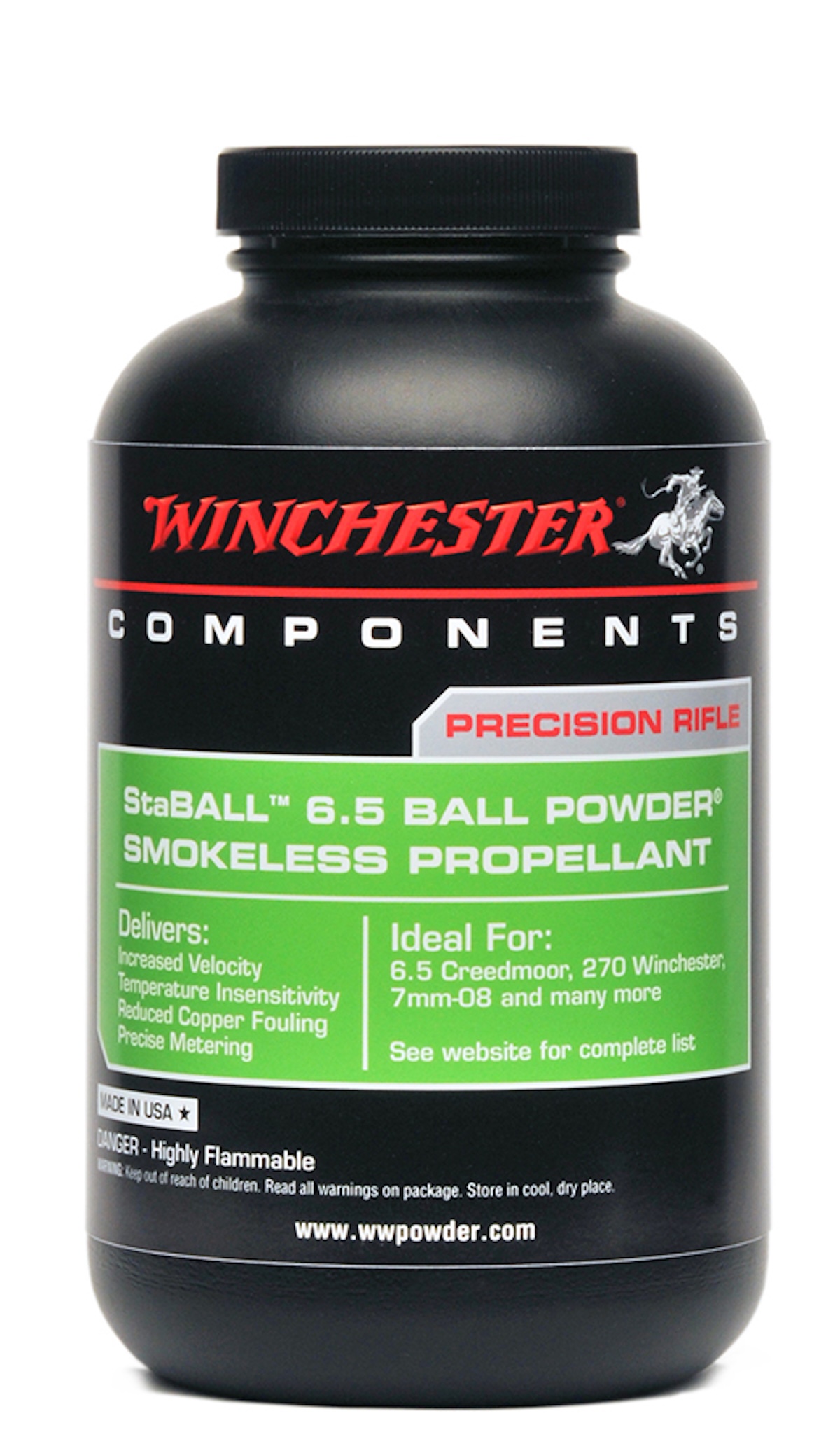
George Gardner started shooting the 6mm GT in PRS competition in 2017, and as mentioned, it was designed for use with Varget. But after trying a new propellant from Hodgdon in early 2019, he was impressed enough by its performance to make the switch. That powder’s story begins when Hodgdon Product Manager Ron Reiber sent samples of H4350 to St. Marks Powder in St. Petersburg, Florida, and requested a Ball propellant that would duplicate its performance in the 6.5 Creedmoor. A temperature-insensitive Ball powder had been an elusive goal for many years, and that was added to Reiber’s specifications. Another requirement was a copper-fouling reduction additive.
The new propellant has everything Ron asked for, and it was introduced under the Winchester label as StaBALL 6.5. Don’t be misled by its name because due to a burn rate similar to that of H4350, along with a 10 percent higher gravimetric density, it is destined to become an excellent choice for cartridges of other calibers. I tried StaBALL 6.5 in a fairly lightweight mountain rifle in 7mm-08 Remington built by Kenny Jarrett, and in addition to impressive velocities, sub-half-MOA accuracy with the Nosler 140-grain Ballistic Tip came easily.
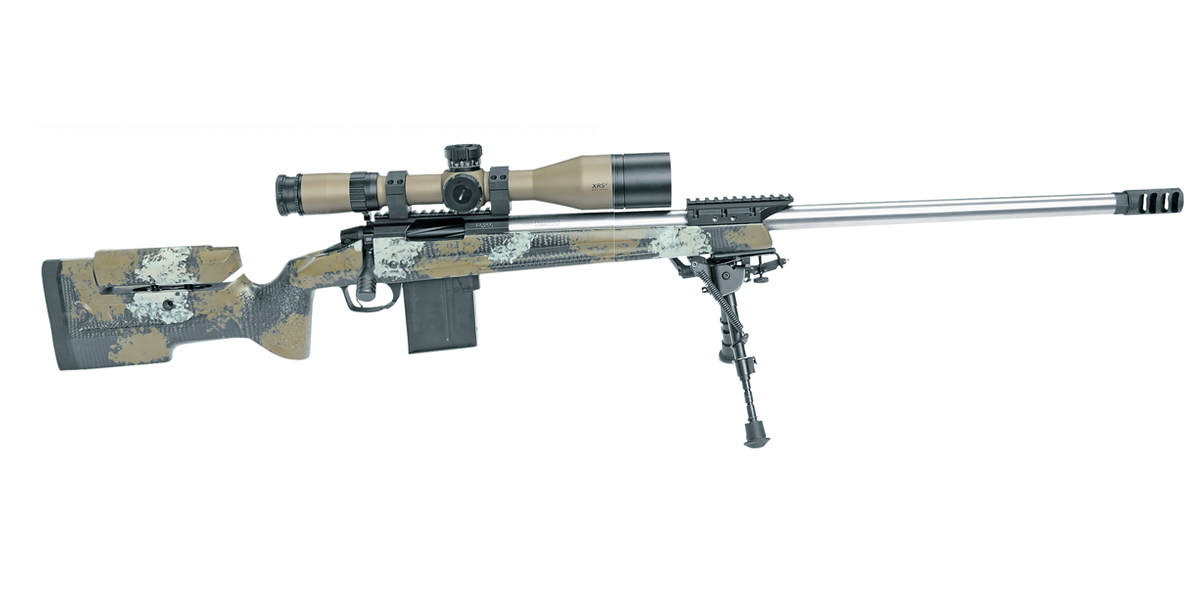
The rifle in 6mm GT featured in this report is the same build as George and other Team GAP members use in PRS matches. I have shot so many fine rifles over the years it takes a lot to impress me, but I have to say quality and workmanship on this rifle rank among the very best. Bolt travel of the Templar action feels like it’s on ball bearings, and bolt lift during firing pin spring compression is about 30 percent lighter than on a Remington Model 700 action as it comes from the factory. The bolt has dual-opposed locking lugs, a Sako-style extractor, and a plunger ejector. Locktime is inside 3.0 milliseconds. The heavy 27.5-inch Bartlein stainless-steel barrel with 5R rifling at a twist rate of 1:7.7 measures 0.830 inch at the muzzle. The rifle has a Manners Elite Tactical stock and a two-chamber, eight-port muzzle brake from ZRODelta.
Pushing forward on an ambidextrous magazine release in the front of the trigger guard gravity-drops the empty 12-round magazine. The Diamond trigger from TriggerTech has a two-position safety and an adjustment range of 1.5 to 6.0 ounces. Ten pulls with a Lyman digital gauge ranged from 2.9 to 3.4 ounces for an average of 3.1 ounces. There was no detectable creep or overtravel, and yes, the trigger passed my jar-off test with flying colors. The rifle is equipped with a Bushnell 4.5-30X XRS Elite Tactical scope and a Harris folding bipod, and total weight is 18.25 pounds. It departs the GA Precision shop with a 0.375-MOA accuracy guarantee.
Brass was in short supply when I needed it, so Ron sent a generous batch of once-fired Alpha 6mm GT cases fresh from Hodgdon’s pressure gun. After running the cases through an RCBS Ultrasonic cleaner, I annealed their necks and full-length resized with a Redding Type S die. Neck diameter with a 0.243-inch bullet seated was 0.2675 inch, so I installed a 0.265-inch titanium nitride bushing in the die. (Chamber neck diameter of the rifle was 0.273 inch.) Trimming to 1.720 inches came next, followed by chamfering and deburring.
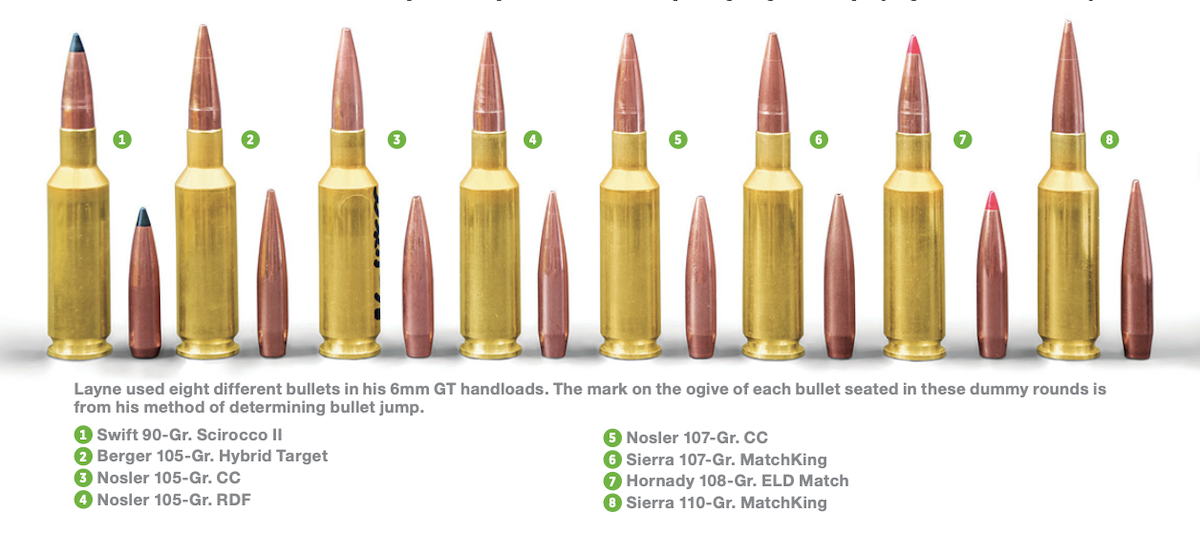
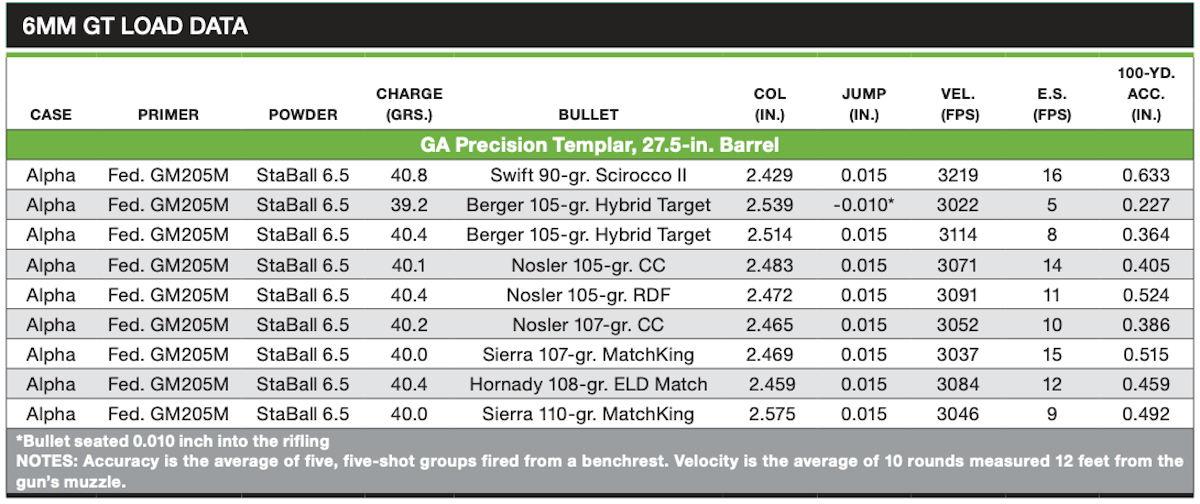
While my report was being written, load data for the 6mm GT had been developed only for the heavier bullets, so I was unable to shoot any of the varmint weights. Based on my experience with other cartridges of the same caliber, I’d say maximum velocities should be in the neighborhood of 3,800 to 3,900 fps for 55-grain bullets and 3,600 to 3,700 fps for those weighing 70 and 75 grains. The lightest bullet shot during my testing was the Swift 90-grain Scirocco II, which is my favorite deer medicine in the 6mm Creedmoor, the 6mm-06, and the 243 Winchester. A chamber throat length of 0.120 inch in the test rifle allowed bullets to be seated fairly long with minimal intrusion on the powder cavity of the case. When seated to the overall cartridge lengths shown in the load data chart, the bases of bullets were no deeper than the body/shoulder juncture of the case. That put load density of StaBALL 6.5 at 100 percent.
One of the more noteworthy characteristics of StaBALL 6.5 is its ability to flow smoothly and accurately through a good powder measure. I used a measure built for me during my short-range benchrest shooting days by Neil Jones of Custom Products, and there was no detectable weight variation among thrown charges.
Maximum charge weights in the data sheets I received from Ron were 40.4 grains for 105- and 110-grain bullets and 40.5 grains for a 107-grain bullet. Those maximums worked fine with three of the bullets I included in my tests, but with the others, pressures were a bit too high in the GA Precision rifle. Charge weights were reduced accordingly. George had mentioned that the rifle sent to me preferred a bullet jump ranging from 0.010 to 0.015 inch, so I went with 0.015 inch for all but one of my handloads.
The Shooting Results
When shooting the GA Precision rifle, I placed a Lyman Tac-Mat atop a concrete benchrest and used the Harris bipod along with a bunny-ear sandbag at the rear. All cartridges fed smoothly from the magazine.
There was a light shifting breeze, so I placed wind flags at 20 and 95 yards. After choosing one of the more prevailing conditions, I sent a bullet downrange only when the flags indicated the condition had returned.
A typical stage in PRS competition requires 10 to 12 rounds fired, and since time limits usually range from 90 to 120 seconds, barrels can become quite hot, especially during the heat of summer. With that in mind, I fired five, five-shot groups with each load and only water-cooled the barrel after each 25-round string had been fired.
Because I was sending each bullet downrange only when the wind flags told me to squeeze the trigger, my shooting times ranged from eight to 10 minutes for each 25-round string. The firing along with an ambient temperature of 94 degrees Fahrenheit got the barrel quite hot, yet there was very little variation in group size.
The accuracy of the GA Precision rifle with all the match bullets I tried proved to be good enough to win PRS matches, and while shooter ability and experience would be far more important than further reductions in group size, I could not resist seeing what the rifle and cartridge were capable of with a bit of precision handloading.
I sorted a batch of Alpha 6mm GT cases by capacity. And while the neck wall is a bit thinner than 6x47 Lapua cases, there is still enough brass to allow outside-turning just enough for uniform thickness, so I did that. Then I annealed the necks, and I also uniformed the primer pockets and flash holes.
On the first go-round, the Berger 105-grain Hybrid Target edged out the other bullets in accuracy, and that, along with a good supply in my reloading room, prompted me to run a batch through a Sinclair Bullet Sorting Stand.
I usually would neck-size cases fired in the rifle, but not having a die for that, I relied on the 0.2434-inch diameter chamber throat of the rifle for the precise alignment of a chambered cartridge. While several different charge weights of StaBALL 6.5 were being tried, the rifle indicated a strong preference for 39.2 grains. The biggest improvement in accuracy came with the Berger bullet seated for 0.010-inch rifling engagement. The rifle came very close to breaking the quarter-minute barrier. I doubt if a PRS competitor would want to jam bullets, but benchrest shooters often do.
I am impressed by the quality and performance of the GA Precision rifle, and I’m equally impressed by the StaBALL 6.5 powder and the 6mm GT cartridge.
I am impressed by the quality and performance of the GA Precision rifle, and I’m equally impressed by the StaBALL 6.5 powder and the 6mm GT cartridge. Match-winning accuracy is there, and extreme velocity spread is where it needs to be for precision shooting at extreme distances. I seldom mention standard deviation because the information is misleading when small samplings of ammunition are tested, but I will say that it ranged from 3 to 7 for the nine handloads.