




Classic shotguns loaded with Olde Eynsford black powder are pure joy for hunting pheasants and mallards.
Last year in the 2019 Annual Manual we plowed some mostly untouched ground. The basis was a scientific look (with real pressure guns and chronographs) at shotgun shells loaded with black powder. With the knowledge of the true pressure and velocity of the original gun powder, we created similar performance using the latest nitro powders. But while great loading data and scientific information are interesting, the real fun happens when we put it all to work—work that happens in great, wild places—with grand old shotguns and a fine dog. This is in its own way a very real journey back to the future with guns ranging from a petite 18-bore flintlock to 10-gauge hammerless wildfowl guns.
Three of a Kind
One of the guns is of the most pure German kind and actually was part of a collection that, against all odds, survived two world wars in Germany and remained in the original family of the King of Prussia. It is a 16-gauge double, with wonderful Damascus barrels and an opening lever under the forearm and hammers. Its survival, in almost-new condition, hints that it might be inhabited by very happy spirits. The first time I shot it with Longshot and an ounce of #8 shot, a dove that had been screaming across the top of some standing corn folded. The gun did not seem to understand missing.

A month later, the gun and I were following the lead of my dog, Miss Feather, across a half-section of native grass in South Dakota. Most of the day had been spent 20 miles east in a place where a huge thunderstorm had apparently wiped out the pheasant nests. I carried another gun and perfectly missed the only rooster we saw. This was my last day in South Dakota, the end of a week with wonderful success. My intent was to catch one more bird. With the afternoon fading, I returned to a place where I was pretty sure we could find a rooster and with a gun I knew would be unlikely to let him get away if I got the chance. The little 16 was loaded with an ounce of #6 nickel-plated shot and Longshot powder. This is a humble load at just over 1,200 fps and only 6,300 psi chamber pressure—a load that in this time of whizbang does not seem very impressive.
Feather was very birdy. There was game afoot, and she flushed a hen and then another. She gave them a momentary glance and buried her nose in the cover when it all began to happen. A matched pair of roosters exploded about 20 yards in front of me. One went right, and his brother flew left. In much less time than it takes to tell, right and left birds were dead in the air. Miss Feather launched herself to retrieve the left-hand rooster as I drew the hammers to half-cock, swung the lever, reloaded, closed the gun, and looked up to see her veering hard to the left from her retrieve course, on a mission to flush a third cackling jewel. He crossed in front of me and very suddenly quit flying. Miss Feather returned with the third rooster, and it was over almost before it began. I had not moved my feet and really never dreamed such could happen. This was the seventh bird of the week with the little “German Lady” with as many shells. As the old German gunmaker would say, “Ja, him works.”
Old 10-Gauge Friends
I have a special soft spot in my heart for old 10-gauge guns, and they have been part of my life for a very long time. Not so very long ago, shotguns with Damascus barrels were pronounced to be death traps. And when they had that stigma and 10-gauge chambers, the finest English doubles often cost less than a Remington pump. They were guns that a $400-per-month cowboy could afford, and along the way, I learned they were the most deadly shotguns ever devised. Their success on pheasants, ducks, geese, quail, and doves is something I truly envy. And I’ve done it.
They spawned a need for low-pressure nitro loads (this was before I had learned the true magic of real black gunpowder), and recipes found in the very old Lyman manuals fed them well, but that data was with powders that are obsolete now. The mission became to reinvent that wheel with new-generation Hodgdon, IMR, and Winchester powders. So for last year’s edition of the Annual Manual, we created spectacular nitro-for-black loads in 2⅞-inch 10-gauge cases using Longshot, IMR Blue, and W572. But when the dust settles, if I had to pick a grand champion load from the dozens we created in all gauges, it would be the 4¼-dram, 1¼-ounce 10-gauge load with Olde Eynsford 1½F black powder. It generates 1,225 fps velocity and only 4,900 psi pressure. While I suspect over the years I have caught more game with a 10 gauge than all the rest, only a small portion was with black powder. But in the way of reverse-progress, I dedicated much of my duck hunting over the last two seasons with that spectacular Olde Eynsford 1½F load (substituting Bismuth for lead shot).

One of the guns, my “oldest” 10-gauge friend, came to me as half of a trade in the mid-1970s. I swapped a Smith & Wesson 22 Jet for a nice German 10 gauge and this W&C Scott Premier gun straight up. The Premier was made in 1878 at the astronomical cost of $295. It’s fun to realize that I paid less than that for it 100 years later! It weighs 9½ pounds and has Full chokes. The other “old friend” in this story is a W.W. Greener with 32-inch barrels and Full chokes that weighs almost 10 pounds.
The Greener got the call on a cold, snow-covered day when most of the water was covered with ice. It had been a tough year, when ducks were few and chances were fewer. I used big guns with lots of choke and deadly loads. This Greener fit all the criteria and was a veteran of places like the old South Platte River and the Carolina coast (on sea ducks). One has to go back to Greener’s book, Choke-Bore Guns, to fully understand patterns thrown by great barrels using felt and card wads instead of plastic. The essence of it all is uniformity from side to side, without the dense centers we know with modern plastic wads. On this day, the Greener was loaded as it would have been when Greener bored it more than a century ago: 4¼ drams of the best powder available with a card wad and 1/2 inch of best quality white felt soaked in Ox Yoke Wonder Lube, pushing on 1¼ ounces of #5 shot.
The lone drake came high, out of the northwest. He put on the brakes and made a pass over the marsh, pulled up hard, and returned for a second pass much like the first. He then made a long turn to the east and shed about 40 yards of altitude, but when I thought I was going to get him with his feet down, he went into another power climb. I did not like the shot, but if Miss Feather was going to have a duck to carry home, it was likely going to be this one, and it was now or never. I pushed the big barrels way ahead and above him and squeezed the trigger. The smoke momentarily hid him, but the next time I saw him, he was tightly folded and headed for the ground. I think the pattern hit him at about 60 yards, and his body caught six pellets.

A week later, and about 30 degrees warmer, I decided to take the old Scott, with the same shells. The ducks moved more, and the entire marsh was open water. Even though the first few I saw did not offer a shot, there were more to come. The first ones to really decoy came in a flock of five: four drakes and a Suzie. They came in quickly, banking over the oak timber and turning into the stiff south breeze. When I stood, they all had their feet down about 25 yards in front of me. The right barrel swatted the lead drake, and the left caught up with one of the middle ones as he turned left and towered. The first shot was at 30 yards, and the second was at about 45. Neither offered any fun for the retriever, even though she poked them with her nose, hoping they would try to get away.
The next ducks were a pair that landed very quickly about 100 yards away in a place where I could not see them, and they could not see me. About 10 minutes later, a lone drake made a good turn over the decoys and ran into the pattern. Miss Feather was off to retrieve him, and I had the breech open to reload when I realized the previous pair was coming my way. They were leaving, under full power and at the edge of reality, but that old Scott was a serious duck gun, made for this kind of serious situation and dropped one duck into the soybean field on the other side of my permanent water-supply pond.
The World-Record Rooster

The North Dakota pheasants had not been easy, and I had avoided the least efficient gun of all, for four days, to do my very best to catch birds for Miss Feather, but now the time had come. It had been a grand week, every bird hard won, so it was no longer possible to fail. Tomorrow I would carry a 200-year-old Joe Manton 18-bore flint gun. We went to new places, old farmsteads, and margins of fine lakes but did not get a chance. We hunted harvested grain fields and saw nothing at all. It was if every pheasant on earth had disappeared. By midafternoon it was time for the last-ditch plan. The old homestead had treated us well the day before. There were miles of fields bordering the cattail swamp, weed patches, and some high mounds. The odds had to be best there.
The first two hours were again blank as we turned back and headed into the lowering sun. We were most of the way back to the pickup when, for the first time that day, Miss Feather really lit up on a bird and began to push. After 50 yards there was little doubt that this was not a hen but an old, wild-running rooster. All rules of pointing dogs and such were cast aside. I would not interfere. She would hunt, and it was my job to keep up and shoot when the time came. Miss Feather crowded him at an almost run, zigzagging with his elusive trail, and I followed almost as fast. He was paralleling the 500-yard-wide, 3-mile-long cattail swamp.
I felt like the time had come at last, but my heart fell when Miss Feather made a sharp left turn and headed out into the “jungle.” The old rooster would beat us out there; our odds were almost zero. Worst of all, I could see the cattails moving from her pursuit right in line with a 12-foot-tall cane break. It had all gone from difficult to hopeless when suddenly, with a roar and cackle, he flushed out of the right side of the cane. He was level with the top of the cattails, flying dead broadside at about 40 yards and screaming.
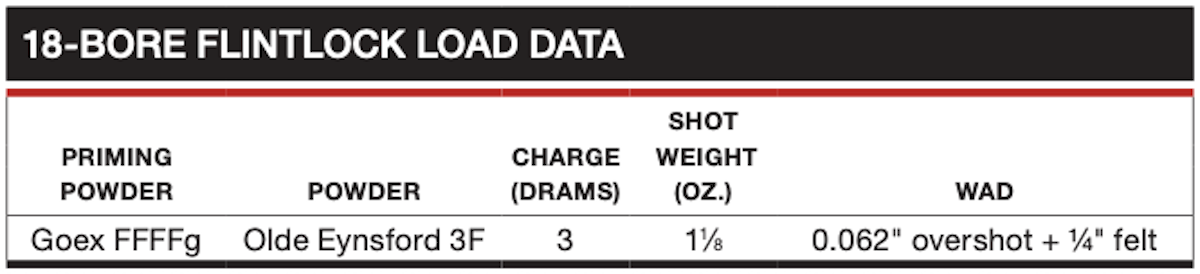
It was a tough shot with a good live pigeon gun and almost folly for my hands and flint. I swung the Manton and pressed the trigger when the front sight passed his beak. I fired the flint gun just because I had to, knowing the probable result would be to see him fly out of the right side of the smoke. The old gun snapped to life as, I have come to learn, few flint guns can; it was almost as fast as a breechloader. The whole process is wonderful: that magical arc of flint kicking the hammer out of the way, the bits of white-hot steel exploding the priming powder, and that transition from the pan through the breech to light the main charge. I had sent 1⅛ ounces of #6 shot after him, and to my absolute disbelief, instead of clearing the smoke to the right, he tumbled out the bottom!
In my elation, there also was concern. Miss Feather had been in that cane break when she flushed him. It would have been impossible for her to see the sky, let alone the rooster. The sun was setting, the swamp was endless, and if the rooster was not stone dead, the odds of catching him were zero. How could I direct her to him? In less time than it took to think about a plan, I saw her, only 10 yards from where he fell, four feet high, leaping over a dense pile of cattails, in flat-out pursuit like a greyhound. She did not fiddle and enjoy him, but instead came at a dead run to me with her rooster. Now, she would not hand him to me, he was hers alone to hold with her paws, while she panted trying to catch her breath. There were little bleeding patches below both of her eyes where cane and cattails had cut her, and we were both about as happy and proud as it is possible to be.
I have had great moments in my life with a gun in my hands, and this humble pheasant is right at the top of the list. Yes, right beside, perhaps even beyond, the elephant. I would not trade this moment and its one single bird for every one of the tens of thousands that Lord Ripon killed.
The rooster’s skin hangs on the old barn wood at the end of my library. Perhaps the most uncanny part of it all is that now, more than two years later, every month or so I will hear Miss Feather squeaking below him. I take the skin down for her, but she does not try to take it. Instead she just buries her nose in the feathers and sniffs deeply. While I know it is impossible, I am also perfectly sure she remembers that afternoon and the world-record rooster.
Classic shotguns loaded with Olde Eynsford black powder are pure joy for hunting pheasants and mallards.
Load Data Charts