


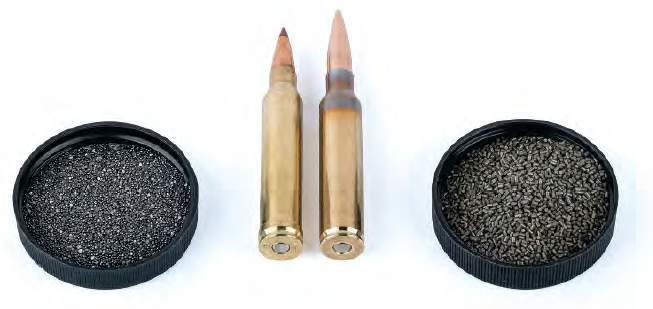
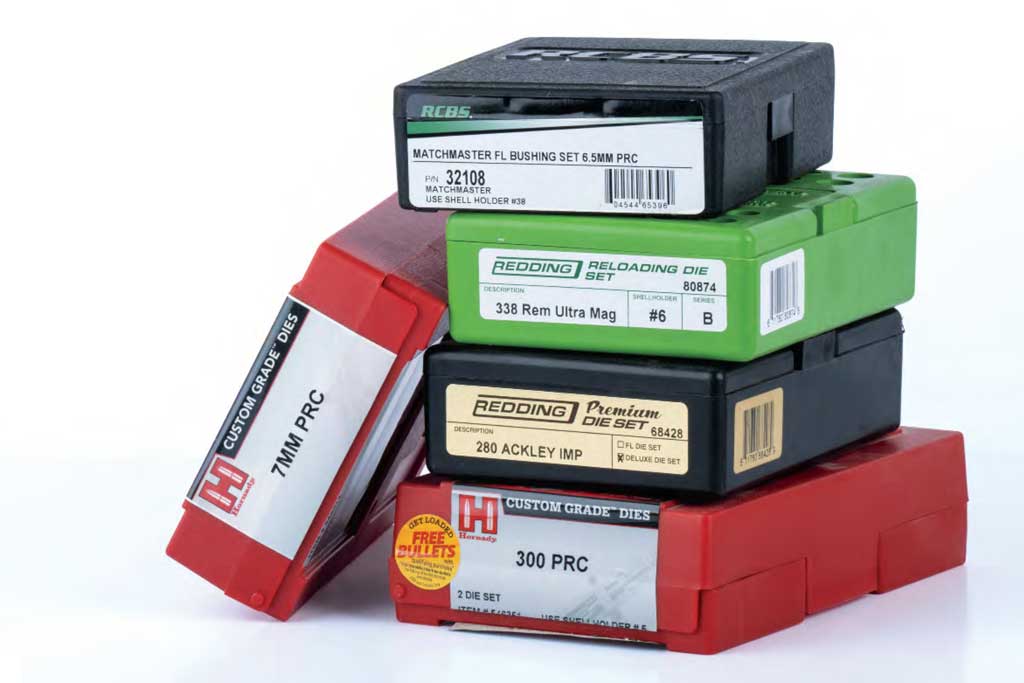
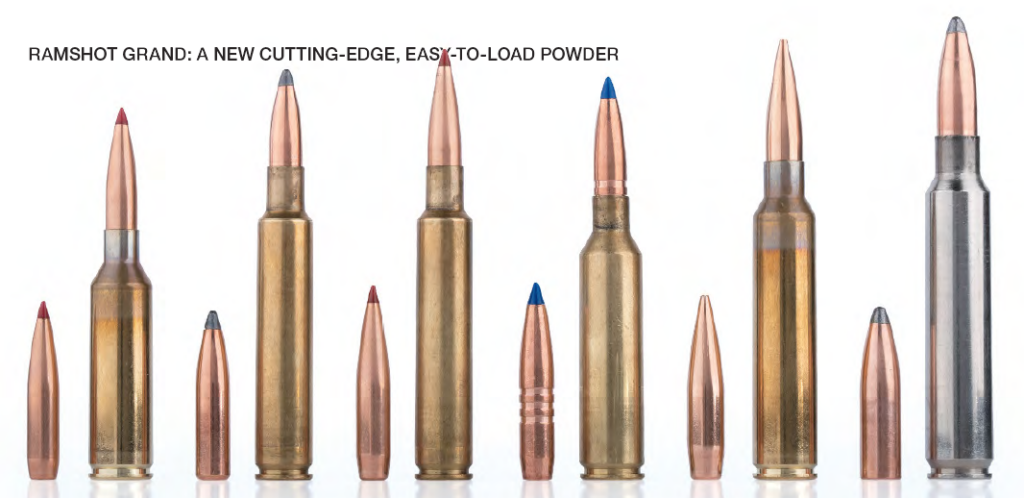
To wring out the new Ramshot powder, I handloaded test batches of several of my favorite cartridges. They were 6.5 PRC, 280 Ackley Improved, 7mm PRC, 300 PRC, and 338 RUM.
Before working up a charge, I requested Ramshot Grand reloading data from Hodgdon Senior Ballistician Justin Schrader. I worked up charges close to the listed maximums but generally stayed a grain or so shy of maximum.
For projectiles, I arbitrarily chose component bullets that I’m interested in working with in those cartridges, as follows:
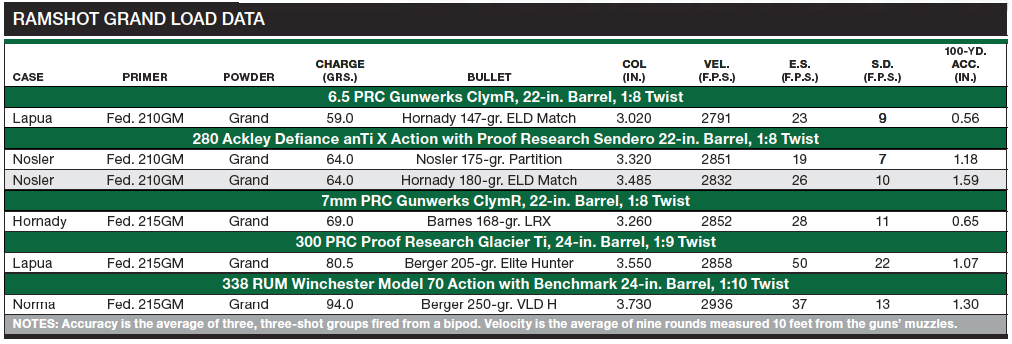
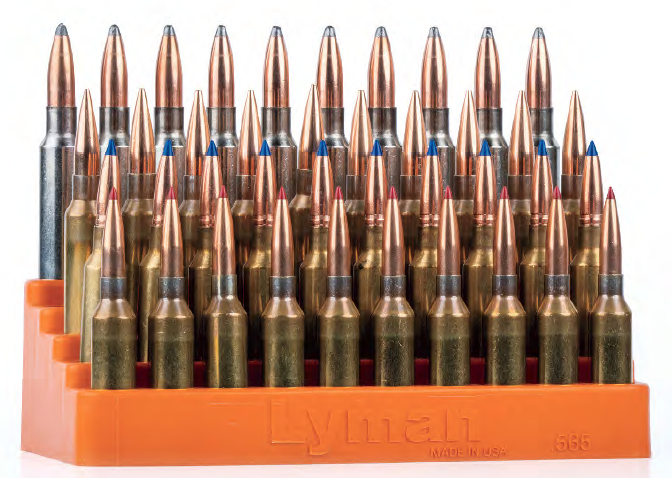
In the 6.5 PRC test batch of handloads, I loaded Hornady 147-grain ELD Match bullets over 59.0 grains of Grand, using new Lapua cases primed with Federal 210 Gold Medal primers. Bullets were seated to just kiss the rifling, resulting in an overall length of 3.020 inches. I assembled two different test batches for my 280 Ackley, one consisting of Nosler 175-grain Partition bullets, the other of Hornady 180-grain ELD Match bullets. Both were seated over 64.0 grains of Grand, in Nosler cases primed with Federal 210 Gold Medal primers. Both projectiles were seated to lightly contact the rifling. Overall length with the Partition bullets was 3.320 inches; with the ELD Match bullets it was 3.485 inches. For the 7mm PRC, I handloaded Barnes 168-grain LRX bullets over 69.0 grains of Grand, using once-fired Hornady cases primed with Federal 215 Gold Medal primers. As the LRX is a very dense, monometal design, I seated the bullets 50 thousandths off the rifling. Overall length was 3.260 inches. My test loads for the 300 PRC consisted of Berger 205-grain Elite Hunter bullets over 80.0 grains of Grand powder. I seated them in new Lapua cases primed with Federal 215 Gold Medal primers, to an overall length of 3.550 inches. The throat on the Proof Research Glacier Ti rifle used for testing is deep, and the Berger bullets had to jump a couple of tenths of an inch before engaging the rifling leade.
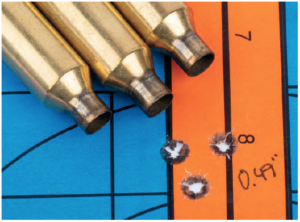
Placing a target at 100 yards, I settled in at the bench, resting each of the five test rifles on a bipod up front and a bunny-ear sandbag under the toe of the stock. Each test batch of ammo consisted of 10 rounds, and I fired three consecutive three-shot groups, allowing the barrel to cool between groups. The extra round I used if I felt like I needed a mulligan because I executed a shot poorly. Impressively, the 6.5 PRC rifle (a Gunwerks ClymR) produced tiny groups, averaging 0.56 inch—and that’s without any load tuning. Standard deviation, too, was excellent—less than I’m accustomed to when loading spherical powder—at just 9 fps. Velocity was acceptable, averaging 2,791 fps. To my dismay my favorite 280 Ackley Improved rifle didn’t particularly like either of the test loads I created for it, averaging 1.18 inches with the 175-grain Partition and 1.59 inches with the 180-grain ELD Match. However, that’s likely just a charge-weight and tuning issue. Standard deviations were excellent at just 7 fps and 10 fps, respectively. Velocity, too, was excellent at 2,851 fps and 2,832 fps.
PRCs apparently like Ramshot Grand. The 7mm PRC shot nearly as well as the 6.5mm version, producing a 0.65-inch average group size from a Gunwerks ClymR riflfle. Standard deviation was 11; velocity was a reasonable 2,852 fps. I suspect the charge weight can be increased considerably with this particular riflfle and bullet and would likely safely bring speed up 100 fps or more.
Likewise with the 300 PRC cartridges loaded with Berger 205-grain bullets. The group size average was acceptable at 1.07 inches. (That’s only a whisker outside the 1.047 inches that constitutes a true MOA at 100 yards.) However, standard deviation was 22 fps, and velocity was a rather pedestrian 2,858 fps. Most likely, filling the cases with a bit more powder would increase fill density, resulting in narrower standard deviations and should result in excellent velocity. According to Schrader, “Ramshot Grand gave the highest velocity (of the propellants tested) in the 300 PRC with all but one bullet.”
I fired the 338 RUM test loads last, figuring that the cumulative recoil it would apply was best served late in the clinical testing. The test rifle is a customized Model 70 Winchester, and it’s always been a bit finicky about accuracy. I wasn’t surprised to see groups average an unimpressive 1.30 inches, but I was delighted at the 2,936 fps muzzle velocity. As an interesting note, when pushed to that speed, the 250-grain Partition bullet generates 4,786 ft-lbs of kinetic energy—exactly the sort of authority I own the 338 RUM for. Standard deviations of the test load ran 13 fps.
When the smoke had cleared, I was impressed with the new Ramshot Grand powder. Candidly, I rarely use spherical-type propellants in my high-octane rifle handloads because I find it’s a bit less consistent and easy to achieve accuracy with than stick-type, extruded-grain propellants. However, Grand is changing my mind. Initial experience with it suggests it’s nontemperamental, easy to load for accuracy and consistency, and offers excellent velocities when loaded to full density in appropriate cartridges.