


Holiday Weekend Sale! Spend $100 or more on powder, get free Hazmat! ($17.49 Value)

New call-to-action

Reloading the 30 Super Carry

Handloading this new personal-defense semiautomatic cartridge was a challenge at first, but the results were totally satisfying.
by Lane Pearce

Several new rifle cartridges and even a few revolver rounds have been introduced since the advent of the 21st century. However, the new 30 Super Carry is the first autoloading pistol cartridge since the 45 G.A.P. (Glock Automatic Pistol) arrived in 2003. A novel result of collaboration between Glock and Speer, the 45 G.A.P. was specifically targeted at the law enforcement market. The 30 Super Carry from Federal Cartridge is touted as today’s premier option for personal defense.

About two years ago, Federal invited Nighthawk Custom to partner with them to introduce a new handgun cartridge. Recognizing the obviously limited production capacity and premium pricing of a strictly custom 1911 pistol, Federal also approached Smith & Wesson to develop a mass-produced, compact version of its popular M&P 2.0 Shield.

Unfortunately, the COVID pandemic delayed the new cartridge’s debut until the 2022 SHOT Show. Advertised as “…filling the gap between the 380 ACP and the 9mm Luger” for personal protection, the 30 Super Carry’s ballistic performance more closely matches the 9mm’s power level. For example, the 30 Super Carry and 9mm Luger both offer 100-grain loads rated at about 1,250 fps in typical 4.0-inch-barreled pistols. Same bullet weight/same velocity means both loads generate the same muzzle energy.

Of course, the laws of physics also apply to munitions performance. So achieving similar 9mm Luger ballistics is possible only if the pressure acting on the base of the 30 Super Carry’s smaller (0.312 versus 0.355 inch) diameter bullet is significantly increased to provide similar acceleration. While the 9mm’s maximum average pressure (MAP) is specified by S.A.A.M.I. as 35,000 psi, the 30 Super Carry’s is 52,000 psi, which is only a little less than the 223 Remington’s MAP.

Obviously, the 30 Super Carry is a spirited performer compared to other automatic pistol cartridges. Both experienced and new shooters might prefer it instead of a 380 ACP because of its much superior terminal ballistics. In addition to nearly par performance with the 9mm, the 30 Super Carry’s smaller case diameter allows about 20 percent increased magazine capacity compared to similar-size 380/9mm pistols.

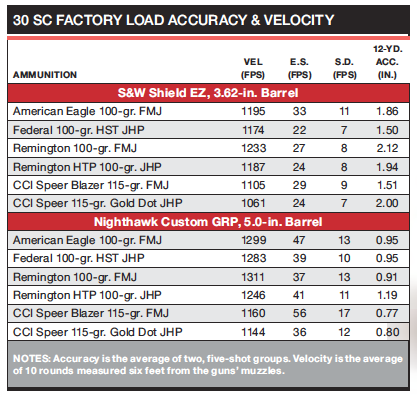
Factory-loaded ammo options include Federal (American Eagle) and Remington 100-grain FMJ loads that are intended as practice/target loads. CCI Blazer 115-grain TMJ ammo also fits in this category. Both Federal (HST) and Remington (HTP) 100-grain JHP and Speer 115-grain Gold Dot ammo delivers optimal performance for personal defense. And Hornady recently introduced a 100-grain Critical Defense load.

Unfortunately, suitable components for the hobbyist handloader aren’t as plentiful. For now, brass is only available by retrieving and reloading fired factory cases. And the availability of component bullets is only a little better. None of the Federal, Remington, or Speer 30 Super Carry bullets is offered as a component. Sierra’s 90-grain JHC and Hornady’s 85-grain and 100-grain XTPs are the only jacketed bullets available as this is being written. Although these were originally developed for reloading revolver rounds, they’re suitable for handloading the 30 Super Carry.

Handloading Tips

The 30 Super Carry moniker suggests it’s topped with nominally .30-caliber bullets, but that’s not so. The only true .30-caliber pistol rounds, i.e., topped with 0.308-/0.309-inch-diameter bullets, are the obsolescent 30 Mauser, 30 Luger, and 30 Tokarev (also 30 Carbine if you include two short-lived pistols that were actually dangerous to shoot). Hornady occasionally offers both 86- and 93-grain FMJ bullets for those who reload these more-than-a-century-old rounds.

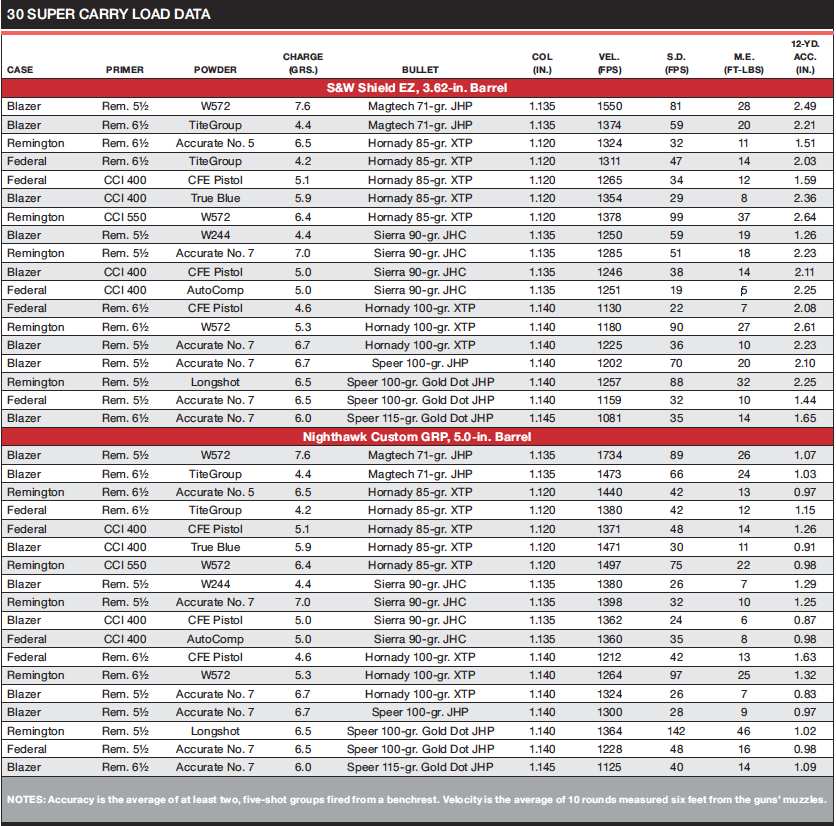
30 Super Carry bullets are actually 0.312 inch in diameter, so they’re usually designated as .32 caliber. As noted earlier, only a few jacketed bullets are available as components, and fortunately, they deliver comparable performance with the factory-loaded ammunition. Speer used to make a 100-grain JHP for reloading the 32 H&R Magnum. I had an almost full box to add to the mix for this special report. Speer catalogs a 100-grain Gold Dot component bullet designed for the 327 Federal Magnum, but it, too, has not been produced recently. A Vista Outdoor senior executive stated they do plan to offer one or more of the 30 Super Carry factory bullets for handloading in the near future. Test loads using the 100-and 115-grain Gold Dot bullets are included in my load data chart.

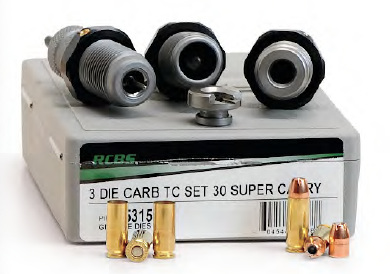
RCBS was first to offer reloading dies for the
30 Super Carry, and that is what Lane used to load his 30 Super Carry handloads.

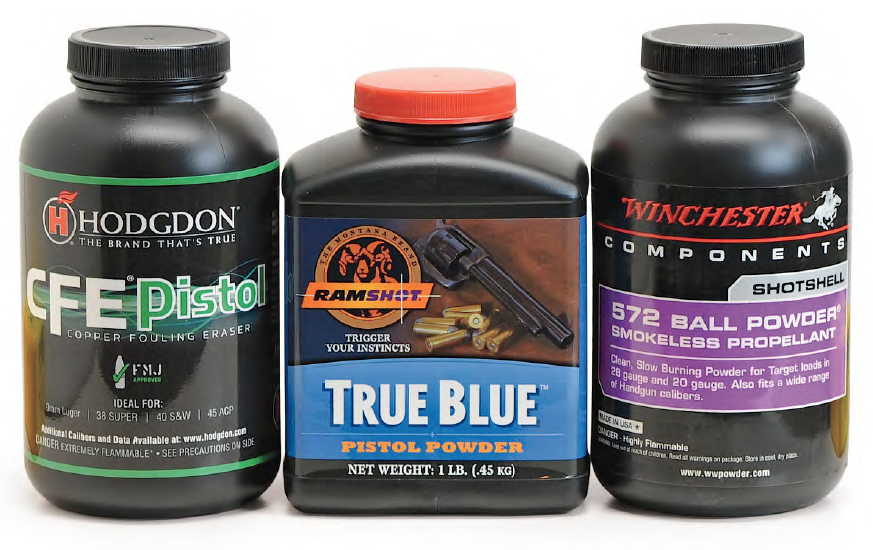
Of course, the OEM propellant used in the factory ammo is not available as an off-the-shelf canister component. However, among the many Hodgdon, Winchester, Ramshot, and Accurate propellants, there are several suitable selections. Magnum Small Pistol and Small Rifle primers are recommended. They’re not as much needed to ignite the relatively small powder charges; however, because they have thicker and stronger cups, they readily accommodate the 30 Super Carry’s much greater MAP. Extensive testing indicates these primers can be used interchangeably, i.e., there’s minimal effect on internal ballistic performance.

RCBS and Lee Precision offer excellent reloading die sets with carbide sizers. Hornady should be shipping dies soon, and Redding may join the market but will offer only a precision-machined, tool-steel sizer die that will require applying lube before resizing. I received a set of the first production run of RCBS dies. The recommended shellholder (#17) is the same as required for the 30 Carbine and 32 ACP. The #12 RCBS shellholder will also work, and both require close attention to properly positioning the small cartridge cases. Other than this little procedural quirk, the reloading process is straightforward.

As usual, the sizer die also decaps the fired case. The expander die plug opens the case diameter up just enough to ensure adequate bullet retention and must be carefully adjusted to slightly flare the case mouth to ensure the bullet can be properly aligned before seating. I weighed each powder charge of the first development rounds to achieve no more than a tenth of a grain variation. A Redding precision pistol mechanical powder measure accurately dispensed the propellant charges listed in the chart. After adjusting the measure to the desired value, the last charge thrown duplicated the first one almost every time.
Before seating the bullets, I spot-check weigh several charges using an RCBS digital scale. I next inspect the whole tray with a small penlight to verify every case is charged and each powder level appears to be the same as its neighbor. I first incrementally adjust the seater die to insert the bullet to the desired overall length. Then I back off the seater stem and adjust the die body down and slightly taper crimp the case mouth to remove the case mouth flare. The rimless round headspaces on the case mouth, so the case wall must be straight to fit the chamber correctly and ensure reliable ignition. Finally, I just reposition the seater stem so the bullet will be seated to the desired overall length and simultaneously crimped in place.

One final but important caution: Because the 30 Super Carry is a relatively small-capacity round with a substantially greater MAP, overall cartridge length (COL) must be very close to the recommended load data and definitely not any shorter. The maximum COL is 1.150 inches. As the chart shows, the COL for several loads is less than that number. You should also note that a much-reduced COL is only for lighter-weight, i.e., shorter, bullets. The chart includes load data for Speer’s 115-grain Gold Dot bullet that may be offered as a component in the future. I asked and Hodgdon graciously included it in its load development effort. The heavier bullet is also longer and if seated much shorter than 1.150 inches COL will cause pressures to jump possibly to a dangerous level. As you can see in the chart, Accurate No. 7 and this bullet are very compatible.
Naming the New Cartridge

As an aside and strictly anecdotal discussion, let’s discuss the new 30 Super Carry’s name. As stated elsewhere, pistol cartridges topped with 0.312-/0.313-inch-diameter bullets are always referred to as .32 caliber. The 32 S&W and 32 Colt centerfire revolver rounds evolved from the original .31-caliber cap-and-ball handguns and subsequent .32-caliber rimfire cartridges. In the mid-1980s, Federal teamed with Harrington & Richardson to introduce the 32 H&R Magnum. It’s essentially an even longer 32 S&W Long cartridge with a modestly greater MAP.

In 2008 Federal upped the ante again with an even longer and stronger .32-caliber cartridge called the 327 Federal Magnum. Its MAP is more than double that of the 32 H&R round. Naming that new revolver cartridge was apparently not without discussion because somewhere in my shop there’s a fired case with a “320 Federal Magnum” headstamp. Obviously, similar conversations occurred among Federal’s marketers and executives before the “30 Super Carry” designation was nailed down. They apparently wanted to distance the new round as far from the much-weaker 32 ACP as possible. It’s essentially the ballistic twin of the pretty potent 30 Luger if that helps.

Making a Case for the 30 Super Carry

If you’re wondering why anyone needs this exciting new personal-defense cartridge, let me offer this. If the quest of “need” is equitably applied to rationalizing the proliferation of two dozen or so “new and/or better” rifle cartridges during the last 20+ years, then the personal-defense pistol cartridge market is woefully inadequate, and shooters desperately “need” the new 30 Super Carry.

The 30 and 9mm Parabellum (Luger) rounds are 120+ years old. The 45 ACP is 110+ years old. The 32 and 380 ACPs are at least 100+ years old. The 38 Special (I know, it’s a revolver round!) is about as old as the 9mm. More recent personal-defense handgun cartridges include the 32 H&R Mag., 327 Federal Mag., 357 Sig, 40 S&W, and 45 GAP. All of these, except for the 327 Federal Mag. and 45 GAP, were introduced before Y2K.

I asked myself the above question when I first heard about the 30 Super Carry. My initial cursory assessment (before firing any rounds) concluded that it almost duplicates the 9mm’s ballistics plus provides capacity for two or more additional rounds in the same-size magazine. However, the experience of working with this cartridge has been enlightening to say the least. I purchased an S&W Shield EZ and proceeded to fire nearly 1,000 rounds of factory-loaded and handloaded ammo. Of course, there was no load data at that time, and 50 years of handloading endeavors could not fully protect me from mishaps while I developed safe and reliable test loads for my first attempt at handloading this new round.

The compact Shield EZ worked perfectly, jamming only once when a previously fired, 120 percent MAP handload left its primer in the bowels of the pistol. After industry friends pressure-tested most of my crude results and several other candidate recipes, all of my subsequent test loads retained the primers. The Nighthawk Custom GRP 1911 arrived several weeks into the effort, and its fare included only factory ammo and reliably proven load recipes developed in Hodgdon’s lab.

I recently read that during the last two years, more than five million citizens purchased their first firearm. They likely had little if any preconceived notions as to what type or caliber firearm would be the “best” for their need. The only guidance they may have had is from someone they’d never met before at a local gunshop. The gunshop employee’s prejudices (and available inventory, of course) would surely affect a new buyer’s choice of firearm and cartridge.

Tens of thousands of ARs were bought simply because “…they’re going to be banned!” Similar quantities of handguns were bought because “…I need one to protect myself and my family. You can’t depend on law enforcement to be there, so I need them.” Such is the political and social environment we live in today.

So it’s understandable to stick with existing and long-proven choices. I would likely recommend a compact, double-action revolver as the best choice for the novice shooter. You can’t get much simpler than “pick it up, aim, and continue to squeeze the trigger until the threat is over.” And just as important, they should routinely practice to ensure the gun functions reliably and they maintain proficiency shooting it.

However, if the new shooter is willing to commit to more than basic training, a compact semiautomatic pistol may be a better choice. Unlike the typical revolver, most pistols have one or more mechanical safeties to help preclude “negligent” discharges. I say negligent instead of accidental discharge because if the firearm is in working order, the only way it can fire is if the responsible user is negligent!

The two pistols used in this report have active and passive safeties. One control must be purposely set to the “Safe” or “Fire” position, and the other is concurrently disengaged when the firearm is properly gripped before firing it. More than a thousand rounds cycled through the S&W pistol. Several hundred more factory rounds and handloads were fired in the Nighthawk Custom GRP pistol. I mentioned the cause of the only mishap with the Shield EZ earlier. By the time the GRP joined the review, there were no test ammo overloads, and it functioned flawlessly.

Both guns came with two single-stack magazines that are easy to charge. The GRP’s one-third longer barrel added from 40 to 130 fps compared to the EZ’s recorded velocities. The factory target ammo is loaded to lower pressure than S.A.A.M.I. MAP. The handload data also reflects a modest margin of safety because a few tenths of a grain of propellant will significantly affect pressures.

After purchasing the Shield EZ and firing many rounds, I became a supporter of the 30 Super Carry cartridge. So much so that I bought the Nighthawk Custom GRP. Both are excellent handguns.