


 The emergence of the new 338 WBY RPM can be likened to the formation of new stars. Gravity pulls in matter that is assimilated into the physical dimensions and fused to form a stellar nebula. From that a new star is formed.
The 338 WBY RPM is quite evolutionary. By the way, “RPM” stands for “Rebated Precision Magnum.” The 338 WBY RPM is the second in what we might call the “RPM Universe” and offers a unique avenue to reloading opportunities for the shooter and big-game hunter.
First, a little background. The name Weatherby is well known in shooting orbits, but the 338 WBY RPM is a huge departure from the standard Weatherby paradigm. Cartridges from the firm that Roy Weatherby started in 1945 are based on a simple but profound concept: High velocity kills. (Yes, I know the proper term is “speed,” since “velocity,” as Mark Denny has recently pointed out, describes how fast and in what direction an object is going. “Speed” just tells us how fast it’s going. But I’ll use “velocity” here.)
Roy was obsessed with velocity and designed his cartridges to achieve higher velocities than “standard” cartridges of a given caliber. To do this, for most of them, he used a cut-off and blown-out belted magnum case, necked to the caliber under development. This increased the powder capacity. In addition, the barrels of rifles chambered for Weatherby cartridges had long throats, or lots of “freebore.” This gave the bullets a running start at the rifling, and stiff powder charges gave maximum velocities. Another characteristic of the Weatherby case was the double-radius shoulder. Weatherby’s early PR literature implied this produced better ballistics, but rumor has it that it may have been a marketing ploy.
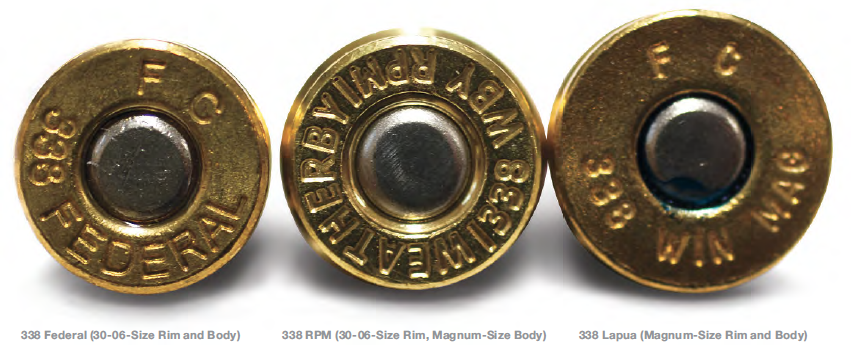
The 6.5 WBY RPM was introduced in 2019. It is Weatherby’s 16th cartridge. (The first was the 270 Weatherby Magnum, dating from 1945.) It is remarkable in that the WBY RPM case deviates considerably from the usual Weatherby case. The WBY RPM doesn’t have a belt or a double-radius shoulder. What’s more, it has a rebated rim! None of this was for show; rather, it was for “go.” The rim is the same diameter as the 30-06, and many other cartridges, but the case body is about the same diameter as a belted magnum, starting at 0.500 inch and tapering slightly to the 35-degree shoulder. Also, WBY RPM rifle chambers do not have the typical Weatherby freebore. Furthermore, the overall cartridge length is short enough to fit in standard-length actions. These tweaks resulted in stellar ballistics from the new round.
The Weatherby folks thought a big-bore cartridge that would fit into the “standard” length actions, like the 6.5 WBY RPM, would be a welcome addition to what the late Warren Page called the “cartridge picket fence.” Such a round would propel large-diameter, heavy bullets at velocities that nibbled at the velocities of existing 338 Magnums but could be housed in a trimmer and lighter rifle. Thus, the concept of the new 338 WBY RPM was born.
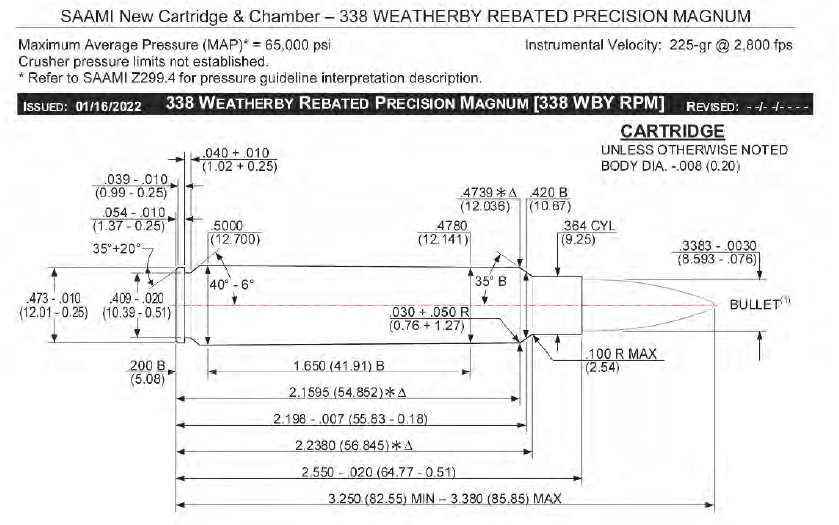
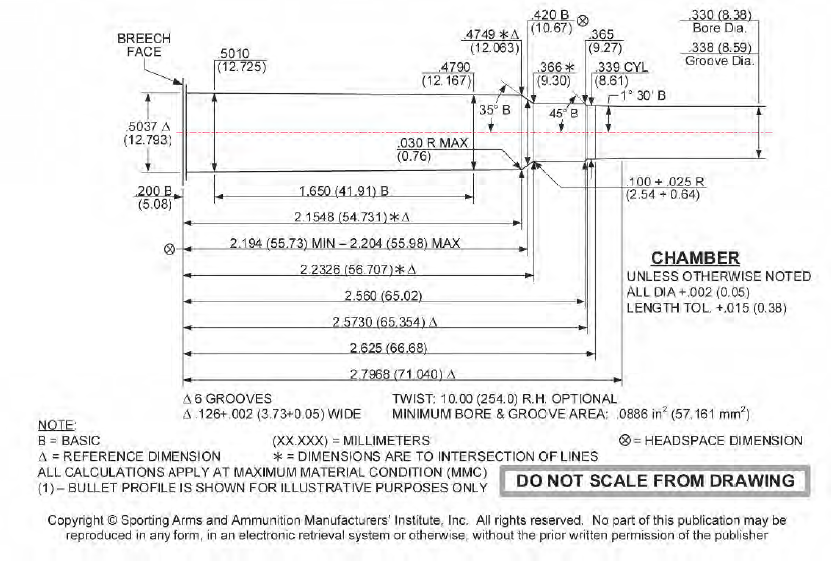
The 338 WBY RPM is merely the 6.5 WBY RPM case necked up to .338 caliber. The new round was approved by S.A.A.M.I. in January 2022. Its maximum cartridge overall length is 3.25 inches, only 0.090 inch longer than the 30-06, and recall that its rim is the same diameter as the 30-06. The neck length of the 338 WBY RPM is 0.314 inch, or .93 caliber, which is very close to the one-caliber principle that’s considered optimal.
The good folks at Weatherby loaned me a brand new Mark V Backcountry 2.0 rifle with an 18-inch barrel for this special report. The 338 WBY RPM is also offered in the Backcountry Ti (also with an 18-inch barrel) and the Backcountry 2.0 Carbon and Ti Carbon with 20-inch barrels. The Accumark and Carbonmark models have 24-inch barrels. All have 1:10 twists. My Mark V Backcountry test rifle weighs five pounds, five ounces, without a scope.
Speaking of scopes, I used a new Sightron Series G2 S1 4-12X 40mm scope. This excellent glass has 0.25-minute clicks and crystal-clear optics. It weighs only 14.1 ounces. The weight of the scoped rifle is 6.19 pounds, which makes it great for toting over western hunting country.
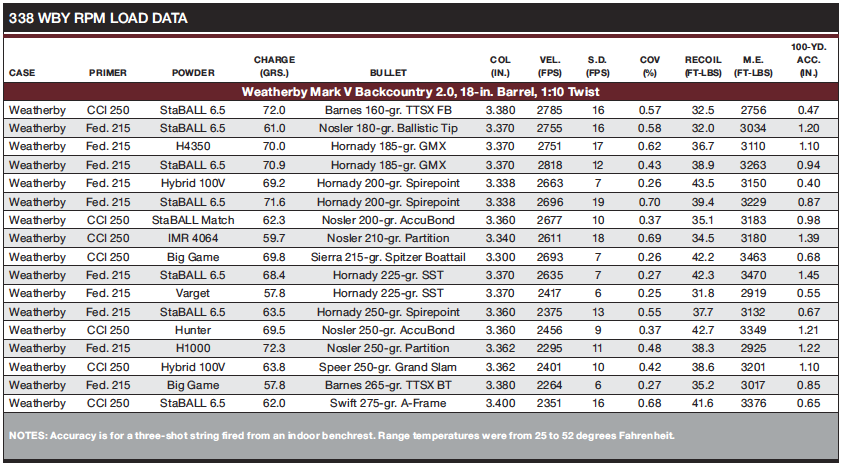
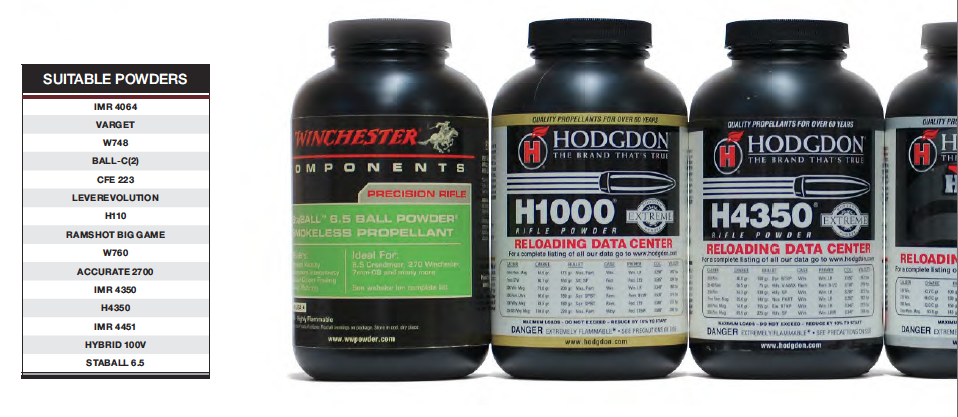
The size and shape of the 338 WBY RPM round’s case is just right to utilize many propellants, and the clever folks at Hodgdon’s sophisticated ballistics labs were quick to see the potential of this new round. They have carefully developed dozens of pressure-tested loads with bullets ranging from 185 to 265 grains. The data for 130 pressure-tested loads are shown elsewhere in this manual, and they also are available online at the Hodgdon Data Center. I’ve compiled a list of powders suitable for the 338 WBY RPM, and it is shown in the accompanying chart. I can honestly tell you the 338 WBY RPM is not picky about the powder it’s fed, as many work very well with a variety of bullets. The maximum average pressure (MAP) set by S.A.A.M.I. for the cartridge is 65,000 psi, and none of Hodgdon’s loads exceed that limit.
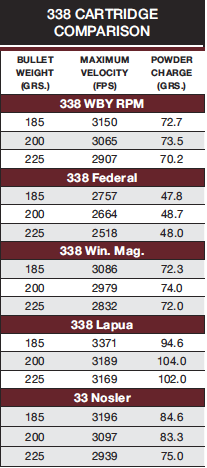
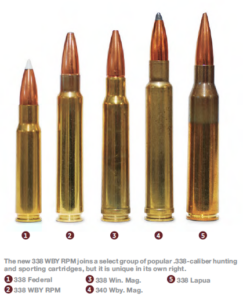 As you can see from the cartridge comparison chart, the 338 WBY RPM virtually matches the classic 338 Winchester Magnum in performance, and Hodgdon’s load data confirms that. This places it in good company indeed, as the 338 Win. Mag. is the quintessential western cartridge for hunting elk and mule deer. The neat thing about the 338 WBY RPM is it can be housed in a rifle that is lighter and trimmer.
Let’s look at the two rounds in a side-by-side comparison of maximum velocities with several bullet weights. I’ll point out that the 338 Win. Mag.’s MAP is 64,000 psi, which is a tad lower than that of the 338 WBY RPM. But this is as close to an “apples-to-apples” comparison as we can get, as all these data were obtained in Hodgdon’s minimum S.A.A.M.I.-spec pressure barrels that were 24 inches long and had 1:10 twists.
With the Barnes 185-grain bullet, the 338 WBY RPM achieved 3,150 fps with 73.5 grains of StaBALL 6.5. Note that the pressure for this load is 2,000 psi below the round’s MAP. The 338 Win. Mag. went 3,086 fps with 72.3 grains of the same powder.
Moving to 200-grain bullets, the 338 WBY RPM launched the Federal Fusion bullet at 3,065 fps with 73.5 grains of StaBALL 6.5. The 338 Win. Mag. pushed the Speer 200-grain Softpoint to 2,979 fps with 74.0 grains of H4350.