

Holiday Weekend Sale! Spend $100 or more on powder, get free Hazmat! ($17.49 Value)

New call-to-action

Reloading the 360 Buckhammer

Remington’s new cartridge is easy to handload, with the right powders.
by Steve Gash
The straight-wall 360 Buckhammer was created for hunters, and excellent full-power handloads and subsonic handloads are easy to build with the right powders and bullets.

Carrying a rifle afield allows for ethical harvests at greater distances. While this seems like an obvious win, that capability increase also can make rifles dangerous in areas where shotguns and muzzleloaders play just fine. For this reason, many jurisdictions limit hunters to the latter two platforms, and that can present some difficulties. Shotguns loaded with slugs produce a level of recoil that many hunters will find uncomfortable and, as such, will decline to practice with them in the off-season. Furthermore, one is pushing the limits of this platform once they hit the 100-yard mark. Saboted slugs help us to reach out a bit farther but are generally too expensive to practice with and require the additional expense of a rifled barrel. For these reasons, shooters turn to muzzleloaders, but with them, you are limited to a single-shot firearm and the task of learning an entirely new skill set to produce repeatable accuracy.

These arguments were presented to the lawmakers of these hunting locales and, to much surprise, fell on sympathetic ears. Many, being hunters themselves, understood that rifle cartridges span a wide variety of effective ranges, thus making it unfair to outlaw them as a whole. After working with firearms experts and advocacy groups, legislators determined that a subset of cartridges deemed “straight wall” represented rifle fodder that was about as safe to shoot in densely populated areas as scatterguns and front stuffers. Although an epic win for the firearms community, it didn’t leave a perfect option for deer hunting. Winchester first addressed this with the 350 Legend cartridge, but some hunters found it underpowered and weren’t pleased that its rimless case nearly precluded it from functioning in lever-action rifles.
Enter the 360 Buckhammer

While Winchester might have built the first cartridge specifically for straight-wall country, Remington had the idea on its storyboard many years prior. Initial thoughts were to chamber a lever-action Marlin Model 336 in 357 Maximum, but with bankruptcy looming, there wasn’t enough in the budget left for new product development. Slowly, the idea got pushed to the back of the engineering department, and the Remington company was sold off. Big Green, as we knew it, entered a restructuring phase, directing most of its resources to rebuilding, retooling, and resupplying the factory floor with raw materials. Once back on its feet, Remington realized that the best way to announce its reentry was to bring a new cartridge to the industry.

With straight-wall acceptance catching on, the company thought it could make a better .35-caliber round, one that would pull on sentimental heartstrings as well as serve utility beyond novelty. Taking a traditional 30-30 Winchester case, the boys in Arkansas cut out the bottlenecking step and instead gently tapered it to hold the classic Core-Lokt bullets already being made for the 35 Remington round. Also, the case was cut to 1.800 inches on the nose, putting it right at the legal maximum for states that have one set. What we have in the new 360 Buckhammer is a cartridge that produces substantially more energy than the 30-30 Win. and is about as close as you can get to carrying a trusty 35 Rem. afield without getting in trouble.

After filling my freezer from a single hunt, I quickly fell in love with the 360 Buckhammer and the Henry lever-action rifles chambered to fire it. Owning a lever action in 360 Buckhammer makes a lot of sense for a guy in my position. As I now hang my hat in the state of Pennsylvania, many wildlife management units have opened up to allow straight-wall ammunition. Additionally, the entire state is one of the few places with a ban in place on semiautomatic firearms for big-game hunting. To my west is Ohio, which mandates straightwall cartridge rifles, and to my east is New York, which requires a nonexistent permit to possess a semiautomatic. However, even if I weren’t “forced” to shoot the 360 Buckhammer, it still would be my go-to woods cartridge/gun combo. I enjoy the manual of arms that goes with a lever-action rifle, and the round has power to spare without being overbearing to the shoulder. It also is a fun little cartridge to reload, which brings me to this report.

Powder Selection

Handloading the 360 BH is interesting because only a few powders work well with it. If you go with propellants that are too fast, you’ll experience pressure issues. Too slow, and you won’t get the velocity that makes this round worthwhile. In short, it operates on a narrow band of burn rates. Furthermore, many powders will be too voluminous to cram into the case to meet even the minimum charge. With the exception of Accurate No. 2, all of the workable powders fall between IMR 4227 and H4895 on a burn chart. At the time of this writing, Hodgdon had six powders that could accomplish favorable supersonic performance; however, it was up to me to narrow down the best ones. Because 360 BH isn’t intended for semiautomatic firearms, it is a perfect candidate for subsonic loading. Powder options for flying below the speed of sound were rather plentiful, as I had 10 from which to choose. This made it more difficult in some respects, as it likely meant more poking around before finding a winner. But surely an avid handloader wouldn’t mind that one little bit.

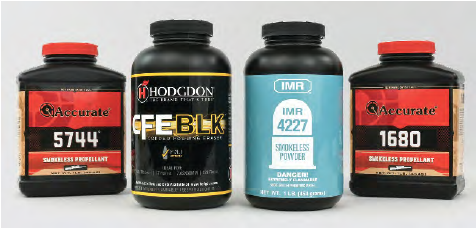
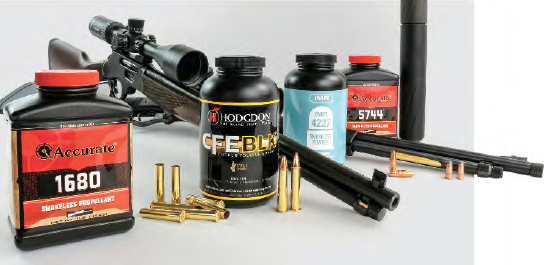
Frank found several powders that work well for the 360 Buckhammer, including Accurate 5744, CFE BLK, IMR 4227, and Accurate 1680.
Bullets used in this report were 0.358 inch in diameter and ranged in weight from 180
to 223 grains.
Bullets used in this report were 0.358 inch in diameter and ranged in weight from 180 to 223 grains.
Bullet Choices

Where lever guns have the advantage of manual cycling, they carry the disadvantage of a tubular magazine. Because the ammunition sits bullet to primer in these guns, abrupt recoil can cause a round to go off prematurely. So, my selection was limited only to bullets that are safe in this configuration. Complicating matters further, the 360 BH slings 0.358-inch-diameter projectiles in lieu of the more popular 0.357-inch ones. However, the good folks at Hodgdon confirmed that 0.357-inch-diameter bullets are safe and even provided some data for their use. I opted to skip this diameter, as using undersized bullets is seldom the path to accuracy, but I would consider seeing how they perform sometime down the road. After a little digging, I was able to find enough 0.358-inch bullets to handle just about every hunting scenario, so we can’t call the 360 BH limited by any means.
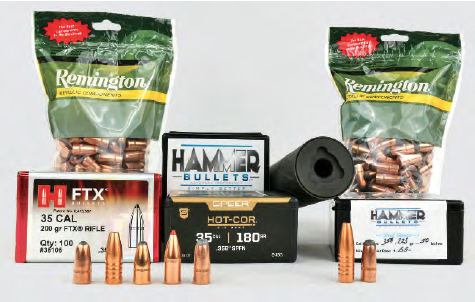
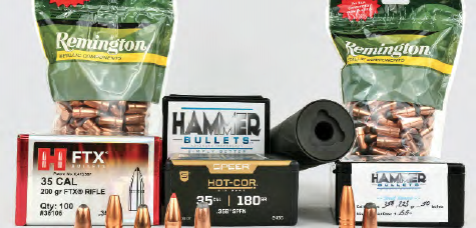
Remington offers its classic 180-grain and 200-grain softpoint Core-Lokt bullets as reloading components, so I included them. My only gripe is that they have a sectional density and ballistic coefficient that pulls them from the sky in a hurry. Don’t get me wrong, when selling this cartridge to those who govern straightwall territories, it was the perfect option, but let’s be honest, half of handloading is about gaming the system. Hornady’s Flex-Tip (FTX) lever-gun bullet was all but built to game said system and dramatically flattens trajectories through its conical profile that is safe for tubular magazines. Luckily, it is available in this caliber, and I was particularly excited to make it sing.

Speer offers a 180-grain 0.358-inch Hot-Cor bullet, which boasts a molten core that is poured in to produce consistency beyond its class. Speer knows a thing or two about bullets, so I trusted this one enough to spend time building cartridges. And a small bulletmaker in Montana called Hammer Bullets specializes in monolithic copper bullets, so I selected its 178-grain and 223-grain Shock Hammer bullets. They are Spitzer-style bullets, but they are perfectly safe for use in tubular magazines because of their oversized hollow points that essentially produce less primer contact than even a blunted softpoint bullet.
Tooling Up

When Remington made the 360 Buckhammer, it knew folks were going to want to handload it. Therefore, the company worked closely with its sister company RCBS to ensure that dies would be available right at the start. In fact, I had dies in my hands before there was loading data! Expanding on its Group C series, this all-steel set includes a sizer that is void of a carbide ring, meaning you have to lube each case before running them through. The plus side of this is that they are tough as nails, and you don’t have to back them off of the shellholder, providing a more thorough resizing. This set also comes with a “stepped” expander die to uniformly expand the case mouth without subjecting it to undue stress. This extra work can potentially split a cartridge upon ignition, causing a point of impact shift and a wounded deer limping through the woods. The seater die is built to place a gamut of different-profiled bullets without damaging them and contains a roll crimp feature that is perfect for lever-action cartridges that headspace on the rim.

I utilized the latest generation of RCBS’s iconic Rock Chucker reloading press to maximize my mechanical advantage, except I upgraded it with the Hornady Lock-N-Load bushing system. This allows dies to be snapped in and out of the press, retaining their settings. When you have more than half a dozen different loads to make, this saves a boatload of time and aggravation. In addition, it makes the unquantifiable process of crimping repeatable, allowing for accurate reproduction once you find your favorite load.

Building Some Handloads

I began by building supersonic loads for a Henry 20-inch-barreled lever gun (H009G-360BH), which is what I consider the average rifle in this chambering. After topping it with a Riton 1 Conquer 6-24X scope, I had a perfect 100-yard load-development tool.

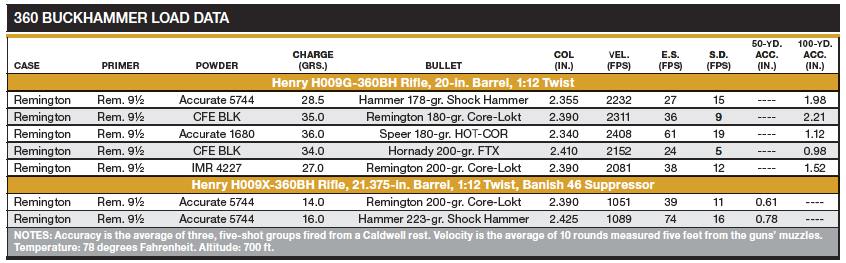
Starting with the lightest bullets, I looked over my propellant choices for the 178-grain Shock Hammer. Comparing its lengthy bearing surface to the powders that I was familiar with, I had an eerie feeling that they were all too bulky for proper seating depth. I was right on nearly all of them, except for Accurate 5744. This wasn’t a total shock, as this powder is made to keep fluffiness to a minimum, despite being an extruded formula.

At a minimum charge, the powder column was nearly touching the base of the bullet, and this was concerning because I knew it meant I wasn’t going to get much more in for the next series. However, at the very next charge step, I found performance that rivaled factory ammo, so I settled on it as my special-purpose lead-free load.

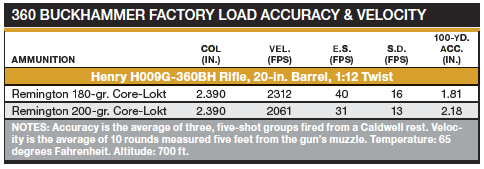
The Remington 180-grain Core-Lokt bullets were a touch heavier, and with them, I wanted to build a load using CFE BLK powder. Due to the spherical nature of this propellant, rounds could be banged out on a progressive press, and the powder’s copper-removal properties make it an outstanding practice round for the off-season. A 35-grain charge was about all that the case could fit if I wanted to seat the bullet to the cannelure, which I did because that allows for a solid crimp without deforming the bullet. As luck would have it, this load duplicated factory ammo velocity to within 1 fps and grouped just slightly larger than Remington factory-loaded ammo. Although I was tempted to try to tighten accuracy with a different powder, I left well enough alone because if I were ever in a spot where I couldn’t handload, I could substitute a box of loaded ammo off the shelf without having to rezero my rifle.

Since CFE BLK produced a single-digit standard deviation, I was not ready to give up on it, despite the larger groups, and I reasoned that using a heavier bullet would allow for less powder, which might make the difference because having more bearing surface inside the case can sometimes lead to a more uniform burn. The results with the Hornady FTX bullet showed that my hypothesis was correct, and it turned out to be the tightest-shooting load I would fire through this rifle.

Because 180-grain bullets and CFE didn’t look like a great match, I decided to switch to Accurate 1680 to see how well I could get the Speer Hot-Cors to fly. This powder is just a step slower than Accurate 5744, but it is of the smooth-metering spherical variety. With it, I was able to get within two grains of the maximum charge without compressing, and the load produced the fastest velocity of the handloads I fired. With an average muzzle velocity of 2,408 fps, the muzzle energy was a whopping 2,317 ft-lbs, which isn’t too far from some 308 Winchester loads. On top of that, most of my five-shot groups were under the 1.0-inch mark, making this load a top candidate for game larger than whitetails. The downside? It’s not for the squeamish. It took just 20 rounds before I started to feel it, which isn’t a problem for hunting, but I won’t be plinking steel anytime soon with this load.

Not to leave IMR out of the story, IMR 4227 made the cut of acceptable powders, so I decided to include it. Intended for magnumpistol cartridges, this super-shortgrain propellant left enough case capacity for bullets with small amounts of bearing surface, such as Remington’s 200-grain Core-Lokt. The Core-Lokts stabilized well with a 27-grain charge of powder, out-grouped the factory ammo, and nearly matched factory ammo velocity and drop. Needless to say, I was satisfied, so I moved on to developing subsonic handloads.

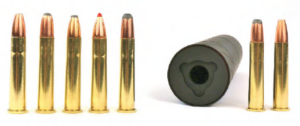
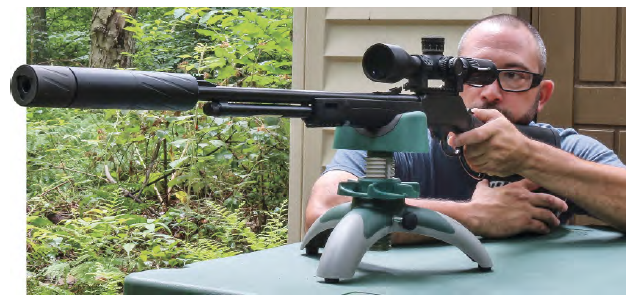
Henry and Remington had subsonic plans for the 360 BH from the start, but it was up to me to create the first rounds. The other Henry rifle I used for the load development (H009X-360BH) features a 21.375-inch barrel with a threaded muzzle, to which I promptly affixed a Silencer Central Banish 46 suppressor. With the Sightmark Presidio 3-18X I mounted on this rig, I had one heck of a close-quarters deer slayer for state land that butts up against a residential neighborhood.
The 360 Buckhammer is an excellent deer-hunting cartridge, and the handloads developed for this report shot extremely well in two different Henry lever-action rifles.

Since velocity is limited in this type of load development, kinetic energy must come from the weight side of the equation. That’s where those 223-grain Shock Hammers come into play, as well as an encore with the 200-grain Core-Lokts. Load development is easy, as Hodgdon prints subsonic data almost the way it does shotgun data. If the recommended load doesn’t work well for your particular rifle/suppressor/altitude/temperature combination, consider adding or subtracting a tenth of a grain until subsonic speeds are achieved. Some velocity and accuracy tweaking can be had by varying primers, seating depth, and crimp tension, but understand that the recipes I have listed below were not derived from a conventional load-development process. That being said, both of my loads loved being pushed by Accurate 5744, and they punched many onehole groups at 50 yards. The hardest-hitting of the pair was the Shock Hammer, which produced 583 ft-lbs of energy at the muzzle and is likely to carry more to the target than the Core-Lokt, which is built to shed its punch rapidly. Although the numbers are there, gel evidence suggested only minimal expansion with each bullet at these speeds, so it’s best to keep shots close when using them.

Although usable powders were supposed to be limited, I found several top contenders that could power a wider variety of bullets than I imagined. Careful load development produced accuracy in most cases that was more than twice what is needed to ethically harvest medium-sized game out to 200 yards, with many putting neck shots on the table at that distance. The two excellent subsonic loads make my suppressed Henry lever gun hearing-safe, and they make for good medicine on backyard deer, where the law allows. Overall, the 360 Buckhammer is a capable cartridge that’s easily handloaded, and sourcing components locally shouldn’t be much trouble at all.