



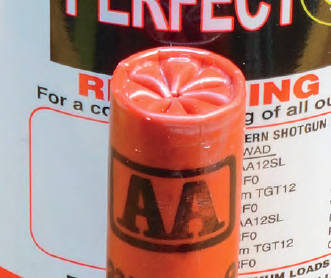
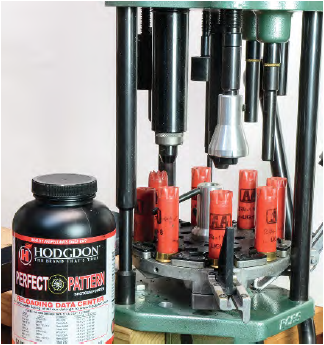
Ideally, with those three components inserted into a case, the top surface of the shot charge is level with the crimp fold point at the mouth of the case. This ensures a perfect crimp, and getting there requires just the right combination of powder charge, plastic wad, and shot charge. And while selecting and specifying those items for publication in load data is the ballistician’s job, proper crimp and wad seating pressure adjustments of the shotshell loader are the operator’s responsibility. The surface of the crimp should be fairly flat, and when loading the Remington STS, Federal Gold Medal, and Winchester AA hulls, I keep crimp depth at 0.050 inch.
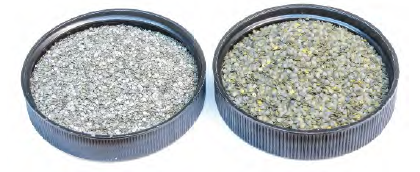
While Perfect Pattern has a high density, ballisticians at Hodgdon were able to come up with the proper stack height for loading 7/8 ounce of shot in the 12-gauge shell. This is good news for me because it is the shot charge weight I have long used for shooting skeet, for some sporting clays presentations, and for 16-yard trap. I mostly hunt doves and quail with shotguns in .410 and 28 gauge, but on the few occasions when I use a 12-gauge shotgun, it is fed handloads with 7/8 ounce of shot. Clays powder has been a favorite propellant in such loads, but I will definitely try some of the 7/8-ounce loads as soon as they become available online through the Hodgdon Data Center. The Hodgdon folks say they will be available by the time you read this.
Among hunters and clay target shooters across the country, 1-ounce and 11⁄8-ounce shot charges are far more popular in the 12-gauge shell, and Perfect Pattern is proving to be, well, perfect for those. It burns too quickly to be suitable for shot charges heavier than 11⁄8 ounces, so for that application, I will continue hanging in there with Hodgdon Universal.
Shooting Perfect Pattern has convinced me that for 1-ounce and 11⁄8-ounce loadings it is now a powder I will keep on the shelf, not because it is better than old faithful Clays but because it is just as good, and it appears to be more readily available.
And how does recoil compare? A 12-gauge Krieghoff K32 with Purbaugh sub-gauge tubes for the .410, 28-gauge, and 20-gauge events has long been my skeet gun, but for this project I switched to a favorite Remington Model 1100 in order to check out Perfect Pattern in a gas-operated semiautomatic. When shooting doubles in skeet, one shell loaded in that gun contained Perfect Pattern and the other contained Clays. I shoot doubles in trap with a Remington Model 3200 over-under, and the shell in its bottom barrel contained Perfect Pattern, while Clays was up top. I perceived recoil in both guns with shells loaded with the two powders to be the same. One of many things I like about Clays is it burns cleanly and leaves very little residue behind. Perfect Pattern rates just as high in that department as well.
Pattern quality delivered by a shotgun is mostly influenced by the type of lead shot used, with magnum and chilled shot being the two types commonly available. Magnum shot costs more to manufacture because it contains a higher percentage of antimony, and that increases its hardness. The No. 7½ and No. 8 shot in premium-grade shells loaded by Federal and Remington for trap shooting can contain as much as 6 percent antimony. For many years I have used shot made by Lawrence when loading shells ranging from .410 to 12 gauge, and magnum-grade shot made by that company is available in sizes 4, 5, 6, 7, 7½, 8, 8½, and 9. Extremely hard shot does a good job of resisting setback deformation during firing, as well as the damage that can occur as the charge is violently squeezed through the forcing cone and choke section of the barrel.
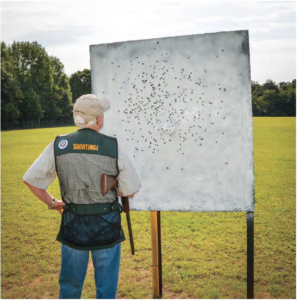
distances. The performance of loads containing Perfect Pattern powder proved to be quite good.
With that lesson behind us, let’s now look at the results of pattern-testing a couple of loads containing Perfect Pattern. There is more than one way to do it, but I prefer to use a 40×40-inch steel patterning plate attached at eye level to a pair of support posts. In preparation for the first shot, a felt paint roller is used to apply a mixture of white paint pigment and new motor oil. Testing reveals the effective diameter of a pattern at various distances and how uniformly a charge of pellets is distributed throughout the pattern. After a round is fired and its pattern evaluated and recorded, the paint roller is used to erase those pellet strikes prior to firing the next round. Shooting the plate at various distances also reveals the maximum effective range of a particular choke/shot charge combination—in other words, the distance at which any part of the pattern will deliver enough pellets to shatter a clay target or kill a game bird stone dead in flight. Due to the possibility of pellets bouncing back and striking the shooter, steel shot or any other type of shot harder than lead should not be pattern-tested on a steel plate.
Targets in skeet are usually broken inside 25 yards, so it is the distance at which I pattern-tested the Remington Model 1100 with a choke constriction of 0.005 inch. Moving to trap, I am a fairly quick shooter and when shooting singles from the 16-yard line, I usually break most targets at about the same distance. In trap doubles, the first target is broken at about 25 yards, whereas the second target is probably a good 10 yards farther out when the trigger is squeezed. When shooting trap from longer handicap distances, targets can be 40 yards away when broken, and that, along with the second shot in doubles, is where pattern quality has to be perfect. When shooting both trap doubles and singles from the 16-yard line, I use a Remington Model 3200 with 30-inch barrels with 0.015 inch of choke constriction in its bottom barrel and 0.034 inch up top. When shooting trap from longer handicap distances, I use a Remington 90T, and its 32-inch barrel has 0.035 inch of choke constriction.
Most flushing game birds are taken inside 30 yards, but late in the season, pheasants are sometimes dropped a bit farther out. I never take a first shot as far away as 40 yards, but I do want to know how effective a load is at that distance should a follow-up shot on a crippled bird be required. My favorite late-season pheasant gun is a 12-gauge Fox Sterlingworth double with 30-inch barrels, and it has choke constrictions of 0.020 inch in its right barrel and 0.040 inch in the left. During my 40-yard pattern-testing, I shot it as well as my Remington Model 90T trap gun.
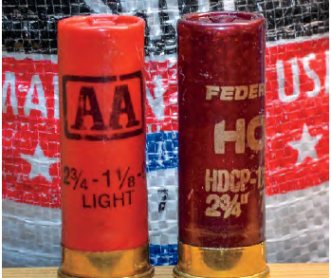
For clay target shooting with the 12 gauge, I load 7/8 ounce of shot in green Remington STS cases, 1 ounce of shot in red Winchester AA cases, and 11⁄8 ounces of shot in burgundy Federal Gold Medal cases. Doing so is an easy way of keeping track of different shot charge weights. If I am shooting skeet or 16-yard trap, I shoot either green or red shells, but when moving back to handicap distance in trap, I know that all shells in my bag should be of another color. Federal also loads the Gold Medal shell with a paper case, so it is important to note that all cases mentioned in this report are plastic.
The load used when pattern-testing the Remington Model 1100 at 25 yards consisted of the Winchester AA case, Remington 209P primer, 15.0 grains of Perfect Pattern, Winchester WAA12SL wad, and an ounce of No. 9 magnum shot at a velocity of 1,180 fps. My 16-yard trap load for the Remington Model 3200 was the same except No. 8 shot was used. The load used for pattern-testing the Remington 90T at 40 yards consisted of the Federal Gold Medal case, Remington 209P primer, 18.2 grains of Perfect Pattern, Clay Buster No. 6118-12 wad, and 11⁄8 ounces of Lawrence No. 7½ magnum-grade shot for a velocity of 1,255 fps. With the exception of increasing shot size to No. 5, the load for my Fox Sterlingworth was the same. Muzzle velocity is 1,200 fps.
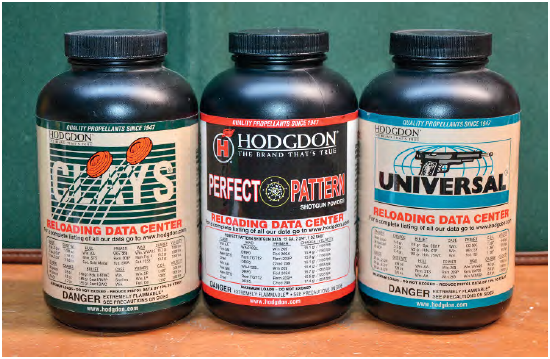
When evaluating patterns shot with the four guns, it quickly became apparent that all were as fond of loads built around Perfect Pattern as they are with loads containing Clays. I will keep Clays on hand for loading 7/8 ounce of shot in the 12 gauge and Universal on the shelf for loading 1¼ ounces of shot, but for everything in between, Perfect Pattern will do an equally good job.