




Understanding powder burn rates is one of the most important factors in being able to select a powder for your specific application.
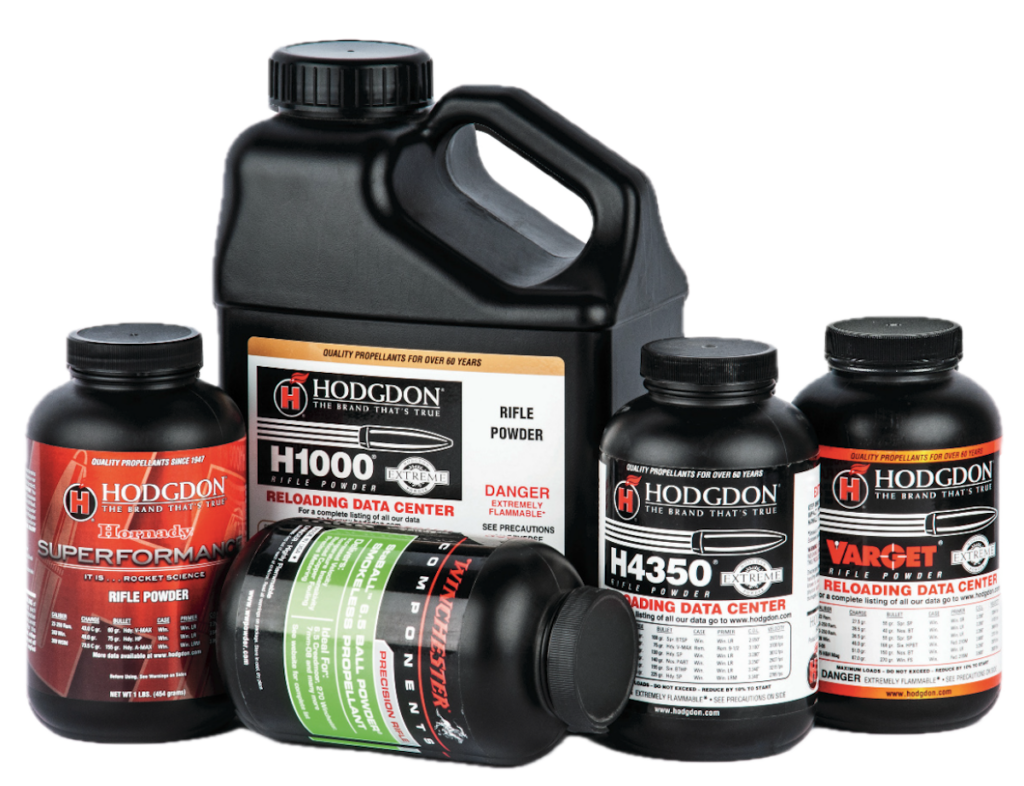
Understanding powder burn rates is one of the most important factors in being able to select a powder for your specific application. At Hodgdon, we do our best to test and list every powder that can be used effectively in any given load combination. The Hodgdon Relative Burn Rate Chart has been compiled over time and contains all the powders in the Hodgdon family of powder brands, as well as our other product lines. It is a tool to reference when selecting powders appropriate for a given load.
Our reload data could list as few as three or as many as 25 powders, depending on the load. The loads listed online and in the Hodgdon Annual Manual are arranged in order of charge weight—the heaviest charge weights (the slower powders) are listed first, working down to the lightest charge weights (the fastest powders) that will work in that load combination.
If a powder is not listed, there is a good chance that it is either too fast (resulting in high pressure or too much air space in the case) or too slow (resulting in low pressures and low velocities) for that load combination. Too much airspace in the case can create an unsafe state when the propellant shifts in the case and goes from a powder-to-primer condition to a powder-to-bullet condition. Let’s discuss a couple of loading scenarios.
Loading Range Ammo
Let’s say that you are preparing to load up a large amount of range ammo for target shooting. You want something that will be accurate and reliable while maximizing the number of rounds that you’ll be able to load per pound of powder. Your first stop should be the online Hodgdon Reloading Data Center to find a load that matches the bullet, case, and primer that you’ll be using.
After you have input your components and are ready to review your results, you’ll want to choose from the lighter charge weights toward the bottom of the list; this will give you more loaded rounds per pound of powder than the ones at the top of the list.
Loading for Accuracy
Now let’s switch gears and talk about loading for accuracy. One of the variables that contributes to accuracy is case fill, a.k.a. load density. The reason is a full case is more likely to shoot the same velocity regardless of the powder resting against the primer or the bullet.
Once again, the first stop is the online Hodgdon Reloading Data Center to find a load that matches the bullet, case, and primer that you’ll be using. This time, however, you should be looking for powders toward the top of the list.
For example, if you are loading 223 Remington ammunition with 55-grain bullets, the difference between loading the slowest powder versus the fastest powder could be 5.5 to 6.0 grains per round. That doesn’t sound like much, but that works out to an additional 100 rounds per pound of powder—something worth considering if you are loading thousands of rounds of ammo.
In many cases, these will have a “C” behind them to indicate they are compressed, meaning these loads have a load density that is over 100 percent. While these charges are compressed, our ballistics testing shows that they still have consistent ignition. By selecting one of these loads featuring these slower powders, you are effectively removing load density as a variable that could affect your accuracy. The downside, as we’ve already seen above, is that this requires more powder.
The Relative Burn Rate Chart can be used to identify not-yet-tried powders that have similar burn rates. You might hear someone say a powder is a “4350” burn speed or a “Varget” burn speed. You can use the chart to identify powders that are a bit faster or maybe a little bit slower.
Perhaps, you’ll try a new-to-you powder that gives you those tiny groups that we’re all chasing.
Hodgdon is proud to offer a broad range of propellants that will work in just about every application imaginable. It’s our hope that the tools available here and online at hodgdonreloading.com will help get you to the range and keep you on target.
Understanding powder burn rates is one of the most important factors in being able to select a powder for your specific application.