



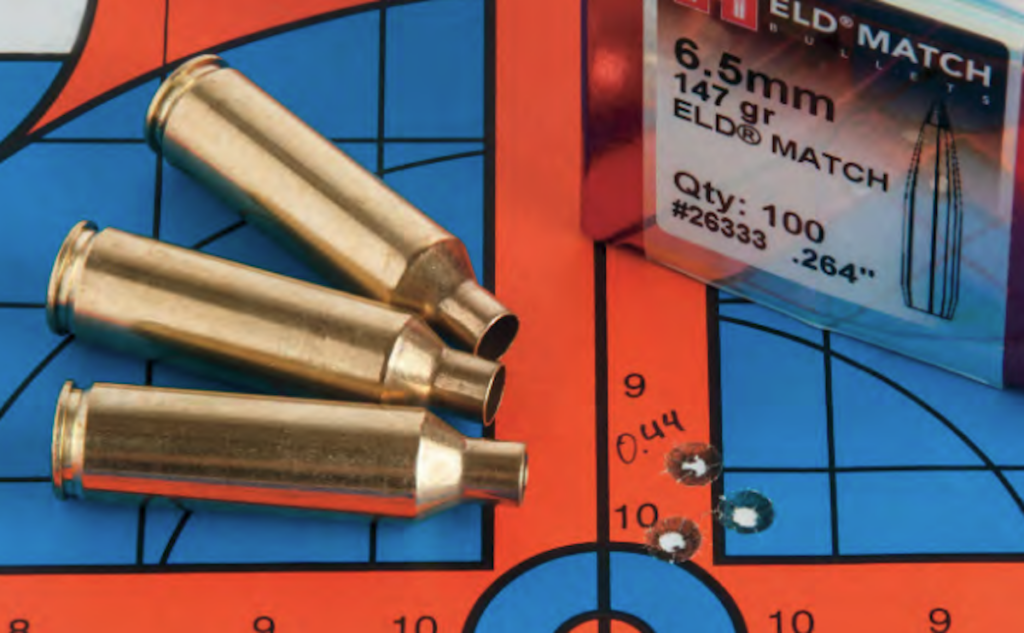

Because the three PRC cartridges are designed to excel, and do just that, one or all should be in your battery.
During the last part of the last century, Hornady morphed from being “just” a bulletmaker to becoming the most successful cartridge designer of our era. All, literally all, of the widely—and wildly—successful cartridges introduced in the last two decades were engineered by Hornady. Arguably the best of the lineup are the PRC cartridges. For anyone who doesn’t know it, PRC stands for Precision Rifle Cartridge. Currently, there are three: 6.5 PRC, 7mm PRC, and 300 PRC.
The introduction of these three market-stormers didn’t come in order of size. The 6.5 PRC came first, in 2018. Following in 2019 was the big hammer of the family—the 300 PRC. Hornady took a breather through the COVID 19 pandemic, then introduced the 7mm PRC in 2022. It is potentially the most versatile of the lot.
Before addressing each of the three PRCs individually, let’s unpack the defining characteristics shared by all three, those elements that give these rounds an edge over previous cartridges. All are focused on achieving two things: better extended-range performance and better out-of-the-box accuracy.
Fast-Twist Rifling
All three PRCs have fast-twist rifling that’s optimized for use with extremely long, high-ballistic-coefficient bullets.
Modern rifle projectiles tend to be engineered for long-range performance. Whether you admire it or despise it, long-range shooting and hunting is a massive trend. Increased aerodynamics, ballistic coefficient, are crucial to modern hunting and target bullets, but their use is limited in classic cartridges.
Traditional cartridges aren’t compatible with the best iterations of such bullets. Why? Because these modern projectiles have extremely sleek, long shapes, and they tend to be heavier than usual. Such bullets must be spun faster than traditional rifling pitch rates or else they won’t stabilize and shoot accurately.
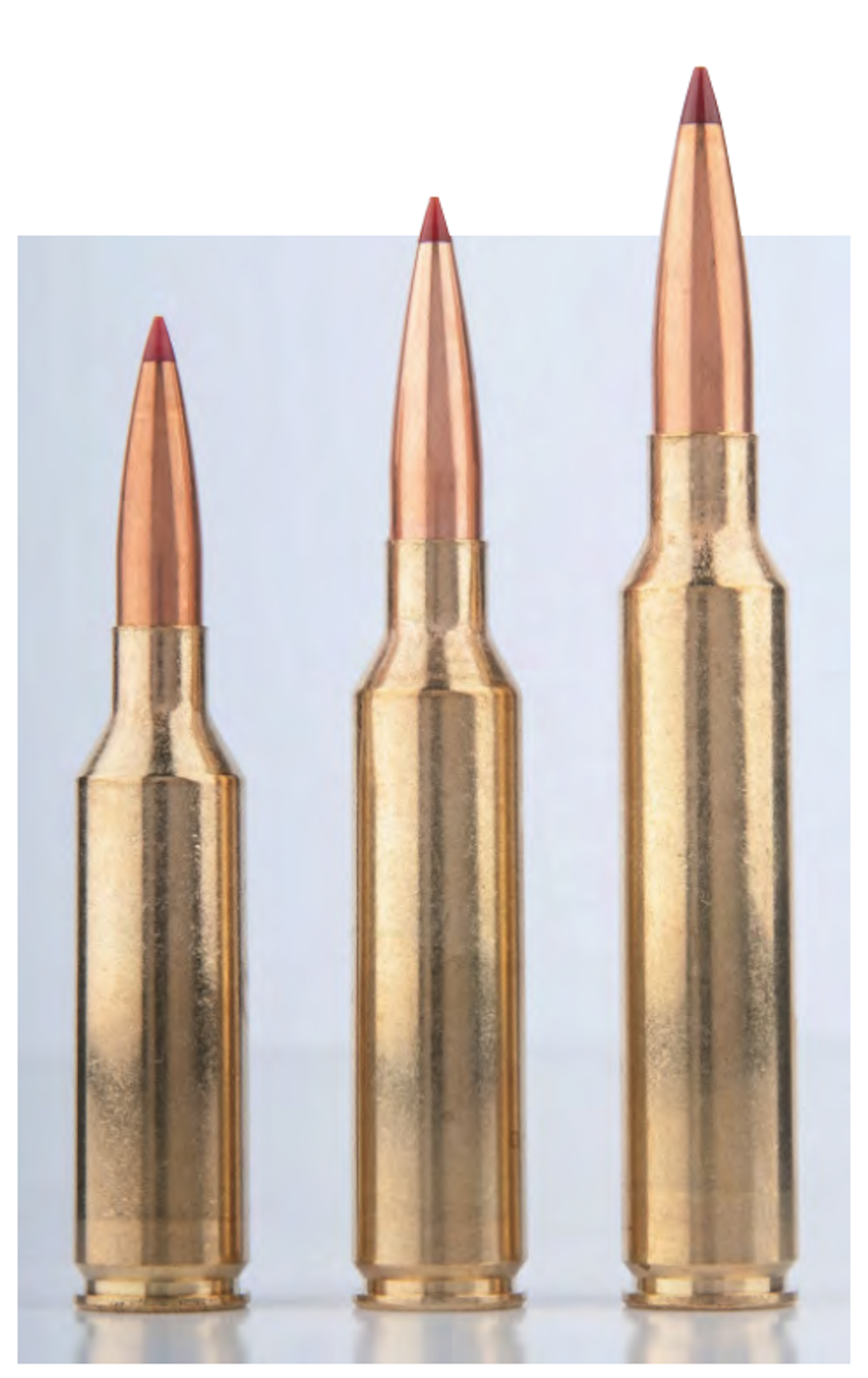
Unfortunately, most traditional cartridges feature slowish rifling twist rates. For example, the 270 Winchester, 30-06, and 300 Winchester Magnum are usually built with 1:10 twist rates. The 308 Winchester usually has a 1:11 or 1:12 twist. Even the faster 1:9 twist in a 7mm Remington Magnum is still slow by modern standards.
When Hornady submitted the PRC cartridges to S.A.A.M.I., it specified the 6.5 PRC with a 1:8 twist, the 7mm PRC with a 1:8 twist, and the 300 PRC with a 1:8.5 twist. That’s fast enough to stabilize the longest, sleekest heavy-for-caliber bullets available.
Plentiful Head Height
Another reason those long, streamlined bullets aren’t compatible with traditional cartridges is that they have noses shaped like a speedboat rather than like the blunt-fronted barge of many classic bullets. As a result, they must be seated with most of the bullet outside the front of the case so that the mouth of the case will not hang over the curve of the bullet’s nose.
The trouble is, classic cartridges don’t have enough room, termed “head height,” in the magazine for bullets that stick way out of the case. When modern long-range bullets are seated in traditional cartridges, they won’t fit in the magazine and must be single-fed into the chamber.
Modern cartridges optimized for long shooting—from the 6mm Creedmoor to the 300 PRC—have plentiful head height and are built from the ground up to be ultimately compatible with those long, sleek bullets.
Min-Spec Geometry
The three PRC cartridges are better designed for accuracy than traditional cartridges are. For example, classic cartridges were born in the decades during and after the two World Wars and have some wartime characteristics built in. Most classic cartridges have big dimensional tolerances between the cartridge and the chamber. This enhances reliability when a rifle and the ammo are dirty, bloody, muddy, or compromised with water or snow or ice. However, those generous tolerances are not good for accuracy.
Since precision is such a focus these days, modern cartridges are specced with very snug tolerances. Starting with the 6.5 Creedmoor, Hornady engineered the chamber shape and throat and rifling leade dimensions to optimize accuracy, and the recipe the company uses borders on magic.
That magic is bestowed on all three PRCs. Each is specced with minimum tolerances, and all have the chamber/throat/leade technology that’s proven to offer best-in-class accuracy.
Balanced Bore-to-Case-Capacity Ratio
Because they rely so effectively on highly aerodynamic bullets rather than extreme muzzle velocity, the PRC cartridges were not engineered for maximum propellant capacity. Rather, the bore-size-to-case-capacity ratio was optimized for potent but balanced efficiency.
All three rounds generate muzzle speeds between 2,800 and 3,100 fps with the most suitable bullet weights. All have reasonably good barrel life. None is overbore, which means none is temperamental about accuracy.
Naysayers who point out that competing cartridges, the 28 Nosler versus the 7mm PRC for example, are faster have completely missed the point. The PRCs are dominating the field not by virtue of one characteristic enhanced at the expense of others, but by a balanced set of characteristics all engineered to provide one final optimal result.
PRC cartridges and rifles are engineered to provide nonhandloading hunters and target shooters with a turnkey setup ready to hunt or compete. When each PRC cartridge was introduced, Hornady flooded the market with at least two factory loads, one for hunting and one for long-range match shooting.
The hunting ammo is loaded with heavy, high-ballistic-coefficient ELD-X bullets. Named Precision Hunter ammo, it is just that. Generally, these bullets provide the best factory-loaded ballistic coefficients in their class, and they shoot very well.
The match ammo is loaded with super-heavy, extreme-ballistic-coefficient ELD Match bullets. These are generally head and shoulders above the competition in terms of extremely slippery drag coefficient. In other words, at long range, they dominate.
Both types of ammo provide minimal wind drift and maximum accuracy. Over and over, I’ve seen production-grade factory rifles, such as Browning X-Bolts and Tikkas and Ruger Americans and Mossberg Patriots, shoot sub-MOA, often 1/2-MOA, groups with both types of ammo.
If you don’t want to fiddle with and tune handloads to a special min-spec chamber custom-built in your high-dollar rifle chambered in a classic cartridge, pick a PRC. It’ll most likely shoot wonderfully with factory ammo and a production-grade rifle.
That said, as always, a serious shooter can tune and optimize performance in his or her rifle by handloading a bullet chosen for a specific task with a propellant optimized for the cartridge, bullet weight, and barrel length, and gain best-possible accuracy and downrange effectiveness.
Let’s look at each cartridge in turn.
6.5 PRC
Birth: 2018
Type: Intermediate/short magnum
7mm PRC
Birth: 2022
Type: Standard-length magnum
300 PRC
Born: 2019
Type: Full-length magnum
6.5 PRC
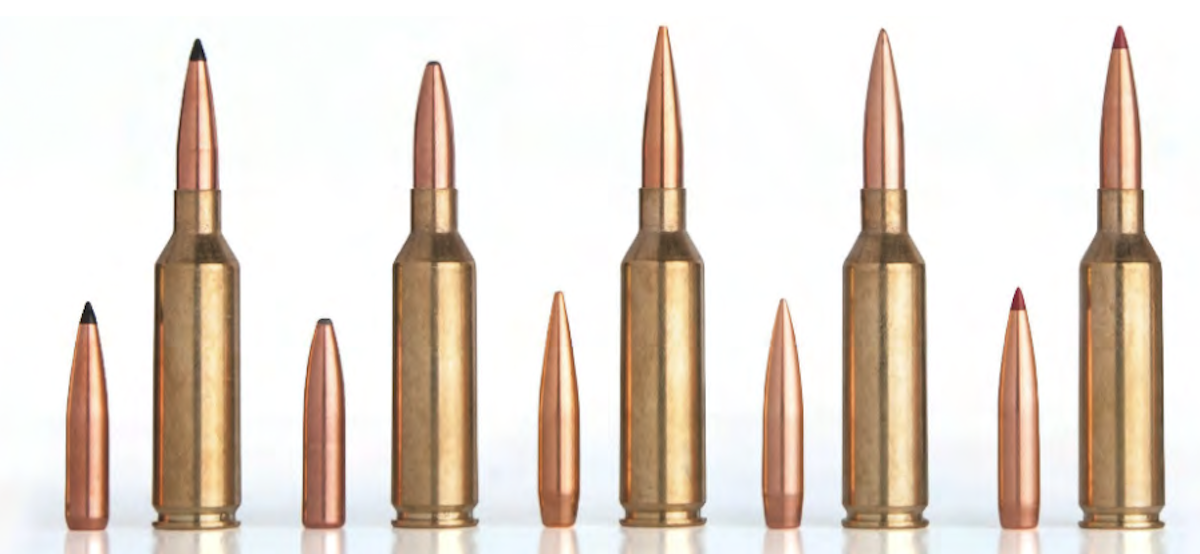
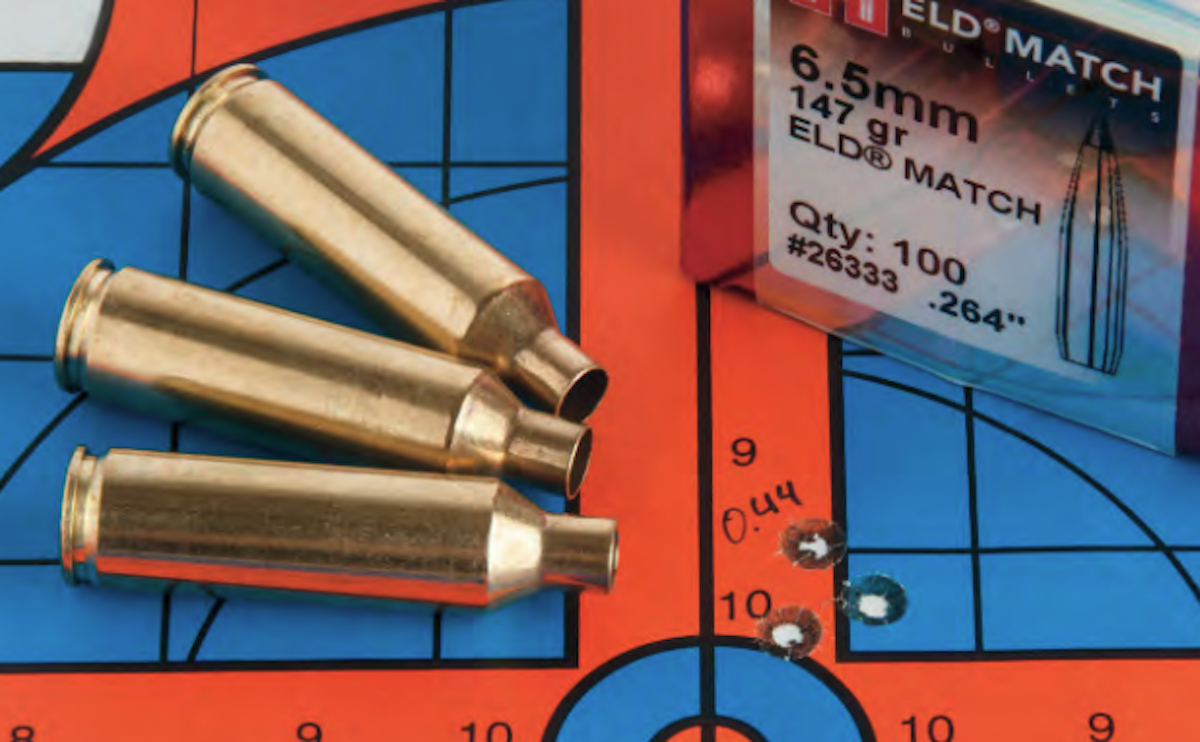
Although it’s the smallest of the three PRCs, the 6.5 version is no slouch. It’s a zesty modern short magnum in the finest sense of the term and just could be the best all-around deer and sheep cartridge there is.
That said, hunters who regularly use the 6.5 PRC on elk will generally tell you it works fine, but often they wish they had a bit more authority. The cartridge generates about 2,960 fps in velocity and 2,780 ft-lbs of energy at the muzzle with the 143-grain ELD-X, but elk are tough, and the larger frontal diameter and bullet weight and energy payload of the bigger PRCs are more effective.
When handloading the 6.5 PRC, look to propellants in that medium-slow to slow burn rate. Anything from Accurate 4350 up to Retumbo. According to Hodgdon’s Reloading Data site, StaBALL HD, Ramshot Magnum, and Accurate MagPro provide the best velocities with that heavy-for-caliber range of 140- to 156-grain bullets that are so good in 6.5mm cartridges. Depending on the specific weight, expect from 2,850 to 3,050 fps.
If you want to run a light and steamy bullet, 120-grainers do well over Ramshot Grand and Hodgdon Retumbo. Either should get you to 3,150 fps in a 24-inch barrel.
All that said, my favorite go-to powder with all three of the PRCs is Hodgdon’s H1000. Even though it doesn’t always provide the highest speed, it’s still darned fast. More importantly, it’s incredibly consistent and easy to handload for excellent accuracy.
7mm PRC
The 7mm PRC is arguably the most versatile and best balanced of the three PRCs. It’s not too much for whitetail deer, and it’s not too little for Alaskan/Yukon moose. It’s ideal for mule deer, caribou, elk, black bears, mountain sheep, and so forth.
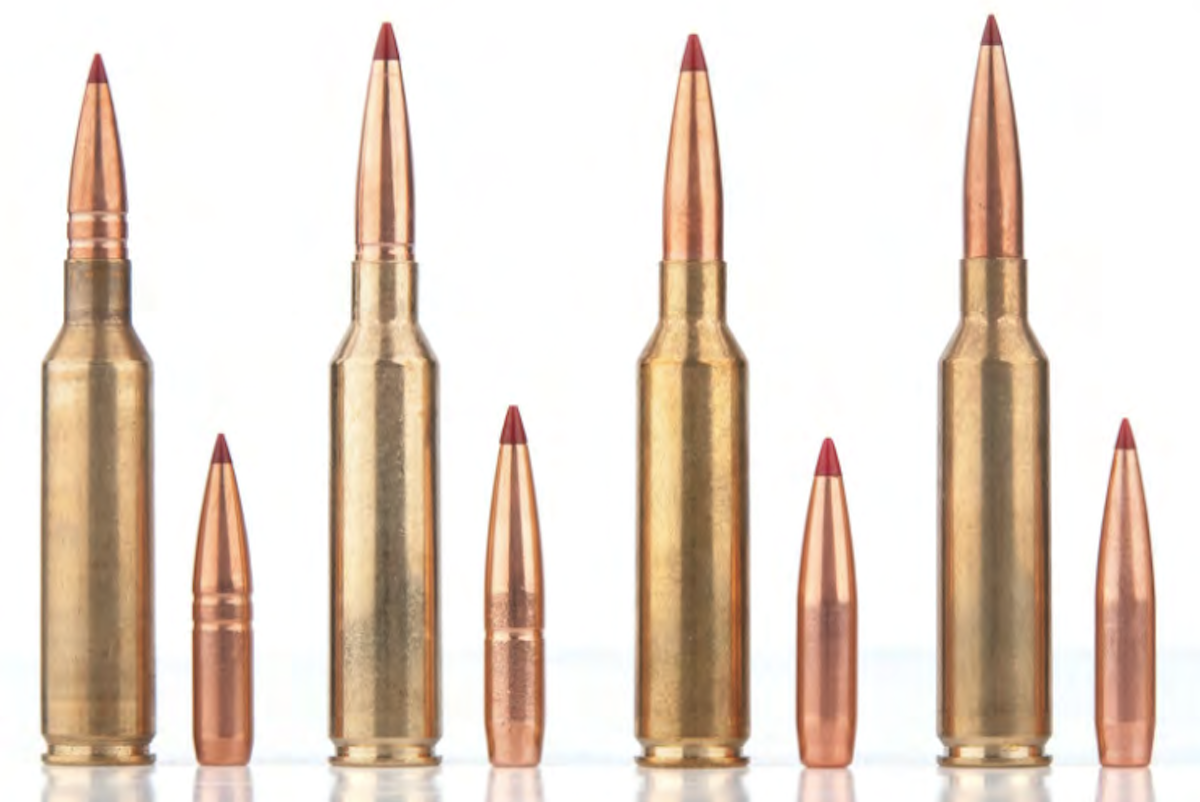
Plus, it technically has the best wind-bucking ability of the three, as well as the best retention of muzzle velocity and energy way downrange. For example, in Hornady’s Match factory ammo the 7mm PRC pushes the highest-ballistic-coefficient bullet, and it does so faster than the 6.5mm and the .30-caliber versions. You can replicate that with handloads. You just can’t argue with a combination of faster and more streamlined.
Of course, we’re mostly handloaders here, so you may be thinking, “Yeah, but I can actually outdo that with my handloads.”
You could be right, but keep in mind that Hornady’s very savvy engineers optimized each PRC with the best load they could devise for it—and they have a lot more resources than you and I have.
What propellants are best in 7mm PRC handloads? Glad you asked. I got my first one six months before the cartridge launched, and my daughter Audrey was the first person to take a big-game animal with it—a 5.5-foot Idaho black bear shot across a canyon. She used handloaded Hornady 150-grain CX bullets, the 160-grain versions weren’t out yet, over H1000 powder. As I mentioned in the section on the 6.5 PRC, H1000 is my go-to favorite with all three PRCs, and I believe it’s particularly good with shorter-than-standard barrels. That 7mm PRC rifle Audrey used has a 20-inch barrel, and we get impressive speeds from it with H1000.
It’s worth noting that Accurate MagPro and Ramshot Grand are particularly good if you want the most velocity possible with 160-grain and lighter bullets. Zesty charges will generate between 3,000 and 3,100 fps. However, my much-loved H1000 is nearly as good as it gets with 168-grain bullets, which is a rather magic weight in the 7mm, producing north of 3,000 fps in 24-inch barrels.
When stepping up to the heavies that the 7mm PRC is so incredible with, Ramshot Grand, Accurate MagPro, and Hodgdon Retumbo rule. And if you really want projectile weight, push Berger 195-grain EOLs over Ramshot Grand. You can achieve 2,900 fps with a 24-inch barrel.
The 7mm PRC’s balance of velocity, bullet weight, aerodynamic efficiency, and downrange energy makes it a standout all-around hunting and precision cartridge.
300 PRC

When you want to turn a bull elk’s knees to jelly or tip over a bull moose with profound effect, this is your PRC. It’s the freight train of modern cartridges.
Engineered to fire bullets weighing from 190 to 250 grains, the 300 PRC is potent in all ways. It’s good at extreme ranges. It absolutely wallops game, both close and far away. It kicks hard and clobbers shooters, too, thanks to the very heavy bullets it fires. Most 300 PRC shooters tame their rifles with muzzle brakes or suppressors.
Since I believe there’s no such thing as overkill, you can’t kill an animal too dead, I’d use the 300 PRC on pronghorn antelopes, Coues deer, and small Southern whitetails without hesitation. However, it really comes into its own on elk-size game and bigger. The 7mm PRC is good at dropping elk, but the 300 PRC is great at taking elk. A professional elk guide acquaintance of mine keeps a custom 300 PRC in his truck, ready to loan to clients who can’t get the job done with their own rifle. His rifle has a good suppressor on the muzzle and is easy to shoot well. It’s turned a lot of elk into steaks and roasts. If I were an Alaskan or Canadian resident and hunted moose and grizzlies regularly, of the three PRCs, this is by far the best choice.
Hornady’s factory ammo utilizes a 190-grain CX in the Outfitter line, a 212-grain ELD-X in the Precision Hunter line, and a 225-grain ELD Match in the target line. All are terrific loads, but handloaders have a vast spectrum of great projectiles to choose from. A personal favorite is Barnes’s 208-grain LRX, which features state-of-the-art engineering for best-in-class aerodynamics among monometal bullets. I load it over H1000 and get near-half-MOA accuracy in a 6.75-pound, with scope, Proof Research Glacier Ti rifle.
According to Hodgdon’s data, 150-grain bullets, such as Swift’s Scirocco II, can be driven to more than 3,400 fps using Ramshot Grand powder. That’s pretty spicy and should turn out a deer’s lights like flipping a switch. I’ve never tried light-for-caliber bullets in the 300 PRC because when I’m hunting with mine I want all the heavy magnum performance I can get—and that means picking heavy bullets.
If speed is your end goal, projectiles in the 180- to 190-grain range are best matched with slow-burning double-based propellants like Ramshot LRT, Grand, and Magnum. These should produce 3,000 to 3,150 fps.
Although you give up a bit of pure speed, Hodgdon’s Extreme powders, including H1000 and Retumbo, are perhaps a bit easier to tune for accuracy—at least in my experience.
With proper heavy-for-caliber bullets ranging from 200 to 230 grains, opt for H1000, Retumbo, Grand, and Winchester StaBALL HD. They should generate 2,800 to 2,900 fps in a 24-inch barrel, depending on bullet weight.
For the extreme-weight 245- and 250-grain .30-caliber bullets, try US 869, Grand, and StaBALL HD.
You may have noted that all three PRC cartridges like the same propellants, and they are in that medium-slow to slow burn rate category that’s so good at achieving excellent velocity along with first-rate accuracy in efficient magnum cartridges. This little fact makes it really easy for a handloader set up for one PRC to readily adopt another PRC.
Although each of the three PRC cartridges is distinctly different in what they’re good at, they all share certain characteristics. They’re well-balanced and are optimized for long range. In order to accomplish this, they’re designed for fast-twist rifling and feature plentiful head height and minimum chamber tolerances. Plus, they are reasonably efficient.
Whether in long-range competition, or shooting elk across a canyon, or walloping a distant whitetail, or just ringing long-distance steel gongs, the three PRC cartridges are simply incredible.
Whether in long-range competition, or shooting elk across a canyon, or walloping a distant whitetail, or just ringing long-distance steel gongs, the three PRC cartridges are simply incredible.
PRC Load Data
| Case | Primer | Powder | Charge (grs.) | Bullet | COL (in.) | Vel. (fps) | E.S. (fps) | S.D. (fps) | 100-Yd. Acc. (in.) |
|---|---|---|---|---|---|---|---|---|---|
| 6.5 PRC, 22-in. Barrel | |||||||||
| Lapua | Fed. GM210M | Grand | 59.0 | Hornady 147-gr. ELD-M | 3.020 | 2791 | 23 | 9 | 0.56 |
| 6.5 PRC, 24-in. Barrel | |||||||||
| Hornady | CCI LR BR-2 | IMR 7828SC | 55.0 | Swift 130-gr. Scirocco II | 2.915 | 3084 | 45 | 13 | 0.97 |
| Hornady | CCI LR BR-2 | H1000 | 58.3 | Berger 140-gr. VLD-H | 2.985 | 3058 | 54 | 21 | 0.38 |
| Hornady | CCI LR BR-2 | H1000 | 57.0 | Swift 140-gr. A-Frame | 2.780 | 2966 | 62 | 19 | 1.28 |
| Hornady | CCI LR BR-2 | H1000 | 56.5 | Sierra 142-gr. MatchKing | 2.975 | 3064 | 61 | 28 | 0.83 |
| Hornady | CCI LR BR-2 | H1000 | 57.5 | Hornady 147-gr. ELD-M | 2.985 | 3008 | 14 | 6 | 0.41 |
| 7mm PRC, 20-in. Barrel | |||||||||
| Hornady | Fed. GM215M | H1000 | 72.0 | Hornady 150-gr. CX | 3.210 | 3054 | 9 | 4 | 0.67 |
| Hornady | Fed. GM215M | H1000 | 67.5 | Hornady 175-gr. ELD-X | 3.350 | 2794 | 38 | 14 | 0.74 |
| Hornady | Fed. GM215M | H1000 | 70.0 | Hornady 180-gr. ELD Match | 3.375 | 2895 | 11 | 6 | 0.42 |
| 7mm PRC, 22-in. Barrel | |||||||||
| Hornady | Fed. GM215M | Grand | 69.0 | Barnes 168-gr. LRX | 3.260 | 2852 | 28 | 11 | 0.65 |
| Hornady | Fed. GM215M | MagPro | 68.0 | Nosler 175-gr. Partition | 3.240 | 2810 | 29 | 9 | 0.53 |
| Hornady | Fed. GM215M | MagPro | 70.0 | Nosler 175-gr. Partition | 3.240 | 2935 | 38 | 12 | 0.91 |
| Hornady | Fed. GM215M | MagPro | 68.0 | Berger 180-gr. VLD Hunting | 3.330 | 2745 | 40 | 14 | 0.50 |
| Hornady | Fed. GM215M | MagPro | 71.0 | Berger 180-gr. VLD Hunting | 3.330 | 2920 | 39 | 14 | 1.19 |
| 300 PRC, 24-in. Barrel | |||||||||
| Hornady | Fed. GM215M | H1000 | 83.0 | Barnes 175-gr. LRX | 3.550 | 3212 | 38 | 13 | 0.69 |
| Hornady | Fed. GM215M | H1000 | 79.0 | Barnes 200-gr. LRX | 3.550 | 3007 | 22 | 7 | 0.43 |
| Hornady | Fed. GM215M | H1000 | 79.0 | Federal 200-gr. Terminal Ascent | 3.550 | 3022 | 16 | 5 | 0.71 |
| Hornady | Fed. GM215M | IMR 8133 | 81.5 | Federal 200-gr. Terminal Ascent | 3.570 | 2971 | 30 | 13 | 0.75 |
| Hornady | Fed. GM215M | H1000 | 78.0 | Nosler 200-gr. AccuBond | 3.550 | 2905 | 44 | 13 | 0.64 |
| Lapua | Fed. GM215M | Grand | 80.5 | Berger 205-gr. Elite Hunter | 3.550 | 2858 | 50 | 22 | 1.07 |
| Hornady | Fed. GM215M | H1000 | 78.0 | Barnes 208-gr. LRX | 3.750 | 2946 | 35 | 12 | 0.55 |
| Hornady | Fed. GM215M | Retumbo | 82.0 | Sierra 210-gr. MatchKing | 3.650 | 3019 | 14 | 6 | 0.86 |
| Hornady | Fed. GM215M | H1000 | 79.0 | Hornady 212-gr. ELD-X | 3.690 | 2968 | 17 | 8 | 1.00 |
| Hornady | Fed. GM215M | H1000 | 79.0 | Hornady 225-gr. ELD Match | 3.690 | 2892 | 18 | 6 | 0.66 |