
Revisiting the 257 Roberts on its 90th birthday is a great way to remind us just how great this cartridge is.
By the 1920s and ’30s, development of modern smokeless propellant cartridges was in full swing. And just like in recent years, not all the activity was occurring in the major ammunition manufacturers’ facilities. Independent riflemen and handloaders like Newton, Niedner, Mann, Gipson, Lindahl, Whelen, and other like-minded fellows vigorously pursued efforts to improve their rifles’ ballistic performances. Bolt-action rifles, war-proven to be inherently stronger and more reliable, also had claimed center stage in the sporting arms marketplace.
Among the other enterprising fellows trying to create ever “better” hunting cartridges was Major (ret.) Ned H. Roberts. Recognized by his peers as a diligent experimenter, Roberts focused on the .25-caliber (i.e., quarter-bore) cartridge. He, with advice from Mann and Niedner, test-fired thousands of rounds in multiple barrels chambered and rifled in yet another slightly different configuration. Whereas Niedner and Mann worked with the 30-06 as the parent case, Roberts chose the 7mm Mauser because its reduced case capacity was similar to that of the venerable 30-40 Krag.
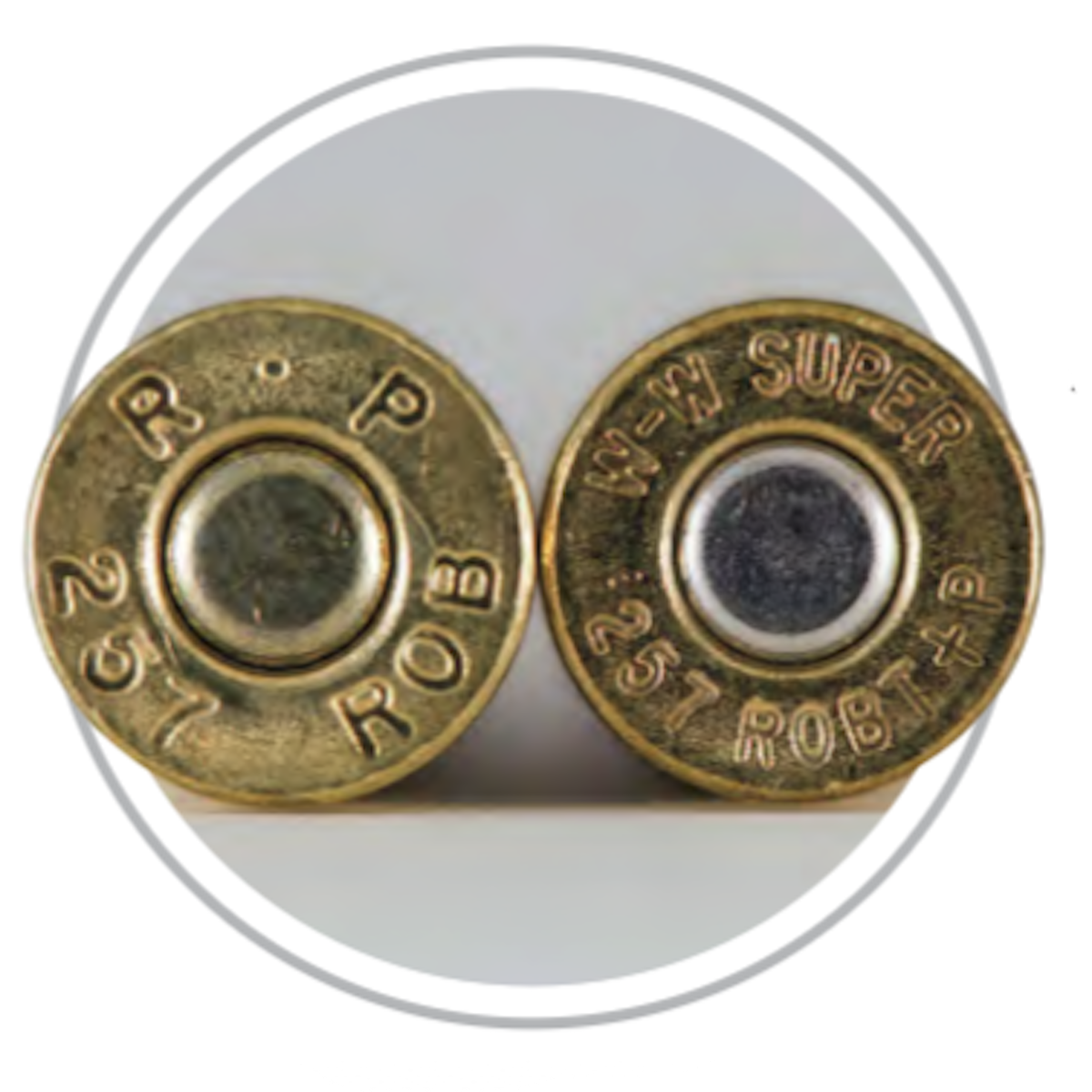
By the late 1920s, he was satisfied with his wildcat cartridge, which was known as the 25 Roberts. His handloads used the same 87- and 100-grain bullets that topped the popular 250-3000 cartridge Newton had developed for Savage a few years earlier. However, because the 25 Roberts had a little greater case capacity, it could achieve about 5 percent more velocity. Griffin & Howe and other custom makers built an estimated 600 25 Roberts-chambered rifles before Remington adopted the wildcat as a factory round in 1934.
To improve its manufacturing capability, Remington’s engineers made modest changes to Roberts’s case design. A slightly sharper shoulder angle and reduced body taper precluded chambering the new cartridge in the earlier custom rifles. The marketing gurus also changed the name to 257 Remington-Roberts to further distinguish the factory round from the 25 Roberts wildcat cartridge.
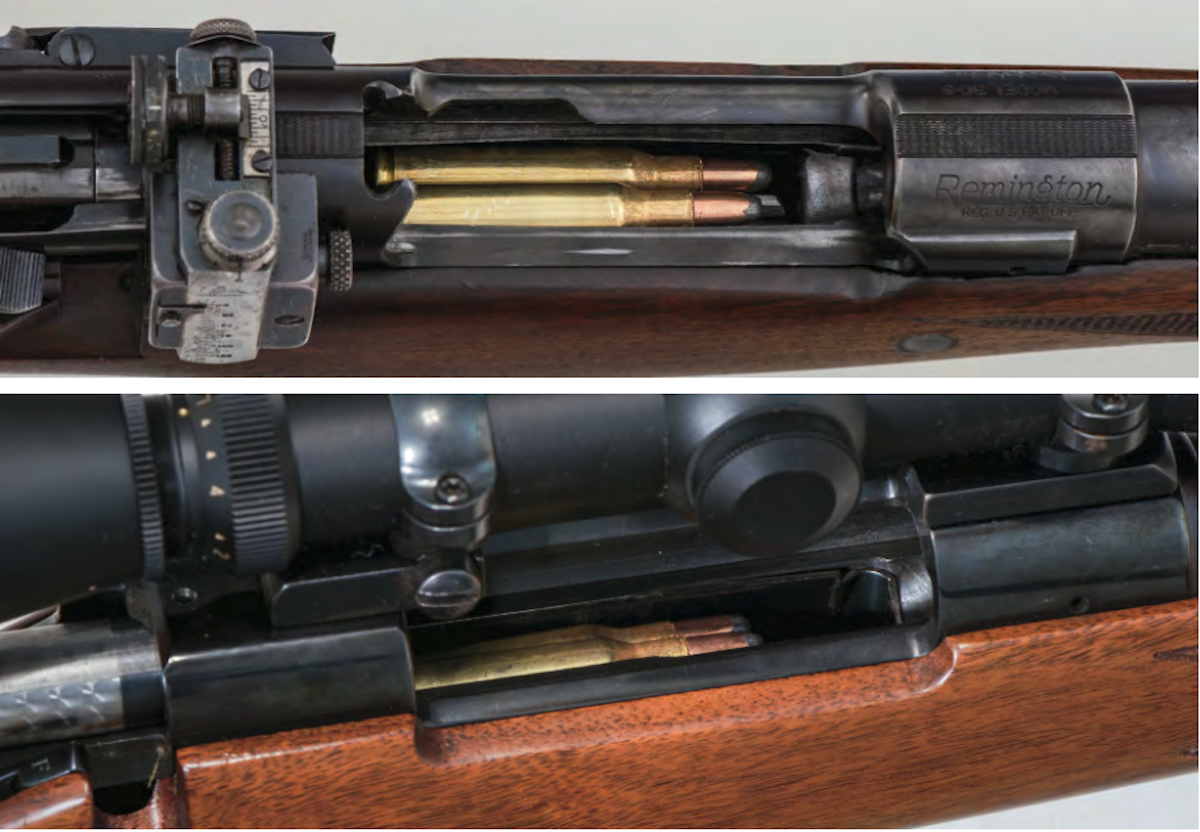
Remington chambered the updated Model 30-S Express rifle in 257 Remington-Roberts. The earlier Remington Model 30 was a refined, sporting version of the P17 30-06 bolt action manufactured for our “doughboys” fighting World War I in Europe. I purchased a Model 30-S Express rifle chambered in 257 Roberts through Guns International, intending to use it for working up the handloads in this report. It’s fitted with a factory-installed Lyman 48R adjustable aperture rear sight on the receiver instead of the typical notched blade rear sight dovetailed into the barrel. The barrel is 22 inches long and measures 0.600 inch in diameter at the muzzle. As noted earlier, the action is based on the P17 30-06 rifle, but the blocked magazine and short throat/leade allow using only S.A.A.M.I.-standard (2.750-inch COL) rounds. The action was modified in the past to accommodate a side-mounted scope, but the rifle retains the P17’s two-stage military-style trigger.
Winchester soon followed Remington’s lead and added the new round as an option in their 1903 Springfield-derived Model 54. When the Model 54 was superseded a couple years later by the improved Model 70, the 257 Roberts remained on the available cartridges list. An interesting aside, the then-new round was also listed in period ammunition catalogs as the 257 Winchester-Roberts.
For reasons now lost to obscurity, the original 257 Roberts loading was unduly burdened with three features that singly and altogether severely curtailed its ballistic performance. Ned Roberts had loaded only roundnose bullets because there were no accurate pointed bullets available. Remington’s stubby 117-grain RN bullet copied his lead. Although Roberts modeled the round after the 7mm Mauser with a cartridge overall length (COL) of about three inches, the 257 Roberts’s COL is specified as only 2.750 inches. The P17/Model 30 action would accommodate the 30-06’s COL of 3.25+ inches; however, the Model 30-S Express magazine is blocked at the rear for the shorter 257 Roberts round.
Finally, the maximum average pressure (MAP) of the Roberts round was specified as the same as the 250-3000 Savage at only 45,000 CUP (approximately 54,000 psi). That’s about 10 percent less than other period “modern” rifle cartridges, including the 30-06 and the 270 Winchester. Ostensibly, that reflects a cautious step to avoid damaging future custom rifles chambered for the factory version since the new round wouldn’t fit the already existing custom rifles.
Who knows?
Remington offered three bullet options in 257 Remington-Roberts ammo. The 87- and 100-grain jacketed softpoints were the same as the 250 Savage. The 117-grain bullet, similar to the 25 Remington and 25-35 WCF loadings, was the third choice. Muzzle velocities modestly exceeded the 250 Savage by 100 to 200 fps. The 117-grain bullets achieved about 2,800 fps, which was more than adequate for deer, antelopes, black bears, and similar size big game. As Whelen’s comment suggests, the 257 Roberts gained many followers during the next 20 years. It also had a popular nickname—the “257 Bob.”
Of course, we firearms enthusiasts are often fickle, and allegiances change quickly—especially when popular gun scribes inform us that we can’t do without this or that latest new item. When the 243 Winchester and 244 Remington rounds were introduced in the mid-1950s, the popularity of the 257 Roberts and the 250 Savage began to wane. For anyone who doesn’t know, the 244 is simply a necked-down Roberts case, and the 243 is a necked-down 308 Winchester case.
Although both were limited to firing 90/100-grain maximum weight bullets, the MAP for both was significantly greater (approximately 60,000 psi), so they could closely duplicate (and even exceed) the ballistic performance of the 257 Roberts. In 1974 S.A.A.M.I. removed one yoke by approving the +P version of the 257 Roberts, and the MAP was bumped up to about 58,000 psi, allowing the 117-grain factory load to achieve a velocity of nearly 3,000 fps. But the round’s too-short COL still restricted using a lower ballistic coefficient roundnose bullet.
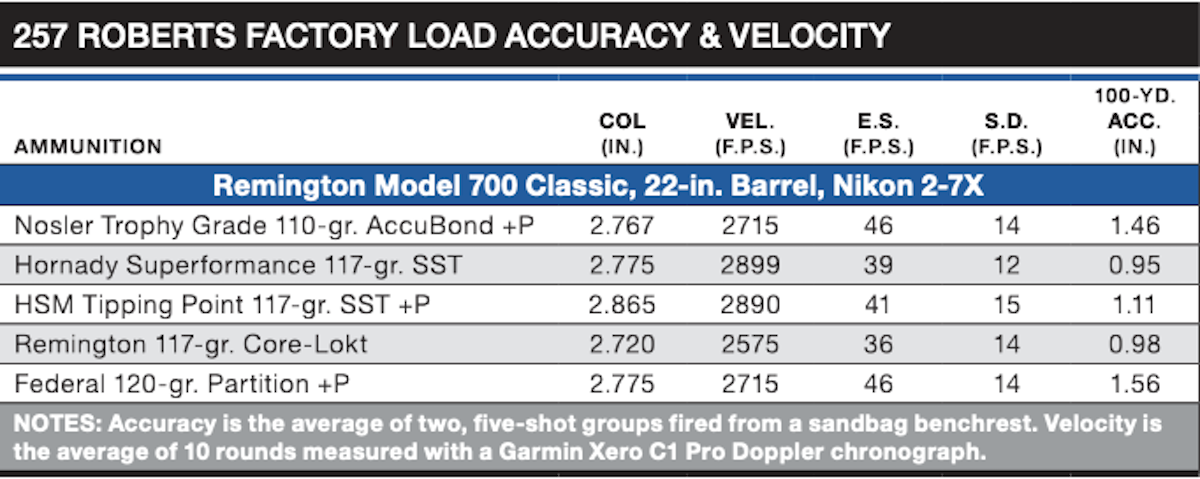
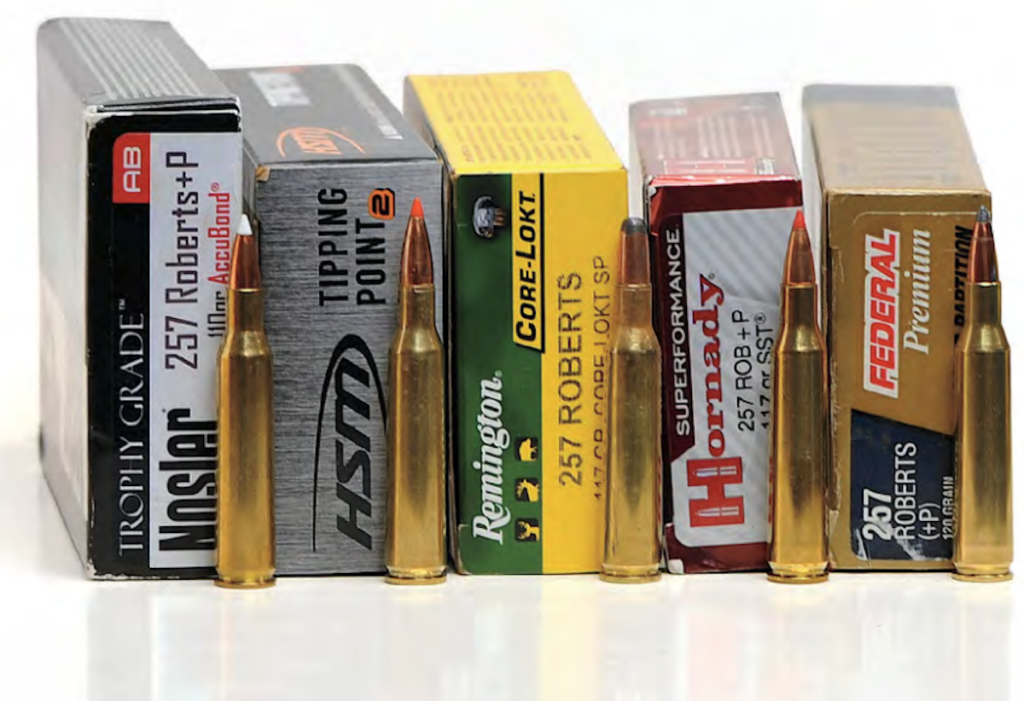
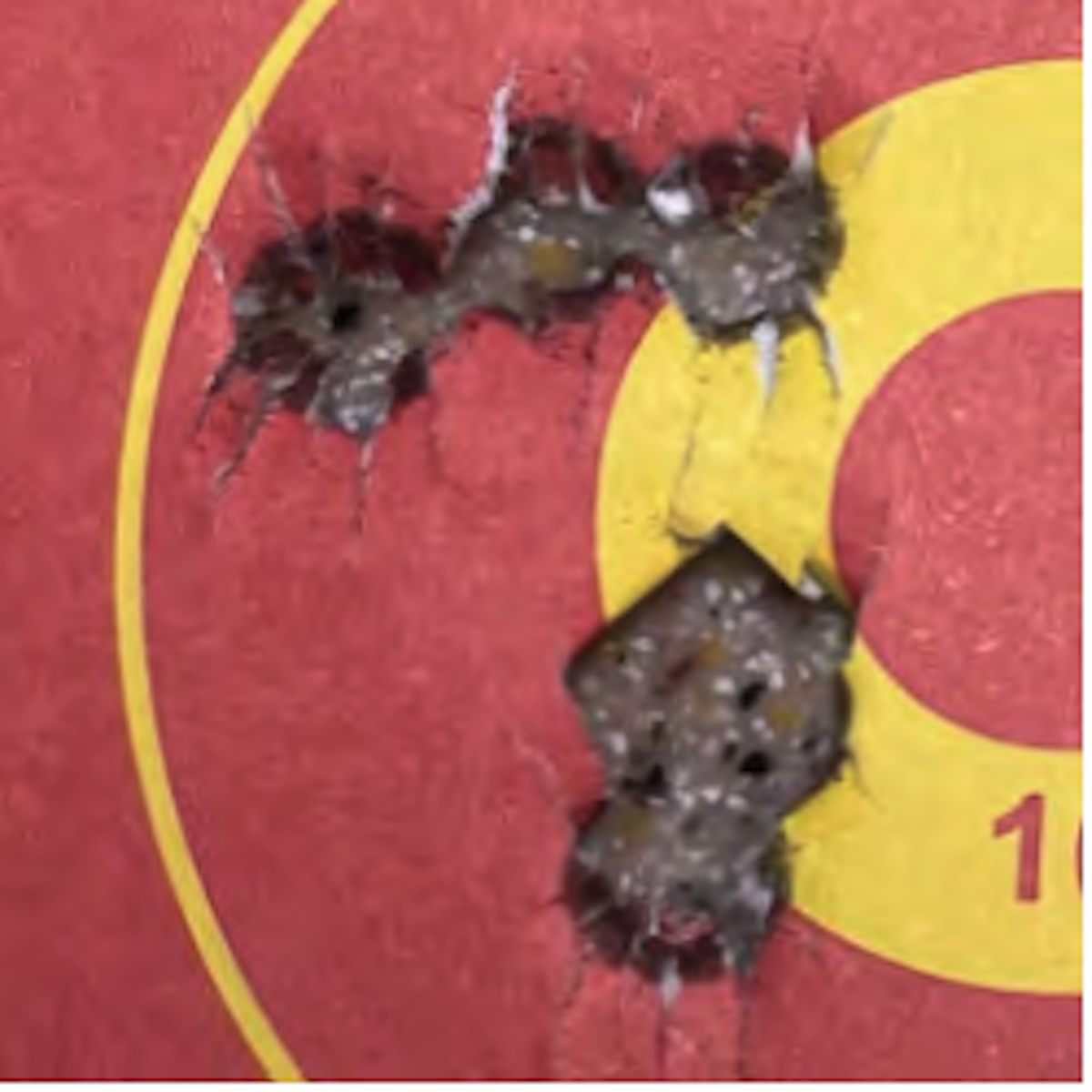
The 87-grain factory load has long since disappeared, and unfortunately, Winchester’s popular 100-grain Silvertip load also has been discontinued. Norma and Nosler offer 100- and 110-grain factory loads, respectively. Remington’s non+P load features the original 117-grain RNSP bullet. Federal only offers custom-loaded, 120-grain Partition ammo. Hornady offers a Superformance load topped with the company’s 117-grain SST bullet. HSM’s factory load also is available with 117-grain Hornady SST bullets. I fired it first for this report in a Remington Model 700 Classic, and its first group for record measured 0.75 inch.
Remington and Winchester made thousands of 257 Roberts rifles up until the 243/6mm prevailed. When Ruger introduced the single-shot No. 1 and bolt-action Model 77 rifles in the late 1960s, they were soon chambered for 257 Roberts in addition to the usual more popular cartridge choices. In recent years, Winchester and Ruger sporadically made short production runs of 257 Bob rifles. Browning and Kimber offered rifles also. Remington made the aforementioned Model 700 Classic rifle in 1982, and luckily, I was able to use Robert “Bob” Hodgdon’s personal Model 700 Classic for this project because his grandson Joel Hodgdon loaned it to me. Can you believe it? I’m shooting Bob Hodgdon’s personal 257 “Bob” rifle.
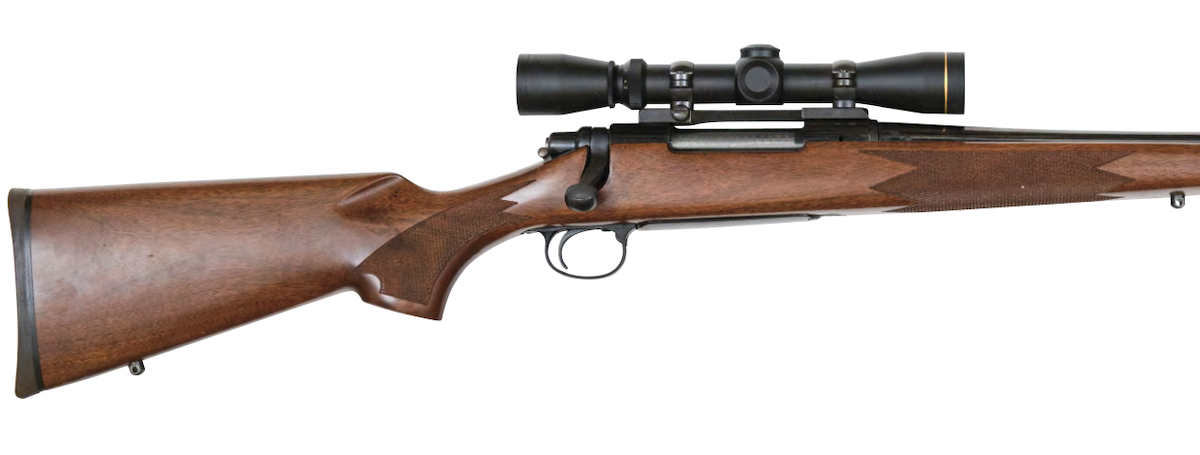
Sans iron sights, the Model 700’s receiver is factory drilled and tapped, so my gunsmith, Isaac Gallagher, supplied a steel, one-piece Redfield base and a pair of one-inch steel rings to mount a Leupold 2-7X 36mm scope. The rifle has a 22-inch barrel, and its diameter at the muzzle is 0.655 inch. The action and magazine follower are standard (30-06) length. It weighs about 8.5 pounds, according to my gauge.
I had intended to use two other bolt-action rifles in my inventory for this project—a Remington Model 722 made in 1954 and a more recent production Ruger Model 77 Hawkeye. The Model 722 only accommodates the stubby-length Roberts cartridges, so substituting the Remington Model 700 Classic was a positive step. The Ruger Model 77 is an unblocked, long action but originally retained the unduly “short” S.A.A.M.I.-standard 257 Roberts chamber throat/leade dimensions. Again, using the Model 700 Classic was the better way to go.
“If I had to of necessity confine myself to one rifle only I would choose it in this caliber.”
The Hunting Rifle by Townsend Whelen, 1940
Handloading Tips
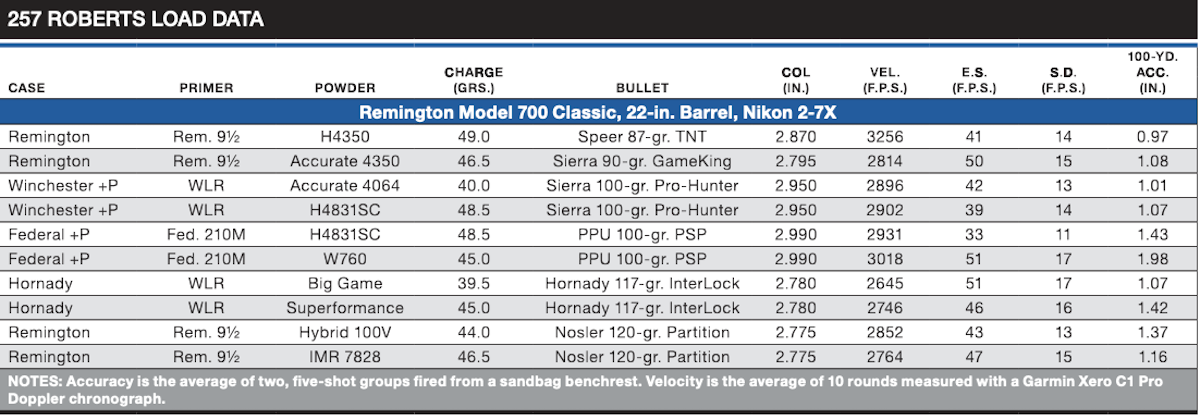
Some scribes report that handloading the 257 Roberts can be finicky. This is likely because most rifles chambered for the round are short actions with 1:10 twist barrels. You’re stymied by both the COL constraint and the reduced spec for MAP, even considering the +P update. In spite of this, you can assemble handloads that will do what Ned Roberts intended his wildcat to do.
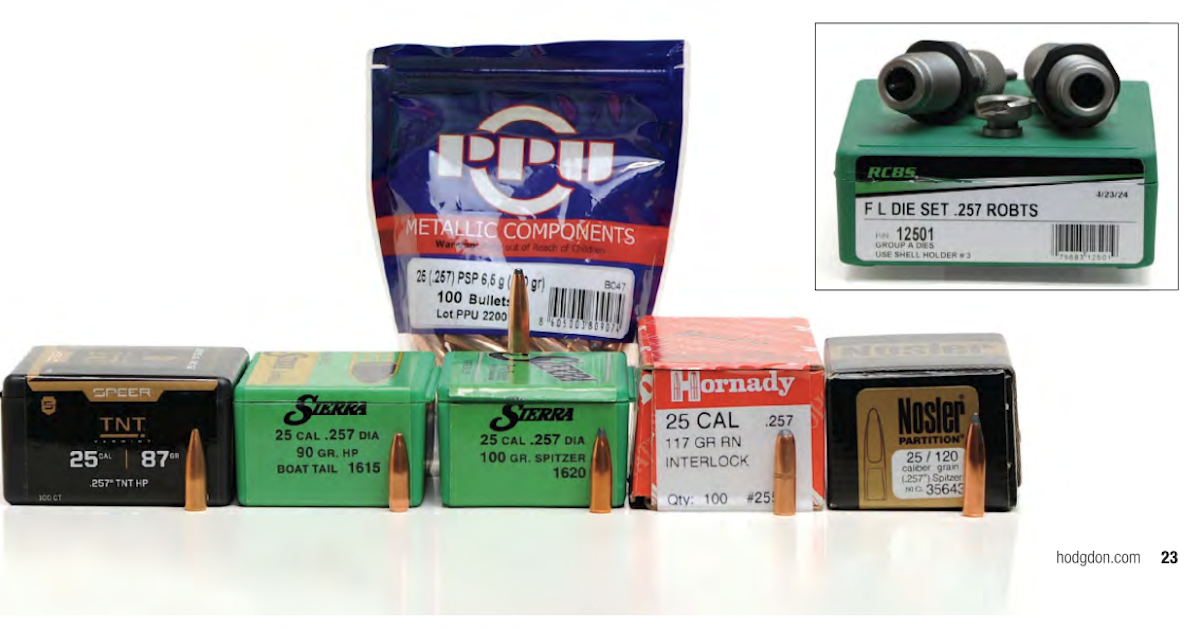
The first step is deciding what you will do with your carefully assembled handloads. Will you be shooting paper targets at the range, helping a land owner get rid of some pests or varmints, or taking your rifle on a long-planned deer/antelope hunt? Just like Roberts’s wildcat and the subsequent factory-loaded ammo, the 257 Roberts is versatile enough to handle any hunting task short of elk and moose and brown bears. The various reloading companies still offer lab-tested data and myriad components to meet any need.
The diemakers also offer excellent tools. I used an RCBS full-length die set to resize the cases and seat the bullets. I usually decap spent primers with a dedicated decapping die before cleaning the fired brass in a Dillon vibratory tumbler filled with Hornady’s corncob media. (It’s the best I’ve ever tried.) I clean inside each case neck with a lightly lubed RCBS case neck brush. I lightly finger-lube each piece of brass with sizing wax before running it into the sizer die that I’ve adjusted to just barely touch the shoulder.
After wiping the sized cases with an old cotton T-shirt to remove the lube, I carefully inspect each primer pocket to make sure all corncob media has been dislodged. This is yet another opportunity to inspect each case for defects. If the neck is split/cracked, the shoulder is dented, or the case body is severely scratched, toss it into the scrap bucket.
Case necks stretch when the round is fired and also when it’s full-length sized, so I measure case length at each load cycle and trim the whole batch when it’s necessary. You don’t want to squeeze the trigger on a handload with a too-long neck. You may not notice the bolt closing a bit too tightly when the case mouth is crimped into the bullet by the chamber, but that surely will cause excessive pressure and adversely affect obtaining consistent velocity and accuracy.
I’m old-school and usually install a simple-to-use RCBS Ram Priming Unit on my Rock Chucker Supreme single-stage press. After adjusting the die body, I can consistently seat each primer to the same depth with minimal effort. As I remove each primed case from the shellholder, I lightly brush the tip of my index finger over the case head to feel if the primer is seated a smidgen below flush. That way, if I should accidently flip the primer in the stem cup and seat it upside down, I’ll catch it and any correctly-oriented-but-protruding primer before charging the case and seating a bullet. If you encounter a loose primer pocket, scrap the case. If you experience several loose pockets when loading a batch of brass, consider scrapping the whole lot and note that you must reduce the powder charge to lower pressures.
I prefer to “throw” powder charges; however, if my mechanical powder measure won’t dispense consistent charges (+/- 0.1 grain) of a certain propellant, I will use an electronic dispenser or simply throw multiple charges and weigh each one on a standalone RCBS electronic scale. If the charge is within range, I pour it through the funnel into a primed case. If it’s too high or too low, I dump it back into the hopper and throw/weigh another one. If you’re doing small batches of a few rounds each of several different component combinations, it’s much faster to use the mechanical measure. When the cases are all charged, I use a small penlight to inspect every one to verify there’s powder present and they all look the same.
Finally, as with any important task, the job’s not done until the paperwork is completed. Keep good records and include load data with each box of handloads. Also keep results from range sessions so you know for sure what worked or didn’t. Buy a chronograph to measure velocities. Between that information and the accuracy results, you have two of the most important factors for achieving the best performance from your firearm. I was an engineer for many years and learned that if you’re not measuring the process, you have little or no chance to manage it.
257 Roberts Ammo and Components
Today, you have to search to find 257 Roberts ammunition and brass. As I mentioned earlier, Hornady, HSM, Nosler, and Remington still make runs of excellent ammo. I checked Graf’s website and noted both Nosler and Winchester offer unprimed cases. Winchester was priced much cheaper, but only the Nosler brass was in stock. You can reform 7mm Mauser and 6mm Remington cases into 257 Roberts cases. I’ve never tried to do so, but they’re also often in short supply. Bullets, primers, and powder are readily available, notwithstanding the recent shortages mostly caused by hoarding.
As you can see in the accompanying chart, the 257 Roberts is a very versatile cartridge—just like Roberts intended. Considering Whelen’s comment, it should be more popular today than it is. If you’re interested in rediscovering a relatively soft-recoiling (less than 12 ft-lbs) compared to a 30-30 (roughly 14 ft-lbs), 270 Winchester (approximately 19.5 ft-lbs), or 30-06 (around 25 ft-lbs), you can find a suitable rifle on the used-gun market.
Unlike Whelen’s declaration from years ago, today, the fickle sporting community has chosen other cartridges as the “best” instead of the 90-year-old 257 Roberts. But know this, even years after he originally made that statement, the 257 Roberts was still one of his two best cartridges. That’s a heck of a declaration from a military officer who cut his teeth on shooting and hunting with Krag and Springfield rifles.
Revisiting the 257 Roberts on its 90th birthday is a great way to remind us just how great this cartridge is.
Factory Load Accuracy & Velocity