Loading these exceptional rounds with Hodgdon, IMR, and Winchester powders increases their versatility.
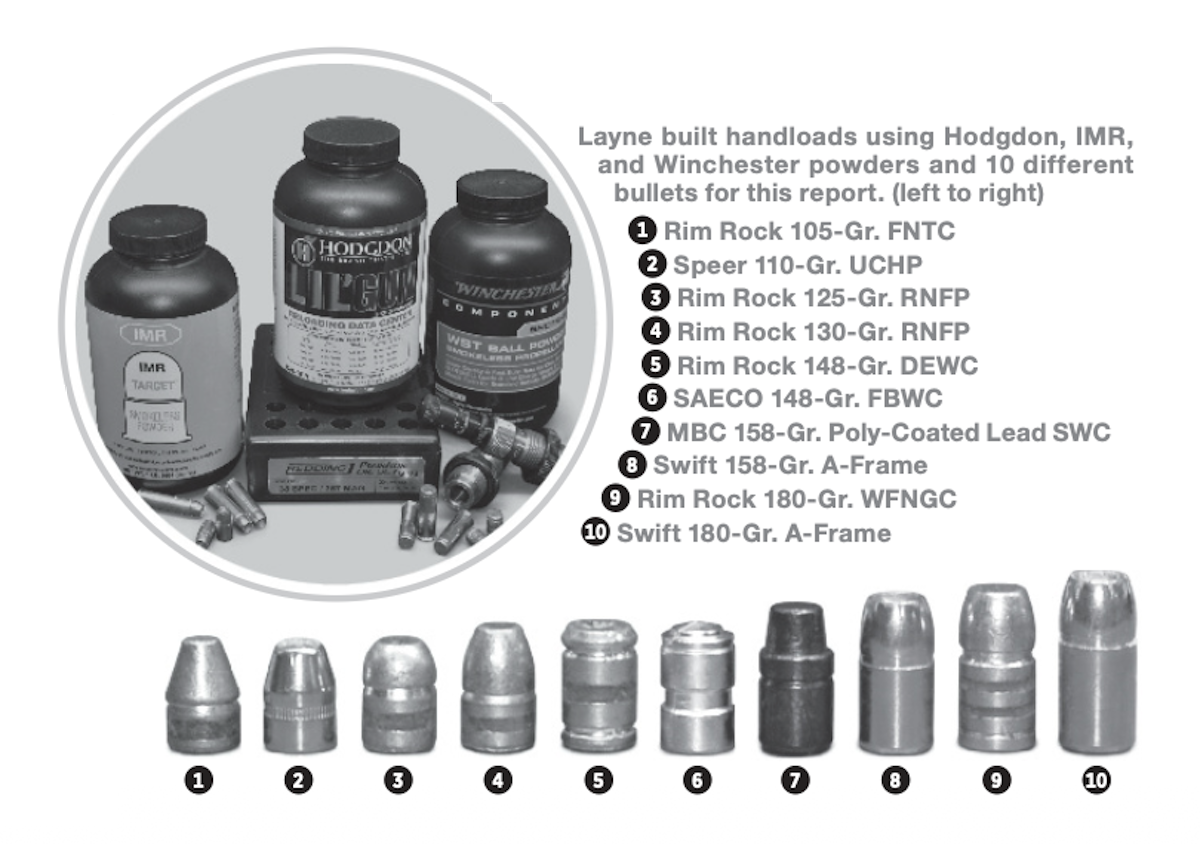
During the Philippine Insurrection of 1899–1902, American soldiers found revolvers in 38 Long Colt to be incapable of consistently stopping suicidal attacks by Moro warriors armed with various edged weapons. While this prompted a return to revolvers in 45 Colt, the Army was still interested in a cartridge of smaller caliber and lighter recoil. With visions of a lucrative government contract, the Union Metallic Cartridge Company (UMC) lengthened the 38 Long Colt case, filled it with black powder, seated a 150-grain lead bullet, and named it the 38 S&W Special. The new cartridge was introduced in 1899 in the Smith & Wesson Hand Ejector double-action revolver, now known as the K-Frame.
While UMC was busy developing the 38 Special, the U.S. Army switched directions by deciding to replace the 38 Long Colt with a cartridge loaded with a bullet similar in diameter to the 45 Colt. A semiautomatic pistol capable of handling such a round was also being considered. John Browning’s design eventually was chosen over several other autoloaders, and in 1911 the Army adopted the Colt Model 1911 pistol chambered for 45 ACP (a.k.a. 45 Auto).
When UMC introduced the first smokeless powder loading of the 38 Special, the velocity of the 158-grain bullet was standardized at 850 fps. Though the cartridge never managed to gain military cartridge status, it was popular through the decades among soldiers and pilots during various conflicts, with some purchasing their own sidearms. The 38 Special reached its peak in popularity during an era when revolvers chambered for it were standard issue among just about every law enforcement agency in the United States.
Then came high-capacity pistols in 9mm Luger. And just when the 38 Special appeared down for the final count, Smith & Wesson came to the rescue in 1950 by designing the small J-Frame Chiefs Special revolver around the cartridge. Many thousands of small revolvers have since been sold by S&W and other companies who hopped aboard the 38 Special pocket-gun express. The fact that the 38 Special can be fired in revolvers chambered for the 357 Magnum also has contributed to its survival.
Let’s move now to what was once considered the world’s most powerful handgun cartridge. The 357 Magnum case is a slightly lengthened 38 Special case. Introduced in 1935, it was Smith & Wesson’s response to the 38 Super semiautomatic pistol cartridge developed by Colt six years earlier. Tests had revealed that a bullet of reasonable weight had to be launched at a minimum speed of 1,300 fps in order to reliably punch through a door of the thick-skinned automobiles built in those days and still have enough power remaining to cancel the tickets of hoodlums riding inside. The 38 Super and 357 Magnum did just that and were also capable of penetrating military-surplus armored vests often worn by bad guys. One of the first S&W revolvers built in 357 Magnum was presented to FBI Director J. Edgar Hoover. Philip Sharpe, who was instrumental in the development of the cartridge, also received one of the first guns.
Remington and Winchester ammo was initially loaded with 158-grain lead bullets. The bullet of the “Metal-Piercing” load was also lead but with a pointed steel cap on its nose. Developed for law enforcement officers on roadblock duty, it was commonly referred to as the Highway Patrol load. There was a time when it was commonly believed that a bullet fired from the 357 Magnum into the engine of an automobile would bring it to a screeching halt.
Years ago a hunting buddy and I decided to find out if the claim was fact or fiction. The farm on which he lived had several abandoned cars, so we pitted my Ruger Blackhawk against the engine of a rusted-out Nash Rambler. One of my uncles had a box of cartridges loaded with the metal-piercing bullet, and he donated a few rounds for our “highly scientific” test. We already had Remington and Winchester ammo loaded with the plain 158-grain bullet.
Imagine our disappointment when not a single bullet managed to punch through the water jacket of the Nash engine. Splashes of lead on rusty steel were the only evidence that two young firearm enthusiasts had been there. To paraphrase a popular TV program of today, one 357 Magnum myth got busted long ago, out behind a barn in rural America.
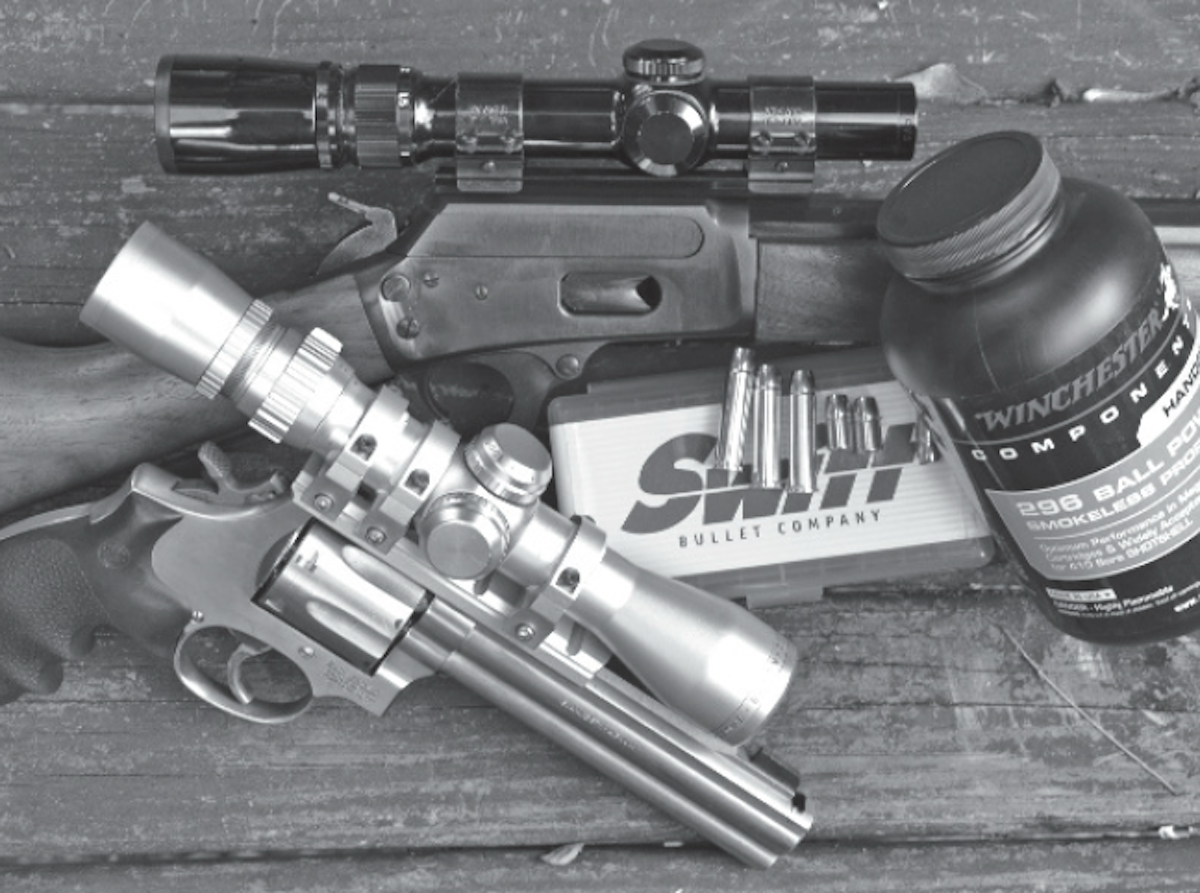
America’s first magnum revolver cartridge was also promoted for hunting deer and other big game. During the 1930s, Maj. Douglas Wesson, who was a grandson of Smith & Wesson co-founder Daniel B. Wesson, used a Smith & Wesson 357 Magnum revolver with an 8.75-inch barrel on highly publicized hunts in Wyoming and Canada for moose, elk, grizzly bear, and pronghorn antelope. Two shots were required to bag the antelope at 200 yards, but the others were said to be one-shot kills. Winchester and Remington loaded the 158-grain bullet to just over 1,500 fps for more than 800 foot-pounds of energy, not too far behind some of today’s 44 Magnum ammunition. Velocity of the 357 Magnum was later reduced to the current 1,250 fps for 550 ft-lbs of energy.
Big-Game Hunting
During the 1960s, I used a Ruger Blackhawk in 357 Magnum to bag several deer with all but one standing inside 100 yards. An S&W Model 29 in 44 Magnum eventually became my primary venison harvester, but I continued to use the 357 Magnum when chasing feral hogs with hounds. A 146-grain half-jacket hollowpoint made by Speer in those days worked fine on deer, and it proved to be enough for up-close shots on pigs ranging in size from small to medium. But when distance was increased to 50 yards or so and the target was a big hog with a thick gristle plate covering its shoulder area, a stouter bullet with a bit more weight was required.
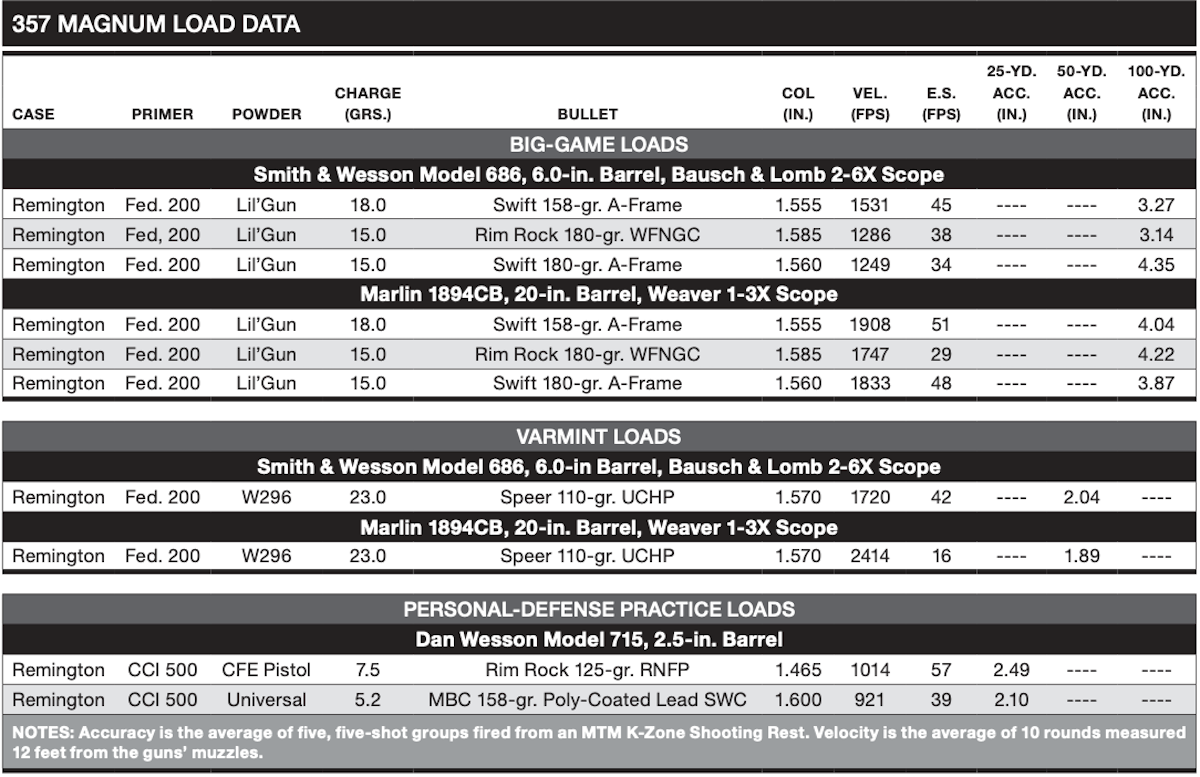
A semiwadcutter weighing around 170 grains cast of scrap wheelweight metal with Lyman’s No. 358429 mold and loaded to 1,250 fps consistently dropped hogs with a shot through the shoulders. It is still a great bullet, but unfortunately, that mold went astray, and I have never gotten around to replacing it. Today, I often load Swift 180-grain A-Frame and Rim Rock 180-grain hard-cast bullets, the latter a gascheck design with a wide, flat nose. IMR 4227, Lil’Gun, H110, and W296 are the powders to use for full-power 357 Magnum hunting loads.
Varmint Hunting
Coyotes in my area prefer to hang out in thickly wooded country due to the protective cover and an abundance of rabbits, squirrels, and other tasty tidbits. When a hungry yodel dog simply cannot resist trotting in to my ancient but still effective Burnham Brothers C-3 long-range call for an easy meal, shots are usually inside 50 yards, and that makes a handgun or a lever-action rifle in 357 Magnum great fun to use. I also enjoy stalking along hedgerows and taking groundhogs up close with the 357 Magnum.
While a 110-grain hollowpoint is ideal, its extremely short, full-diameter shank offers very little gripping area for the case. When a roll crimp alone is not enough to prevent bullet creep due to recoil, a smaller expander plug is an easy solution. I used a micrometer to measure those in 38 Special/357 Magnum dies from Redding and RCBS, and both were 0.3554 inch, which is only 0.0016 inch smaller than nominal jacketed bullet diameter. Buying a second expander plug, chucking it in an electric drill, and using fine abrasive cloth to reduce its diameter to 0.353 inch usually does the trick. If not, continue taking it on down until bullet creep ceases.
My favorite guns for up-close varmints today are an S&W Model 686 with a 5.0-inch ported barrel wearing a faithful old Bausch & Lomb 2-6X scope and a Marlin 1894 Cowboy lever action with a 20-inch barrel wearing a Weaver K3 1.5-4X scope. Wile E. Coyote absolutely hates both guns.
Bullseye Competition
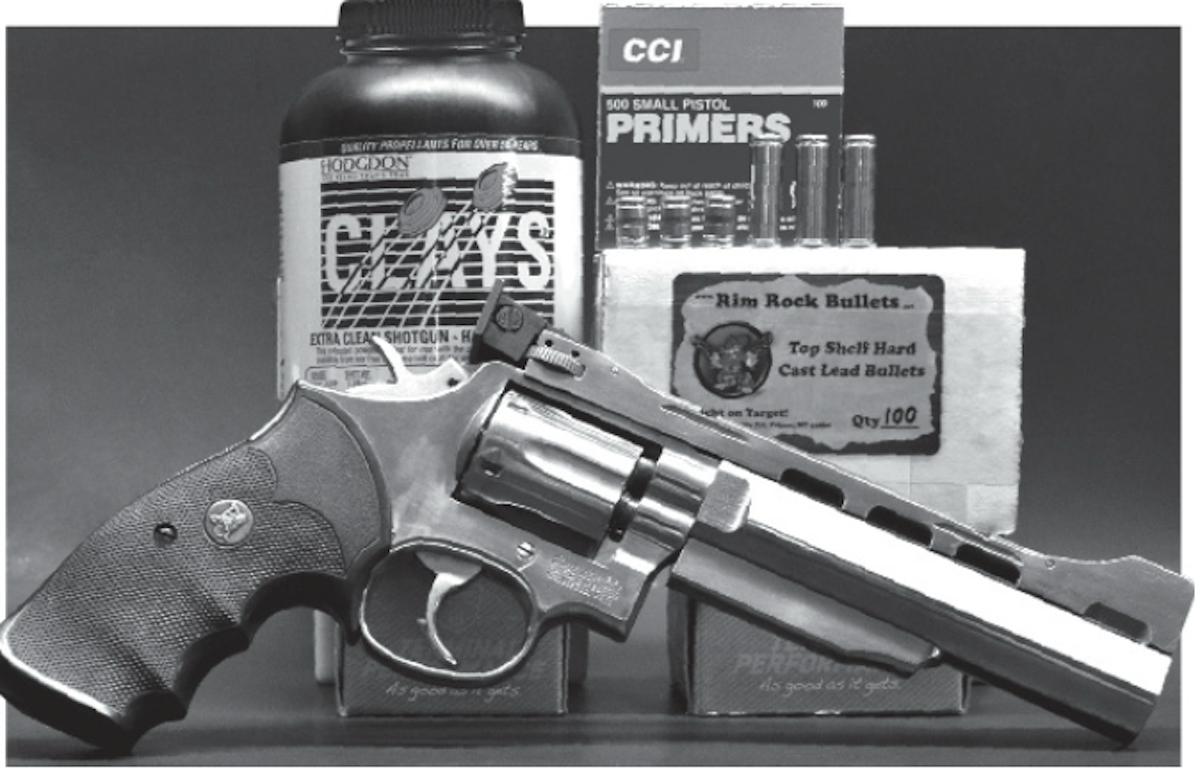
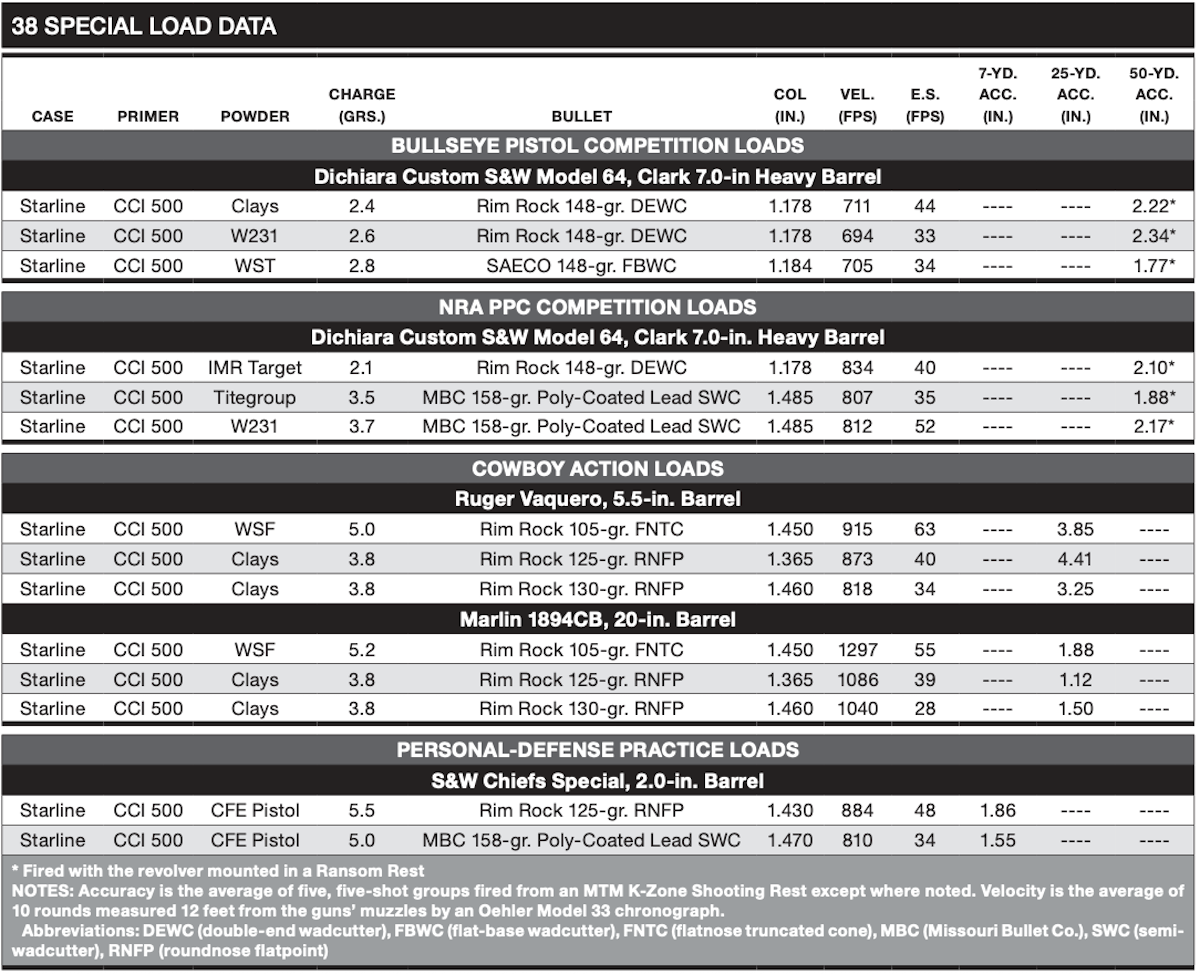
Rules for this mentally demanding shooting sport are quite simple. While standing at the firing line, you hold a pistol in one hand and fire five- or 10-shot strings at 25-yard and 50-yard targets. Slow-fire at 50 yards requires 10 shots in 10 minutes. Timed-fire at 25 yards is five shots in 20 seconds. When shooting rapid-fire at 25 yards, you have 10 seconds to squeeze off five rounds. Repeat those exercises several times, and you have fired an entire match.
The categories of handguns in Bullseye matches are “22 Rimfire,” “Any Centerfire” (.32 caliber or larger), and “45 ACP.” In the old days, Gertrude Backstrom, Bob Chow, Gil Hebard, and many other champions used revolvers in 38 Special for the “Any Centerfire” event. Lead-alloy wadcutter bullets weighing from 140 to 150 grains have long been used in this game because the uniform, full-diameter holes they cut in paper targets make for accurate scoring. Velocity is in the 700-fps to 800-fps range, with most competitors using the same load at 25 and 50 yards. Due to the low chamber pressures, fairly soft cast bullets in the neighborhood of 12 BHN sometimes deliver better accuracy than harder bullets because they better obturate for a snug fit with a handgun barrel.
In the old days, slow-fire scores shot with a revolver were often better than with Model 1911 pistols in 45 ACP, but the autoloader had an edge in the rapid-fire event. In 1964 members of the Advanced Marksmanship Unit at Fort Benning, Georgia, came up with a semi-rimmed version of the 38 Special case called the 38 A.M.U. Loaded by Remington for the Army team, it used the same 148-grain wadcutter as the standard 38 Special match loads. Colt made the Model 1911 pistols chambered for it.
Along about the same time, ace Bullseye competitor and pistolsmith Jim Clark figured out a way to make the Model 1911 pistol function reliably with 38 Special wadcutter ammunition. Soon thereafter, Smith & Wesson introduced the Model 52 semiautomatic pistol, which also functioned with that ammunition, and the 38 A.M.U. was soon forgotten. However, many of today’s Bullseye shooters who love revolvers have returned to shooting the 38 Special loaded with lead-alloy wadcutter bullets for club-level matches.
The Rim Rock 148-grain double-end wadcutter I shot for this report has a tendency to snuggle into small groups at 50 yards, as does the 148-grain wadcutter I cast with a Redding/SAECO No. 053 mold. A Lyman 4500 tool sizes it to 0.358 inch and applies Lyman Super Moly lube. The SAECO No. 052 and No. 397 wadcutters are also quite popular. My Redding 357 Magnum/38 Special die set has an extra flatnose punch for seating wadcutter bullets.
Some bullets are designed to be seated with the nose slightly below the mouth of the case and held in place with a light roll crimp over the nose, while others have a crimp groove. The Rim Rock bullet has a crimp groove at both ends. Regardless of how a wadcutter is seated, trimming cases to the exact same length for a uniform crimp is important, and that includes virgin brass. If an accurate Bullseye gun starts throwing occasional flyers at 50 yards, the cause will often be due to length differences in a batch of cases.
NRA PPC Competition
Police Pistol Combat (PPC) was established by the National Rifle Association in 1962. Most law-enforcement agencies at that time used revolvers and the 38 Special. Some courses of fire require one or more reloads, and speedloader-friendly roundnose and truncated-nose bullets are often preferred. Wadcutters are sometimes used when reloads are not required.
My open-class Smith & Wesson Model 64 revolver in 38 Special was built years ago by ace pistolsmith Al Dichiara, and it has an extremely heavy, slab-sided match barrel made by Jim Clark. The rear sight on its Wichita full-length rib is quickly wheel-adjusted for dead-center holds at four different distances out to 50 yards. Zeros are further fine-tuned by an elevation-adjustable front sight. The gun weighs 48 ounces, and it is capable of consistently shooting five bullets inside 2.0 inches at 50 yards with match-grade ammunition. Revolvers and autoloaders are used in today’s PPC competition.
Cowboy Action Competition
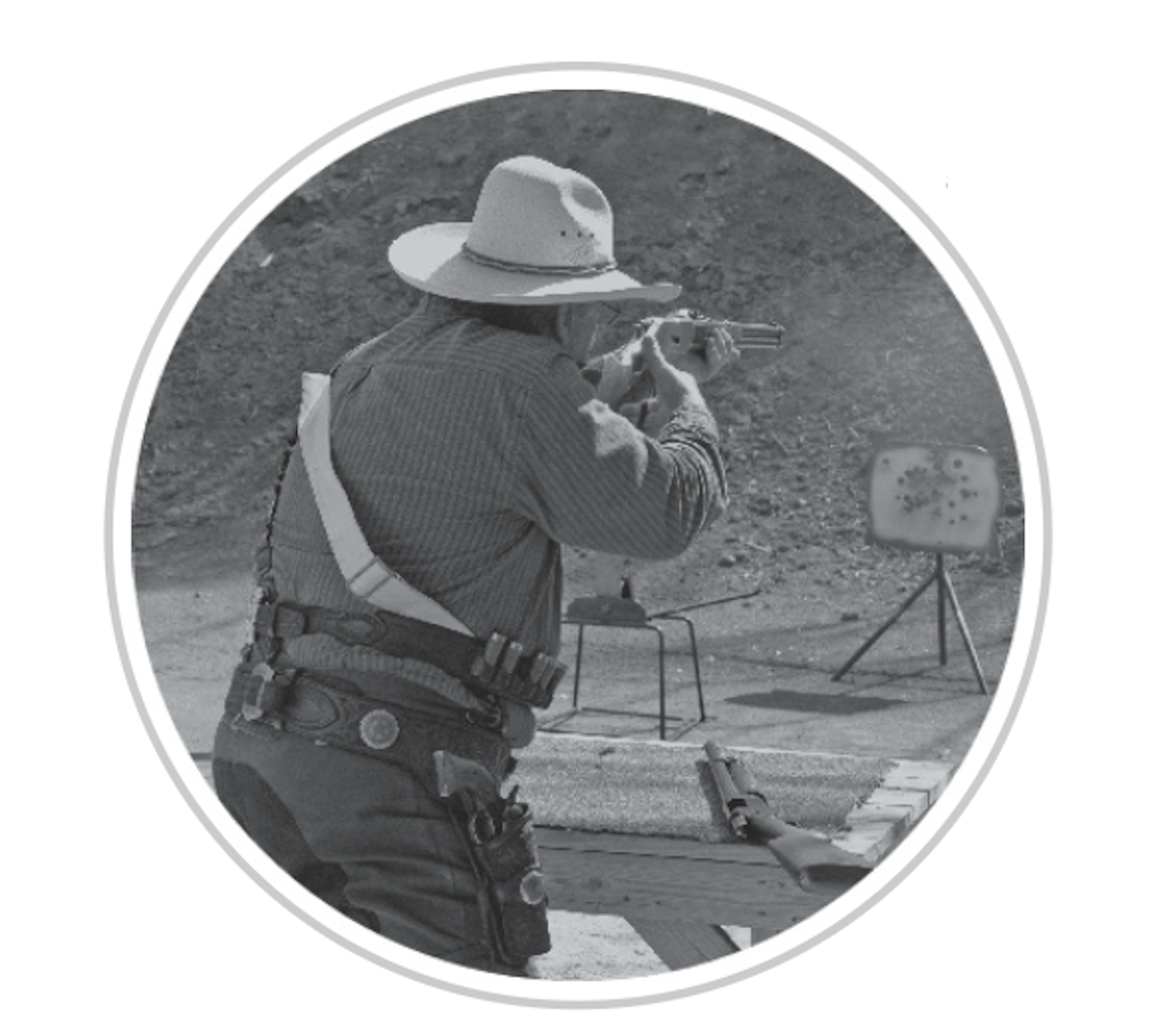
Steel targets in Cowboy Action competition are both big and close, making shooter speed more important than pinpoint accuracy. In the hands of top-ranked competitors, fine-tuned revolvers and lever-action rifles with slicked-up actions and shortened lever throws rival semiautomatics in rapidity of fire. Maximum velocities allowed are 1,000 fps for handguns and 1,400 fps for rifles, but actual speeds are usually slower.
The 38 Special case is nicely suited for the small charges of Clays, Titegroup, W231, and other quick-burn powders, and that along with smooth and reliable feeding in many rifles chambered for 357 Magnum makes it one of the more popular cartridges in the cowboy game. Light recoil is desirable, so the 38 Special is usually loaded with lead-alloy bullets weighing from 100 grains to 130 grains. Fairly soft bullets are safer to use on steel targets and often are more accurate because they obturate to fill the rifling of the barrel at low chamber pressures. I am greatly impressed by how smooth and trouble-free the Marlin 1894 feeds 38 Special ammunition with a variety of bullet-nose profiles and cartridge lengths.
Personal-Defense Practice
Becoming proficient and remaining so with a handgun carried for personal defense requires regular practice, and simply standing in one place while doing what comes easiest is not enough. Distances should be varied from near-muzzle-close to 20 yards or so, and shooting should be from various positions, including kneeling, sitting, prone, and various awkward positions. Learning to shoot accurately while backing away from the target is also important. The same goes for weak-hand-only and strong-hand-only shooting.
The required round count fired annually in practice will vary among shooters, but doing so with factory ammo is more than most of us can afford. Handloading practice ammunition with jacketed bullets is less expensive, but my wife and I shoot a lot, and it is more than we choose to spend. As this is written, 500 of the Rim Rock 125-grain lead-alloy cast bullets I shot for this report cost less than $40, and the same quantity of the Missouri Bullet Co. polymer-coated 158-grain bullets was less than $45. If you have the time, casting your own from scrap wheelweight metal is even less costly, and it does not take long before a casting outfit from Lyman is amortized. The Annual Manual you hold in your hands has an abundance of load data for cast bullets. Regardless of which route is taken, more cast bullets for the dollar can be shot in practice than jacketed bullets, and the cast bullets are easier on the barrel of a handgun as well. We make it a point to end each practice session by firing 20 rounds of the full-power, jacketed-bullet factory ammo we prefer for personal defense.
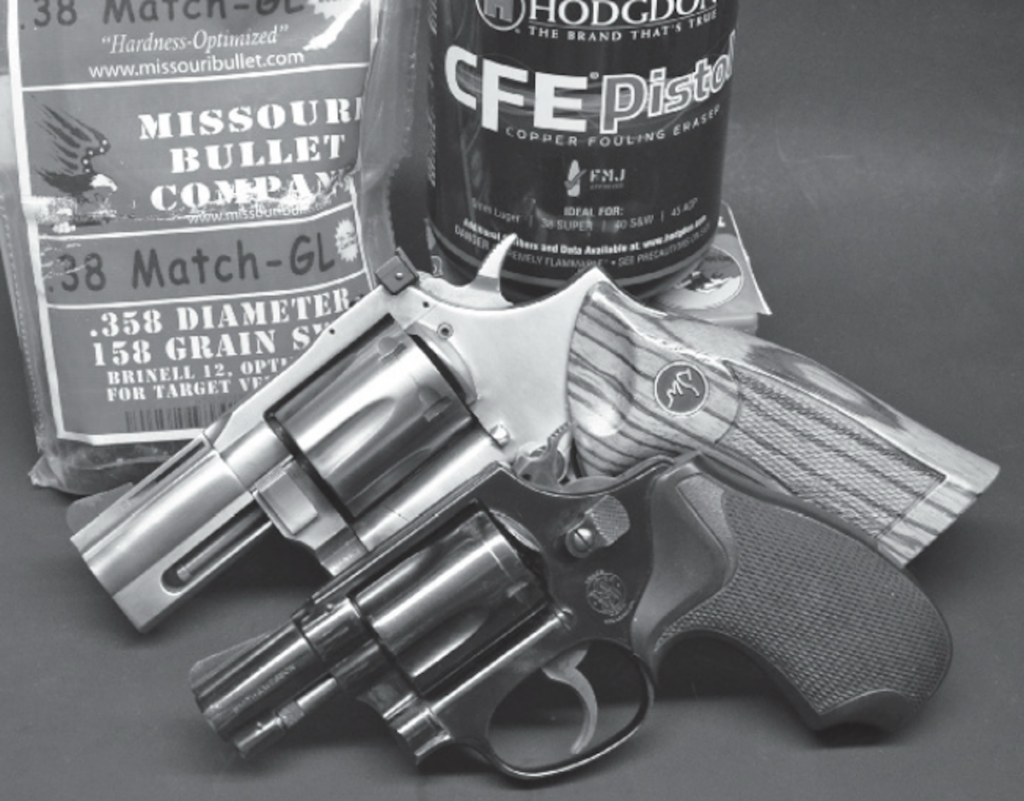
Nowadays, I usually carry semiautomatic pistols, but for old-times’ sake, I occasionally dust off my 1960s-vintage S&W Chiefs Special in 38 Special and my Dan Wesson Model 715 357 Magnum, the latter with interchangeable 2.5-inch, 4.0-inch, 6.0-inch, and 8.0-inch barrels.
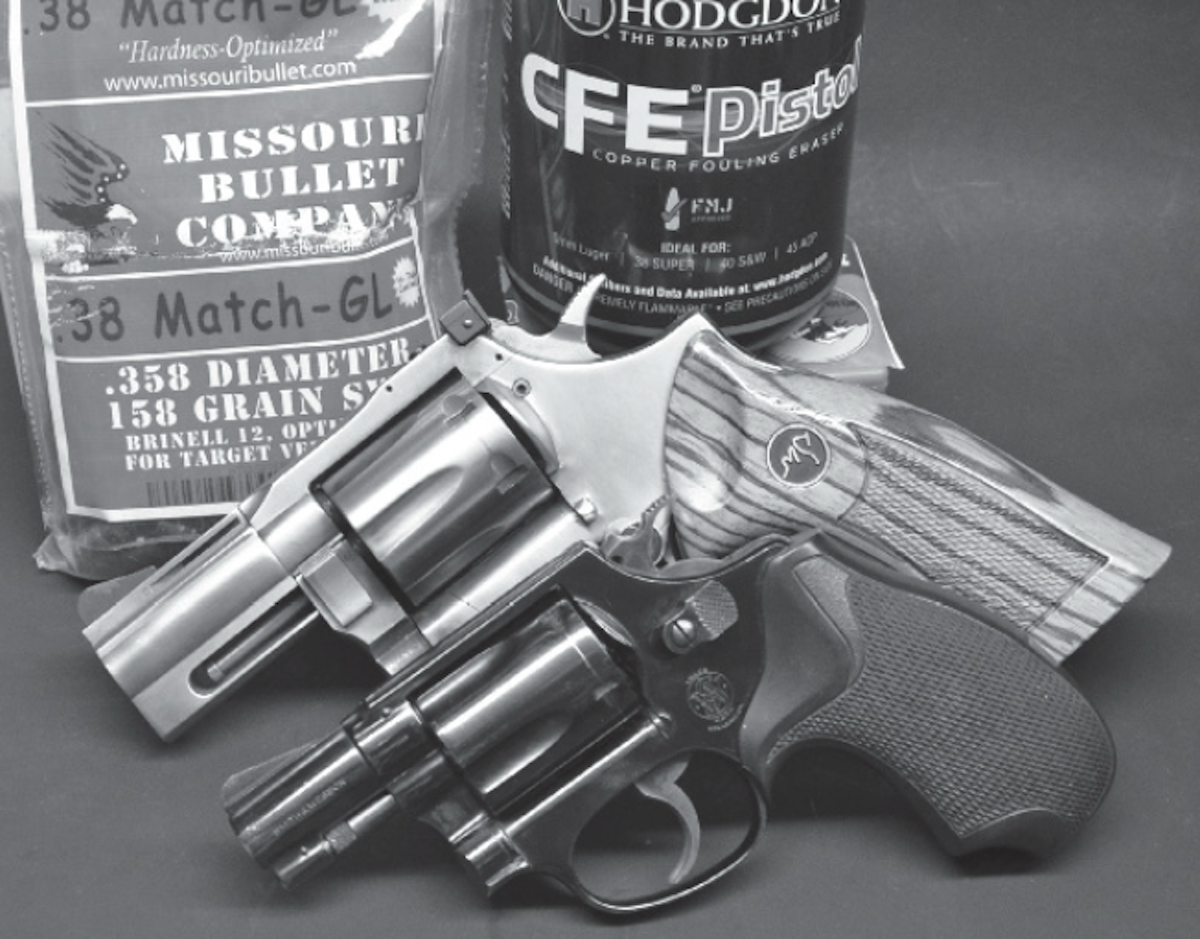
I will close with an important warning. The small powder charges listed for some of the loads I fired for this project take up very little space in a case, and the danger of accidental double-charging is always present. That makes careful visual inspections extremely important. A small goose-neck fluorescent lamp on my loading bench is easily positioned for viewing the charge in each case prior to seating bullets, but a flashlight also works.
Loading these exceptional rounds with Hodgdon, IMR, and Winchester powders increases their versatility.
Load Data Charts